
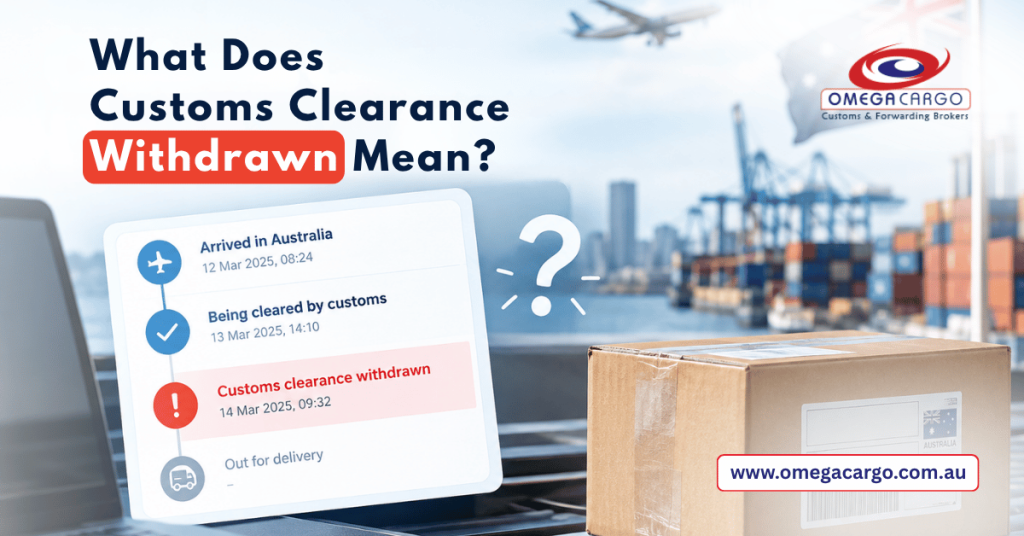
Your parcel landed in Australia, the tracking said it was being cleared, and then a new line appeared: customs clearance withdrawn. No explanation, no next step, and often no reply from the carrier. Has customs rejected your goods? Is the parcel gone for good? Or is someone behind the scenes simply fixing the paperwork?
“Customs clearance withdrawn” means the customs declaration or cargo report lodged for your goods has been withdrawn by the party that lodged it, usually the carrier, cargo reporter or customs broker. It is not a customs refusal. The goods cannot be released on that declaration, so a corrected or replacement declaration normally has to be lodged before delivery can continue.
In most cases it is the paperwork. The status looks alarming, but it describes something quite specific inside the Australian Border Force system, and once you know what it means you can work out who to call and what to ask. This guide explains what a withdrawn clearance is, who actually withdraws it, the common reasons it happens, how it differs from a hold or a seizure, and exactly what to do next, whether you are waiting on one online order or a commercial consignment.
“Customs clearance withdrawn” means the electronic declaration that was lodged to clear your goods through Australian customs has been formally withdrawn by the party that submitted it. The goods themselves stay where they are, under customs control, and they cannot be released until a valid declaration is in place again.
To see why, it helps to know how clearance works behind your tracking page. Every import into Australia is reported to the Australian Border Force (ABF) through the Integrated Cargo System (ICS). Depending on the goods and their value, that report is either a full Import Declaration or a Self-Assessed Clearance (SAC) declaration. Each declaration carries a status inside ICS, such as clear, held or finalised. One of those statuses is WITHDRAWN.
The ABF’s own ICS code list describes a withdrawn document as one that “has been withdrawn by the reporting party and may not be dealt with” (ABF status types code list). That definition appears in the export status list, but the ABF’s import clearance manuals show the same WITHDRAWN status on import declarations and SAC declarations (ABF import cargo clearance manual, Module 15).
Two words in that definition carry the meaning. “Reporting party” tells you who did it: the person or company that lodged the declaration, not the ABF. “May not be dealt with” tells you the consequence: until a replacement is lodged, nobody can legally release, move or deliver the goods on the strength of that withdrawn document.
Your carrier’s tracking page is a plain-English translation of these system events. Carriers word these events in their own way, so the same system event may read differently on another carrier’s tracking page. The exact reason is not shown on the tracking page, which is why the next step is always to ask the lodging party.
The short answer is: whoever lodged it. The ABF’s withdrawal form lets the owner of the goods or the owner’s agent request a withdrawal, whether or not that agent is a licensed customs broker (ABF form B371). In practice, for most shipments that means one of these parties:
| Who lodged the declaration | Typical shipment | Who to contact about a withdrawal |
| Express courier or parcel carrier (as cargo reporter) | Online orders and low-value parcels arriving by air | The carrier named on your tracking, then the seller if the carrier is unresponsive |
| Freight forwarder or consolidator | Air or sea freight consolidated with other cargo | Your freight forwarder |
| Licensed customs broker | Commercial imports, full import declarations | Your customs broker |
| The importer directly | Businesses lodging their own declarations in ICS | Your own compliance team |
For low-value air parcels, the ABF notes that most SAC declarations are lodged by the cargo reporter as part of the cargo report, and that the importer must lodge one themselves if the cargo reporter does not (ABF SAC fact sheet). That is why so many “customs clearance withdrawn” messages turn up on courier tracking for online orders: the courier lodged the original clearance, and the courier (or whoever takes over from it) is the one who withdrew it.
If you are unsure who a customs broker is or what they do, the difference matters here. A broker acts for you and can explain exactly why a declaration was withdrawn. A courier acting as cargo reporter is handling thousands of parcels and may only give you a generic update.
The ABF form does not list fixed reasons. The person withdrawing simply states their own reason. From the way the clearance process works, though, most withdrawals fall into a handful of patterns. The table below is an interpretation of those patterns, not an official ABF list.
| Common reason | What is happening behind the scenes | What usually happens next |
| Correcting an error | The value, tariff classification, consignee or quantity was wrong and the lodging party chose to withdraw and re-lodge rather than amend | A corrected declaration is lodged and the goods continue |
| Wrong type of declaration | Goods were cleared as a low-value SAC declaration but the consignment’s value or contents mean a full Import Declaration is needed | A licensed broker or the importer lodges a full Import Declaration, with duty and GST assessed where they apply |
| Change of clearing party | A different broker, forwarder or carrier is taking over the shipment | The new party lodges its own declaration |
| Duplicate lodgement | Two declarations were lodged for the same goods | The duplicate is withdrawn; the other one proceeds |
| Change of destination | Goods are going into a licensed warehouse, being transhipped or being sent back instead of entering home consumption | A different type of declaration, or none, is lodged |
| The original party can no longer act | The carrier or depot handling the goods is unable to continue, for example after a licence suspension | Another carrier or depot takes over and re-lodges, often after a delay |
Of these, the first three are by far the most routine. An importer’s commercial invoice shows a different value from the one declared, a supplier describes the goods loosely, or a parcel turns out to be one of several that together exceed the low-value threshold. Each one can lead to a withdrawal and a fresh lodgement. If paperwork problems are a recurring theme for you, our guide to the document errors that cause customs delays is a useful next read.
For goods arriving by air or sea cargo, the ABF uses an AUD 1,000 threshold: goods at or below it can usually be cleared on a SAC declaration, while goods above it need a full Import Declaration (ABF import declarations). The ATO applies the same AUD 1,000 customs value line to GST on low value imported goods, which is generally collected at the point of sale instead of at the border (ATO: GST on low value imported goods).
When a parcel that was cleared as low value turns out to sit above that line, or several items consigned together push the total over it, the original SAC is no longer the right document. Withdrawing it and lodging a full declaration is the normal fix. Thresholds and rules can change, so always confirm the current position on the ABF and ATO pages before relying on it.
No. These statuses sound similar on a tracking page, but they describe different events and they involve different people. This is the comparison most readers are really looking for.
| Status you might see | Who caused it | What it means | How serious it usually is |
| Customs clearance withdrawn | The lodging party (carrier, broker or importer) | The declaration was pulled back; a new one is needed before release | Usually administrative, but it stops delivery until someone re-lodges |
| Declaration rejected | The ICS system or the ABF | The declaration failed validation because of errors and must be corrected and re-sent | Administrative; fixed by correcting the data |
| Held by customs / customs hold | The ABF or biosecurity officers | The goods are stopped for a check, a document request, an inspection or payment | Depends on the reason; most holds are resolved |
| Clearance delay | Often a mix of carrier and border processing | Clearance is taking longer than expected | Usually a timing issue |
| Seized | The ABF | The goods have been taken because they are prohibited, restricted without a permit, or breach the law | Serious; there is a formal process to follow |
The practical difference is who holds the next move. With a hold, the ABF or the Department of Agriculture, Fisheries and Forestry is waiting on something. With a withdrawal, the ball is back with the lodging party, and nothing happens until they lodge again. If your status says held rather than withdrawn, our guide to a consignment held by customs covers that situation, and if the word is seized, read what happens when customs seizes a shipment.
When a declaration is withdrawn, the goods do not disappear. They stay at the airport, depot or wharf, under customs control, and they wait.
Here is what the ABF rules tell us. A withdrawal can only be made before the goods are delivered into home consumption or into a warehouse, and on withdrawal “the authority to deal will be revoked” under section 71H(1) of the Customs Act 1901 (ABF form B371). The ABF’s SAC manual adds that a SAC declaration cannot be withdrawn unless its status is clear and the goods have not yet been delivered (ABF Module 19).
That last detail explains something that confuses a lot of people. It is common to see “customs cleared” on your tracking, followed days later by “customs clearance withdrawn”. That sequence is consistent with how the system works: a declaration that had reached clear status was withdrawn before the goods left customs control.
After a withdrawal, the shipment usually follows one of these paths:
There is no standard timeframe, because the delay is not an ABF processing step. It depends on:
A correction lodged by an organised broker can be resolved quickly. A parcel stranded because its original carrier can no longer act can sit for much longer while the handover happens. For a broader picture of timing, see how long customs can hold a package.
Start with the party that lodged the clearance, and ask specific questions. A vague “where is my parcel?” usually gets a vague answer.
Most withdrawals are routine corrections. A few are a sign that something has gone wrong with the business handling your goods, and it pays to recognise the difference.
Warning signs include weeks with no further tracking event after the withdrawal, a carrier that cannot be contacted, a carrier that tells you it “did not clear” your parcel and refers you back to the seller, or many buyers reporting the same status from the same carrier at the same time.
The ABF licenses the depots where imported cargo is held, and a depot licence can be suspended or cancelled for non-compliance. While a licence is suspended, the depot generally cannot operate unless the ABF gives written permission for particular activities (ABF: when you have a depot licence). When that happens to a large parcel operator, legitimate shipments can be caught up in the disruption. In August 2026, for example, the ABC reported that legitimate parcels were left in limbo after the ABF suspended the depot licences of a parcel logistics business during an investigation, with some buyers seeing “customs clearance withdrawn” on their tracking (ABC News).
In a situation like that, the fix is outside your control and outside your broker’s control. Your best levers are the seller and the marketplace or payment provider. Keep your screenshots, lodge a claim within the platform’s deadlines, and watch for official updates rather than relying on social media threads.
The following is a hypothetical example to show how the process fits together. It is not a real customer case.
Example: A Perth e-bike workshop orders a carton of motors, controllers and battery packs from an overseas supplier. The supplier ships by express courier, and the courier clears it on a low-value SAC declaration using the value on the shipping label.
When the workshop’s commercial invoice arrives, the total value is higher than the label showed and sits above the low-value threshold. The courier withdraws the SAC declaration, and the tracking changes from “customs cleared” to “customs clearance withdrawn”.
The workshop hands the shipment to a licensed customs broker. The broker confirms the tariff classification for each part, checks whether any item needs extra compliance steps, and lodges a full Import Declaration. Duty and GST are assessed on the declaration, the workshop pays them, the ABF issues an authority to deal, and the courier completes delivery.
What drove the delay was not the ABF. It was the time between the withdrawal and the new declaration, and the time the workshop took to supply a correct invoice.
The lesson for importers is simple: the right declaration, lodged once with accurate documents, avoids the withdrawal entirely.
You can’t control every carrier decision, but you can remove the most common causes. Use this checklist before your goods ship.
For a full walkthrough of each stage, our step-by-step customs clearance guide covers the process from arrival to delivery.
A single withdrawn parcel from an online store is usually a matter for the carrier and the seller. A withdrawn clearance on commercial freight is different, because every day the goods sit uncleared can hold up stock, a customer order or a project, and a rushed replacement declaration can create a second problem with duty or classification.
That is where a licensed customs broker earns its place. Australian customs brokers are licensed under the Customs Act 1901 to lodge import declarations and manage customs documentation on behalf of the goods owner (ABF: about customs brokers). A broker can see why the original declaration was withdrawn, lodge the correct one, deal with ABF and biosecurity queries, and tell you what duty and GST will apply before you pay.
Omega Cargo’s customs and quarantine clearance service is run by in-house licensed customs brokers and covers air, sea, parcel and e-commerce clearances at major Australian ports. If your business imports regularly through online channels, our e-commerce logistics service can take clearance off your plate from the start. Unfamiliar with some of the terms in your paperwork? Our shipping terms and acronyms glossary explains them in plain English.
It means the customs declaration lodged for your parcel has been withdrawn by the party that lodged it, usually the carrier or a customs broker. The goods stay under customs control and can’t be released on that declaration. A corrected or replacement declaration normally needs to be lodged before delivery can continue.
No. A withdrawal is an action taken by the lodging party, not a refusal by the Australian Border Force. A rejection is a different status that means the declaration failed validation, and a seizure means the ABF has taken the goods. A withdrawal is usually administrative, although it still stops delivery until someone re-lodges.
The usual reasons are correcting an error in the value, description or consignee, replacing a low-value declaration with a full Import Declaration, handing the shipment to a different broker or carrier, or removing a duplicate lodgement. The carrier or broker that withdrew it is the only party who can tell you the exact reason for your shipment.
In most cases, yes. A withdrawal can only happen before the goods are delivered, so the parcel should still be at the depot or airport under customs control. Once a new declaration is lodged and cleared, delivery normally resumes. If there are no updates for a long period, contact the seller as well as the carrier.
It depends on how quickly the lodging party re-lodges, whether you need to supply documents, whether duty and GST must be assessed, whether biosecurity checks apply, and whether the shipment has to move to a new carrier or depot. A simple correction can be quick; a carrier handover usually takes longer.
Under the ABF process, a declaration is withdrawn after it has been lodged and before the goods are delivered, and a SAC declaration can generally only be withdrawn while its status is clear. So a “cleared” status followed by “withdrawn” is consistent with how the system works: the declaration was pulled back before the goods left customs control.
The owner of the goods, or the owner’s agent, can request a withdrawal. The agent may be a licensed customs broker, a courier acting as cargo reporter, or another authorised party. The withdrawal must be made before the goods are delivered into home consumption or into a warehouse, under the Customs Act 1901.
The withdrawal is an administrative step, not a penalty. If the replacement is a full Import Declaration, duty, GST and clearance charges may apply depending on the goods and their value. Storage charges can also build while goods wait. Only pay through the carrier’s official channel or a broker you have engaged.
Usually not as a first step. The ABF did not withdraw the declaration and generally deals with the lodging party. Contact the carrier or your customs broker first, then the seller if the carrier is unresponsive. For commercial freight, your broker can raise any query with the ABF on your behalf.
Yes. Once a declaration is withdrawn, the goods still need a valid clearance to enter Australia, so the lodging party or a new broker lodges a replacement. That may be a corrected version of the same type of declaration or a different type, such as a full Import Declaration in place of a low-value SAC.
The status itself is genuine and appears on many carriers’ tracking pages. Scams can piggyback on it, though, with texts or emails demanding payment to release a parcel. Check any payment request through the carrier’s official website or app, never through a link in an unsolicited message.
No. A customs hold means the ABF or biosecurity officers have stopped the goods for a check, a document request or payment. A withdrawal means the lodging party has pulled back the declaration itself. With a hold, the authorities are waiting on something; with a withdrawal, the lodging party needs to act next.
A customs clearance withdrawn status is unsettling, but it is rarely the end of the road. It tells you the declaration has been pulled back by whoever lodged it, the goods are still under customs control, and a new declaration is needed before delivery can continue. Find out who lodged it, ask why, supply what they need, and keep records until the goods are in your hands.
If it is commercial freight, you don’t have to chase it alone.
Need a withdrawn clearance sorted? Talk to Omega Cargo’s licensed customs brokers about your shipment. Have your tracking or air waybill number, the commercial invoice and any messages from the carrier ready, and we’ll tell you what has happened and what needs to be lodged next. Contact our customs team or Request a quote for customs clearance.


