
Would it surprise you to learn that a single wrong digit in a 10-digit customs code — buried in paperwork nobody reads twice — can trigger a retrospective duty demand, a compliance audit, and thousands of dollars in penalties, sometimes years after your goods have already been sold? Tariff classification looks like bureaucratic fine print. It's actually one of the highest-stakes decisions in the entire import process — and most businesses get it wrong more often than they realise.
Two products can look almost identical, yet customs may classify them entirely differently—and that simple difference can completely change the amount of duty you have to pay. So, how does customs actually decide which code is correct?
Welcome to our definitive HS Code & Customs Tariff Classification Guide.
If you are importing or exporting goods, you have likely been asked for your product's "HS Code." To the untrained eye, it looks like a random string of six to ten numbers. But to customs authorities worldwide, those numbers are the DNA of your shipment. They dictate what the product is, how much import tax you owe, and whether the goods are even legally allowed into the country.
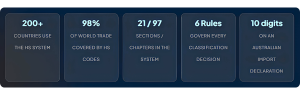
An HS code (Harmonized System code) is an internationally standardized number used to classify traded goods for customs purposes, maintained by the World Customs Organization and used by 200+ countries. The first 6 digits are identical worldwide. In Australia, this extends to an 8-digit tariff classification under the Customs Tariff Act 1995 (the "Working Tariff"), plus a further 2-digit statistical code on import declarations, a full 10-digit code. Correct classification is determined by applying the World Customs Organization's 6 General Rules of Interpretation in strict order. Getting it right determines your duty rate, GST treatment, FTA eligibility, and whether an import permit is required and getting it wrong risks retrospective duty demands, penalties, and clearance delays.
Have you ever wondered why a simple shipment of t-shirts gets held up at customs, while another breezes through, or why you're suddenly hit with unexpected taxes that eat into your profit margins?
The secret language of international trade might be the culprit. If you are importing or exporting goods, you are participating in a massive, complex global system. At the heart of this system is a standardized language that every customs official in the world speaks: the Harmonized System (HS).
Here's a scenario that plays out more often than most importers realise: a business classifies a product under a plausible-sounding tariff code, pays duty accordingly, and moves on with their supply chain for months or even years. Then an Australian Border Force compliance review — sometimes triggered by something completely unrelated to that specific shipment — flags the classification as incorrect. Suddenly, every import under that code, going back years, is subject to reassessment. The back-duty bill alone can run into tens of thousands of dollars, before penalties are even added.
This isn't a rare edge case. Tariff classification is one of the most consistently misunderstood parts of international trade, not because it's impossible to learn, but because it's rarely explained clearly. Product descriptions on commercial invoices are written by salespeople, not customs specialists. Marketing names ("smart home device," "premium accessory") mean nothing to a tariff schedule that only cares about material, function and construction. This guide breaks the entire system down to the structure, the rules, the tools, and the mistakes so you can classify with genuine confidence instead of a guess dressed up as certainty.
Navigating the world of global commerce can feel like trying to solve a puzzle in the dark. But it doesn't have to be that way. This comprehensive HS Code & Customs Tariff Classification Guide is designed to shine a light on the process. We will break down exactly what HS codes are, why they are absolutely critical for your business, and how you can master the art of tariff classification to save money, avoid delays, and keep your supply chain moving smoothly.
An HS Code stands for Harmonized System Code. Its full official name is the Harmonized Commodity Description and Coding System.
Created and maintained by the World Customs Organization (WCO), the Harmonized System is a standardized, international naming and numbering system for classifying traded products. Over 200 countries and economies use the system, meaning that more than 98% of all international merchandise trade is classified using HS Codes.
The genius of the system and the reason it has survived largely unchanged in structure since it was introduced, is that the first six digits of any HS code are identical everywhere in the world. A cotton t-shirt classified as 6109.10 carries that exact same six-digit code whether it's being imported into Fremantle, Rotterdam, Los Angeles or Shanghai. This shared foundation is what allows customs authorities, trade statisticians and businesses across the globe to speak a common numerical language about what's actually crossing their borders.
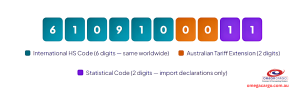
What happens after those first six digits is where things start to differ by country. Each nation extends the international code with additional digits of its own, used for national duty rate determination and detailed trade statistics. This is exactly where Australia's system comes in — and it's a detail that trips up even experienced importers who assume "the HS code" is a single fixed number rather than a layered classification.
Imagine trying to explain a "smartphone" to someone who doesn't speak your language. You might describe it as a small computer, a telephone, or a camera. To avoid this confusion in international trade, the World Customs Organization (WCO) created the Harmonized Commodity Description and Coding System, commonly known as the Harmonized System (HS).
An HS code is essentially a standardized numerical method of classifying traded products. It is used by customs authorities around the world to identify products when assessing duties and taxes and for gathering statistics. Think of it as the DNA or the universal passport for your goods.
When you ship a product, the HS code tells the receiving country's customs office exactly what is in the box, without needing to translate the product name. This 6-digit international standard is used by over 200 countries and economies as a basis for their Customs tariffs and for the collection of international trade statistics. Over 98% of the merchandise in international trade is classified in terms of the HS.
Imagine trying to import a "jumper." In the UK or Australia, a jumper is a knitted sweater. In the US, it might refer to a sleeveless dress or even a car battery cable. If international trade relied solely on product descriptions in different languages, the global supply chain would grind to a halt.
The HS Code solves this problem. It assigns a universal numerical language to products. Whether you are in Melbourne, Tokyo, or New York, the first six digits of an HS Code for a men's cotton t-shirt will be exactly the same.
Key Takeaway: An HS Code is a universal six-digit number used by global customs authorities to identify the physical nature of a traded product.
The structure of an HS code is logical and hierarchical. It starts broad and gets increasingly specific. Let's break down the anatomy of a standard 6-digit HS code:
So, the international 6-digit HS code for roasted, non-decaffeinated coffee is 0901.21.
While the first 6 digits are harmonized globally, individual countries can add longer codes for their own specific tracking and tariff purposes. This is where it can get a little tricky.
Key Takeaway: Always classify your product to the 6-digit international level first. Then, look up the specific 8, 10, or even 12-digit code required by the country you are importing into or exporting from.
Providing the correct HS Code is not just a paperwork formality. It is a legal declaration made to a government entity. Here is exactly what an HS Code affects in your supply chain:
Key Takeaway: The HS Code dictates your landed costs (duty/taxes) and determines how smoothly your cargo moves through the border.
The Harmonized System is highly structured and logical. It works like a descending hierarchy, moving from broad categories down to highly specific product definitions.
The system is divided into:
Let's look at how the number builds up for a Men's Cotton T-Shirt:
| Level | Digits | Code | Description | Scope |
| Chapter | 2 Digits | 61 | Articles of apparel, knitted... | International |
| Heading | 4 Digits | 6109 | T-shirts, singlets... | International |
| Subheading | 6 Digits | 6109.10 | Of cotton | International |
| National Tariff | 8-10 Digits | 6109.10.XX | Country-specific extension | National |
(Note: The digits replacing "XX" will change depending on whether you are importing into Australia, the USA, or the EU).
While "HS Code" and "Tariff Classification" are often used interchangeably, there is an important nuance between the two.
Countries take the 6-digit international HS Code and add their own extra digits (making it 8, 10, or sometimes 12 digits long) to create a national tariff code. These extra digits allow a specific country to apply unique duty rates, import taxes, or statistical tracking to highly specific product variations.
When you submit an import declaration, you aren't just providing the international HS Code; you are providing the full, legally binding Customs Tariff Classification specific to the country of import.
You might be thinking, "This sounds like a lot of administrative work. Can't I just guess the code or let the shipping company figure it out?"
The short answer is: absolutely not. Proper customs tariff classification is the bedrock of compliant and profitable international trade. Here is why you cannot afford to get it wrong.
This is the most immediate financial impact of your HS code. Every code is tied to a specific tariff rate.
Getting the classification right ensures you pay exactly what you owe—no more, no less.
HS codes do more than just determine taxes. They trigger specific regulations, restrictions, and documentation requirements.
The customs system uses the HS code to flag these requirements. Using the wrong code means you might bypass vital safety checks or import restricted items illegally, leading to seized shipments and severe legal consequences.
If you want to take advantage of reduced or zero tariffs under agreements like the USMCA (formerly NAFTA), CAFTA-DR, or other bilateral agreements, you must prove the "origin" of your goods.
The rules of origin for these agreements are heavily tied to HS codes. A common rule is a "tariff shift," meaning the raw materials imported to make your product must be in a different HS classification than the finished product. If you don't know your HS codes, you cannot claim these valuable exemptions.
Customs authorities use risk management systems. If your documentation is inaccurate, incomplete, or features an obviously incorrect HS code (e.g., classifying a car engine as a piece of fruit), your shipment will be flagged for inspection.
Inspections cause delays. Delays mean you pay storage fees at the port, your customers get angry, and your inventory turnover grinds to a halt. Accurate classification is your fast pass through the customs process.
Classifying a product is an investigative process. Here is the step-by-step process professionals use to find the correct customs tariff classification.
"Car parts" or "electronics" is not enough. You need to know exactly what the item is. What is its commercial, common, or technical name?
What is it made of? A chair made of wood (Chapter 94) is classified differently than a chair made of plastic, even though they serve the exact same purpose. If it is a blend of materials, you need to know the percentage of each.
What does the product actually do? What is its intended commercial use? Sometimes, a product is classified by its function (e.g., a camera) rather than its material (e.g., plastic and glass).
Is it raw, semi-manufactured, or fully finished? The manufacturing process matters. For example, a knitted sweater is in Chapter 61, but a woven sweater is in Chapter 62.
Using an official tariff schedule, look at the table of contents. Narrow down the 97 Chapters to the 1 or 2 that logically fit your product.
Drill down into the 4-digit Headings, and then the 6-digit Subheadings. Compare the different options.
This is where most beginners fail. At the start of every Section and Chapter in the official tariff, there are legal notes. These notes will explicitly state, "This chapter does not cover X," or "For the purposes of this heading, Y means Z." You must read these notes.
If the product seems to fit into two different headings, you must apply the GRIs (explained in the next section) to resolve the conflict.
Once you have the 6-digit code, look up your specific country's national tariff database to find the final 8 or 10-digit code and the associated duty rate.
Double-check your logic. Has customs issued any past rulings on this product? If you are unsure, consult a licensed customs broker.
The Harmonized System isn't a flat list of products — it's a hierarchical structure, organised roughly from raw and natural materials through to complex manufactured goods. Understanding this structure is the foundation of learning to classify anything correctly.
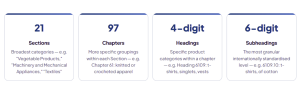
Think of it like a library's classification system. The Section is the floor of the library (say, "Non-Fiction"). The Chapter is the specific aisle ("History"). The Heading is the shelf ("20th Century European History"). The Subheading is the specific book you're looking for. Just as you wouldn't expect to find a novel shelved in the history aisle, goods have to be classified according to what they fundamentally are: their material, function and construction, not what they're called on a marketing brochure.
Every Section and Chapter in the Working Tariff comes with formal legal notes that specify exactly what is — and critically, what is not — included in that classification. These notes frequently redirect goods to a completely different chapter than you'd expect from a surface-level reading of the heading text. For example, certain furniture parts might seem to belong under "Furniture" but are specifically excluded and redirected to a chapter for their base material (like plastics or metal) by a chapter note. Skipping the notes is one of the most common causes of confident, well-intentioned misclassification.
Classifying a product is rarely as simple as typing its name into a search bar and picking the first result. It requires a systematic approach and an understanding of the rules governing the Harmonized System.
Here is a step-by-step guide to finding the correct HS code for your goods.
Before you look at a tariff schedule, you need comprehensive details about what you are shipping. Gathering this information is critical:
Pro Tip: If you are not the manufacturer, ask your supplier for a detailed specification sheet or a Bill of Materials (BOM). You cannot classify what you do not understand.
The Harmonized System is governed by six General Rules of Interpretation (GRIs). These rules must be applied in strict numerical order to resolve classification disputes or ambiguities.
This is where many people make mistakes. The HS is divided into Sections and Chapters, and almost all of them have "Notes" at the beginning.
These notes are legally binding. They can explicitly include or exclude certain products from a chapter or define specific terms.
Example: You want to classify a plastic toy car. You might look at Chapter 39 (Plastics). However, Chapter 39 Note 2(y) explicitly states that this chapter does not cover toys, games, or sports requisites (which belong in Chapter 95). If you skip the notes, you will misclassify the product.
Once you know your product and the rules, you can use online search tools provided by customs authorities (like the USITC HTS search for the US or the TARIC database for the EU).
Warning: Do not rely solely on keyword searches. Language in the tariff schedule is often archaic or highly technical. A "laptop" might be called an "automatic data processing machine." A "drone" might be an "unmanned aircraft."
If you have a complex product and you are stuck between two classifications, the safest route is to ask the experts.
Most customs authorities offer a process where you can submit a detailed description (and sometimes a sample) of your product, and they will issue a legally binding ruling on the correct HS code. In the US, this is called a CROSS ruling (Customs Rulings Online Search System).
Having a binding ruling protects you from penalties if an individual customs officer disagrees with the classification later.
Even with a guide, tariff classification can be a minefield. Here are some of the most common stumbling blocks importers and exporters face.
Many modern products are made of multiple materials or perform multiple functions. How do you classify a smart fridge that has a screen to browse the internet? Is it a refrigerator or a computer?
Under GRI 3(b), you must determine the "essential character." Ask yourself:
In most cases, the refrigerator aspect gives the product its essential character.
The tariff schedule treats parts and accessories differently.
Many chapters have specific "parts" headings, but accessories often have to be classified elsewhere based on their material.
The Harmonized System is updated every five years, but technology moves much faster. Products like 3D printers, smartwatches, and advanced medical devices often don't have a clear, specific heading when they first enter the market, forcing classifiers to rely on broader "other" categories or rulings based on essential character.
The HS system was designed for physical goods. Shipping software on a physical medium (like a USB drive) usually means classifying the medium itself, though the value of the software might affect the customs valuation. Purely digital downloads generally do not require HS codes for customs entry, as they don't physically cross a border, though they may be subject to different digital service taxes.
Australia's tariff classification is governed by Schedule 3 of the Customs Tariff Act 1995, commonly referred to as the Working Tariff. This is where the international 6-digit HS code gets extended into a full Australian tariff classification.
Australian Tariff Classification — How the Full Code Is Built
| Digit Position | What It Represents | Standardisation Level |
| Digits 1–2 | HS Chapter (e.g. 61 = knitted/crocheted apparel) | International — same worldwide |
| Digits 3–4 | HS Heading (e.g. 09 = t-shirts, singlets, vests) | International — same worldwide |
| Digits 5–6 | HS Subheading (e.g. 10 = of cotton) | International — same worldwide |
| Digits 7–8 | Australian tariff subheading — determines the applicable duty rate | Australia-specific |
| Digits 9–10 | Statistical code — used for ABS trade statistics on Import Declarations | Australia-specific (import declarations only) |
| The 8-digit code (digits 1–8) is the formal "tariff classification" that determines your duty rate under the Customs Tariff Act 1995. The full 10-digit code (with the statistical suffix) is what appears on a formal Import Declaration lodged through the ABF's Integrated Cargo System. | ||
This is a genuinely useful distinction to understand, because it explains why you might see both "8-digit" and "10-digit" referenced in different customs resources — both are correct, just describing different stages of the same classification. The 8-digit number is what determines how much duty you pay. The 10-digit number is what appears on the formal customs paperwork lodged with the Australian Border Force.
Self-Assessment: You're Legally Responsible, Even With a Broker
Australia operates a
self-assessment customs system
. This means the legal responsibility for correctly classifying goods valued over AUD $1,000 sits with the
importer
— not the Australian Border Force, and not automatically your customs broker, even though a licensed broker typically prepares and lodges the declaration on your behalf. If a classification is later found to be incorrect, the ABF's compliance action is directed at you as the importer. This is precisely why working with an experienced, licensed customs broker isn't just a convenience — it's a meaningful reduction in your own legal and financial risk.
It's easy to think of a tariff code as a bureaucratic label — a formality buried in the Import Declaration that doesn't really change anything about your shipment. In reality, your HS code classification is the single number that determines nearly every financial and regulatory outcome of your import.
What Your HS Code Classification Actually Determines
| Outcome Determined by HS Code | Why It Matters |
| Customs Duty Rate | Rates vary by product category — commonly 0–5%, but can be higher for specific goods |
| GST Liability (10%) | Applied to the Value of Taxable Importation, which includes duty — a misclassified duty rate compounds into a GST error too |
| Free Trade Agreement Eligibility | Determines whether ChAFTA, AUSFTA or other FTA concessions (often 0% duty) apply to your goods |
| Anti-Dumping Duty (ADD) | Certain classifications trigger additional duties on goods from specific countries deemed to be "dumped" below fair value |
| Import Permit Requirements | Some tariff classifications automatically require permits from TGA, FSANZ, AICIS or DAFF before goods can be released |
| Wine Equalisation Tax (WET) | Applies specifically to wine and wine-based products under relevant classifications |
| Luxury Car Tax (LCT) | Applies to vehicles classified above a specific value threshold |
| Trade Statistics Accuracy | Incorrect classification skews national trade data used for policy and industry analysis |
One Number, Compounding Consequences
Because GST is calculated on the Value of Taxable Importation — which itself includes the customs duty paid, a single classification error doesn't just affect one line item. It cascades: the wrong duty rate produces the wrong GST amount, which produces the wrong total landed cost, which can throw off your product pricing and margin calculations across an entire product line, sometimes for years, until someone finally notices.
The Harmonized System is governed by six legal rules known as the General Rules for the Interpretation of the Harmonized System (GRIs). Customs brokers and authorities use these to classify tricky products.
Here is a simplified, beginner-friendly explanation of how they work:
Key Takeaway: You cannot just pick a code that sounds right. You must follow the legal hierarchy of the GRIs, starting always with the Chapter Notes.
Understanding your HS codes isn't just about compliance; it's a strategic business advantage. Here is how you can use tariff classification to optimize your operations.
Tariff engineering is the perfectly legal process of designing or assembling a product in a way that results in a lower duty rate.
Example: A company imports men's jackets. If they import a finished jacket, the duty rate might be 15%. However, if they import the jacket unhemmed and without buttons, it might be classified as an "unfinished good" or "parts of garments" at a 5% rate. They can then finish the assembly domestically.
You must be careful to ensure the product doesn't already possess the "essential character" of the finished product under GRI 2, but when done correctly, this can save millions.
As mentioned earlier, FTAs can eliminate duties entirely. However, you must prove the goods originate from the qualifying country. This requires a deep understanding of your Bill of Materials and the specific HS codes for every component used in manufacturing to ensure they meet the specific "tariff shift" rules of the agreement.
Your product catalog changes, and the HS system updates every few years. A code you determined in 2020 might be invalid today. Implement a schedule to regularly review and audit your product classifications. Working with a licensed customs broker or trade compliance consultant can provide an objective review of your databases.
Every customs authority in the world — and every licensed customs broker — classifies goods using the same foundational framework: the World Customs Organization's General Rules of Interpretation (GRI). There are six of them, and critically, they must be applied in strict numerical order. You don't skip ahead to whichever rule seems most convenient — you work through them sequentially until your goods are correctly classified.
Goods are classified according to the actual wording of the heading and any relevant Section or Chapter notes. This is where the large majority of products are correctly and finally classified — if the heading's wording clearly and directly describes your goods, the job is essentially done at this first step. Always start here, and only move to GRI 2 if the heading terms genuinely don't resolve the classification.
GRI 2(a) covers incomplete or unfinished articles that still have the "essential character" of the complete article (for example, a bicycle shipped without its pedals is still classified as a bicycle). GRI 2(b) covers mixtures or combinations of materials — goods made of more than one material are classified according to the principles of GRI 3.
Applied when goods seem to reasonably fit under two or more headings. Resolved in order: 3(a) the heading providing the most specific description wins over a more general one; 3(b) if that doesn't resolve it, classify by the material or component that gives the goods their essential character; 3(c) if still genuinely tied, classify under whichever heading occurs last in numerical order among those equally applicable.
Used rarely, and only when GRI 1 through 3 genuinely fail to resolve a classification — typically for a truly novel product that doesn't fit any existing heading. In this case, the goods are classified under the heading for the existing product they most closely resemble.
Covers how packaging is classified alongside its contents. Specially shaped or fitted containers designed for long-term use with a specific article (like a camera case designed specifically for one camera model) are classified with that article. General or reusable packing materials are typically classified separately, following their own material classification.
Once you've determined the correct 4-digit heading using GRI 1–5, GRI 6 requires you to apply those exact same principles again at the subheading level — but critically, only comparing subheadings of the same level against each other, not mixing levels. This second pass is what takes you from a 4-digit heading down to the full 6-digit international subheading.
The Practical Reality: Most Classifications Never Go Past GRI 1
Despite the formal complexity of six sequential rules, the overwhelming majority of everyday commercial goods are classified successfully using just
GRI 1 — reading the heading terms and applicable notes carefully, and finding a clear match. The GRI framework only becomes genuinely necessary for edge cases: composite products made of multiple materials, sets containing different item types, incomplete or disassembled goods, or genuinely novel products that don't fit neatly anywhere. Knowing the full framework matters most so you recognise when your product has moved beyond a simple GRI 1 case and needs more careful analysis.
To classify a product accurately, a customs broker or classification specialist needs comprehensive data. Vague descriptions like "spares," "accessories," or "machinery" will result in rejection or misclassification.
Before attempting to classify a product, gather the following:
Disclaimer: This is an educational example to demonstrate the methodology, not an official customs classification ruling.
The Scenario: You are importing a smartwatch. It tells the time, connects to Wi-Fi, tracks heart rate, and receives text messages.
The Investigation:
Because of its communication capabilities, modern customs authorities generally classify smartwatches as data reception/transmission apparatus rather than traditional wristwatches. This distinction heavily impacts the duty rate.
Importers frequently make costly errors when self-classifying. Here are the most common red flags:
Most classification errors are not deliberate; they're the result of time pressure, incomplete product information, or genuine ambiguity in how a product should be described. The consequences, however, don't distinguish between honest mistakes and deliberate misclassification when it comes to back-duty liability.
Using the wrong HS Code can range from a minor administrative headache to a severe legal penalty. While not every mistake results in a fine, the consequences can include:
Theory is easier to absorb with a concrete example. Let's walk through classifying a simple, common import item: a men's 100% cotton knitted t-shirt.
Identify what it actually is: A knitted (not woven) garment, worn on the upper body, made entirely of cotton fibre, designed for men.
Find the relevant Section: Section XI covers "Textiles and Textile Articles" — this immediately narrows the search from all 21 Sections down to one.
Find the relevant Chapter: Because the garment is knitted rather than woven, it falls under Chapter 61 ("Articles of apparel and clothing accessories, knitted or crocheted") rather than Chapter 62 (woven apparel) — a distinction that matters even though both chapters cover clothing.
Find the relevant Heading: Heading 6109 specifically covers "T-shirts, singlets and other vests, knitted or crocheted" — this matches the product directly under GRI 1, since the heading terms describe it precisely.
Find the relevant Subheading: Within heading 6109, subheading 6109.10 specifically covers garments "of cotton" — distinguishing it from 6109.90, which covers t-shirts of other textile materials.
Apply the Australian extension: The Working Tariff extends 6109.10 with the additional Australian digits that determine the specific applicable duty rate for cotton t-shirts entering Australia.
Check FTA eligibility: If the t-shirt was manufactured in a country with an active Australian Free Trade Agreement (e.g. China under ChAFTA), a Certificate of Origin could reduce the duty rate to 0%.
Result: 6109.10 (international) → extended to the full Australian 8-digit tariff classification + 2-digit statistical suffix for import declaration
Notice how each step narrowed the field of possibilities using the product's actual physical characteristics: knitted vs woven, material composition, garment type rather than anything about brand, price point or marketing description. This is the essential discipline of tariff classification: strip away everything except what the product physically is.

Get Your Customs Clearance Services
The official, authoritative source for Australian import tariff classifications, published online by the Australian Border Force under Schedule 3 of the Customs Tariff Act 1995.
Administered by the Department of Foreign Affairs and Trade, this portal helps determine whether your classified goods qualify for preferential duty rates under agreements like ChAFTA or AUSFTA.
The Australian Harmonized Export Commodity Classification, maintained by the Australian Bureau of Statistics, is the equivalent classification system used specifically for goods leaving Australia.
Published alongside the Working Tariff, these formal legal notes define exactly what's included and excluded from each classification — always read them before finalising a code.
A formal, binding ruling service from the Australian Border Force that provides legal certainty on the correct classification for your specific goods — see the dedicated section below.
An experienced broker applies the GRI framework professionally across thousands of classifications, dramatically reducing your practical risk of error on both routine and complex goods.
Don't Confuse Import Classification with Export Classification
If you're exporting goods from Australia rather than importing, you'll use the
AHECC (Australian Harmonized Export Commodity Classification)
, maintained by the Australian Bureau of Statistics not the Working Tariff used for imports. While both systems share the same international 6-digit HS foundation, the extension digits, purpose and lodgement process differ. Always confirm which system applies to your specific transaction direction before searching for a code.
Your HS code classification and your Free Trade Agreement eligibility are two separate questions that intersect at the most financially important point in your import: the final duty rate you actually pay.
Once your goods are correctly classified under the Working Tariff, that classification is checked against Australia's network of Free Trade Agreements — including ChAFTA (China), AUSFTA (United States), JAEPA (Japan), and others — to determine whether your specific tariff line qualifies for a preferential duty rate based on the goods' country of origin. For many eligible products, this can mean the difference between paying the standard Most Favoured Nation (MFN) duty rate and paying 0% duty entirely.
Classification First, FTA Second — Never the Other Way Around
A critical discipline: always classify your goods correctly first, based purely on what they are — then check FTA eligibility for that classification. Never work backwards by choosing a classification because it happens to carry a lower duty rate or an FTA concession. This is a form of misclassification that carries the same compliance risk as any other incorrect code, regardless of intent. Your goods are what they are; the classification has to follow the product, not the other way around.
For genuinely uncertain, high-value, high-volume, or novel products, guessing isn't a strategy you want to rely on. The Australian Border Force offers a formal service specifically for this situation: Tariff Advice.
Tariff Advice is a written, binding ruling issued by the ABF confirming the correct tariff classification for your specific goods. Once issued, it protects you from retrospective duty demands or penalties tied to that classification provided the actual goods imported match the description covered by the ruling, and the underlying tariff schedule hasn't since changed.
Consider applying for Tariff Advice when: your product genuinely doesn't fit cleanly into an obvious heading; you're importing at high volume, so a classification error would compound significantly; the goods have high per-unit value, making duty rate differences financially material; or you've had a classification challenged or corrected by the ABF before and want certainty going forward.
Applications are submitted directly to the ABF with a detailed product description, technical specifications, and often product samples or images. The ABF reviews the submission against the Working Tariff and the GRI framework, then issues a formal written ruling.
Processing a Tariff Advice application can take several weeks. This is a tool best used before your goods are shipped and a dispute has already arisen — not as an emergency response once a classification has already been challenged. Build the lead time into your sourcing timeline for any product you're genuinely unsure about.
DIY Classification vs Professional Broker Support
| Scenario | Recommended Approach |
| Simple, well-established product category (e.g. standard cotton apparel) | Working Tariff self-check is often sufficient, ideally broker-reviewed |
| Composite or multi-material products | Apply GRI 3 carefully or engage a licensed customs broker |
| High-value or high-volume regular imports | Licensed customs broker + consider formal Tariff Advice |
| Genuinely novel product with no obvious heading | Licensed customs broker, likely combined with Tariff Advice application |
| Goods potentially subject to Anti-Dumping Duty | Licensed customs broker — specialist knowledge required |
| Goods that might require an import permit (TGA, FSANZ, DAFF) | Licensed customs broker to confirm regulatory pathway alongside classification |
| Any classification that materially affects your product margin | Licensed customs broker — the fee is minor against the financial exposure |
Why This Is Worth Professional Attention
A licensed customs broker classifies goods for a living, across thousands of products and every conceivable edge case applying the GRI framework with a depth of pattern recognition that's genuinely difficult to replicate as an occasional importer. The cost of professional classification review is almost always smaller than the cost of a single retrospective duty correction.
Omega Cargo's licensed customs brokers verify tariff classification as a standard part of every Import Declaration we lodge, not an optional add-on.
These acronyms often confuse beginners. Here is a clear breakdown:
| Term | Meaning | Where It Is Used | Length |
| HS Code | Harmonized System Code | Global framework (WCO) | First 6 digits |
| Tariff Code | National Customs Tariff Classification | Country of import | Usually 8 to 10 digits |
| HTS Code | Harmonized Tariff Schedule | United States | 10 digits (US specific) |
| TARIC Code | Integrated Tariff of the European Union | European Union | 10 digits (EU specific) |
Key Takeaway: The "HS Code" is the international root. The "HTS Code" or "Tariff Code" is the fully fleshed-out national version required for your import paperwork.
Do not confuse your customs codes with your retail or inventory codes.
| Identifier | Full Name | Purpose | Determined By |
| HS Code | Harmonized System Code | Determines customs duty and import rules | WCO / Customs Authorities |
| SKU | Stock Keeping Unit | Internal inventory management | Your business |
| UPC / EAN | Universal Product Code / European Article Number | Retail barcode for point of sale | GS1 (Global Standards) |
| ECCN | Export Control Classification Number | Regulates dual-use/military export control | Government export departments |
HS Code ≠ Country of Origin.
You need both to calculate your final landed cost. For example, under a Free Trade Agreement, a product (identified by its HS Code) may be duty-free if it was made in Japan (its Country of Origin), but subject to 5% duty if made in a country without a trade agreement.
How does classification actually affect the money you pay? The HS Code itself does not automatically spit out a dollar figure; it provides the Duty Rate.
Here is the relationship flow:
Product Characteristics ➔ HS Classification ➔ National Tariff Treatment ➔ Duty Rate ➔ Applied to Customs Value ➔ Final Duty Paid
Example:
You import goods valued at $10,000.
Remember, the HS Code does not determine other taxes like GST/VAT. Those are usually calculated after the duty is added to the customs value.
When your goods arrive at the border, your customs broker submits an electronic Import Declaration to the customs authority.
Customs clearance systems are highly automated. The algorithm looks at the HS Code on your declaration and instantly cross-references it against risk profiles.
If you declare an accurate, low-risk HS Code, your shipment is likely to clear customs rapidly. If you declare a code heavily flagged for biosecurity risks, your shipment will be stopped for documentation review.
A freight forwarder manages the logistics of moving your cargo from Point A to Point B. They handle the Bill of Lading, shipping lines, and truck transport.
Can a freight forwarder classify your goods for you?
Generally, a pure freight forwarder will ask you to provide the HS Code for the shipping documentation. However, many major freight forwarding companies have in-house licensed customs brokerage divisions.
While a forwarder can provide logistical guidance, the legal responsibility for tariff classification usually requires the expertise of a licensed customs broker or the importer themselves.
While you can technically attempt to classify goods yourself, utilizing a licensed customs broker is highly recommended in the following scenarios:
Customs brokers are trained to navigate the complex legal jargon of the tariff schedule. They can also help you apply for an Advance Ruling—a legally binding decision from the customs authority on your product's classification prior to import.
Need expert help? Speak with a professional freight forwarding and customs clearance specialist today to ensure your classifications are 100% compliant.
Never guess your classification. Use this checklist to verify it:
While third-party AI tools and global lookup websites are great for initial research, they are not legally binding.
To find the most accurate national codes, use official government portals:
As established, the first six digits are harmonized globally. But look at how countries extend those digits for a Plastic Kitchen Bowl (3924.10):
This is why an exporter in China cannot give you a 10-digit code that works seamlessly in Australia. The final digits must match the destination country's legal schedule.
For Australian importers, customs tariff classification is governed by the Australian Border Force (ABF) under the Customs Tariff Act 1995.
Australia uses an 8-digit tariff classification system.
Most standard manufactured goods imported into Australia attract a general duty rate of 5%, calculated on the Customs Value (FOB value). Following duty assessment, a 10% Goods and Services Tax (GST) is applied to the Value of the Taxable Importation (VoTI), which includes the customs value + international freight + insurance + the duty itself.
Australia has a unique system called Tariff Concession Orders (TCOs). If you import a product (e.g., a highly specialized industrial machine) that has no local Australian manufacturer producing a substitutable product, you can apply for a TCO. If granted, your 5% duty rate is reduced to 0%. Linking your accurate HS Code to a valid TCO is a primary way Australian customs brokers save importers money legally.
In Australia, if you are unsure of your classification, your broker can lodge a Tariff Advice (TA) application with the ABF. This provides a legally binding classification decision from the government, shielding you from future audit penalties regarding that specific product.
Free Trade Agreements (FTAs) eliminate or reduce import duties between participating countries (e.g., ChAFTA between China and Australia, or USMCA in North America).
However, preferential duty treatment is never automatic.
To claim FTA benefits, your product must meet the Rules of Origin (ROO). The ROO are almost entirely based on your product's HS Code. The FTA text will state exactly what transformation must occur to the goods, defined by a "Change in Tariff Classification" (e.g., raw materials imported from outside the FTA must undergo enough manufacturing to change their HS Heading).
Without an accurate tariff classification, your Certificate of Origin is invalid, and you cannot legally claim the duty exemption.
An HS Code does not just calculate money; it is a gateway for government border security. Various government agencies tie their regulations to specific HS chapters.
For example, classifying a wooden product accurately will trigger the customs system to alert agricultural/biosecurity departments that the shipment may require fumigation certificates. Classifying a chemical correctly will alert environmental protection agencies to check for import permits.
Note: The HS Code alone does not determine every regulatory requirement. Even if a code doesn't explicitly flag an item, the importer is still legally responsible for ensuring the goods meet all national safety and biosecurity standards.
An HS Code (Harmonized System Code) is a standardized 6-digit international numbering system used by customs authorities globally to identify products for the assessment of duties, taxes, and import restrictions.
It stands for Harmonized System Code. The full legal name is the Harmonized Commodity Description and Coding System, managed by the World Customs Organization (WCO).
You can find an HS Code by identifying your product’s material and function, searching the official customs tariff schedule for your country, reading the relevant Chapter Notes, and applying the General Rules of Interpretation.
Internationally, the World Customs Organization manages the 6-digit framework. Nationally, your country's customs authority (e.g., Australian Border Force, US CBP) governs the final legally binding 8 to 10-digit classification.
The international HS Code is exactly 6 digits long. However, individual countries add digits to create an 8, 10, or 12-digit national tariff code for import declarations.
Yes and no. The first 6 digits are identical across all 200+ member countries. Any digits following the 6th digit are country-specific and will vary between nations.
Tariff classification is the process of determining the correct national customs code (usually 8-10 digits) for a product to establish the legal duty rate and import requirements for a specific country.
Using the incorrect HS Code can result in customs clearance delays, overpayment of duties, demands for short-paid duty, shipment inspections, seizure of goods, and severe financial penalties.
The HS Code dictates the specific duty rate (e.g., 0%, 5%, 10%) applied to your product. Customs multiplies this percentage by your shipment's customs value to calculate the total duty owed.
While not always legally required, a customs broker is highly recommended to ensure accurate classification, prevent duty overpayments, navigate complex regulations, and prevent costly border delays.
The HS Code is the universal 6-digit number. A tariff code is the national extension (usually 8-10 digits) created by a specific country to apply its unique duty rates and laws.
An HS Code is the global 6-digit standard. An HTS Code (Harmonized Tariff Schedule) is the specific 10-digit national tariff code system used exclusively by the United States.
FTAs use HS Codes to define "Rules of Origin." To claim duty-free status, you must prove your product meets the exact tariff shift or classification requirements outlined in the trade agreement text.
Navigating the complexities of HS codes and customs tariffs is a critical component of any successful import/export business. Mistakes are costly, but accuracy provides a competitive edge, ensuring your goods move swiftly and profitably across borders.
If you find yourself struggling with complex classifications, worrying about compliance risks, or simply wanting to ensure you aren't overpaying on duties, you don't have to do it alone.
Take the guesswork out of your supply chain. Explore our comprehensive suite of Customs Brokerage Services and Trade Compliance Solutions today. Our team of experts can help you classify your products accurately, identify duty-saving opportunities, and ensure your shipments breeze through customs every time.
Tariff classification isn't glamorous work; it's precise, rules-based, and easy to underestimate until the moment it costs you money. But once you understand the structure Sections, Chapters, Headings, Subheadings, and the six General Rules of Interpretation that govern how they all fit together the process stops feeling like guesswork and starts feeling like what it actually is: a systematic, learnable discipline with a clear right answer for almost every product.
The single most important habit to build is this: classify based on what the product physically is material, function, construction — never based on its brand name, its marketing copy, or which classification happens to carry a lower duty rate. Read the Section and Chapter notes every time, even when the heading seems obvious. And for anything genuinely uncertain, high-value, or high-volume, don't guess get a formal Tariff Advice ruling or bring in a licensed customs broker before your goods ship, not after a compliance letter arrives.
Omega Cargo's in-house licensed customs brokers verify tariff classification on every single Import Declaration we lodge not as an optional extra, but as standard practice, because we've seen firsthand what a single wrong digit can cost an importer years down the track.

Get Your Free Quote or Customs Clearance Services
Legal & Compliance Disclaimer: This guide is intended for educational and informational purposes only. HS classification can be highly fact-specific and tariff treatments vary by jurisdiction. Official customs authorities hold the final word on binding decisions. Businesses should always obtain professional advice from a licensed customs broker where classification is complex or carries compliance risk.


