
Your shipment has landed in Australia. The vessel's docked, the container's unloaded — so why can't you just drive down, collect it, and start selling? Because getting goods across an international border legally involves a lot more than getting them across physically. That's exactly where a customs broker comes in — and understanding what a customs broker does could be the difference between a shipment that clears smoothly and one that sits at the terminal racking up storage fees while you wonder what went wrong.
What does a customs broker do? A customs broker helps importers prepare and manage the customs-related process of bringing goods into Australia. This includes reviewing shipping documents, classifying goods under the correct tariff (HS) code, lodging the formal import declaration with the Australian Border Force, helping identify likely duty and GST obligations, checking for import permits or biosecurity requirements, and communicating with the ABF or DAFF if a query or hold arises. In short, a customs broker manages the legal and administrative work needed to get your goods lawfully released from the border — separate from the physical transport, which is a freight forwarder's role.
Did you know that the U.S. federal government recently collected over $100 billion in customs duties in a single fiscal year—and that a single paperwork mistake can leave your cargo stranded at a port, accumulating thousands of dollars in daily fees? With millions of shipping containers crossing global borders every month, how do you make sure your goods don't get stuck in a massive, costly bureaucratic bottleneck?
If you are thinking about importing goods for your business, you are about to step into a world of complex rules, tight deadlines, and endless paperwork. It can feel completely overwhelming. But do not worry; you do not have to do it alone.
If you've never imported anything before, this whole process can feel like a black box. You pay a supplier, goods get put on a ship or plane, and then — somehow — weeks later, boxes show up at your warehouse. What actually happens in the middle, and who's responsible for making sure it happens correctly?
This guide answers that question completely. We'll walk through exactly what a customs broker does, step by step, document by document — what happens during customs clearance, what causes delays, how brokers work alongside freight forwarders, what it typically costs, and how to choose the right one for your business. Whether you're bringing in your first trial shipment from a supplier in Shenzhen or you're a regular importer trying to understand where your money actually goes, this is the complete resource.
you are going to learn exactly who these international trade experts are, why your business needs one, and how they can save you time, money, and major headaches. Whether you are an e-commerce seller ordering your first batch of products from overseas or a growing manufacturer bringing in raw materials, this guide is built just for you.
Let’s dive in and demystify the world of customs clearance!
A customs broker is a licensed professional authorised by the Australian Border Force (ABF) to prepare and lodge import declarations on behalf of importers. They act as your legal representative in dealings with Australian customs and biosecurity authorities — applying specialist knowledge of tariff classification, valuation, and compliance rules so that your goods can be lawfully cleared for release into Australia.
A customs broker helps importers navigate government regulations to legally clear goods across international borders. In Australia, they prepare and lodge customs declarations, classify goods using HS codes, calculate customs duties and GST, ensure compliance with Australian Border Force (ABF) and biosecurity (DAFF) requirements, and coordinate final cargo release. Essentially, they act as your expert representative to prevent delays and avoid costly compliance errors during the import process.
It's just as useful to understand what a customs broker isn't. A customs broker is not a government employee; they work for you, the importer, as your paid representative, not for the Australian Border Force. A customs broker is not automatically the same as a freight forwarder, although many companies (including Omega Cargo) hold both functions. And a customs broker cannot override government decisions if the ABF or the Department of Agriculture, Fisheries and Forestry (DAFF) decides to hold, inspect, or query a shipment, the broker's job is to manage that process on your behalf, not to make the final call themselves.
To put it simply, a customs broker is a highly trained, licensed professional who helps businesses clear their goods through customs barriers when importing and exporting. Think of them as your personal translator, legal advisor, and fast-pass ticket combined into one.
When your goods reach a border, they cannot just roll through. They must be inspected, documented, and taxed by the government—specifically, in the United States, by Customs and Border Protection (CBP). The rules governing this process fill massive books. Instead of forcing you to memorize thousands of pages of trade laws, a customs broker handles all the legalities on your behalf.
Customs brokers can be individuals, partnerships, or large corporations. To do their job, they must pass a rigorous examination and background check to earn a license from the government. This means when you hire a broker, you are hiring a certified expert who knows exactly how to get your cargo from a massive cargo ship directly into your hands.
Customs brokerage exists as a licensed profession specifically because tariff classification, customs valuation, and compliance requirements are genuinely technical. A single incorrect digit in a tariff code, or a missed biosecurity requirement, can lead to real financial and compliance consequences which is exactly why the Australian Border Force restricts who can formally lodge declarations on an importer's behalf to licensed individuals and companies.
A customs broker acts as your legal representative in all customs matters. They have the power to file documents, make decisions, and communicate directly with customs authorities on your behalf. This is why their expertise is so valuable. A customs broker is a licensed professional or corporate entity that clears goods through customs barriers for importers and exporters. They act as a specialized intermediary between your business and government agencies—such as the Australian Border Force (ABF) and the Department of Agriculture, Fisheries and Forestry (DAFF).
What a customs broker is:
What a customs broker is NOT:
Importers, exporters, wholesalers, e-commerce retailers, and manufacturers use customs brokers because international trade laws are incredibly complex, constantly changing, and carry severe financial penalties for mistakes.
A customs broker is a person or company licensed by the Australian Border Force to prepare and lodge import (and export) declarations, classify goods for tariff purposes, and manage customs compliance on behalf of importers and exporters. Customs brokers are licensed under the Customs Act 1901 and act as your registered agent when dealing with the ABF and other border agencies.
A customs broker is not a government official and can’t make the final call on whether your goods are released — that decision always sits with the relevant authority. A broker also isn’t automatically a freight forwarder, warehouse operator, or insurer, even though many logistics companies (Omega Cargo included) bundle these services together for convenience.
Who uses one? E-commerce sellers bringing in overseas stock, manufacturers importing components or machinery, wholesalers restocking from China, the US or Europe, and first-time importers who’ve never dealt with the Integrated Cargo System. Large, high-volume importers use brokers just as often as small ones — the paperwork burden doesn’t shrink with shipment size, and a delay often hurts a small business more, since it can’t absorb a week of unplanned storage fees as easily.
Customs brokers sit at a specific point in the trade chain: after the supplier and freight forwarder, before the goods reach your door. They handle the part neither is licensed or resourced to do — the legal declaration of what’s crossing the border, and what’s owed on it.
You might be wondering what these professionals actually do behind their desks all day. A customs broker wears many hats. Here is a clear breakdown of their primary responsibilities.
Every commercial shipment requires a formal import declaration (often called an N10 form in Australia) if valued over AUD $1,000. Your broker takes your commercial data and translates it into the highly specific, coded format required by the ABF’s Integrated Cargo System (ICS).
The broker prepares your import declaration and lodges it electronically through the Integrated Cargo System (ICS) — the platform the ABF uses to process cargo information — stating what the goods are, their tariff classification, customs value, origin and importer details. This matters because a declaration is a legal statement to the Australian Government, and Australia’s self-assessment system means errors can surface as a duty demand or penalty long after the goods are sold. A broker who prepares declarations daily catches the errors a once-a-year importer wouldn’t know to look for.
Before anything is lodged, the broker checks your commercial invoice, packing list, bill of lading and transport documents for consistency and completeness before lodging anything. — does the invoice value match the packing list, does the consignee name match your import details, is the origin declared correctly. They look for discrepancies that could trigger an audit. What happens without this? A simple typo on an invoice can stall your shipment for weeks. Most clearance delays trace back to a documentation mismatch rather than a customs decision, and catching one before lodgement rather than after an ABF query is often the difference between a same-day clearance and a week-long hold.
Every single item manufactured in the world has a specific numerical code attached to it, known as a Harmonized System (HS) code. This code determines how much tax (duty) you will have to pay.
Every product in the world corresponds to a specific 8- or 10-digit Harmonized System (HS) code. Your broker analyzes your product specifications and assigns the legally correct tariff classification. This single code determines how much duty you pay and what restrictions apply.
The broker determines the correct tariff classification under the Customs Tariff Act 1995 — the code that drives the duty rate, whether a permit applies, and how goods are treated for compliance and statistics. Classifying under the wrong heading can mean paying the wrong duty rate for years, or missing a permit requirement that only surfaces at inspection. A broker who classifies goods for a living recognises product edge cases a business owner encounters once.
However, assigning these codes is not always easy. For example, if you are importing a pair of shoes, the code changes depending on whether the sole is made of leather, rubber, or plastic. If you guess the wrong code, you could end up paying too much in taxes, or worse, face heavy fines for underpaying. Your customs broker analyzes your products and assigns the exact, legally correct HS code to keep you compliant and save you money.
The broker determines the correct tariff classification for your goods based on their material, function and construction. Why it matters: this single code determines your duty rate, GST treatment, whether a free trade agreement concession applies, and whether an import permit is required. Without proper classification: you risk paying the wrong duty, missing an available concession, or triggering a compliance review.
To get your goods released from the port, a massive amount of paperwork must be submitted electronically to the government. This is called a "customs entry." Your broker gathers all your documents—like your commercial invoice, packing list, and bill of lading—and transmits this data securely to the authorities. They ensure every single box is checked, typed correctly, and filed on time.
The broker formally lodges your import declaration with the ABF through its Integrated Cargo System; this is the legal document that tells the government what's arriving, its value, and its classification. Why it matters: only a licensed broker (or the importer directly) can lodge this. Without it: your goods simply cannot be released from the port or airport.
The broker checks whether your specific goods trigger special requirements — permits, quarantine conditions, safety standards, labelling rules — based on what they are and where they’re from. Requirements differ enormously by product, and discovering one after the goods have left their origin is far more expensive to fix than discovering it beforehand.
A broker evaluates your specific shipment against current trade laws. They check if your goods fall under Free Trade Agreements (like ChAFTA for China), which could legally reduce or eliminate your import duty.
Nobody likes paying taxes, but in international trade, it is mandatory. Your broker calculates exactly how much you owe in customs duties, tariffs, and processing fees. Many brokers will even advance these payments on your behalf to ensure your goods are not delayed, billing you for the total on one clean invoice later.
Based on the HS code, customs value, and origin, your broker calculates your precise Customs Duty and Goods and Services Tax (GST) liabilities. This gives you financial visibility before the goods even arrive.
The broker works out the duty and GST your shipment is likely to attract, based on classification, customs value and origin. You need a realistic landed cost before pricing your product for sale, not after the invoice from customs arrives — underestimating duty and GST can turn a profitable order into a loss-making one.
Based on the tariff classification and declared customs value, the broker helps identify the duty and GST likely to apply to your shipment. Why it matters: this directly affects your total landed cost and cash flow planning. Without it: you may be caught off guard by charges you hadn't budgeted for.
The value of your goods isn't always just the price on the invoice. Brokers help you determine the correct "Customs Value," ensuring you have correctly accounted for international freight, insurance, and royalties, keeping you compliant with valuation laws.
The broker helps ensure your declared customs value is calculated on the correct basis and supported by the right documents — invoice, payment terms, and any assists or royalties that should be added. Customs value is the base duty and GST are calculated from, so understating it (even accidentally, by leaving out freight or tooling costs that should be included) is one of the most common triggers for a query that holds an entire shipment.
The broker helps ensure the declared customs value reflects the correct basis for assessment, which generally relates to the transaction value of the goods. Why it matters: an incorrect declared value — too high or too low — can lead to overpaid duty or a compliance investigation. Without proper valuation support: discrepancies can trigger ABF queries that delay your shipment.
Not everything can be freely imported. Your broker checks if your goods are classified as restricted or prohibited in Australia—saving you from having goods seized and destroyed at the border.
The broker checks whether your product category is restricted or requires special conditions — certain chemicals, electrical goods and food products are common examples. Restricted usually means “allowed only if a specific condition is met,” and finding this out while the container is already on the water leaves far fewer options than finding out beforehand.
The broker checks whether your goods are subject to any import restriction or outright prohibition under Australian law. Why it matters: some goods cannot be imported at all, or only under specific conditions. Without this check: goods can be held, seized, or refused entry entirely.
If your goods require special permission (e.g., certain chemicals, weapons, or agricultural products), your broker identifies these requirements early so you can apply for the necessary permits before the cargo departs the supplier.
Related to restrictions but distinct: some goods need a specific government permit before they can legally enter, regardless of duty status. A missing permit can mean the goods can’t be released at all until it’s obtained — and permits take time, which shipping removes the lead time to arrange. A broker who has handled your product category before knows which permits typically apply.
Certain goods, therapeutic products, specific foods, industrial chemicals, plant or animal products require a permit from a relevant government body before they can be imported. Why it matters: a broker helps flag this need early. Without it: goods can arrive in Australia only to be held indefinitely because a permit was never obtained.
Once the paperwork is perfect and duties are paid, the broker manages the actual electronic clearance process with the ABF, monitoring the system for the official "Clear" status.
The broker manages the whole sequence between arrival and release — lodging the declaration, responding to queries, tracking assessment, and liaising with the terminal or airline — so one point of contact owns the file rather than a query sitting unanswered while everyone assumes someone else is handling it.
The broker prepares biosecurity-related documentation (such as packing declarations) and liaises with the Department of Agriculture, Fisheries and Forestry (DAFF) if your goods require biosecurity assessment. Why it matters: Australia has strict biosecurity requirements that apply to many imported goods. Without proper handling: goods can be held for treatment, further inspection, or in serious cases, destruction.
The broker is your registered point of contact with the ABF and, where relevant, the Department of Agriculture, Fisheries and Forestry (DAFF) for biosecurity matters. These agencies expect to deal with a party that understands the correct process and terminology, and a clear, correctly-worded response closes a query same-day where an incomplete one extends the hold.
If the ABF or DAFF has questions about your shipment, your broker acts as your voice. They understand government terminology and can provide the exact technical answers the authorities are looking for.
If a query, hold, or request for additional information arises, the broker manages this communication on your behalf as your licensed representative. Why it matters: having an experienced intermediary who understands the correct process and terminology genuinely speeds up resolution. Without it: importers unfamiliar with the system can struggle to respond effectively, extending delays.
Sometimes customs will issue a "Request for Information" (RFI). A broker quickly collates technical specs, manufacturer declarations, or payment proofs to satisfy the government's inquiry.
When the ABF or DAFF asks for more information — a supplementary document, a value clarification, a product specification — the broker responds on your behalf, within the short window these queries usually carry. An importer who doesn’t know exactly what’s being asked can send the wrong document and reset the clock; a broker who does gets it resolved faster.
If a classification is queried, a value is disputed, or documentation needs correcting, the broker manages the resolution process. Why it matters: issues that aren't addressed promptly and correctly can escalate into longer holds or compliance reviews. Without professional handling: minor issues can become major delays.
If a document is rejected or a tariff concession order is challenged, the broker uses their legal and procedural knowledge to resolve the dispute, often preventing massive storage fees at the port.
When something does go wrong, a valuation dispute, a classification challenge, an unexpected hold the broker manages the resolution process. Experienced handling shortens the resolution time and reduces the chance of a costly misstep, compared with an importer who doesn’t know who to contact or what evidence is needed.
If a classification is queried, a value is disputed, or documentation needs correcting, the broker manages the resolution process. Why it matters: issues that aren't addressed promptly and correctly can escalate into longer holds or compliance reviews. Without professional handling: minor issues can become major delays.
If your cargo is flagged for a physical or X-ray inspection, the broker coordinates with the depot, the transport company, and the government inspectors to ensure the examination happens as smoothly as possible.
If cargo is selected for a physical or biosecurity inspection, the broker coordinates access, documentation and follow-up with the examining authority. Goods held for inspection with no one actively managing the process can sit far longer than the inspection itself requires.
If your shipment is selected for a documentary or physical inspection, the broker coordinates the process and provides any information requested. Why it matters: a broker's familiarity with the inspection process helps things move as efficiently as possible. What a broker cannot do: control whether an inspection happens or override its outcome — that decision sits with the ABF or DAFF.
Once the government gives the green light, the broker ensures the physical holding facility (stevedore or depot) receives the release messages so your transport company can finally collect the goods.
Once clearance is granted, the broker arranges for cargo to be released from the terminal, airport or bonded facility to your transport provider — a distinct step from the clearance decision itself. A cleared shipment that isn’t actioned for release can still keep accruing storage charges, so promptness here matters.
Once clearance is granted and any duty or GST is paid, the broker helps coordinate the formal release of your goods from the port or airport terminal. Why it matters: this final administrative step needs to happen correctly for your goods to actually leave the terminal. Without it: cleared goods can still sit unnecessarily if the release paperwork isn't finalised.
In Australia, you are legally required to keep import records for up to five years. A good broker provides you with organized digital copies of all declarations and receipts to protect you during future ABF audits.
Brokers keep records of your declarations, supporting documents and correspondence, which importers are legally required to retain for a set period under Australian customs law. This paper trail is what you produce if the ABF conducts a post-transaction compliance check months or years later.
Brokers typically maintain records of declarations lodged and supporting documentation, which can be important if a shipment is later reviewed or audited. Why it matters: good record-keeping protects you if questions arise about a past import. Without it: reconstructing historical import information can be difficult and time-consuming.
Beyond a single shipment, a broker helps you understand your obligations as a regular importer — recordkeeping, valuation consistency, and tariff or regulatory changes affecting your product range — and ideally reviews a new product line before you place the order, not after it’s shipped. Rules and concessions change; an adviser who flags a relevant change before it costs you money is worth more than one who only reacts once the shipment is already moving.
Across all of the above, the common thread is prevention: correct documentation, correct classification, correct valuation and early identification of permit or biosecurity requirements are what keep a shipment moving without unplanned stops. Most delays importers experience are avoidable, not inherent to the customs process — and a broker engaged early, with complete documentation, gives your shipment the best realistic chance of a clean, fast clearance.
Beyond a single shipment, a good broker can advise on what to expect for future imports of similar goods — helping you plan sourcing, documentation, and compliance more proactively. Why it matters: this turns a reactive, shipment-by-shipment process into a more predictable, planned one over time.
Customs and Border Protection is not the only agency watching the borders. Depending on what you are importing, other agencies might need to get involved.
Your broker acts as the middleman between you and all these different government agencies, ensuring you meet everyone's strict requirements.
Governments require you to keep all your import records for several years. If you are ever audited, you must produce these documents immediately. A good customs broker maintains digital, highly secure archives of all your shipping records, keeping you perfectly compliant and ready for any surprise inspections.
A customs broker manages the legal and administrative work needed to get your goods lawfully released from the Australian border. They don't move your cargo — that's a freight forwarder's job — and they don't make final government decisions — that's the ABF and DAFF's role. A broker is your licensed, knowledgeable representative navigating between those two things on your behalf.
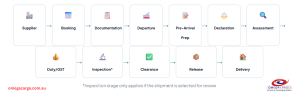
Customs brokerage isn’t a single event at the border — it’s a chain of steps that starts well before your goods leave the supplier’s dock and ends after they reach yours.
How does customs brokerage work in practice? Here is the typical workflow when importing into Australia:
Your overseas supplier manufactures and packs your goods. Supplier manufactures and prepares the goods, and should provide accurate commercial documentation from the start this is where documentation problems often originate.
Your supplier prepares your goods, and your freight forwarder (or the same company acting as both forwarder and broker) books the sea or air freight. This stage is largely outside the customs broker's direct control but sets up everything downstream.
The goods are booked onto a vessel or aircraft (usually by a freight forwarder). your freight forwarder books space with a shipping line or airline and confirms routing and expected transit time.
The supplier generates the commercial invoice, packing list, and origin certificates. The supplier issues the commercial invoice and packing list; your broker reviews these early, ideally before the vessel departs.
Your broker begins reviewing the commercial invoice, packing list and transport document as they become available, checking for consistency and confirming tariff classification ahead of arrival.
The goods leave the origin country. goods leave origin. Your broker can begin pre-arrival preparation using the shipping documents already in hand.
Your goods depart the country of origin. Your broker can often begin preliminary classification and compliance checks at this stage, even before the goods are en route.
You send the documents to your customs broker before the goods arrive. The broker checks everything and classifies the goods. The broker classifies the goods, checks for permits or biosecurity conditions, and drafts the declaration ahead of arrival — the single highest-leverage stage for avoiding delay.
A good broker prepares your import declaration ahead of arrival — sometimes called pre-lodgement so it's ready to be assessed by the ABF as soon as possible after (or even before) the vessel or aircraft lands.
The broker electronically lodges the import declaration with the ABF. The broker lodges the formal declaration through the Integrated Cargo System once shipment details are finalised.
Your broker formally lodges the import declaration through the ABF's Integrated Cargo System, including the tariff classification, declared value, and origin of the goods.
The ABF and DAFF systems assess the declaration for risks, duties, and biosecurity concerns. The ABF’s systems assess the declaration, which can clear automatically or be flagged for a documentary or physical check.
The ABF assesses the declaration using its own risk-based system. Straightforward, well-documented declarations are often processed without further review; others may be flagged for closer examination.
The broker notifies you of the taxes owed, and payment is made to the government.
Any amount payable is calculated and paid before release (or deferred under the ATO’s deferred GST scheme, if registered). Based on the assessment, any duty and GST owing is calculated and paid before the goods can be formally cleared. Your broker coordinates this step.
If flagged, the goods undergo X-ray or physical examination. A documentary or physical/biosecurity check, government-directed and not something a broker controls.
If the ABF or DAFF selects your shipment for document review or physical inspection, this happens before clearance is finalised. Your broker manages communication throughout.
Authorities issue a formal release status. Once assessment (and any inspection) is complete, the ABF or DAFF grants clearance. Once the ABF (and DAFF, if biosecurity assessment applied) is satisfied, formal clearance is granted and your goods are approved for release.
The broker notifies the port/depot that the goods are cleared. The broker coordinates physical release from the terminal, airport or bonded facility.
Your goods are released from the port or airport terminal, and transport is arranged often by your freight forwarder to your final Australian address.Your transport provider collects and delivers the goods to your door.
Need Help Navigating Your Next Import?
Omega Cargo's in-house ABF-licensed customs brokers manage the entire clearance process documentation, classification, and communication with the ABF and DAFF.
Get Your Free Quote or Customs Clearance Services
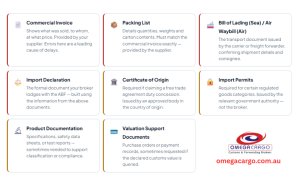
To clear your goods, a customs broker needs a specific set of documents. Providing these early is the easiest way to ensure a smooth clearance.
Every one of the documents below plays a specific role, and a missing or inconsistent one is the single most common cause of a preventable delay.
| Document | What it is | Why it matters | Who typically provides it |
| Commercial invoice | Commercial Invoice: The official bill of sale from the supplier. It details the buyer, seller, items, quantities, prices, and the currency used.
Errors here are the #1 cause of delays. The supplier’s invoice showing goods, quantities, unit price and total value. It shows what was sold, to whom, at what price. Provided by your supplier. Errors here are a leading cause of delays. |
Forms the basis of customs valuation and duty/GST calculation | Your supplier |
| Packing list | A breakdown of what’s in each package or container. Details exactly how the goods are packed (boxes, pallets, weights, dimensions). It is crucial for physical inspections.
Details quantities, weights and carton contents. Must match the commercial invoice exactly provided by the supplier. |
Used to verify the shipment matches the invoice and support any inspection | Your supplier |
| Bill of lading (sea) or air waybill (air) | The transport contract and receipt for the goods.
The official transport contract and receipt of cargo issued by the shipping line or airline. The transport document issued by the carrier or freight forwarder, confirming shipment details and consignee. |
Confirms carriage, consignee and cargo details; needed to take control of the cargo | Shipping line / airline / freight forwarder |
| Import declaration | The formal statement lodged with the ABF describing the goods, value, origin and classification
The formal document your broker lodges with the ABF built using the information from the above documents. |
The legal document that triggers assessment and clearance | Prepared and lodged by your customs broker |
| Certificate of origin(CoO) | A formal document proving where the goods were manufactured. This is essential for claiming reduced duty rates under Free Trade Agreements.
Required if claiming a free trade agreement duty concession. Issued by an approved body in the country of origin. |
Needed to claim preferential tariff treatment under a free trade agreement such as ChAFTA | Supplier, or a recognised issuing body in the origin country |
| Import permit | A government-issued permissions for restricted regulated goods (e.g., certain foods, wood products).
Required for certain regulated goods categories. Issued by the relevant government authority not the broker. |
Legally required before certain goods can be released, regardless of duty status | Relevant government agency (varies by product) |
| Manufacturer’s Declarations . | Documents explaining the material makeup of a product (often required for biosecurity) | ||
| Product documentation | Specification sheets, safety data sheets, material composition.
Schematics, MSDS (Material Safety Data Sheets), or technical catalogs used by the broker to prove the HS code is correct. Test reports, sometimes needed to support classification or compliance. |
Supports classification and any compliance or biosecurity assessment | Your supplier or manufacturer |
| Valuation support documents | Payment terms, proof of payment, details of any assists, royalties or commissions.
Purchase orders or payment records, sometimes requested if the declared customs value is queried. |
Confirms the declared customs value is complete and correctly calculated | You and your supplier jointly |
An incomplete or inconsistent set of these documents is the number one reason a broker can’t lodge on time — not because the broker is slow, but because the file isn’t ready.
Your commercial invoice, packing list, and transport document all need to describe the same goods, in the same quantities, at consistent values. Even small mismatches — a slightly different product description, a rounding difference in value — can flag a shipment for a documentary review. This is one of the most preventable causes of clearance delay, and it's exactly why your broker's document review step exists.
One of the most complex parts of answering "what does a customs broker do?" is explaining Tariff Classification.
An HS code (Harmonized System code) is an internationally standardized system of numbers used to classify traded goods or products for customs purposes.Every product has a code, Maintained by the World Customs Organization and used by customs authorities in more than 200 countries. The international HS code is six digits; the first six digits are the same worldwide; Australia extends this to an eight-digit tariff classification under the Customs Tariff Act 1995, with a further two-digit statistical code making up the ten digits shown on an Australian import declaration.This classification is one of the most technical and important parts of a customs broker's job.
Why does it matter to you?
Because the HS code dictates exactly how much Customs Duty you will pay. It also flags whether your product requires an import permit or biosecurity treatment.
The risk of getting it wrong:
If you guess your HS code to get a lower duty rate, you are committing customs fraud. If the ABF audits you (which they frequently do), you will be forced to back-pay the duty shortfall plus massive administrative penalties.
A customs broker uses their extensive training, legal precedents, and official tariff schedules to classify your goods based on what they actually are, not just what the invoice calls them.
Tariff classification means matching your product to the correct code within that system — governed by a strict set of General Rules of Interpretation applied in order, not by guesswork or copying the code a competitor used.
Classification drives almost everything downstream:
Australia runs a self-assessment system, so goods can clear under an incorrect code and the error only surfaces in a later compliance review — sometimes long after the shipment has been sold, at which point it can mean a retrospective duty demand plus penalties, with no margin left to absorb the cost.
Why classification matters: the tariff code determines the duty rate that applies, whether GST calculations are affected, whether a free trade agreement concession like ChAFTA might apply, and whether an import permit is required. Classification is based strictly on what the goods actually are — their material, function and construction — not their brand name or how they're marketed.
What can go wrong with incorrect classification: an incorrect code can lead to underpaid or overpaid duty, missed permit requirements, or a compliance review if the classification is later found to be wrong. This is exactly why classification is treated as a core, non-negotiable part of a broker's role rather than a formality.
This is why product descriptions matter more than most importers expect. A vague description (“plastic parts”) gives a broker nothing to classify against; a specific one (material, function, use) lets the classification rules be applied correctly. Classification should be based on the actual goods — not the code used for a similar product last time, since a small difference in material or use can put an item in a different heading entirely. This guide won’t assign a specific tariff code to any product, because doing that responsibly requires seeing the actual goods and their full specification. For a deeper walkthrough of how the classification system itself works,
Tariff classification is detailed enough that it deserves its own dedicated resource. For a complete explanation of how the Harmonized System works, the General Rules of Interpretation used to classify goods, and a worked classification example,
see HS Code & Customs Tariff Classification Guide.
A primary role of an Australian customs broker is managing your border taxes.
Once your goods are classified, your customs broker helps you understand the charges likely to apply to your shipment — but the actual amount always depends on the specifics of your goods and shipment, not a fixed formula that applies to everyone.
The charges a broker will typically help you think through include:
Customs Duty: Generally, this is 5% of the customs value of the goods. However, many goods are duty-free, and others can have duty eliminated through Free Trade Agreements. Your broker ensures you never pay more duty than legally required.
calculated on your goods’ customs value at the rate that applies to their tariff classification — which can be a general rate, a concessional rate, or duty-free, depending on the product and its origin.
What It Depends On: Tariff classification, customs value, country of origin, applicable FTA
Who Determines the Final Amount: Australian Border Force assessment
Import GST: In Australia, you must pay 10% Goods and Services Tax on imported goods.
The GST is calculated on the Value of the Taxable Importation (VoTI), which includes:
Customs Value + Customs Duty + International Transport + Marine Insurance.
Your broker calculates these exact figures. Furthermore, if your business is registered for the Deferred GST scheme, your broker will code the declaration so you don't have to pay cash upfront at the border, vastly improving your cash flow.
GST, generally calculated on the Value of Taxable Importation (broadly, the customs value plus duty and certain other charges), separately from any GST you already deal with domestically.
What It Depends On: Value of the taxable importation (customs value + duty + certain other costs)
Who Determines the Final Amount: ABF assessment; ATO for broader GST treatment
Import Processing Charge and other charges that can apply depending on how the declaration is lodged and the value of the shipment. It Depends On a standard government charge applied per declaration
Who Determines the Final Amount: Set by the Australian Government
Other charges (where applicable) for specific goods categories, this can include things like anti-dumping duty, wine equalisation tax or luxury car tax, none of which apply broadly but all of which a broker will flag if relevant to your product.
What It Depends On: Specific goods categories — e.g. certain excise-equivalent goods
Who Determines the Final Amount: Relevant government body
Actual amounts depend entirely on your specific goods, their classification, value and origin. This guide does not state fixed rates — always confirm current charges with your customs broker or the Australian Border Force directly.
The importer is generally responsible for paying customs duty and GST on imported goods — not the customs broker. Your broker helps calculate and identify what's likely owed, and typically coordinates the payment process as part of clearance, but the legal obligation sits with you as the importer. GST-registered businesses should also confirm their specific GST treatment, including potential input tax credits, with their accountant or the Australian Taxation Office.
What actually determines your bill: the tariff classification of the goods, the customs value, the country of origin (and whether a free trade agreement applies), any specific concessions your goods qualify for, and the individual circumstances of the shipment. Two shipments of what looks like “the same product” can carry different duty outcomes if the classification, origin or valuation basis differs.
This is deliberately general. Duty rates, GST rules, thresholds and charges are set and updated by the Australian Government, and they change. For current rates and thresholds, the Australian Border Force and the Australian Taxation Office are the primary sources — a broker’s job is to interpret how those current rules apply to your specific goods, not to publish a fixed price list that would be wrong the moment a rate changes. For a walkthrough of how duty and GST are actually calculated line by line,
see our duty and GST calculation guide.
Customs valuation refers to how the value of your imported goods is determined for the purpose of calculating duty and GST. This value generally relates to the transaction value — broadly, the price actually paid or payable for the goods when sold for export to Australia — though specific rules and adjustments can apply depending on the circumstances of the sale.
"Customs Valuation" is the process of determining the correct economic value of imported goods for the purpose of assessing duties and taxes.
You might think the value is simply what you paid the supplier. However, under Australian law, the customs value must often include certain additions, such as:
A customs broker ensures your valuation complies strictly with World Trade Organization (WTO) and Australian legal standards, protecting you from future valuation audits.
Why this matters: since duty and GST are calculated based on this value, an inaccurate declared value can result in paying more duty than necessary, or in underpayment that leads to a compliance query or reassessment later. A customs broker helps ensure the declared value is supported by appropriate documentation, such as the commercial invoice and purchase order, and reflects the correct basis under Australian customs valuation rules.
Customs valuation is the process of determining the value your goods are declared at for customs purposes — the figure duty and GST are calculated from. Get the valuation wrong and every downstream calculation is wrong with it.
In most straightforward commercial transactions, customs value is based on the transaction value — broadly, the price actually paid or payable for the goods when sold for export to Australia, adjusted to include certain costs where required (such as some commissions, packing costs, or the value of tooling or materials supplied by the buyer). Where a straightforward transaction value can’t be used or verified — related-party transactions are a common example — other valuation methods apply.
Common considerations a broker checks include whether the invoice reflects the full price paid, whether any “assists” (items or services you provided to the manufacturer free or at reduced cost) should be added, and whether the relationship between buyer and seller might have affected the price. This is not a universal formula that applies identically to every shipment — it depends on the transaction. For the current, complete rules, Australian importers should refer to Australian Border Force guidance on customs valuation.
Australia has some of the strictest border rules in the world. A customs broker helps you navigate two major hurdles. Some goods can be imported freely once duty and GST are settled. Others need a specific permit or condition met before release — regardless of value or duty status. A customs broker helps identify, ahead of arrival, which category your goods fall into:
Not everything can be freely imported into Australia. Some goods are prohibited outright. Others are restricted, meaning they can be imported only with specific permits, licences, or conditions met. A customs broker helps identify whether your goods fall into either category — though the permits themselves are issued by the relevant government authority, not the broker.
The most important thing to understand about permits and restrictions is timing: many permit requirements need to be satisfied before your goods are shipped, not after they arrive. Checking with your customs broker before placing an order — not after your goods are already at sea or in the air — gives you time to obtain what's needed without your shipment sitting in limbo at the Australian border.
The Department of Agriculture, Fisheries and Forestry (DAFF) protects Australia from foreign pests and diseases. They use a system called BICON (Biosecurity Import Conditions).
Australia’s isolation from many pests and diseases affecting agriculture elsewhere is a genuine national asset, and the government protects it accordingly. The Department of Agriculture, Fisheries and Forestry (DAFF) is responsible for biosecurity at the border, working alongside the ABF on cargo clearance. BICON (the Biosecurity Import Conditions system) is the online database importers and brokers use to check the specific conditions that apply to a product, by product type and origin — ideally checked before the shipment leaves origin, not after it lands.
Depending on what you’re importing, biosecurity requirements can include inspection of the goods, packaging or container on arrival; treatment such as fumigation or heat treatment for goods identified as carrying risk; additional documentation such as a phytosanitary certificate issued at origin; and specific conditions unique to the product-origin combination, which range from straightforward to genuinely restrictive. Seasonal risk is part of the picture too — certain pests are treated as a heightened risk from specific countries during particular months, adding treatment requirements that don’t apply the rest of the year.
This guide deliberately doesn’t list current biosecurity conditions, since they’re product- and origin-specific and DAFF updates them regularly. Check BICON directly, or speak with your broker before you place the order — not after the goods have shipped.
Australia has some of the strictest biosecurity requirements in the world, managed by the Department of Agriculture, Fisheries and Forestry (DAFF). Biosecurity rules exist to protect Australia's unique environment, agriculture and human health from pests, diseases and contaminants that could arrive with imported goods.
DAFF maintains BICON (Biosecurity Import Conditions system) — the official government tool importers and brokers use to check what biosecurity conditions apply to specific goods. Depending on what you're importing, DAFF may require:
Biosecurity requirements can change and are highly specific to the exact product and its origin. Your customs broker can help prepare biosecurity documentation and liaise with DAFF, but current, product-specific import conditions should always be verified directly through BICON or DAFF's official resources — this guide provides general context, not a substitute for checking current requirements for your specific goods.
It is vital to distinguish between a broker and the government.
Customs Broker ≠ Australian Border Force.
A broker cannot "force" the ABF to clear your goods, nor can they bypass the law. Their value lies in preparing your shipment so perfectly that the ABF has no reason to delay it.
The Australian Border Force (ABF) is the Australian Government agency responsible for border protection, including customs control, cargo clearance decisions and enforcement. It is important to be precise about the boundary here: a customs broker is not the ABF, and does not work for the ABF.
Customs Broker vs Australian Border Force — Who Does What
| Function | Customs broker | Australian Border Force |
| Who they work for | You, the importer (or exporter) | The Australian Government |
| What they do | Prepare and lodge your declaration, classify goods, manage documentation and communication | Assess declarations, make clearance decisions, conduct inspections, enforce customs law |
| Can they release your goods? | No — they coordinate release once clearance is granted | Yes — clearance and release decisions sit with the ABF (and DAFF for biosecurity) |
| Can they guarantee an outcome? | No — they can prepare the strongest possible case for a smooth clearance | Yes — final decisions are theirs alone |
A broker’s job is to give the ABF everything it needs to make a fast, straightforward decision. The broker cannot instruct the ABF, negotiate a guaranteed clearance time, or override an inspection decision. Any broker who implies otherwise is overstating what the role can actually do.
| Function | Customs Broker | Australian Border Force |
| Prepares and lodges the import declaration | Yes ✓ | Receives and assesses it |
| Determines tariff classification | Proposes based on expertise ✓ | Can review, query, or reassess |
| Decides whether goods are inspected | No — cannot control this | Yes — risk-based decision ✓ |
| Grants final clearance | No — facilitates the process | Yes — final authority ✓ |
| Sets duty rates and GST rules | No — applies existing rules | Enforces government-set rules ✓ |
| Communicates with importer | Yes — primary contact ✓ | May contact importer/broker directly if needed |
Think of it this way: your customs broker is your advocate and preparer, presenting your case to the border authorities as accurately and completely as possible. The ABF is the government body that actually assesses and decides. A good broker dramatically improves your chances of a smooth, fast clearance — but they cannot guarantee outcomes that are ultimately the government's decision to make.
Even with a perfect customs broker, the ABF or DAFF may randomly select your cargo for inspection.
What a broker does during this: They track the status, liaise with the inspection facility, provide the inspectors with any requested documentation, and keep you informed of the delays and inspection fees involved. They cannot stop the inspection, but they ensure it progresses administratively without stalls.
Customs or DAFF, for biosecurity may examine cargo for several reasons: random selection, an inconsistency in the declared documentation, intelligence-led targeting, or because the product category carries an inherent inspection rate (certain biosecurity-risk goods, for example).
An inspection can involve a documentary review (checking paperwork against what’s declared), a physical examination of the cargo, or in biosecurity cases, sampling and testing. Inspections add time how much depends entirely on what’s found and how quickly any follow-up requirements can be satisfied.
Customs authorities examine cargo for a range of reasons — compliance verification, biosecurity risk, random selection as part of a broader risk management program, or specific intelligence about a shipment, supplier or commodity type. An inspection can involve a documentary review (checking paperwork more closely) or a physical examination of the goods themselves.
What a broker can do during an inspection: coordinate access for the examining officers, provide any additional documentation requested promptly, and manage communication so the process isn’t held up by anything on the importer’s side.
respond promptly to any information requests, provide additional documentation if asked, and communicate on your behalf with the ABF or DAFF throughout the process.
What a broker cannot control: whether an inspection happens at all, how long the examining agency takes, or the outcome of the examination. No broker can honestly promise to guarantee inspection avoidance; that decision sits entirely with the government agency involved, and any supplier or broker who promises otherwise is not being straight with you.
guarantee that your shipment won't be selected for inspection, influence the outcome of an inspection, or speed up a government-mandated review beyond providing complete and prompt information. Any customs broker who promises to "guarantee" avoiding inspection isn't being accurate about how the system works.
A major reason businesses ask "what does a customs broker do?" is because they have experienced severe delays in the past. Here are the most common causes of clearance delays:
Most delays are avoidable. Here are the causes brokers see most often, and what actually prevents each one — for a closer look at this exact problem,
Common Causes of Customs Clearance Delays
| Cause | Impact | Prevention |
| Incorrect documents: Invoices lacking vital information. | Declaration rejected or queried, resetting the clock | Have your broker review documents before the vessel departs |
| Missing documents: Waiting on original certificates of origin. | Declaration can’t be lodged at all | Confirm the full document set with your supplier before shipping |
| Incorrect HS code:Customs flagging a mismatch between the product and the code. | Wrong duty applied, or a permit requirement missed. Duty miscalculated; possible reassessment | Provide full, specific product detail so classification is accurate the first time.
|
| Incomplete product description: "Car parts" instead of "Steel brake rotors for 2015 Toyota Hilux." | Classification can’t be confirmed. Difficulty confirming correct classification | Give material, function and use — not just a product name.
Provide detailed, accurate descriptions |
| Import permit issues: Applying for a permit after the goods arrive. | Goods can’t be released until resolved or permit obtained | Check permit requirements before the shipping/order is placed, not after shipping |
| Restricted or prohibited goods: importing goods that require ABF permission. | Additional conditions must be met before release.
Goods held, refused, or seized |
Screen the product category early with your broker.
Verify import eligibility in advance |
| Biosecurity requirements: Mud on a container or untreated wood packaging. | Inspection, treatment or extra documentation needed.
DAFF hold pending documentation or treatment |
Check BICON conditions before departure.
Confirm biosecurity conditions via broker/BICON |
| Customs inspection: Random or targeted border holds. | Physical or documentary hold while examined.
Additional time for examination |
Cannot be fully preventable — clean documentation reduces the odds and the length. respond promptly if selected |
| Valuation questions: Customs believing the declared price is suspiciously low. | The query can hold the whole declaration. Clearance paused pending clarification | Ensure the invoice reflects full value, including any assists or commissions. Provide clear, consistent valuation documentation |
| Duty/tax issues: Payment failures or incorrect GST exemptions claimed. | Payment must be resolved before release. | Confirm duty/GST liability and have funds ready before arrival. Pay promptly once amounts are advised |
| Supplier documentation errors: The factory loaded the wrong goods. | Wrong invoice details, mismatched paperwork.
Inconsistencies flagged during review |
Brief your supplier clearly on what customs documentation needs to show.
Confirm documents with supplier before shipping |
| Incorrect consignee information: The importer's ABN doesn't match the documents. | The declaration doesn’t match import licence or business details.
Declaration details don't match reality |
Double-check consignee, company and address details match your registered business details. |
| Port congestion: Backlogs at the terminal preventing physical movement. | Physical delay in handling regardless of clearance status.
Physical delays independent of documentation. |
Build buffer time into your supply chain during peak periods.
Outside broker's control — plan buffer time |
| Shipping documentation problems | Bill of lading or manifest errors block cargo release.
Bill of lading/AWB inconsistencies |
Confirm transport documents match commercial documents before arrival.
Confirm transport documents match invoice/packing list. |
| Government processing requirements: System outages or seasonal backlogs. | Standard processing time for the relevant agency.
Standard processing can vary by volume/season |
Lodge as early as pre-arrival provisions allow.
Outside broker's control — pre-lodge where possible |
| Product compliance issues | Goods don’t meet a mandatory safety or labelling standard | Check compliance requirements before ordering, not after shipping |
| Incomplete declarations | Missing fields or unsupported claims trigger a query | Have an experienced broker prepare and check the declaration before lodgement |
| Unexpected regulatory requirements: Sudden embargoes or new biosecurity alerts. | A rule change since your last shipment of the same product.
New requirements not anticipated at booking |
Ask your broker to check for recent changes on repeat product lines.
Work with a broker who monitors regulatory updates |
Most of these causes are at least partly preventable with careful preparation. For a deeper dive into Australian customs delay causes specifically, see our dedicated guide: full breakdown of why customs clearance gets delayed in Australia.
Yes and no. A customs broker can prevent avoidable delays caused by missing documents, bad HS codes, or poor descriptions through proactive pre-arrival preparation. However, they cannot control weather, port strikes, random government inspections, or slow government processing times.
A good customs broker can meaningfully reduce avoidable delays. That includes thorough document checks before lodgement, careful classification review, pre-arrival preparation so the declaration is ready the moment it can be lodged, proactive compliance checks against known requirements, accurate declarations that don’t invite a query, and fast, complete responses if a query does come in.
What a broker cannot control: whether the ABF or DAFF selects your shipment for inspection, weather events, port closures, carrier delays, general government processing volumes, or a genuine regulatory decision on your specific goods. Anyone who tells you a broker can guarantee a clearance time or guarantee no inspection is not describing how the system actually works.
A good customs broker can meaningfully reduce the risk of avoidable delays — through careful document review, accurate classification, proactive compliance checks, and prompt, well-prepared responses to any queries. This is genuinely one of the strongest reasons to work with an experienced broker rather than navigating the process alone.
What's Within a Broker's Control — and What Isn't
Within their control:
document accuracy, correct classification, proactive compliance checks, prompt communication, pre-lodgement timing.
Outside their control:
whether the ABF or DAFF selects your shipment for inspection, port or terminal congestion, weather events, carrier scheduling issues, and broader government processing timeframes. No customs broker can honestly promise to eliminate delays entirely — what a good one can promise is minimising the delays that are actually preventable.
When you partner with a licensed customs broker, you unlock several strategic advantages that go far beyond just checking boxes on a form. Here are the top benefits you can expect:
A broker acts as the grease in the gears of your supply chain. By handling the complexities of customs clearance, they ensure your goods move across borders as fast as physically possible. This means you can get your products to market faster, keeping your customers happy and your inventory flowing without interruption.
There is nothing worse than calculating your profit margins, only to be hit with a surprise tax bill from the government. Customs brokers help you calculate your exact landed costs before you even place an order with an overseas supplier. You will know exactly what you owe in duties and fees, allowing you to price your products accurately and protect your profits.
You did not start your business to become an expert in international trade law. By handing over the complicated regulatory work to a trusted professional, you win back countless hours. You can reinvest that time into product development, marketing, and expanding your business.
When a shipment gets flagged for a random exam or a new tariff is suddenly announced, panic often sets in. A customs broker is your calm, experienced problem-solver. They know exactly who to call, what forms to file, and how to resolve disputes with port authorities quickly so your cargo does not stay stranded.
Trying to handle customs clearance without a broker is risky. A single mistake could cost you thousands in fines, penalties, or lost shipments. The small fee you pay a customs broker is insurance against these disasters.
Now that you know what they do and the benefits they offer, you might still be thinking: Can I just do this myself? Technically, yes, an individual or company can try to clear their own goods. Practically? It is a huge risk. Here is why hiring a customs broker is one of the smartest commercial decisions you can make for your digital growth and global supply chain.
If you make a mistake on your customs entry, the government will not just politely ask you to fix it. They can seize your cargo, hold it at the port, and fine you thousands of dollars. While your goods sit at the port, you also get hit with "demurrage" fees—daily rental charges for taking up space. A broker ensures things are done right the first time, preventing these budget-destroying delays.
As a business owner, your time is your most valuable asset. Do you really want to spend 20 hours a week reading dense government trade manuals and trying to understand complex tariff schedules? By outsourcing this highly technical task to a broker, you can focus on what you do best: marketing, selling, and growing your business.
International trade rules change almost daily. Trade wars, new tariffs, and sudden import bans happen all the time. A great customs broker monitors these daily shifts and alerts you before they impact your bottom line. They are your radar for global trade storms.
Brokers know the law inside and out. They know about special trade agreements, duty drawback programs, and legal exemptions that you probably have no idea exist. A sharp broker can often legally classify your goods in a way that significantly lowers your tax burden.
If you are new to importing, you have probably heard the term "freight forwarder" thrown around, and you might be confusing them with customs brokers. While they work closely together, they have entirely different jobs. Let's make it simple:
Check out reliable Freight Forwarding services here.
Many first-time importers constantly confuse these two roles and for good reason — they often sit inside the same company and touch the same shipment. But they are legally and functionally distinct. While they work together seamlessly, they perform completely different functions.
Customs Broker vs Freight Forwarder — Full Comparison
| Function | Customs broker | Freight forwarder |
| Customs declarations | Yes. Lodges legal entries with ABF.
Core function — licensed to prepare and lodge them Core responsibility — legally licensed ✓ |
Not licensed to lodge declarations themselves.
No. Cannot lodge entries unless they employ brokers. Not licensed to do this |
| Freight booking | Not typically their role, No. Does not book the ship/plane | Core function — books space with carriers. Yes. Secures space on vessels and aircraft.
Core responsibility ✓ |
| Cargo transportation | Not involved in physical movement, No. Does not move physical freight. Not their role | Arranges and coordinates the physical movement. Yes. Manages the physical movement of boxes/pallets.
Coordinates carriers ✓ |
| Tariff classification | Core responsibility. Yes. legally classifies goods | No. Not licensed to classify for duty purposes.
May assist informally, but it isn’t their licensed role, Not their specialty |
| Customs clearance | Yes. Specializes entirely in border clearance. Their specialised, licensed service.
Core responsibility ✓ |
No. Only handles the transport side.
May coordinate the process via a broker partner. Coordinates with broker |
| Documentation | Yes. Reviews for legal/tax compliance. Prepares and lodges customs-specific documents. Reviews for customs purposes | Prepares transport documents (bill of lading, booking confirmations). Yes. Issues transport docs (Bill of Lading). Prepares Bill of Lading/AWB ✓ |
| Warehousing | No, Not a typical core service, Not their role | Yes. Often owns or rents storage facilities. Often available as an add-on, Often arranged ✓ |
| Shipment tracking | Not their role, Limited to the clearance stage, | Core responsibility ✓, Core service, often door-to-door |
| Import compliance | Core responsibility ✓ Yes. Ensures ABF/DAFF compliance. Their primary area of expertise | No. Focuses on logistics routing. Supports, doesn't lead, Generally relies on a broker for this |
| Final delivery | Not typically involved, Not their role | Arranges wharf cartage/delivery ✓ Often arranges or coordinates final delivery |
| Government licence required? | Yes — ABF licence ✓ | No mandatory government licence |
Some companies, including Omega Cargo, provide both services under one roof, which is genuinely convenient — one point of contact for booking, transport and clearance. But not every freight forwarder is a licensed customs broker, and not every customs broker offers freight forwarding. If a provider is vague about which licence they actually hold, that’s worth asking about directly. For a deeper side-by-side breakdown of where these roles overlap and where they diverge, see our dedicated guide, freight forwarder vs customs broker.
You may also come across the term "customs agent" — in Australian usage, this term is generally used interchangeably with "customs broker," referring to the same licensed profession. Terminology can vary slightly in other countries, but for Australian importers, these terms typically describe the same role: a licensed professional managing your customs declaration and clearance process.
In Australia, "Customs Broker" is the legally recognized term for the licensed professional. You may hear the term "Customs Agent" or "Clearance Agent"—these are just older or international colloquialisms for the exact same job.
In everyday Australian usage, “customs broker” and “customs clearance agent” are generally used to mean the same thing — a licensed party who prepares and lodges import declarations on your behalf. You may also see “customs clearance agent” used more loosely to describe a company’s clearance service rather than the individual broker performing the work. The practical point for an importer: check that whoever is handling your clearance holds a current customs broker licence, rather than getting caught up in which of these interchangeable terms they use to describe themselves.
Think of it this way: If you are taking a bus across a country border, the freight forwarder is the bus driver. The customs broker is the person who checks your passport and visa to make sure you are legally allowed to enter.
Many large logistics companies offer both services under one roof, which can be highly convenient for your business!
Do you need both? Yes, usually! In most cases, you need a freight forwarder to physically move the goods, and a customs broker to legally clear them. Fortunately, many modern logistics companies (like ours) offer both services under one roof, providing a seamless experience. Ready to simplify your supply chain? Explore our integrated Customs Clearance Solutions here.
Only a licensed customs broker can officially represent you before U.S. Customs and Border Protection. If you need legal customs representation, make sure your service provider is licensed as a customs broker. You can verify this on the CBP website.
Are you legally required to use a customs broker in Australia? Technically, no. An individual can attempt to submit their own documentary declaration to the ABF.
Should you do it yourself? Absolutely not.
You need a customs broker if:
Unless you are importing a personal item worth less than $1,000 through the post, professional customs assistance is a mandatory cost of doing business safely.
There isn’t one answer that fits every importer, but the patterns are clear. First-time importers almost always benefit — the Integrated Cargo System, classification rules and documentation requirements have a real learning curve, and mistakes on a first shipment are expensive lessons. Regular commercial importers use a broker because the compliance obligation doesn’t shrink with experience, and the time saved usually outweighs the fee once a business is placing multiple orders a month.
Small importers and e-commerce sellers benefit because a held shipment often represents a bigger share of their inventory and cash flow than it would for a larger business. High-volume businesses use a broker for consistency and risk management across dozens or hundreds of declarations a year, where one repeated classification error compounds quickly. Importers of complex, restricted or regulated products — machinery, chemicals, food, therapeutic goods, anything biosecurity-flagged — benefit most, because the cost of getting these wrong is highest.
To be clear: Australian law does not require every importer to use a licensed broker in every circumstance — some self-lodge directly. But the compliance responsibility for an incorrect declaration sits with the importer regardless of who prepared it, which is why most commercial importers, especially first-timers, choose professional help rather than carry that risk alone.
Do You Need a Customs Broker? — By Importer Type
| Importer Type | Is Professional Brokerage Typically Valuable? | Why |
| First-time importer | Very likely ✓ | Unfamiliar process; higher risk of avoidable mistakes |
| Small e-commerce business | Likely ✓ | Limited internal resources for compliance management |
| Regular commercial importer | Yes — standard practice ✓ | Volume makes professional efficiency and accuracy valuable |
| Business importing complex products | Yes ✓ | Classification and compliance complexity is higher |
| Business importing restricted/regulated goods | Strongly recommended ✓ | Permit and compliance risk is significant |
| High-volume enterprise importer | Yes — typically integral to operations ✓ | Scale and consistency benefit from professional management |
| Very simple, low-value, one-off import | Case-by-case | Some importers manage simple cases independently |
| Australia does not mandate broker use for every importer, but only a licensed broker (or the importer directly) can lodge a formal declaration — and most businesses find professional support more practical than managing the process independently. | ||
Why pay for a broker? Here is the return on your investment:
When you are managing international shipping, moving a product from a factory overseas to your warehouse involves a lot of moving parts. A customs broker acts as the crucial anchor in this chaotic process. While your cargo is physically crossing the ocean or flying through the air, your broker is already hard at work electronically preparing for its arrival.
They help with international shipping by bridging the gap between transportation logistics and strict government regulations. They coordinate directly with your freight forwarders, the shipping lines, and the port authorities. For example, if a shipping container gets flagged for a random X-ray exam upon arrival, the broker immediately steps in. They communicate with the port officials, pay the examination fees on your behalf, and provide the exact documentation Customs needs to release the container.
Furthermore, they often coordinate the final leg of the journey—making sure that once the legal hold is lifted, a local trucking company is instantly notified to pick up your cargo. By managing the legal hurdles that physically stop containers from moving, customs brokers ensure your international shipments actually reach your doorstep instead of becoming expensive parking lot decorations at the port.
To give you a better idea of how this all plays out in the real world, let us walk through the typical timeline of importing goods with the help of a customs broker.
Long before your cargo ship arrives at the port, your broker goes to work. You will provide them with essential documents from your supplier. These usually include:
Your broker reviews these documents for accuracy. They assign the correct HS tariff codes and calculate your duties. Then, they pre-file your entry electronically with Customs. Doing this before the ship arrives helps speed up the release process.
The ship arrives at the port! Customs officers look at the electronic entry your broker filed. At this point, the government system decides whether to simply release the goods, ask for more paperwork, or physically inspect the cargo.
Most shipments pass through without a physical check. However, customs uses risk-management algorithms to randomly select containers for inspection. If yours is chosen, your broker coordinates with the port authorities to get the container moved to an exam station. (Note: You are responsible for paying the fees associated with this exam, even though it is random!).
Once Customs is satisfied, they issue a release. Your broker immediately notifies your freight forwarder or trucking company. Your cargo is loaded onto a truck and delivered directly to your warehouse or fulfillment center.
You might think the process ends when the truck arrives, but there is one final step. About 300 days after your goods enter the country, Customs performs a final review of the entry to ensure everything was perfect. This is called "liquidation." Once liquidated, the entry is officially closed. Your broker tracks this to ensure no surprise bills pop up months later.
Even smart business owners make mistakes when entering international trade. Here are some of the most common pitfalls that a licensed customs broker will help you avoid:
Many importers think that if they order product samples, they don't have to pay duties. This is a myth. Unless the sample is physically mutilated (like a shirt with a giant hole cut in it so it cannot be sold), Customs considers it a commercial product, and you must pay taxes on its value. Brokers ensure you declare samples correctly to avoid fraud charges.
Every product imported into the United States must be visibly marked with its country of origin (e.g., "Made in China" or "Made in Vietnam"). If your goods arrive without these marks, Customs will force you to hire workers to manually label every single item at the port before they are released. This is incredibly expensive. Your broker will advise you on proper labeling before your goods ever leave the foreign factory.
By now, you understand the immense value of having a professional on your side. But how do you choose the right one? Not all brokers are created equal. When shopping for a customs broker, ask these crucial questions:
There’s no single fixed price for customs brokerage in Australia, and any article that quotes you one flat number is oversimplifying. What a broker charges typically depends on:
A genuinely important point: the cheapest brokerage quote is not automatically the cheapest total import cost. A broker who under-quotes on fees but gets a classification wrong, misses a permit requirement, or lodges an incomplete declaration can cost you far more in penalties, storage fees and delay than a properly-resourced broker charging a fair price from the start. Price the service, not just the fee.
Warning: Cheap brokerage does not always mean lower total import costs. A "cheap" broker who carelessly uses the wrong HS code could cost you thousands in overpaid duties or port storage fees when the goods are detained.
Remember that your broker's fee is just one small slice of the "Landed Cost" pie. Your total cost will include:
Understanding what you’re actually paying for matters more than any single number. A complete landed-cost picture typically includes several separate components, only one of which is the broker’s own fee:
| Cost component | What it covers |
| Customs broker fee | The broker’s own service fee for classification, declaration and clearance coordination |
| Freight cost | Ocean or air transport from origin to Australia |
| Customs duty | Government charge based on tariff classification, value and origin |
| GST | Generally calculated on the value of taxable importation |
| Government charges | Import processing and any product-specific government fees |
| Inspection-related costs | Costs associated with a physical or biosecurity examination, if one occurs |
| Storage | Terminal or warehouse storage charges, particularly if clearance takes longer than the free period allowed |
| Storage /Demurrage / detention | Charges from the shipping line for holding a container beyond the free time allowed |
| Delivery | Transport from the port or airport to your final destination |
| Other destination charges | Terminal handling and other local charges specific to the port of arrival |
Seeing these laid out separately is the point: a broker’s fee is usually a modest line item next to freight, duty and GST — but it’s the one line item that most directly determines whether the rest of the process runs smoothly or expensively.
Are you legally required to use a customs broker in Australia? Technically, no. An individual can attempt to submit their own documentary declaration to the ABF.
Should you do it yourself? Absolutely not.
You need a customs broker if:
Unless you are importing a personal item worth less than $1,000 through the post, professional customs assistance is a mandatory cost of doing business safely.
Evaluate a prospective broker against criteria that actually predict good service, not just a low quote:
To make this completely clear, let’s look at a hypothetical scenario. Meet Alex. Alex runs a fast-growing online fitness brand and decides to import $50,000 worth of rubber yoga mats from a manufacturer overseas.
Alex figures he can save a few hundred dollars by handling the customs paperwork himself. His shipment arrives at the port of Los Angeles.
Alex decides to hire a licensed customs broker before the goods leave the factory.
To truly understand what a customs broker does, let's look at four illustrative scenarios:
Example 1: The First-Time Importer
Example 2: E-commerce Business Importing from China
Example 3: Regulated Goods (Food)
Example 4: Recurring Commercial Importer
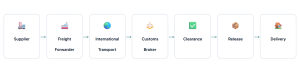
On many shipments, a freight forwarder and a customs broker are working the same file from two different angles — and when they coordinate well, the handover between them is invisible to you.
A typical combined workflow looks like this:
Service structures differ by company. Some businesses use entirely separate providers for freight forwarding and customs brokerage and coordinate between them manually. Others — Omega Cargo among them — offer both under one roof specifically so the handover in step 4 doesn’t introduce a delay or a communication gap.
Typically, the freight forwarder handles everything related to physically moving your goods — booking, transport documentation, tracking — while the customs broker handles everything related to legally clearing those goods through the Australian border. When both functions are provided by the same company, this handover happens internally and seamlessly. When they're separate businesses, documents and information need to be actively shared between them — which works perfectly well with good communication, but does introduce an extra coordination point.
Service structures genuinely differ by company — some freight forwarders outsource customs clearance to a separate licensed broker, others (like Omega Cargo) hold the ABF licence in-house alongside freight forwarding. Both models can work well; what matters most is clear communication and defined responsibility at every stage.
You might be wondering, "Why are we talking about cloud infrastructure in a guide about customs brokers?"
The answer is simple: Modern global trade runs entirely on digital data. the logistics and customs brokerage industries have undergone a massive technological revolution. The days of brokers physically walking stacks of paper to a customs office are long gone. Today, the best customs brokers leverage top cloud infrastructure trends to offer resilience, scalability, and digital growth to their clients.
Here is how cloud technology directly impacts you as an importer:
If you are an e-commerce business owner, your sales might spike dramatically during the holidays. Suddenly, instead of importing one container a month, you are importing twenty. A modern customs broker using robust cloud infrastructure can automatically scale their processing power to handle your increased volume. Cloud-based customs software integrates directly with your online store and your supplier's systems, automatically processing thousands of entries without a single human error.
Global trade is unpredictable. Ports go on strike, natural disasters occur, and trade regulations change overnight. Cloud-based logistics platforms offer extreme resilience. Because your customs data is stored securely in the cloud, your broker can access your files and clear your cargo from anywhere in the world. If a server goes down in one city, cloud redundancy ensures your customs entry is still securely transmitted to the government without delay.
In the past, importers had to call their broker on the phone and ask, "Where is my container?" Today, thanks to cloud integrations and APIs (Application Programming Interfaces), you get a digital dashboard. You can log into a portal and see exactly where your cargo is, whether customs has released it, and exactly how much duty you paid, all in real-time.
When you choose a customs broker, you aren't just hiring a legal expert; you are hiring their technology stack. Partnering with a broker who embraces digital growth and cloud scalability is the secret to outperforming your competitors.
To make this What Does a Customs Broker Do? as complete as possible, let's answer a few common questions beginners often ask.
Most brokers charge a flat "clearance fee" per shipment, which usually ranges between $100 and $150. However, this does not include the actual taxes and duties you owe the government, nor does it include extra fees for things like FDA processing or physical customs exams.
Yes and no. A broker cannot make a cargo ship sail faster across the ocean. However, by pre-filing your paperwork perfectly, they ensure your goods are not delayed after they arrive. Perfect paperwork is the secret to fast clearance.
Usually, no. Express courier services like FedEx, UPS, and DHL have their own internal customs brokers who clear small, low-value packages on your behalf as part of their shipping service. You generally only need to hire an independent broker when you are shipping large commercial quantities via ocean freight or major air freight.
Think of a customs bond as an insurance policy that guarantees the government will get paid its duties and taxes. If you are importing commercial goods, you are legally required to have a bond. Your customs broker will usually purchase this bond on your behalf and include it in your setup fees.
Goods are usually seized because they are counterfeit, illegal, or severely misdeclared. If this happens, your broker will receive a formal notice. They will help you understand why the seizure happened and guide you through the complex legal process of petitioning the government to release the goods—though success is never guaranteed if laws were broken.
Getting a shipment through Australian customs cleanly comes down to the same things every time: accurate documentation, correct classification, early preparation, and someone who knows what the ABF and DAFF expect to see. That’s the real answer to “what does a customs broker do” — not a single task, but managing that entire chain so you don’t have to learn it under time pressure.
If you’re bringing in your first shipment, scaling up a regular import routine, or handling a product category with biosecurity or permit conditions attached, Omega Cargo’s customs and quarantine clearance team can review your documentation, handle classification and lodgement, and coordinate with freight forwarding so nothing falls into a gap between providers. Request a quote for your next shipment, or get in touch to talk through your import needs before you place the order.
At its heart, a customs broker does one essential thing: they turn a genuinely complex legal and regulatory process into something you can navigate confidently, without needing to become a customs expert yourself. From reviewing your documents and classifying your goods, to lodging your declaration and managing communication with the Australian Border Force and DAFF, a broker handles the technical, compliance-heavy work standing between your goods arriving in Australia and actually being in your hands.
What a broker can't do is override government decisions, guarantee inspection-free clearance, or promise specific timeframes — no honest broker will claim otherwise. What a good one can do is dramatically reduce the avoidable risks and delays in your import, communicate clearly when something needs attention, and become a genuine long-term partner in how your business handles international trade.
Omega Cargo has provided in-house, ABF-licensed customs brokerage alongside freight forwarding since 2000 — helping Australian importers of every size navigate exactly the process this guide describes, shipment after shipment.
Importing goods is one of the most exciting steps you can take to grow your business. It opens up a world of new products, better profit margins, and global partnerships. However, the red tape at the border is real, and it is unforgiving.
As we have explored in this What Does a Customs Broker Do?, a licensed broker is far more than just a paperwork filer. They are your compliance shield, your tax strategist, and your logistics problem-solver. By partnering with a dedicated, tech-forward customs broker, you remove the stress of border regulations entirely.
You can stop worrying about HS codes, FDA requirements, and CBP holds. Instead, you can put your full energy into what truly matters: serving your customers, expanding your market, and driving the digital growth of your brand.
Ready to make your next import seamless? Start researching licensed customs brokers today, ask the right questions, and secure the expert partner your global supply chain deserves!
Don't leave your global supply chain up to chance.
If you are ready to import with confidence, you need a partner who combines decades of compliance expertise with modern, scalable technology. Our team of licensed customs brokers is standing by to streamline your imports, eliminate delays, and protect your bottom line.
Partner With Our Licensed Customs Brokerage Experts Today - Click Here to Get Started! 👉 Need to move your cargo first? Explore our seamless Freight Forwarding Services!
Have Questions About Your Next Import?
Omega Cargo's in-house ABF-licensed customs brokers can help with documentation, classification, and clearance — talk to us about your shipment.
Talk to a Customs Broker → Customs Clearance Services


