
Here’s the question worth asking before you book anything: are you choosing a container for your cargo, or squeezing your cargo into whatever container was quoted? Getting that the wrong way round is how importers end up with goods that don’t fit, cargo that spoils, or a shipment held at the wharf for treatment nobody planned for.
Your supplier says the order is ready, your forwarder asks what equipment you need, and suddenly “a container” isn’t one thing any more. Do you need a high cube? Will a flat rack work for the machine? Does the chilled stock really need a reefer, or will an insulated box do?
This guide walks through the shipping container types you’re most likely to meet when importing into or exporting from Australia — what each one is built for, the cargo it suits, the limits that catch people out, and the Australian rules that change depending on the box you pick. By the end, you’ll be able to match your cargo to the right equipment and brief your freight forwarder with confidence.
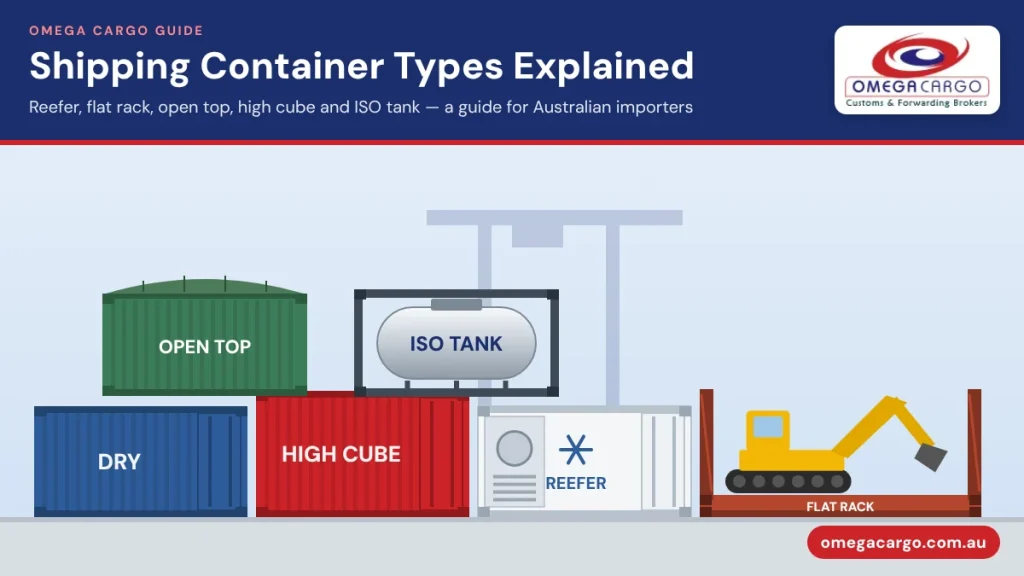
The main shipping container types are the dry (general purpose) container, the high cube container, the refrigerated (reefer) container, the open top container, the flat rack container and the ISO tank container. Each solves a different cargo problem: volume, height, temperature, top loading, oversized or heavy items, and bulk liquids.
Most of these come in 20ft and 40ft lengths. Specialised versions such as open side, insulated and ventilated containers also exist, but availability depends on the shipping line and the trade lane.
How to read an ISO container type code
Almost every container you’ll book is built to international (ISO) standards, which is why a box loaded in Shanghai can be lifted, stacked and trucked in Fremantle without anyone measuring it first. The standards fix the outside dimensions and the corner fittings. They don’t fix every internal measurement, so two containers of the same type from different owners can differ slightly inside.
You’ll see that standardisation in a short code printed on every container and on many booking documents. Hapag-Lloyd’s published fleet specifications, for example, list a 20ft dry container as 22G1, a 40ft high cube as 45G1, a 20ft reefer as 22R1 and a 20ft open top as 22U1. In that format, the first digit is the length (2 for 20ft, 4 for 40ft), the second is the height and width group (5 marks a high cube), and the letter is the type (G for general purpose, R for reefer, U for open top, P for flat rack and platform).
You don’t need to memorise the codes. It’s worth knowing they exist, because if your booking confirmation shows a different code from the one you asked for, you’ve just spotted a mistake before it costs you anything. Our guide to shipping terms and acronyms covers the other abbreviations that turn up on freight paperwork.
Six core container types and the cargo problem each one solves
The table below compares the common types using one shipping line’s published example specifications. Treat the figures as a guide only — Hapag-Lloyd notes its specifications vary by manufacturer, and other lines’ equipment differs.
| Container type | Example ISO code | Example internal height | Example capacity | What it solves |
|---|---|---|---|---|
| 20ft dry (general purpose) | 22G1 | 2,395 mm | 33.2 m³ | Standard boxed and palletised cargo |
| 40ft dry (general purpose) | 42G1 | 2,395 mm | 67.7 m³ | Larger volumes of standard cargo |
| 40ft high cube | 45G1 | 2,700 mm | 76.3 m³ | Light, bulky or tall cargo |
| 20ft reefer | 22R1 | 2,159 mm | 28.1 m³ | Chilled or frozen cargo |
| 40ft high cube reefer | 45R1 | 2,425 mm | 67.7 m³ | Larger volumes of temperature-controlled cargo |
| 20ft open top | 22U1 | 2,340 mm | 32.5 m³ | Over-height cargo or cargo loaded by crane from above |
| 20ft flat rack | 22P3 | No roof or side walls | Not applicable | Oversized, wide or very heavy cargo |
| ISO tank container | Varies by tank | Not applicable | Varies by tank | Bulk liquids, gases and some powders |
Source: Hapag-Lloyd container specifications (example fleet data). Always confirm the exact specification with your carrier before loading.
Notice what the table quietly tells you: a 20ft reefer has noticeably less internal height and volume than a 20ft dry box, because the insulation and refrigeration machinery take up space. If you’ve measured your cargo against dry container dimensions, re-measure it against reefer dimensions before you book.
If your real question is length — 20ft or 40ft — our 20ft vs 40ft container guide covers that decision in depth. This article focuses on the type of box.
The dry container suits most boxed and palletised cargo
A dry container is the fully enclosed steel box most people picture: four walls, a roof, a floor and doors at one end. It carries the bulk of the world’s containerised trade, and it’s the right answer for most importers most of the time.
Best for: cartons, palletised goods, furniture, homewares, textiles, packaged food that doesn’t need temperature control, building products, retail stock and e-commerce inventory.
Watch out for:
If your shipment won’t fill a container, you may not need one of your own at all. Our comparison of LCL vs FCL shipping to Australia explains when sharing container space makes more sense.
A high cube adds height, not floor space
A high cube container is a dry container that’s taller than standard — the “cube” refers to cubic capacity. Externally, a high cube stands 9ft 6in tall compared with 8ft 6in for a standard box, so you gain roughly 30 cm of height. Length and width stay the same.
Using Hapag-Lloyd’s examples, a 40ft high cube offers about 2,700 mm of internal height and 76.3 m³ of capacity, compared with about 2,395 mm and 67.7 m³ in a standard 40ft.
A high cube doesn’t give you a bigger floor. If your cargo is dense — tiles, steel, stone, bagged powders — you’ll reach the maximum payload well before you use the extra height, so you’d be paying for space you can’t fill.
Work out your cargo’s volume before deciding. Our guide to CBM and volumetric weight calculations shows you how.
Yes, but it’s far less common than the 40ft version, and many lines don’t offer it on every route. If your plan depends on one, confirm availability before you commit.
A reefer container is a refrigerated shipping container with insulated walls and a built-in refrigeration unit that holds cargo at a set temperature throughout the journey. It’s the standard equipment for chilled and frozen food, fresh produce, some pharmaceuticals, and other temperature-sensitive goods.
Unlike a cool room, a reefer is designed to maintain temperature, not bring warm cargo down to temperature. That makes pre-cooling your goods to the correct setpoint before loading essential.
Maersk explains that reefers use a bottom-air delivery system: conditioned air moves along the floor and up through the cargo. That’s why the floor is grooved (often called a T-floor), and why stacking cargo too high or blocking the floor channels can leave warm spots.
Maersk publishes example operating ranges of -30°C to +30°C for a standard 20ft reefer and -35°C to +30°C for a 40ft high cube reefer. Specialised equipment goes further: controlled atmosphere reefers adjust oxygen and carbon dioxide to slow ripening, and super freezers operate far colder. Confirm the exact range for the unit you’re booking.
Reefers need power at every handover: ship, terminal and road
A reefer needs power from start to finish. At sea it plugs into the ship. At the terminal it plugs into a reefer point. On the road it usually runs on a clip-on generator set (genset). Each handover is a moment where the unit can lose power, which is why temperature logging and monitoring matter. Many modern units report temperature, humidity and alarms remotely.
An insulated (or thermal) container has insulated walls but no active refrigeration. It slows temperature change but can’t hold a setpoint. For anything with a strict temperature requirement, it’s not a substitute for a reefer.
The container keeps your goods cold. It doesn’t make them compliant. If you’re importing food for sale, the Department of Agriculture, Fisheries and Forestry (DAFF) sets out the steps in its guide on how to import food into Australia, starting with the biosecurity import conditions in BICON. Your goods may be referred for inspection and testing under the Imported Food Inspection Scheme, and inspections are cost recovered.
For the bigger picture of moving temperature-sensitive goods around Australia, see our guide to cold chain logistics in Australia.
Open tops take over-height cargo loaded from above
An open top container has no fixed steel roof. Instead, it has removable roof bows and a heavy-duty tarpaulin that’s secured over the cargo. The end doors still open, so you can load from the end or from above.
Hapag-Lloyd’s example 20ft open top lists a roof opening of about 2,230 mm by 5,338 mm, which gives you a sense of what can be lowered in from above.
Flat racks carry cargo too wide or heavy for enclosed containers
A flat rack container is a heavy-duty base with end walls but no side walls and no roof. Many flat racks have collapsible end walls, so empty units can be stacked for return. A platform container goes one step further, with no end walls at all.
Flat racks carry cargo that’s too wide, too tall or too heavy for any enclosed box — what the industry calls out-of-gauge (OOG) cargo. Typical examples include:
Flat racks are built for weight. Hapag-Lloyd’s example 20ft flat rack lists a maximum payload of 42,100 kg — significantly more than its example 20ft dry container. Even so, whether you can actually use that payload depends on how the load is spread across the floor and on Australian road limits after discharge.
Over-height usually means an open top; over-width means a flat rack
| Question | Open top | Flat rack |
|---|---|---|
| Is the cargo too tall for a high cube? | Usually suitable | Suitable |
| Is the cargo too wide for a standard box? | Not suitable — fixed side walls | Suitable |
| Does it need side or top loading? | Top loading | Top and side loading |
| Is the cargo very heavy and concentrated? | Sometimes | Usually the better choice |
| Does it need weather protection? | Tarpaulin cover | Minimal — must be wrapped or protected |
If the cargo is only over-height, an open top is usually simpler. If it’s over-width, a flat rack is generally the container option before you move to breakbulk shipping.
Getting an OOG item off the ship is only half the job. Under the Heavy Vehicle National Law, a heavy vehicle carrying a large indivisible item that exceeds mass or dimension limits needs to operate under a notice or an oversize overmass (OSOM) permit. The National Heavy Vehicle Regulator processes permits for most states, but for travel within Western Australia and the Northern Territory you apply directly to the relevant state or territory road authority. Some moves also need pilot or escort vehicles.
That matters if your flat rack is discharging at Fremantle, Port Botany or Port of Brisbane and heading inland. For more on planning these moves, read our guides to project cargo shipping and importing machinery into Australia.
Under BMSB measures, flat racks and open tops count as break bulk
This is the Australian detail most container type guides miss, and it can decide whether your shipment is allowed to discharge.
Each season, DAFF applies seasonal measures for brown marmorated stink bug (BMSB) to target goods manufactured in or shipped from target risk countries, where the goods are shipped between 1 September and 30 April. DAFF uses the shipped-on-board date on the ocean bill of lading to decide whether a shipment falls inside that window.
Here’s where the container type matters. According to DAFF:
In plain terms: if you’re moving a target good such as machinery on a flat rack or in an open top during BMSB season, the treatment needs to happen before the ship sails, not after it arrives. That has to be built into your supplier’s timeline. BMSB measures are reviewed during each season, so check DAFF’s current list of target goods and countries before every shipment.
Our customs and quarantine clearance team can check whether your goods are caught by the measures before they’re loaded.
An ISO tank fits the same frame as a standard container
An ISO tank container is a cylindrical tank, usually stainless steel, built inside a frame with the same corner fittings and footprint as a standard container. That frame lets it move by ship, rail and road like any other box.
Tank capacity, insulation, heating and pressure ratings vary from tank to tank, so the right unit depends on what you’re carrying and how it behaves in transit.
If the contents are dangerous goods, sea transport falls under the International Maritime Dangerous Goods (IMDG) Code, with documentation, labelling and segregation requirements to match. Our guide to shipping dangerous goods to Australia covers those steps.
Weight declarations apply to tanks as well. The Australian Maritime Safety Authority (AMSA) states that a verified gross mass must be supplied before any container is loaded onto a ship, and its guidance specifically addresses portable tanks. For liquids and gases, residues left after discharge count as contents when working out the VGM of an “empty” tank.
A flexitank is a bladder, typically single-use, fitted inside a standard 20ft dry container. It can work for some non-hazardous bulk liquids, but it isn’t a replacement for an ISO tank for dangerous goods or liquids that need heating, pressure or strict hygiene control.
Niche container types: check availability on your trade lane
Not every type of shipping container is available on every trade lane, but these are worth knowing.
An open side container has doors that open along one full side, as well as the end doors. It suits wide items or cargo that’s easier to load from the side by forklift, and it’s popular for site storage in Australia. For international shipping, check that the line offers it on your route.
Insulated containers slow temperature change without active cooling. Ventilated containers have openings that let air move through the box, which helps some cargo — such as certain agricultural products — that gives off moisture. Both are niche, so availability is limited.
A hard top has a removable steel roof instead of a tarpaulin. It combines top loading with better protection than an open top.
Double door containers open at both ends, which can speed up loading and unloading. Bulk containers have loading hatches in the roof and a discharge hatch at the end for free-flowing dry bulk such as grain or plastic pellets.
A five-step check before you request a quote
Use this five-step check before you request a quote. It takes ten minutes and saves the most common equipment mistakes.
| If your cargo is… | Start with… |
|---|---|
| Standard and within dry container limits | Dry container (20ft or 40ft) |
| Light and bulky, or slightly too tall | High cube container |
| Chilled, frozen or temperature-sensitive | Reefer container |
| Too tall, or must be crane-loaded from above | Open top container |
| Too wide, too heavy or both | Flat rack container |
| A bulk liquid, gas or powder | ISO tank container |
Hypothetical scenario: an importer in Perth is bringing in a compact excavator and three pallets of spare parts from China, arriving at Fremantle in October.
The decision isn’t just “which box”. It’s which box, which rules come with it, and what has to happen before the ship leaves.
Most problems with specialised shipping container types come from a handful of avoidable errors.
Specialised shipping container types are usually priced differently from standard dry containers, and there’s no single rate that applies to every shipment. What you’ll pay depends on:
Our breakdown of container shipping cost and rates in Australia explains how these charges come together on a quote. For a figure you can rely on, ask for a shipment-specific quote based on your cargo’s real dimensions and weight.
Delivery equipment depends on the container type
Shipping container types also differ once they reach Australia, because each one needs different delivery equipment. Dry, high cube and reefer containers can usually be delivered on a side loader or skel trailer, depending on your site. Flat racks and open tops with heavy or OOG cargo often need cranes or specialist trailers. Our container transport services guide explains the options.
When you unpack, check the container for damage, tampering and hitchhiker pests. Our import container check guide explains what to look for and what to do if you find something.
The main types of shipping containers are dry (general purpose), high cube, reefer (refrigerated), open top, flat rack and ISO tank containers. Each is designed for a different cargo need: standard goods, extra volume, temperature control, top loading, oversized or heavy items, and bulk liquids. Most come in 20ft and 40ft lengths.
There’s no fixed number of shipping container types, because shipping lines and leasing companies offer different specialised variants. Most importers only need to know six core types — dry, high cube, reefer, open top, flat rack and tank — plus a handful of niche options such as open side, insulated, ventilated, hard top and bulk containers.
The difference is height. A high cube container is 9ft 6in tall externally, compared with 8ft 6in for a standard container, giving roughly 30 cm of extra internal height. Length and width are the same, so a high cube suits light, bulky cargo rather than heavy cargo that reaches the weight limit first.
A reefer container has insulated walls and a refrigeration unit that holds cargo at a set temperature, while a normal dry container has no temperature control. Reefers need power throughout the journey and have slightly less internal space than dry containers of the same length, because the insulation and machinery take up room.
A reefer is designed to maintain temperature, not to bring warm cargo down to its setpoint. Goods should be pre-cooled to the correct temperature before loading. Loading warm cargo puts strain on the unit and can leave parts of the shipment outside the safe temperature range.
An open top container has fixed side walls and a removable tarpaulin roof, so it suits cargo that’s too tall or must be crane-loaded from above. A flat rack has no side walls or roof, so it suits cargo that’s too wide, too heavy or both. If cargo is only over-height, an open top is usually simpler.
During the BMSB season, DAFF treats goods shipped on flat racks and in open top containers as break bulk. Target high-risk goods shipped as break bulk from target risk countries must be treated offshore before arrival, or they may be denied discharge. Check DAFF’s current target goods and countries for each shipment.
An ISO tank container carries bulk liquids, and some gases and powders, in a cylindrical tank fitted inside a standard container frame. Common cargo includes food-grade liquids such as oils and wine, and chemicals. Dangerous goods in tanks must also meet the IMDG Code for sea transport.
They’re ISO size and type codes. The first digit shows the length (2 for 20ft, 4 for 40ft), the second shows the height group (5 marks a high cube), and the letters show the type (G for general purpose, R for reefer, U for open top, P for flat rack). They help you confirm the right equipment was booked.
Specialised containers are usually priced differently from dry containers because availability is lower and handling is more involved. Out-of-gauge dimensions, reefer power, treatment and permits can all add to the total. The only reliable figure is a quote built on your cargo’s actual dimensions, weight and route.
Choosing between shipping container types is easier when someone looks at the actual cargo. If you have an awkward, heavy, tall or temperature-sensitive shipment coming up, send us your packing list or item dimensions, the gross weight, the origin and the destination. We’ll help you work out the right container type, flag any BMSB, biosecurity or permit issues for that equipment, and arrange the sea freight and clearance.
Request a quote for your container shipment and tell us what you’re moving we’ll take it from there.


