
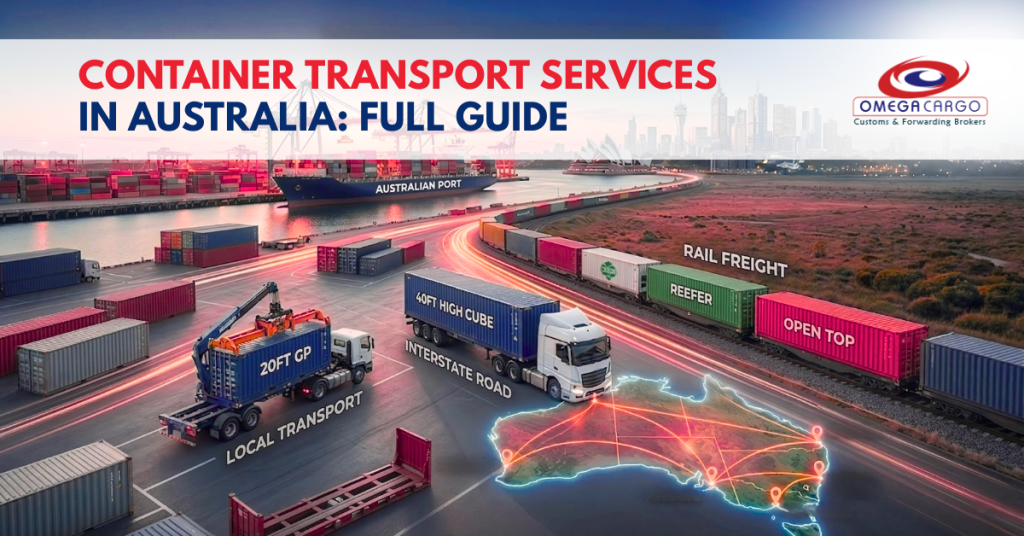
Container transport services in Australia move 20ft and 40ft shipping containers by road, rail or a mix of both between ports, warehouses, depots, homes and job sites. They connect every import and export that arrives by sea with the businesses and people who need the goods, and they also carry containers between states for commercial freight and household moves.
Quick answer: the main services are wharf cartage (moving containers between port terminals and your premises), interstate container transport, self-pack container moves, commercial FCL and LCL freight, and specialised transport for refrigerated, open-top and flat rack containers. The price and timing of each move depend on distance, route and direction, container size and weight, delivery equipment, port and depot charges, fuel levies, waiting time and how flexible your dates are. An all-in quote for your specific move is the only reliable way to budget.
Whether you are a small business receiving your first import container, a logistics manager running a national supply chain, or someone moving a container to a regional site, this guide explains how the system works. You will learn the types of container transport, the container sizes and delivery trucks you will come across, what drives the cost, how the major ports operate, the biosecurity rules for Western Australia, and how to choose a reliable transport provider.
Container transport services in Australia are the logistics network that moves shipping containers around the country. That includes collecting containers from port terminals, moving them by truck or train, and delivering them to distribution centres, warehouses, building sites or private properties, then returning empty containers to a nominated depot.
Australia is an island nation with long distances between its capital cities, so freight relies on a coordinated mix of sea freight, rail and heavy road transport. When you book container transport, you are using a chain of prime movers, trains, terminal cranes, empty container parks and booking systems that all need to line up.
The container itself is the standard steel box you see stacked at ports or travelling along highways on the back of a truck. The two most common sizes are the 20ft container (internal volume of about 33 cubic metres) and the 40ft container (about 67 cubic metres). Working out which size suits your load is the first step towards an accurate quote. Our guide to CBM and volumetric weight calculations shows you how to measure your cargo.
This guide focuses on domestic container transport: moving containers by road and rail between Australian locations. International container shipping, such as importing from China or exporting to the USA, is handled through sea freight and freight forwarding. For the ocean leg itself, see our sea freight shipping guide.
The two services meet at the port. Your imported container arrives at an Australian terminal, is cleared by the Australian Border Force (ABF) and the Department of Agriculture, Fisheries and Forestry (DAFF), and then needs domestic container transport to reach your warehouse or site.
Wharf cartage is the road transport leg between a port terminal and your warehouse, depot or delivery address. Every container unloaded at a terminal such as Port Botany, the Port of Melbourne, the Port of Brisbane, Fremantle or Port Adelaide has to physically travel to its final destination. That leg is wharf cartage. It also works in reverse for export containers heading to the wharf.
Your freight forwarder or customs broker usually arranges wharf cartage as part of the import process. A cartage quote can include the terminal pickup, the road transport leg, fuel levies, any port-related charges passed on by the carrier and the return of the empty container. Timing depends on when the container is cleared and released, terminal booking slot availability, the distance to your site and whether you need a side loader or can unload from a skel trailer yourself.
Container detention: don't get caught out. Once a shipping line releases your container, you have a limited period of free time to unpack it and return the empty to a nominated depot. The length of free time depends on the shipping line, your contract and the container type. After it runs out, detention charges apply for every extra day and they can add up quickly. Confirm the free time with your freight forwarder before the container arrives and have a plan to unpack and return it on time.
Interstate container transport moves a full or empty container between states. Shorter interstate routes are often run by road. Long-haul routes, such as Sydney to Perth, commonly combine road and rail: a prime mover collects the container from your address, takes it to a rail terminal, the container travels by train to the destination state, and another truck delivers it to your door.
For long distances, rail is often the more economical option and generally gives your goods a smoother ride than road-only transport. Road can suit tighter timeframes, shorter routes and destinations away from the rail network. If you move palletised or loose freight rather than full containers, see our interstate transport service.
Self-pack (DIY) container moves are a popular way to move house or relocate business equipment interstate. An empty container is delivered to your property, you load it at your own pace, and the transport company collects it and delivers it to your new address, where you unpack.
Because you do the packing and unpacking, self-pack moves usually cost less than a full-service removalist. The trade-off is that you supply the labour, take responsibility for packing and securing the load, and need suitable space and access at both ends for the delivery truck.
Businesses use container transport to move commercial goods within Australia and to connect with international shipments. That includes FCL (Full Container Load) moves for large consignments and LCL (Less than Container Load) consolidated services for smaller freight that shares space with other shippers. Imported sea freight often feeds straight into domestic container transport for delivery to your warehouse. Our LCL vs FCL shipping guide explains how to choose between the two.
Not everything fits in a standard steel box. Specialised container transport handles refrigerated cargo, heavy machinery, oversized equipment and goods that need open-top or flat rack containers. These moves may need extra planning, specialised trailers, permits, escort vehicles or cranes. For temperature-controlled freight, see our cold chain logistics guide, and for oversized loads, our project cargo shipping guide.
Choosing the right container protects your goods and keeps your costs under control. Transport companies base their equipment and pricing on the type of container you need moved, so know what you are dealing with before you request a quote.
| Container | Approx. internal dimensions (L x W x H) | Approx. internal volume | Typical use |
|---|---|---|---|
| 20ft General Purpose (GP) | 5.90 m x 2.35 m x 2.39 m | 33 CBM | Smaller commercial loads, household moves, heavy dense cargo |
| 40ft General Purpose (GP) | 12.03 m x 2.35 m x 2.39 m | 67 CBM | High-volume commercial freight, larger household moves |
| 40ft High Cube (HC) | 12.03 m x 2.35 m x 2.69 m | 76 CBM | Bulky, lighter cargo and tall items |
Dimensions vary slightly between manufacturers, and usable space is lower than the internal volume once you allow for packaging and load shape. Maximum gross weights also vary by container and are limited further by road rules and the truck configuration, so confirm weight limits with your transport provider before you pack.
The standard enclosed steel container for general cargo. It is lockable, weatherproof and the most widely available type across Australia. Dry vans suit furniture, household goods, retail stock and general freight.
The same as a dry van but about 30 cm (one foot) taller, giving you extra volume. High cubes are useful for tall furniture, wardrobes and bulky but light cargo. The 40ft HC is very common; the 20ft HC is less widely available.
Temperature-controlled containers for perishable goods such as food, pharmaceuticals and agricultural products. They have an integrated refrigeration unit that needs power at depots and terminals, and a generator set or plug-in point during transport.
Containers with a removable roof cover, so goods can be loaded from above by crane. They suit machinery, timber and items too tall to fit through standard doors. You usually need crane access at both the loading and unloading sites.
A flat base with end walls and no sides or roof. Flat racks carry oversized, heavy or awkwardly shaped cargo such as construction equipment, vehicles and industrial machinery. Out-of-gauge loads may need permits and special routing.
Like a dry van, but with extra doors along one side. This makes it easier to load and reach goods anywhere along the container without unpacking the whole load.
One of the most important things to tell your transport provider is how the container will be unloaded at your site. A loaded container can weigh many tonnes, so it cannot simply be dropped anywhere. Depending on your site and equipment, the transport company will use one of the following truck types.
The most common delivery method for both commercial and residential deliveries. A side loader has hydraulic cranes at the front and rear of the trailer. It pulls up parallel to the drop-off spot and lifts the container off the side of the trailer onto the ground, or onto another truck.
A tilt tray works much like a tow truck. The truck bed tilts backwards and the container slides off the back until it rests on the ground.
A skel trailer is the standard way to move containers between ports, depots and distribution centres. The truck delivers the container but has no way of lifting it off.
For difficult sites, such as lifting a container over a fence or onto a raised platform, a truck with a built-in articulated crane (often called a Hiab) is used. It is generally the most expensive delivery option, but it gives you the most precise placement.
Whatever equipment you choose, describe your site honestly when you book: the surface, slope, access width, overhead clearance and any gates or tight turns. If the truck arrives and cannot deliver safely, you may pay for a wasted trip and a second delivery.
"How much does it cost to transport a shipping container?" is the question every transport company hears, and the honest answer is that it depends on your move. Container transport costs in Australia are built from several components, and two moves of the same distance can be priced very differently. Here is what influences your container transport quote.
The further your container travels, the more you can expect to pay, but distance is not the whole story. Delivering to an accessible industrial estate in a capital city is usually cheaper per kilometre than delivering along narrow or unsealed rural roads to a farm or remote site. Regional and remote deliveries can attract extra charges for longer travel time and limited return loads.
Freight does not flow evenly around Australia. Western Australia, for example, brings in a large share of its goods from the eastern states, so services heading west tend to be fuller than services returning east. Carriers price these imbalances into their rates, which means the same route can cost a different amount depending on the direction. If your timing is flexible, ask your provider whether the direction of travel affects your quote.
A 20ft container is lighter and easier to move, and can sometimes travel on a smaller truck. A heavily loaded 40ft container may need heavy-vehicle combinations and, in some cases, permits. Overweight containers can require specific axle configurations and may not be legal on certain roads. Always give your provider an accurate gross weight.
A skel trailer drop at a warehouse with its own forklift usually costs less than a side loader delivery to a residential driveway, and a crane truck generally costs more again. Matching the right equipment to your site avoids failed deliveries and extra charges.
If your container is coming straight off an international vessel, the terminal operators (stevedores) apply landside access or infrastructure charges to trucks collecting and delivering containers. These charges are set by each terminal, can change over time and are usually passed on from the transport operator to you. Terminal booking slots, known as vehicle booking systems, can also affect when your container can be collected.
Once you unpack an imported container, the empty must be returned to an empty container park nominated by the shipping line. Some parks charge the transport operator booking or handling fees, and these costs are often included in your cartage bill. Congestion at empty parks can also lead to waiting time.
Diesel prices move up and down, so most container transport services in Australia apply a variable fuel levy on top of the base rate. Routes that use toll roads, including some port access corridors, may also have toll charges added. Check whether your quote includes both.
Transport companies usually allow a set amount of free time to load or unload a container while the truck waits, or for a side loader to drop the container. If your site is not ready, or packing takes longer than planned while the driver waits, waiting time is charged. Ask how much free time is included and how waiting time is billed before the truck arrives.
These two charges are often confused. Detention is charged by the shipping line when you keep its container beyond the agreed free time before returning the empty. Demurrage generally refers to charges for containers left at the terminal beyond the allowed free period, for example because clearance is delayed or collection is late. Both can grow quickly, and both are avoidable with good planning and prompt customs and quarantine clearance.
Demand for trucks and rail space rises in busy periods, such as before Christmas and around the end of the financial year, and import volumes also move with factory closures in Asia around Chinese New Year. Weekend, after-hours or urgent bookings may be priced differently from standard weekday work. If your dates are flexible, backloading can lower your cost (see the tips below).
| Cost component | What it covers | What changes it |
|---|---|---|
| Base transport rate | Moving the container from pickup to delivery | Distance, route, direction, mode (road or rail), container size and weight |
| Delivery equipment | Side loader, tilt tray, skel trailer or crane truck | Site access, whether the container is loaded, placement requirements |
| Fuel levy | Variable surcharge to cover diesel costs | Fuel prices and each carrier's levy method |
| Port and terminal charges | Landside infrastructure and access charges passed on by carriers | The terminal used and each stevedore's charges |
| Empty park fees | Returning the empty container to a nominated depot | The depot nominated by the shipping line, congestion |
| Tolls | Toll roads used on the route | Route choice and vehicle class |
| Waiting time | Truck time beyond the included free time | Site readiness, packing or unpacking speed |
| Detention and demurrage | Container or terminal charges after free time ends | Clearance speed, unpacking time, prompt return of empties |
| GST | Tax on taxable domestic transport services | Whether the quote is shown including or excluding GST |
Rather than relying on published price lists, which go out of date quickly and rarely include every surcharge, use this table to understand what shapes the cost and timing on major interstate corridors. Your provider can then quote for your actual pickup and delivery points.
| Route | Common transport mode | What affects cost and timing |
|---|---|---|
| Sydney to Melbourne | Road or rail | Busy corridor with many services; equipment at each end, terminal slots and date flexibility |
| Sydney to Brisbane | Road or rail | Busy corridor; road suits tighter timeframes, rail suits flexible dates |
| Sydney to Perth | Usually road and rail combined | Long east-west distance, rail schedules and directional imbalance |
| Melbourne to Brisbane | Road or rail | Route choice, rail connections and date flexibility |
| Melbourne to Perth | Usually road and rail combined | Long distance, rail capacity and directional imbalance |
| Brisbane to Perth | Usually road and rail combined | Very long distance, connections between rail services and limited backload options |
| Adelaide to Melbourne | Road or rail | Shorter interstate route; equipment and timing at each end |
| Darwin to Brisbane | Road, or a road and rail combination | Long remote distances, seasonal weather and limited return loads |
Pricing and transit for every route depend on the carrier, schedules, current demand, equipment availability, weather and your pickup and delivery addresses. Always ask for an all-in quote before you book.
Want a clear price for your move? Request a quote from Omega Cargo with your pickup and delivery addresses, container size, approximate weight and site access details, and our team will come back to you with a tailored quotation.
If you import goods into Australia, whether from China, the USA, Europe or anywhere else, your container will arrive at one of the major ports and then need wharf cartage to reach you. Knowing how each port works helps you plan your supply chain. For a wider overview, see our guide to the major shipping ports in Australia.
The Port of Melbourne is one of Australia's two busiest container ports and a hub for import and export trade. If you distribute goods to Victoria, Tasmania or southern New South Wales, your containers are likely to pass through here. The port has good road and rail connections, but traffic around the port precinct means transport companies must book terminal time slots to collect and deliver containers. For local support, see freight forwarding in Melbourne.
Port Botany is the other of Australia's two busiest container ports and the main container gateway for New South Wales. Investment in on-dock rail aims to move more containers onto trains and off congested Sydney roads. If you supply the Sydney market, Port Botany is your hub. See freight forwarding in Sydney for local services.
Located at the mouth of the Brisbane River, the Port of Brisbane is a key gateway for Queensland's population and agricultural exports. It includes automated terminal operations and has a dedicated motorway linking the port to the wider road network, which helps road transport move efficiently.
Fremantle handles most of Western Australia's container trade. Because WA is so far from the eastern seaboard, Fremantle is a vital link for the state. The WA Government is planning a new container port in the outer harbour through the Westport project to meet future demand. For local help, see freight forwarding in Fremantle.
Port Adelaide serves South Australia's importers and exporters and connects to road and rail routes across the state and interstate.
When you import through a freight forwarder, wharf cartage is often arranged as part of a door-to-door service. Your forwarder coordinates the terminal pickup, the release paperwork and the road delivery. Before a container can leave the terminal, the goods must be cleared by the ABF and any biosecurity requirements must be met, and the shipping line must release the container. Delays at any of these steps can push back your collection and run down your free time. Our step-by-step customs clearance guide explains the process.
Western Australia has strict interstate quarantine rules to protect its agriculture from pests and diseases. If you are moving a container into WA from another state, whether for a household move or commercial freight, check the rules before the container leaves the eastern states. Common requirements include:
Requirements can change, so check the Quarantine WA importing and exporting page before you pack.
International containers arriving at Fremantle or any other Australian port fall under federal biosecurity rules managed by DAFF. During the brown marmorated stink bug (BMSB) risk season, which DAFF sets as goods shipped between 1 September and 30 April, targeted goods manufactured in or shipped from target risk countries may need offshore treatment or other measures. Check the current DAFF BMSB seasonal measures for your origin country and goods. If you import from China, our guide to freight shipping from China to Australia covers the compliance steps.
Backloading means your container travels on a truck or rail service that is already heading in your direction, often on a return trip that would otherwise run empty. Backload rates can be noticeably cheaper than a dedicated move. The catch is that you need flexible dates, because your container moves when space is available.
Some providers price weekend, public holiday or after-hours work differently from standard weekday bookings. Ask whether a midweek pickup or delivery would lower your quote.
Never compare base transport rates alone. Ask for all-in quotes that list fuel levies, tolls, port and terminal charges, empty park fees, waiting time terms and GST. A low headline rate can hide higher surcharges, so the total cost of the move is the only fair comparison.
Booking a 40ft container for a load that fits in a 20ft means paying to move empty space. Measure your main items and calculate your total CBM before you book. Your provider can help you choose the right container for your load.
Detention charges on import containers can quickly outweigh any savings you made elsewhere. Book your unpacking labour in advance, unpack as soon as the container arrives and arrange the empty return well within your free time.
For long interstate routes, such as east coast to Perth, rail is often cheaper than road-only transport and gives your goods a smoother ride. Ask your provider about combined road and rail services on your route.
Truck and rail capacity tightens before Christmas, around the end of the financial year and when import volumes surge after Chinese New Year. Book well ahead during these periods to secure your preferred dates and reduce the risk of peak pricing.
If your commercial freight will not fill a container, consider LCL consolidation instead of an under-used FCL booking. Your freight shares container space with other shippers and you pay for the cubic metres you use. Our LCL vs FCL comparison explains when each makes sense.
Your supply chain is only as strong as its weakest link. The wrong transport provider can mean damaged goods, missed deadlines and budget blowouts. When you compare container transport services in Australia, use this checklist.
Ask whether the company runs its own trucks or subcontracts the work. Either can work well, but you want a provider with reliable access to the right mix of side loaders, tilt trays and skel trailers, so they can match the equipment to your site and recover quickly if a truck breaks down.
A provider using a modern transport management system can give you booking confirmations, status updates or tracking, digital proof of delivery (POD) and clear invoices. Ask what visibility you will have once your container is on the move.
Ask for details of the provider's public liability and goods-in-transit cover, and check what is excluded and how claims are handled. Many carrier contracts limit liability, so consider your own cover too; our freight insurance guide explains the options. Heavy vehicle operators must comply with the Heavy Vehicle National Law administered by the National Heavy Vehicle Regulator (NHVR), or with state rules in Western Australia and the Northern Territory, which manage their own heavy vehicle regulation. Accreditation schemes and quality certifications are a good sign that a provider takes safety seriously.
In logistics, things occasionally go wrong. A port may close for high winds or a truck may break down. What separates a good provider is communication: you want a contact who tells you about a delay early, rather than leaving you to chase answers.
If you are moving dangerous goods, refrigerated containers or oversized flat racks, make sure the provider has proven experience with that type of cargo. Moving standard dry goods is very different from moving hazardous chemicals or temperature-sensitive medicines. Our guide to shipping dangerous goods to Australia covers the compliance side.
| Factor | What to check | Red flags |
|---|---|---|
| Compliance | Heavy vehicle compliance and any relevant state licences or accreditation | Cannot explain how they meet heavy vehicle rules |
| Insurance | Public liability and goods-in-transit cover, with clear claims terms | Refuses to share policy details |
| Tracking and updates | Booking confirmations, status updates and proof of delivery | No way to check where your container is |
| Equipment | Suitable side loaders, tilt trays and skel trailers for your site | Unclear about what truck will arrive |
| Reviews and references | Consistently positive, recent reviews and responses to feedback | No reviews, or only old ones |
| Pricing transparency | All-in quotes with surcharges itemised | Very low headline rate with vague extras |
| Communication | Prompt replies and written booking confirmation | Hard to reach, no confirmation in writing |
When comparing quotes, always ask: Is this rate all-in? Does it include fuel levies, tolls, port charges and GST? How much free waiting time is included? What happens if my goods are damaged in transit? How are detention and empty returns handled for import containers? A provider who answers these questions clearly is one you can work with.
Whether you are organising a one-off container move or looking for a long-term logistics partner for regular imports, the more detail you give, the more accurate your quote will be. Have this information ready:
With this information upfront, your provider can choose the right equipment and route for your move and give you a more accurate quote. For tricky freight terms, our shipping terms and acronyms guide may help.
Container transport services in Australia cover the road, rail or combined movement of 20ft and 40ft shipping containers between ports, homes, warehouses, depots and job sites. They include wharf cartage after international sea freight arrives, interstate container transport, self-pack container moves, refrigerated container transport for perishables, and flat rack or open-top transport for oversized cargo.
It depends mainly on distance and your site. For short local trips, a skel trailer delivery is often the cheapest option if you can unload the container yourself with a forklift or at a dock. For long interstate routes, rail or combined road and rail is usually more economical than road-only transport. Backloading and flexible dates can lower the cost further.
Container transport costs vary with the distance and route, the direction of travel, container size and weight, delivery equipment, fuel levies, tolls, port and empty park charges, waiting time and how flexible your dates are. Published price lists go out of date quickly and rarely include every surcharge, so request an all-in quote for your specific pickup and delivery points.
The main differences are capacity and the space needed for delivery. A 20ft container has an internal volume of about 33 cubic metres and is easier to place in tight driveways. A 40ft container has about 67 cubic metres, roughly double, but needs a larger truck and much more space to deliver and unload safely. A 40ft High Cube adds extra height for bulky cargo.
Wharf cartage is the transport of shipping containers to or from a port terminal. The transport operator books a time slot with the terminal, collects your import container once it has been cleared and released (or delivers your export container), and moves it by road to or from your premises. It links sea freight with the local road network.
A self-pack container move is usually cheaper than a full-service removalist, especially for interstate moves, because you do the packing and unpacking yourself and the transport company handles the lifting and the long-distance leg. A removalist may still suit you if you need packing help, have limited space for a container or want everything handled for you.
Interstate transit times depend on the distance, whether the container travels by road, rail or both, rail schedules, connections at terminals, the equipment available at each end, weather and track or road maintenance. Ask your provider for a transit estimate for your specific route and build in some contingency for disruptions.
Yes, container transport services reach most parts of Australia. Remote properties may need specialised equipment, such as side loaders or heavy-duty trucks suited to unsealed or narrow roads, and extra charges usually apply for long distances outside major cities. Check site access with your provider before you book.
Western Australia has strict interstate quarantine rules. Before a container travels to WA, make sure its contents, and the container itself, are clean and free of soil, plant material, seeds and insects, and check whether any items need treatment or are restricted. Quarantine WA may inspect goods entering the state. Check the current rules on the DPIRD website before you pack.
Container detention is a charge from the shipping line when you do not return an empty container within the agreed free time. Free time varies by shipping line, contract and container type, so confirm it before the container arrives. To avoid detention, plan your unpacking in advance, unpack promptly and arrange the empty return early.
Container transport services in Australia give you a flexible way to move goods, whether you are receiving an import container from overseas, shifting stock between states or managing regular commercial freight. The keys to good value are simple: choose the right container size, compare all-in quotes, use backloading when your timing is flexible, return import containers promptly and work with providers who are properly insured and compliant.
If your freight starts or ends with international shipping, it helps to work with a freight forwarder who can coordinate the whole journey. Omega Cargo is a West Australian family company founded in 2000, offering sea freight, customs and quarantine clearance, warehousing and logistics and interstate transport.
Contact Omega Cargo to discuss your shipment and request a tailored freight quotation. Request a quote online, or contact our team to talk through your container transport and freight requirements.


