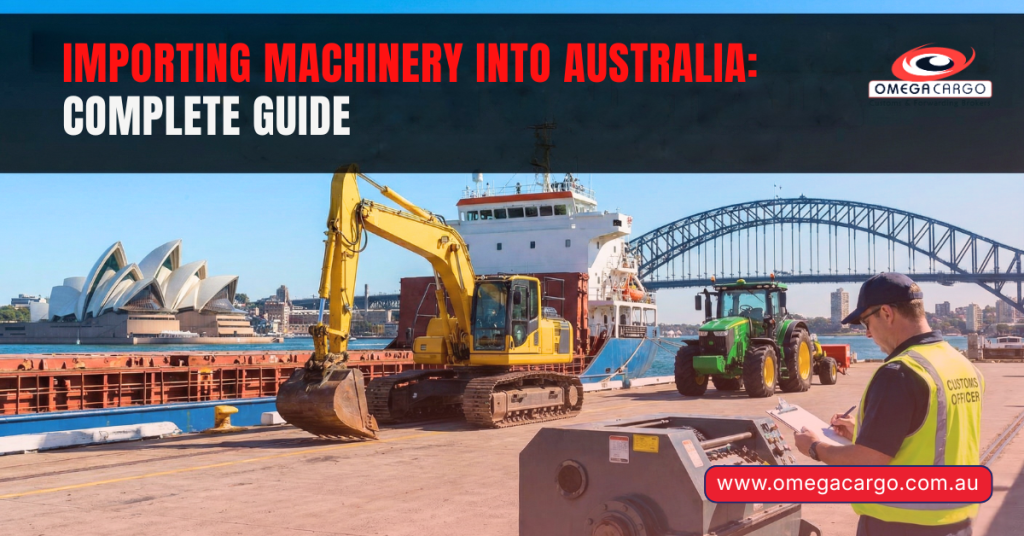
Importing machinery into Australia requires careful planning, compliance with strict quarantine requirements, and understanding of import regulations. Whether you're importing construction equipment, manufacturing machinery, or agricultural tools, navigating customs clearance, biosecurity inspections, and compliance certifications is essential for a successful import.
However, Australia has some of the strictest biosecurity and customs regulations in the world. Get it wrong, and your machinery could be held at the border for weeks, subjected to cleaning fees costing thousands, or even ordered for re-export.
This comprehensive guide covers everything about machinery import Australia—from import duty (typically 5%), GST (10%), and quarantine inspection processes to step-by-step procedures, required documentation, and total cost breakdowns. With machinery import costs ranging from thousands to tens of thousands of dollars depending on equipment value and origin, understanding the process is crucial.
This guide helps Australian businesses successfully import machinery while avoiding costly delays, quarantine failures, and compliance issues.
Can You Import Machinery into Australia?
Yes, Australian businesses and individuals are permitted to import machinery from overseas. There is no general ban on importing industrial or agricultural equipment. However, the process is not as simple as paying for the item and waiting for delivery. The Australian Border Force (ABF) and the Department of Agriculture, Fisheries and Forestry (DAFF) control the entry of all goods.
What Machinery Can Be Imported
You can import almost any type of commercial or industrial machinery, provided it meets safety and biosecurity standards. Common imports include:
- Earthmoving Equipment: Excavators, bulldozers, wheel loaders, and skid steers.
- Agricultural Machinery: Tractors, combine harvesters, seeders, and ploughs.
- Manufacturing Equipment: CNC mills, lathes, laser cutters, and injection moulding machines.
- Construction Gear: Cranes, forklifts, and concrete pumps.
- Forestry & Mining Equipment: Skidders, crushers, and screeners.
Restricted and Prohibited Equipment
While most machinery is allowed, there are strict prohibitions on hazardous materials often found in older or used equipment.
- Asbestos: Australia has a zero-tolerance ban on asbestos. It is illegal to import machinery containing asbestos brake pads, gaskets, seals, or insulation. This is common in older machinery from China or the USA. If found, your machine may be seized and destroyed.
- Ozone Depleting Substances (ODS): Machinery with air conditioning units (like tractor cabs) containing banned refrigerant gases (e.g., CFCs or HCFCs) requires a specific license.
- Non-Compliant Engines: While Australia does not currently enforce strict Tier 4 emission standards on off-road imports as rigidly as the USA or EU, the engine must still meet basic safety and pollution controls.
New vs Used Machinery Regulations
The rules change drastically depending on the condition of the machine:
- New Machinery: Generally easier to import. The biosecurity risk is low, and customs clearance is straightforward.
- Used Machinery: High risk. Used machinery is a primary target for DAFF inspections. It must be cleaned to a "new standard" condition. Any soil, plant matter, or animal debris found will result in the machine being held.
Pro Tip: If you are importing used machinery, you must ask yourself if the savings on the purchase price outweigh the high risk of cleaning and quarantine costs upon arrival.
Machinery Import Requirements Australia
Before you sign a purchase order, you must ensure you can meet the regulatory requirements.
Import Permits and Licenses
For standard machinery (like a brand-new excavator), you generally do not need an import permit. However, exceptions apply:
- Air Conditioning: If the machine has a pre-charged AC unit, you may need an ODSG (Ozone Depleting Substances and Synthetic Greenhouse Gases) equipment license.
- Road Vehicles: If the machinery is mounted on a truck chassis (like a concrete pump truck or mobile crane) and is intended for road use, you will need a Vehicle Import Approval (VIA) under the Road Vehicle Standards (RVS) legislation.
Quarantine and Biosecurity Requirements
This is the most critical hurdle. DAFF requires all machinery to be free of:
- Soil and mud
- Seeds and plant material
- Animal material (feathers, bones, manure)
- Insects and pests (snails, bees, borers)
If your machine arrives with any contamination, it will fail inspection.
Compliance Certifications Needed
While Australia accepts many international standards, you should look for:
- CE Marking: Common on European machinery; generally indicates a good safety standard but does not automatically guarantee Australian compliance.
- ROPS/FOPS: Roll-Over Protective Structures must meet Australian Standards (AS 2294) or ISO equivalents.
- Noise Emissions: Some equipment may require noise testing documentation.
Safety and Electrical Standards
Imported machinery must be safe to use in an Australian workplace under Work Health and Safety (WHS) laws.
- Electrical: If the machine runs on 240V/415V, it must comply with AS/NZS 3000 (Wiring Rules). You may need a local electrician to certify or modify the machine after arrival.
- Guarding: Moving parts must be guarded to Australian standards. You may need to retrofit guards after import.
How Much Does It Cost to Import Machinery to Australia?
Many importers calculate the machine price and shipping but forget the landing charges. Here is the financial reality of importing machinery.
Import Duty Rates on Machinery (5%)
The standard customs duty rate for machinery (classified under Chapter 84 of the tariff) is 5% of the FOB (Free on Board) value.
- Free Trade Agreements (FTA): If you import from China (ChAFTA), the USA (AUSFTA), Thailand (TAFTA), or other FTA partners, the duty rate is often 0%. You will need a valid Certificate of Origin to claim this.
GST on Machinery Imports (10%)
Goods and Services Tax (GST) applies to all imports. It is calculated on the Value of the Taxable Import (VoTI).
- Formula: (Customs Value + Duty + International Transport + Insurance) x 10%.
- Note: If you are a GST-registered business, you can usually claim this back as an Input Tax Credit.
Customs Clearance Fees
You will need to pay for the processing of your declaration:
- Import Processing Charge (IPC): Charged by the government.
- Sea Freight (Value >$10k): Approx. $152 - $200 per declaration.
- Customs Broker Fee: A professional broker will charge between $150 and $300 to handle your paperwork.
Quarantine Inspection Costs
If DAFF orders an inspection (common for used machinery), you pay:
- Inspection Fee: Approx. $60 - $80 per 15 minutes.
- Movement Fees: Moving the container to a bond store/inspection depot ($300+).
Freight and Shipping Costs
- Ocean Freight: Varies wildly. A 40ft container from China might cost $3,000–$6,000 depending on the season.
- Port Charges (Landed Costs): Do not ignore these. Australian ports charge "Terminal Handling Charges" (THC) and "Port Service Charges" which can add $1,500 - $2,500 per container.
Total Cost Breakdown Calculator
Here is an example calculation for importing a Used Excavator from China.
| Cost Item |
Amount (AUD) |
Notes |
| Machinery Price (FOB) |
$50,000 |
Price paid to supplier |
| Ocean Freight & Insurance |
$4,500 |
Cost to ship to Australia |
| Customs Duty (0%) |
$0 |
Assumes ChAFTA applies (otherwise $2,500) |
| Value of Taxable Import |
$54,500 |
Basis for GST calculation |
| GST (10%) |
$5,450 |
Claimable if registered |
| Port Charges & Handling |
$1,800 |
THC, DO fees, Wharfage |
| Customs Broker & IPC |
$450 |
Processing fees |
| Quarantine Inspection |
$600 |
Estimated standard inspection |
| Delivery (Trucking) |
$800 |
Port to your yard |
| TOTAL LANDED COST |
$63,600 |
Approx. 27% on top of purchase price |
Quarantine Requirements for Importing Machinery
This section is where most first-time importers fail. Australia's ecosystem is fragile, and DAFF (Biosecurity) is the gatekeeper.
Why Quarantine Inspection Is Mandatory
Foreign soil can harbour Foot-and-Mouth Disease, Fire Ants, or Nematodes. DAFF has the power to order your machine to be re-exported if it is too dirty to be cleaned safely in Australia.
Biosecurity Risk Assessment
Before the ship arrives, DAFF assesses your paperwork.
- New Machinery: Usually processed on documents only.
- Used Machinery: Almost always flagged for a physical inspection at a Quarantine Approved Premise (QAP).
Cleaning and Fumigation Requirements
- Pressure Washing: All used machinery must be high-pressure washed before shipment.
- Dismantling: You may need to remove protection plates, tracks, and guards to clean internal voids.
- Fumigation (BMSB): If importing from a target risk country (like USA or Europe) between September and April, you must fumigate for Brown Marmorated Stink Bug (BMSB) before shipping.
Soil and Organic Matter Removal
"Clean" implies:
- No grease with embedded soil.
- No dried mud in the tracks.
- No seeds in the radiator.
- No fluid pooling in the engine bay.
DAFF/Biosecurity Australia Inspection Process
- Direction: DAFF issues a direction to move the cargo to an inspection depot.
- Inspection: An officer inspects the machine with a torch and mirror.
- Outcome:
- Pass: Released.
- Fail: Ordered for washing (at your expense).
- Heavily Contaminated: Ordered for re-export (massive cost).
Common Quarantine Failures and How to Avoid Them
- Hidden Soil: Behind the counterweight or inside the chassis rails.
- Plant Material: Dried grass wrapped around axles.
- Solution: Pay for a third-party pre-shipment inspection specifically for biosecurity cleanliness, not just mechanical function.
Step-by-Step Process: How to Import Machinery to Australia
Follow this exact roadmap to avoid costly delays.
Step 1: Research and Compliance Check
Identify the HS Code (Harmonized System) for your machine. Check if it requires an import permit (e.g., for road use) or if it contains prohibited gases.
Step 2: Calculate Landed Costs
Do not guess. Use the calculator logic above. Get a quote from a freight forwarder that includes local Australian charges, not just the freight.
Step 3: Secure the Supplier and Purchase
Pay your supplier. Ensure the contract terms (Incoterms) are clear. FOB (Free on Board) is recommended as it gives you control over the shipping. Avoid CIF if possible, as it hides costs.
Step 4: Arrange Cleaning (If Used)
If the machine is used, hire a professional cleaning crew at the origin. Instruct them to strip the machine and wash every crevice.
Step 5: Book Freight and Forwarding
Engage an Australian freight forwarder. They will book the space on the vessel and act as your agent.
Step 6: Prepare Documentation
Gather the Commercial Invoice, Packing List, and Bill of Lading. Ensure the Packing Declaration is signed.
Step 7: Lodging Customs Declaration
Your Customs Broker will lodge the Import Declaration (N10) with the Australian Border Force and pay the duty/GST on your behalf.
Step 8: Quarantine Assessment
DAFF will review the documents. If required, the container will be flagged for inspection.
Step 9: Arrival and Clearance
The ship docks. The container is moved to a depot. If inspection is passed and duties paid, the goods are released.
Step 10: Transport and Delivery
Arrange a sideloader (for containers) or a low-loader (for large machinery) to deliver the equipment to your door.
Required Documents for Importing Machinery
Missing one piece of paper can stop your shipment.
- Commercial Invoice: Must show the seller, buyer, description of goods, currency, and Incoterm.
- Packing List: Details the weight, dimensions, and contents of each package.
- Bill of Lading (BOL): The official transport document.
- Packing Declaration: Mandatory for sea freight. Declares if straw, timber, or bark is used in the packaging.
- New/Used Declaration: A statement confirming the condition of the goods.
- Cleanliness Declaration: For used machinery, detailing how it was cleaned.
- Fumigation Certificate: Required during BMSB season for certain countries.
- Certificate of Origin: Required to claim 0% duty under an FTA.
Customs Clearance for Machinery Imports
How Customs Clearance Works
Customs clearance is a digital process. Your broker communicates with the Integrated Cargo System (ICS). The system assesses the risk and determines if a physical check is needed.
Do You Need a Customs Broker?
Legally, you can self-lodge. Practically, you should not. The ICS software is complex, and one wrong code can lead to fines. A broker saves you money by ensuring you use the correct Tariff Concession.
Customs Declaration Process
The broker inputs the data ~5 days before arrival. This allows "Pre-Clearance," meaning your goods can move immediately upon discharge if no issues are found.
Duty and Tax Calculation
The broker calculates the exact VoTI. They will send you an invoice for the Duty, GST, and IPC before the goods arrive. You must pay this to the broker (or directly to ABF) to get release.
Customs Hold and Delays
Holds occur if:
- Documents are missing.
- Value seems understated (valuation fraud).
- Random compliance check.
Shipping Methods for Machinery to Australia
Container Shipping (FCL/LCL)
- FCL (Full Container Load): You rent the whole 20ft or 40ft container. Best for protection.
- LCL (Less than Container Load): For small machines (e.g., a single lathe).
- Constraint: The machine must fit inside. You may need to remove the cab or arm of an excavator to fit it in a 40ft container.
RoRo Shipping
- Roll-on/Roll-off: The machine is driven onto the ship.
- Pros: Cheaper for huge machinery; no dismantling required.
- Cons: Higher risk of damage/theft; stricter cleaning requirements (as the machine is exposed).
Break Bulk Shipping
Used for massive static machinery that cannot be driven. It is lifted onto the deck. This is the most expensive method.
Air Freight
Only for urgent spare parts or small, high-value components. Prohibitively expensive for heavy iron.
Choosing the Right Shipping Method
- Small/Medium Excavator: 40ft Container (Dismantled).
- Large Wheel Loader: RoRo.
- Factory Line: multiple FCL containers.
Compliance and Safety Requirements
Once the machine is in Australia, your job isn't done.
- WorkSafe / SafeWork: You have a duty of care. The machine must be fit for purpose.
- Registration: If it drives on the road, it needs state registration (requiring the VIA permit).
- Manuals: Ensure you have English language safety manuals and decals.
Importing Used vs New Machinery: Key Differences
| Feature |
New Machinery |
Used Machinery |
| Purchase Cost |
High |
Low (30-60% cheaper) |
| Duty Rate |
5% (or 0% FTA) |
5% (or 0% FTA) |
| Biosecurity Risk |
Low |
Very High |
| Cleaning Cost |
Minimal |
High ($1,000+) |
| Inspection Chance |
Low (<5%) |
High (>90%) |
| Asbestos Risk |
None |
High (Older machines) |
Importing Specific Machinery Types
Excavators and Earthmoving
- Focus: Tracks and undercarriage. You must loosen the tracks to wash out the mud behind the idlers.
- Buckets: Must be scraped clean of all clay.
Tractors and Farm Equipment
- Focus: Tyres and radiators. Seeds hide in the radiator fins.
- Risk: High biosecurity risk due to farm use.
CNC and Manufacturing Machines
- Focus: Coolant tanks. Old coolant must be drained and tanks wiped dry. Wood crating must be ISPM15 compliant.
Food Processing Machinery
- Focus: Stainless steel must be food grade. No organic residue allowed.
Common Countries for Machinery Imports
China
- Duty: 0% (ChAFTA).
- Volume: Largest source of imports.
- Tip: Verify the steel quality and hydraulic components (look for Japanese pumps in Chinese machines).
USA
- Duty: 0% (AUSFTA).
- Volume: High for heavy mining and John Deere/Caterpillar equipment.
- Risk: BMSB fumigation is mandatory in season.
Europe (Germany/Italy/UK)
- Duty: 5% (unless UK-Australia FTA applies).
- Quality: High-end manufacturing equipment.
- Risk: BMSB fumigation required for most EU countries.
Japan
- Duty: 0% (JAEPA).
- Volume: Excellent source for used low-hour excavators (Grey Imports).
How Long Does It Take to Import Machinery to Australia?
- Production: 30–90 days (if new).
- Shipping (Sea):
- China: 12–20 days.
- USA West Coast: 25–35 days.
- USA East Coast: 40–50 days.
- Europe: 45–60 days.
- Customs/Quarantine: 5–14 days.
- Total: Plan for 3 months from order to operation.
Common Problems When Importing Machinery
- Soil Contamination: The #1 reason for delays.
- Missing Asbestos Declaration: Customs will not clear the goods without a specific declaration stating the goods are asbestos-free.
- Undervaluation: Declaring a $50k machine as $10k to save tax. ABF checks market values; you will be fined and audited.
- Air Conditioning Gas: Importing a machine with charged gas without a license results in the machine being held until a licensed technician degasses it (very expensive).
Do You Need a Customs Broker for Machinery Imports?
Yes. While legally optional, the complexity of machinery classification (Tariff Concession Orders, Bylaws) and the high stakes of biosecurity make a broker essential. A broker might cost $200 but can save you $2,500 in duty by finding the correct concession code.
Temporary Machinery Imports (ATA Carnet)
If you are bringing machinery in for a trade show, demonstration, or a specific short-term project (under 12 months), you can use an ATA Carnet.
- Benefit: No Duty or GST payable.
- Condition: The machine must leave Australia within 12 months.
Tips to Save Money When Importing Machinery
- Use Free Trade Agreements: Always get a Certificate of Origin.
- Ship FCL: If you can fit it in a container, it's safer and cheaper than RoRo.
- Clean Overseas: Cleaning in Australia costs $200/hr + depot fees. Cleaning in China/Thailand costs a fraction of that.
- Buy Ex-Works or FOB: Negotiate better freight rates yourself rather than letting the supplier overcharge you on CIF terms.
Case Studies: Successful Machinery Imports
Case Study 1: The Farm Expansion
- Importer: Wheat Farmer in WA.
- Import: Used John Deere Harvester from the USA.
- Challenge: BMSB season and soil risk.
- Solution: Farmer paid for premium steam cleaning and fumigation in the US ($3k).
- Result: Passed DAFF inspection first time. Saved $120k compared to local used prices.
Case Study 2: The Manufacturing Upgrade
- Importer: Metal Fab Shop in Melbourne.
- Import: New Fiber Laser Cutter from China ($80k).
- Challenge: Large size required Open Top Container.
- Outcome: Broker applied ChAFTA (0% duty). The landed cost was $92k total. The Australian dealer price was $145k.
FAQs About Importing Machinery into Australia
Do I need an import license for an excavator?
Generally, no. Standard earthmoving equipment does not require a specific import license, but it must pass biosecurity checks.
Is there a 5% duty on machinery?
Yes, the general rate is 5%. However, if you import from a country with a Free Trade Agreement (like China, USA, Japan), it is usually 0%.
Can I import a tractor with air conditioning?
Yes, but if the AC contains gas, you need an ODSG license. It is often easier to have the supplier degas the unit before shipping and provide a certificate.
What happens if my machine fails quarantine?
It will be moved to a wash bay. You will be charged for transport, wash bay hire, and labour (approx. $200-$400 per hour). If it cannot be cleaned, it will be exported.
Can I import a car engine or machinery engine?
Yes, but used engines are high risk for oil and fluid leaks. They must be drained and steam cleaned.
Key Takeaways for Importing Machinery to Australia
Importing machinery offers massive cost advantages, but the barrier to entry is compliance.
- Biosecurity is King: Clean your used machinery until it looks new.
- Paperwork Matters: Get your Packing Declarations and Asbestos statements right.
- Calculate Correctly: Factor in the 15-20% on top of the purchase price for landing costs.
- Use Experts: A good customs broker and freight forwarder are investments, not expenses.
By following this guide, you can navigate the complex waters of Australian customs and land your equipment safely, legally, and under budget.
Get a Quote for Your Machinery Import