
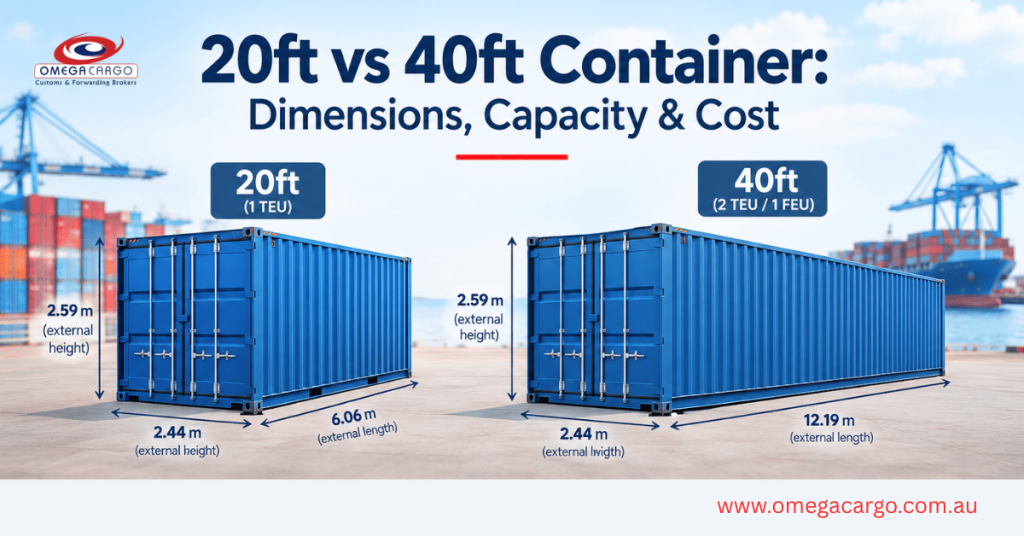
A 40ft container is twice as long as a 20ft. So it holds twice as much and costs twice as much to ship, right? Not quite, on any of the three counts.
If you are weighing up 20ft vs 40ft container options for your next import, the decision usually comes down to three things the brochure figures do not tell you: how your cargo actually packs, how much it weighs, and which charges are billed per box rather than per cubic metre. Get those right and you avoid paying for air, or worse, finding out at the loading dock that your goods do not fit.
So which container is right for your shipment, and how do you know before you book?
This guide walks you through the real dimensions of both containers, the capacity you can actually use, the weight limits that often matter more than space, and the factors that move the cost of each. By the end, you will be able to work out which size suits your cargo and what to have ready when you ask for a quote.
A 20ft container holds roughly 33 cubic metres and suits heavy, dense or smaller loads. A 40ft container holds roughly 67 cubic metres and suits lighter, bulkier cargo. The 40ft gives you about twice the space but carries little more weight, so dense goods often fit a 20ft better. A 40ft rarely costs double to ship, which makes it better value per cubic metre when you can fill it.
Before getting into detail, here is how the two standard dry containers compare side by side. The internal figures below are from Hapag-Lloyd’s published fleet specifications, used here as a representative example; every container varies slightly by manufacturer, so check the plate on the actual box for the exact ratings.
| Specification | 20ft standard (20GP) | 40ft standard (40GP) |
| Nominal external size | 20ft × 8ft × 8ft 6in | 40ft × 8ft × 8ft 6in |
| Internal length | 5,900 mm | 12,032 mm |
| Internal width | 2,352 mm | 2,352 mm |
| Internal height | 2,395 mm | 2,395 mm |
| Door opening (W × H) | 2,340 × 2,292 mm | 2,340 × 2,292 mm |
| Cubic capacity | 33.2 m³ | 67.7 m³ |
| Tare (empty) weight | 2,350 kg | 3,750 kg |
| Maximum payload | 28,130 kg | 28,750 kg |
| Maximum gross weight | 30,480 kg | 32,500 kg |
| Container equivalent | 1 TEU | 2 TEU (1 FEU) |
Source: Hapag-Lloyd 20’ Standard and 40’ Standard specifications. Figures vary between container builds.
Look closely at the bottom half of that table. The 40ft has double the cubic capacity, yet its maximum payload is only a few hundred kilograms higher. That single fact drives most of the decision.
You will see container sizes written in shorthand on quotes, bookings and port statistics.
TEU stands for twenty-foot equivalent unit. One 20ft container equals one TEU. FEU means forty-foot equivalent unit, and one 40ft container equals one FEU, or two TEU.
Carriers and ports use TEU to measure vessel capacity and throughput. On your paperwork, you will more often see the ISO size-type codes: 22G1 for a 20ft general-purpose container and 42G1 for a 40ft. A high cube 40ft appears as 45G1. If you are new to the jargon, our shipping terms and acronyms guide explains the rest.
Container dimensions come in three sets, and each one matters for a different reason.
Standard dry containers are built to the international standard ISO 668, which classifies Series 1 freight containers by their external dimensions and ratings. That standardisation is why any 20ft or 40ft box fits any ship, crane, truck or rail wagon designed for it.
Both standard sizes share the same width and height. Only the length changes. External dimensions matter mainly for transport and site access: whether a truck can reach your loading dock, whether a container fits on your site, and what equipment can lift it.
The internal dimensions tell you what fits inside. Steel walls, corrugations and the floor structure take up space, so the inside is always smaller than the outside.
The figure people forget is the door opening. In a standard container, the door is narrower and lower than the interior: 2,340 mm wide and 2,292 mm high in the example specification above. A crate or machine that would fit inside comfortably can still be blocked at the doorway. If you ship tall items, measure against the door height, not the internal height.
The 40ft high cube (40HC) is the same length and width as a standard 40ft but roughly one foot taller. That extra height lifts usable volume noticeably.
| Specification | 40ft standard | 40ft high cube |
| Internal height | 2,395 mm | 2,700 mm |
| Door height | 2,292 mm | 2,597 mm |
| Cubic capacity | 67.7 m³ | 76.3 m³ |
| Maximum payload | 28,750 kg | 28,600 kg |
Source: Hapag-Lloyd 40’ Standard High Cube specification.
For light, bulky cargo such as furniture, bedding or plastic homewares, the high cube is often the better 40ft choice. The decision is not just 20ft vs 40ft; for many importers, it is 20ft vs 40ft high cube.
Cubic capacity is the volume of an empty box. Your cargo will never fill it perfectly. Cartons do not divide neatly into the internal measurements, pallets leave gaps, and you need space for dunnage, bracing and the door header.
That is why the right question is not “how many cubic metres do I have?” but “how do my packages stack inside this container?” You can calculate your total volume with our CBM and volumetric weight guide, then test it against the internal dimensions.
Hypothetical example. Say you are importing 260 cartons of homewares, each measuring 600 × 400 × 500 mm. Each carton is 0.12 m³, so the order totals 31.2 m³. On paper, that fits a 20ft container with 2 m³ to spare.
Now stack the cartons inside a 20ft with the internal dimensions above:
| Step | Calculation | Result |
| Cartons along the length | 5,900 ÷ 600 | 9 |
| Cartons across the width | 2,352 ÷ 400 | 5 |
| Layers up the height | 2,395 ÷ 500 | 4 |
| Cartons per container | 9 × 5 × 4 | 180 |
Even after trying every carton orientation, a uniform stack takes about 180 cartons, roughly 21.6 m³. Squeezing the remaining 80 cartons into the leftover gaps is not realistic. The order that “fits” a 20ft actually needs a 40ft, where the same carton stacks to about 400 per container, or a 20ft plus the overflow by LCL.
The lesson: work out your packing pattern before choosing the container size. Your supplier or forwarder can produce a load plan from carton dimensions quickly, and it saves a painful surprise at the factory.
Pallet counts are one of the most searched questions in the 20ft vs 40ft container comparison, and also one of the most confused. The answer depends on which pallet you use.
The Australian standard pallet measures 1165 × 1165 mm. Here is the floor-level maths in a standard container:
| 20ft standard | 40ft standard | |
| Pallets across the width (2,352 mm ÷ 1,165) | 2 | 2 |
| Pallets along the length | 5 (5,900 ÷ 1,165) | 10 (12,032 ÷ 1,165) |
| Theoretical floor positions | 10 | 20 |
| Spare width with two pallets side by side | About 22 mm | About 22 mm |
Twenty-two millimetres of total clearance across the width is extremely tight. In practice, loading two Australian pallets side by side with a forklift is difficult, any overhang of cartons beyond the pallet edge breaks the pattern, and many loads end up with fewer positions than the theoretical figure. Some exporters ship on smaller pallets or slip sheets precisely for this reason.
Two practical points follow:
If you use Euro pallets or North American pallets from your supplier, the pattern changes completely, so ask for a load plan based on the actual pallet.
For heavy cargo, weight usually runs out long before space does. This is where a 20ft container often beats a 40ft.
Every container carries a plate showing three weight figures:
Using the example specifications above, a 20ft can carry about 28 tonnes of cargo, and a 40ft about 28.75 tonnes. You get twice the space in the 40ft but only a small increase in carrying capacity, because the box itself weighs more.
If your goods are heavy for their size, such as tiles, stone, steel, machinery parts or bagged minerals, you can reach the weight limit while the container is still half empty. Paying for a 40ft in that situation means paying for space you cannot legally use.
Heavy loads also need to be spread evenly across the floor and secured. A concentrated load in the middle of a long container floor is harder to manage than the same weight in a shorter box. If you are importing equipment, our machinery import guide covers packing and compliance in more detail.
A container’s rating is only half of the story. Once it leaves the wharf, it travels on an Australian truck, and the truck has its own legal limits.
According to the National Heavy Vehicle Regulator, General Mass Limits apply to all heavy vehicles, including individual axles and axle groups, and a loaded vehicle must also stay within the manufacturer’s ratings. A container loaded close to its maximum gross weight may be legal on the ship yet still need a particular truck configuration, a permit or a different route to move by road.
The practical takeaway: tell your forwarder the actual gross weight before booking, not after. The heavier the box, the more the final-mile transport options narrow.
Under Australian law, a container cannot be loaded onto a ship without a declared weight. The Australian Maritime Safety Authority states that the shipper must provide a verified gross mass (VGM) before a container is loaded, and must ensure the gross mass recorded on the shipping documents is accurate. For exports from Australia, that responsibility sits with you as the shipper, so build the weighing step into your plan.
Here is the question most people really want answered: which one costs less? The honest answer is that it depends on your cargo, your route and the charges attached to each box, and those move constantly. What does not change is the set of factors that decide the outcome.
With a full container load (FCL), you pay for the box, whether you fill it or not. A 40ft rarely costs twice as much to ship as a 20ft on the same route. That is why a well-filled 40ft usually works out cheaper per cubic metre, and a half-empty 40ft can work out more expensive than a 20ft.
What moves the ocean freight on either size:
For the full breakdown of what makes up a container shipping bill, see our guide to container shipping cost and rates in Australia.
Many of the costs on the Australian side of the journey are charged for each container rather than by volume. This is the part of the 20ft vs 40ft container calculation that catches importers out.
| Charge | How container size affects it |
| Terminal and wharf handling | Charged per box; a 40ft often costs more per box but less per cubic metre |
| Delivery order and documentation fees | Usually per bill of lading or per container, regardless of size |
| Container cartage from the wharf | Per container; depends on size, weight, distance and equipment such as a side loader |
| Biosecurity inspection or treatment | Applied to each container that is directed for inspection or treatment |
| Wharf storage | Per container per period once free time ends |
| Demurrage and detention | Per container per period once free time ends, under the carrier’s tariff |
| Unpacking and warehouse handling | Depends on cargo type, loading method and volume |
The pattern is simple: each extra box adds another set of per-container charges. That is often why one full 40ft costs less in total than two 20ft containers carrying the same goods.
Container size does not change your customs duty rate. Duty depends on the tariff classification and customs value of your goods. GST, however, has a freight link. The Australian Border Force explains that GST on imports is calculated on the value of the taxable importation, which includes the customs value, any duty, and the cost of transporting and insuring the goods to Australia.
So the international freight cost on your container feeds into the GST base. Choosing the right size does not just save on freight; it nudges your GST figure too. For the mechanics, see our guide to understanding duty calculation.
When the 20ft vs 40ft container choice is close, or you are looking at two 20ft containers as an alternative to one 40ft, the comparison is not just about freight.
| Factor | Two 20ft containers | One 40ft container |
| Cubic capacity | About 66 m³ combined | About 68 m³ |
| Maximum payload | About 56 tonnes combined | About 28.75 tonnes |
| Per-container charges | Two sets | One set |
| Flexibility | Can split delivery to two sites or release one earlier | One delivery point, one unpack |
| Unpacking | Two door ends, two unpacks | One unpack, longer container |
| Best for | Heavy cargo, split destinations, staged spending | Lighter cargo that fills the box |
Two 20ft containers win when the cargo is heavy. Combined, they carry nearly double the payload of a single 40ft. They also make sense when goods are going to two different sites, or when one supplier is ready earlier than another.
One 40ft wins when the cargo is light and fills the space, because you pay one set of per-container charges and handle one delivery.
There is no universal winner in the 20ft vs 40ft container debate, but these patterns hold for most Australian imports:
| Cargo type | Usually suits | Why |
| Tiles, stone, steel, machinery | 20ft | Hits the weight limit before the space limit |
| Bagged goods, beverages, paper stock | 20ft | Dense and heavy for its volume |
| Furniture and homewares | 40ft or 40ft high cube | Light, bulky and awkward to stack |
| Clothing, textiles, bedding | 40ft high cube | Very light, so volume is the only constraint |
| Mixed e-commerce stock | Depends on volume | Often LCL until volume justifies a full box |
| Vehicles | 20ft for one car, 40ft for two or more | Depends on vehicle length and racking |
If you are bringing in bulky homewares, our guide to importing furniture from China to Australia shows how container choice affects the total landed cost. Vehicle importers should also read our guide to importing a motor vehicle to Australia, because the compliance requirements matter as much as the container.
Your container choice also affects what happens after the box clears the port.
Site access. A 40ft container on a truck needs a lot more room to manoeuvre than a 20ft. Narrow driveways, tight industrial estates and low overhead clearances can rule out a 40ft or require a different delivery method. Check your site before you book, not when the truck arrives.
Delivery method. Containers can be delivered on a standard trailer for unpacking at the dock, or placed on the ground by a side loader. Each option has its own space and equipment needs, which our guide to container transport services in Australia explains.
Unpacking. Hand-stacked cartons in a 40ft take far longer to unload than palletised goods in a 20ft. If you do not have the labour or the dock, unpacking at a warehouse and delivering pallets may be more practical. Our warehousing and logistics service handles this step.
Biosecurity. Every container imported into Australia needs to be clean. The Department of Agriculture, Fisheries and Forestry states that a cleanliness declaration is required for all imported containers, and contaminated containers and goods will be treated, with delays and charges applying. Certain goods from target risk countries also face seasonal measures for brown marmorated stink bug during the season DAFF publishes each year. Because these measures apply container by container, the number of boxes you ship matters. When the container arrives, follow our import container check guide before you unpack.
Sometimes the right answer is neither a 20ft nor a 40ft.
LCL (less than container load) lets you share container space with other shippers and pay for the volume you use. For smaller loads, it avoids paying for an empty box. The trade-off is extra handling at consolidation depots and more charges on the Australian side. The point at which a full 20ft becomes cheaper than LCL varies by route and cargo, so compare both quotes. Our guide to LCL vs FCL shipping to Australia covers that decision.
Special equipment covers what standard dry containers cannot:
Use this sequence to settle the 20ft vs 40ft container question before you request a quote:
If you are still between sizes after step five, compare a 40ft against a 20ft plus LCL overflow. It is often the deciding scenario.
Most expensive surprises in a 20ft vs 40ft container decision trace back to one of these:
Yes, most passenger cars fit in a 20ft container. A standard 20ft has about 5.9 m of internal length and a door opening about 2.34 m wide. Measure the vehicle’s length and its width including mirrors, and allow room to secure it. Large utes and four-wheel drives may need a 40ft.
A standard 20ft container can typically carry about 28 tonnes of cargo, but the exact maximum payload is printed on each container’s plate and varies by build. In Australia, road mass limits for the truck carrying the container can restrict the practical weight further, so confirm the gross weight with your forwarder before booking.
A 40ft container typically takes two passenger cars loaded conventionally, depending on their length. With racking systems, more vehicles can fit, but this depends on vehicle size, weight and the equipment used. Each vehicle must still meet Australian import and biosecurity requirements, regardless of how it is shipped.
It depends on whether you are buying, hiring or shipping one. To ship a 40ft container, the cost depends on the route, carrier capacity at the time of booking, seasonal demand, surcharges, and the per-container charges at each end. A shipment-specific quote is the only reliable figure for your cargo.
A standard 20ft container has 10 theoretical floor positions for Australian 1165 × 1165 mm pallets, two across and five along. The width leaves only about 22 mm of spare space, so overhang or forklift loading can reduce the count. Euro and North American pallets follow different patterns, so ask for a load plan based on your pallet.
A standard 40ft container has 20 theoretical floor positions for Australian standard pallets, two across and ten along. Double stacking can increase the count if the combined height fits under the internal ceiling and the lower pallets can bear the weight. Overhanging cartons reduce the count.
No. A 40ft rarely costs double a 20ft on the same route, which is why a full 40ft usually works out cheaper per cubic metre. The gap moves with the trade lane, carrier equipment availability and season, so compare both sizes in the same quote.
A 40ft high cube is the same length and width as a standard 40ft but about one foot taller. That raises internal height from about 2.39 m to 2.70 m and capacity from about 68 m³ to 76 m³. It suits light, bulky cargo where height adds usable space.
For light cargo, one 40ft is usually cheaper because you pay one set of per-container charges. For heavy cargo, two 20ft containers can be the only option, since together they carry nearly double the payload of one 40ft. Compare total landed cost, not ocean freight alone.
Yes. Standard 20ft and 40ft containers share the same external height of about 2.59 m and the same width of about 2.44 m. Only the length differs. High cube versions of either length are about 2.90 m tall externally.
Move to a full 20ft when the LCL cost of your volume, plus the extra handling charges on arrival, approaches the cost of a full container on the same route. That crossover depends on the route, the cargo and the rates available at the time of booking, so request both an LCL and an FCL quote and compare the landed totals.
The 20ft vs 40ft container decision is not about which box is bigger. It is about which box fits your cargo’s weight, packs your cartons efficiently, and keeps the per-container charges in check once the goods reach Australia.
To recap: choose a 20ft for heavy or dense cargo and smaller volumes. Choose a 40ft, or a 40ft high cube, for light and bulky goods that will fill the space. When you are between sizes, test a load plan and compare the total landed cost, not just the ocean freight.
If you are unsure which size suits your next import, our team can work through it with you. Send us your packing list with carton dimensions, gross weight, origin port and delivery address, and we will recommend the right container and prepare a shipment-specific sea freight quote, including customs and quarantine clearance on arrival.


