
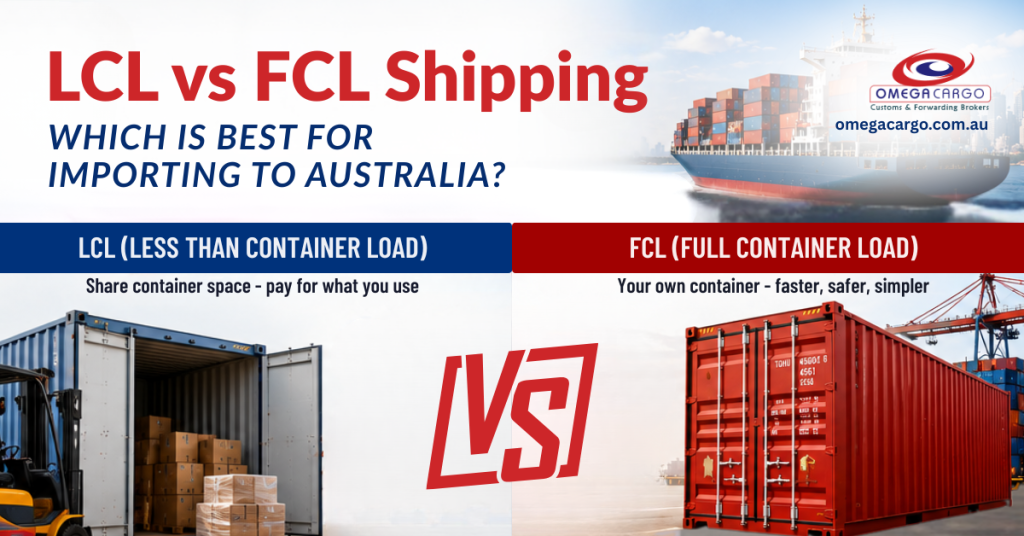
Businesses importing a moderate volume of cargo to Australia via LCL are often paying noticeably more per shipment than they would with an FCL container — simply because nobody told them about the break-even point. The difference between LCL and FCL isn't just about container size. It's about cost, transit time, damage risk, customs complexity and your entire supply chain rhythm. The vast majority of Australia's international trade by volume arrives by sea. It is a massive undertaking that keeps the nation's economy moving. Every day, thousands of steel boxes arrive at major ports in Sydney, Melbourne, Brisbane, and Fremantle, carrying everything from high-tech electronics to everyday clothing. But if you are a business owner or an individual looking to bring goods into the country, you are faced with a crucial decision right at the start line. You have to figure out how to get your products across the ocean efficiently and affordably.
This brings us to the most common question in international logistics: LCL vs FCL Shipping: Which Is Best for Importing to Australia? If you are new to the world of freight forwarding in Australia, or even if you are a seasoned importer looking to optimize your supply chain, the alphabet soup of shipping terms can feel overwhelming. Choosing the right container shipping method can make or break your profit margins, dictate how fast your products arrive, and determine the safety of your goods during transit.
For LCL vs FCL shipping importing to Australia: choose LCL (Less than Container Load) when your shipment is relatively small — you only pay for the space you use. Choose FCL (Full Container Load) once your shipment volume grows large enough that the flat container rate becomes cheaper than LCL's per-CBM charge plus additional CFS fees. On the Australia-specific lane, the break-even tends to sit lower than the global norm because Australian CFS deconsolidation fees run higher than average. Once your shipment is comfortably above that threshold, FCL also tends to win on transit speed, cargo safety and customs simplicity. Always compare all-in door-to-door quotes for both options when your shipment volume is in the borderline range.
If you're importing goods into Australia — whether from China, the USA, Europe or anywhere else — one of the first decisions you make on every shipment is whether to use LCL or FCL. And it's a decision that directly affects your freight cost, your delivery timeline, the safety of your cargo and your customs clearance experience.
The problem is that most importers make this choice once — when they start importing — and then never revisit it. A business that started shipping a small volume of goods per month via LCL might now be shipping considerably more per month and still using LCL, unknowingly paying more per shipment than they need to. Conversely, a business that jumped straight to FCL for a modest shipment is paying for container space they don't need.
In this massive, comprehensive guide, we are going to break down everything you need to know about sea freight to Australia. We will explore the exact definitions of LCL and FCL, dive deep into shipping transit times, uncover the hidden Australian customs duties and destination charges, and give you the exact formulas to calculate which method is cheapest for your specific cargo.
Grab a cup of coffee, and let's dive into the world of Australian imports.
CBM stands for Cubic Metre — the standard unit for measuring LCL cargo volume. Calculate it by multiplying each carton's Length (m) × Width (m) × Height (m). For example: a carton of 0.6m × 0.5m × 0.4m = 0.12 CBM. Multiply that by your number of cartons to get your total shipment CBM. Your total CBM is the starting point for every LCL vs FCL decision.
Before we can compare the two, we need to clearly define what these terms mean in plain, everyday language. When you import goods from China to Australia, or from the USA, Europe, or anywhere else, sea freight is usually the most economical choice. But you don't always need an entire massive steel container all to yourself.
FCL stands for Full Container Load. As the name suggests, when you book an FCL shipment, you are renting an entire shipping container exclusively for your goods. It does not matter if the container is packed to the brim or only half full; the space is entirely yours.
Think of FCL like renting an entire house. You get the keys, you decide which rooms to fill, and no one else is allowed to put their furniture in your living room. You pay a flat rate for the house, regardless of how much stuff you put inside it.
The standard FCL shipping container sizes are:
LCL stands for Less than Container Load. If your shipment is not large enough to fill a whole container, it wouldn't make sense to pay for all that empty space. With LCL, you only rent the specific amount of space your cargo takes up inside a shared container.
Think of LCL like renting a single bedroom in a shared house. You share the overall cost of the house (the container) with other roommates (other importers), and you only pay for the exact square footage (or cubic metres) you use.
In the logistics world, this process is called "consolidation." Your freight forwarder takes your goods, combines them with goods from other businesses heading to the same Australian port, and packs them all into one container at a Container Freight Station (CFS). When the container arrives in Australia, it is unpacked (deconsolidated), and everyone gets their respective goods.
Explore our flexible ocean freight services and see our container size charts here.
Now that we know the definitions, it is time to answer the big question: LCL vs FCL Shipping: Which Is Best for Importing to Australia? The truth is, there is no single "best" answer that applies to everyone. The right choice depends entirely on your unique business needs, the size of your shipment, your budget, and how quickly you need the goods to arrive. Let's break down the four biggest factors that will make this decision for you.
In shipping, volume is king. The size of your cargo is measured in Cubic Metres (CBM). To calculate CBM, you simply multiply the Length x Width x Height (in metres) of your packaged goods.
Your budget plays a massive role in how you ship.
How fast do you need your products on Australian shelves?
How fragile are your goods?
Let's talk about money. Understanding the true LCL shipping cost versus FCL container rates is vital for protecting your profit margins.
It is incredibly important to understand that the "Ocean Freight Rate" you see on a quote is only one part of the puzzle. Importing to Australia involves several local destination charges that can catch new importers by surprise.
LCL rates remain a generally affordable way to get small batches of goods into the country. The cost is calculated per CBM, but the applicable rate depends heavily on the origin, destination, carrier and prevailing market conditions.
Note: These are base ocean rates. You must also account for Origin CFS (Container Freight Station) fees and Destination CFS fees, which apply on both ends of the journey — always request a full breakdown from your freight forwarder rather than relying on the headline per-CBM rate.
FCL container rates to Australia move up and down over time in response to global capacity, fuel costs and demand — they are also subject to peak season fluctuations (such as the rush before major holiday periods).
Because ocean freight rates fluctuate constantly, contact our team for a tailored freight quote reflecting current pricing on your specific route.
This is where many businesses lose their money. When comparing LCL and FCL, you cannot just look at the ocean freight cost. You must look at the "landed cost" — the total price to get the goods to your actual door.
Australian ports are known for having high local charges. When your goods arrive, you will face:
The LCL Cost Trap: While LCL has a cheaper ocean freight rate, the destination handling charges are often higher on a per-unit basis than FCL. Because the shipping line has to manually unpack the container and sort your goods from everyone else's, they charge "deconsolidation fees." Depending on your volume, these deconsolidation fees and higher per-CBM port charges might actually make LCL more expensive overall than simply booking an FCL container — which is exactly why comparing all-in quotes for both options matters.
Need a transparent quote with no hidden fees? Check out our instant freight calculator.
Time is money. If you are waiting on inventory to fulfill customer orders, every day your cargo spends on the water affects your cash flow. Let's look at what actually drives shipping transit times for importing to Australia.
Australia is an island nation, and its major ports are spread far apart. A ship arriving from Asia will usually hit Brisbane first, then travel down the coast to Sydney, then to Melbourne. Ships heading to Perth (Fremantle) usually take a different route directly across the Indian Ocean.
Transit times for FCL vary considerably by trade lane — routes from Asia to Australia's east coast, routes from the US West and East Coasts, and routes from Europe each carry different typical durations, and all are affected by carrier schedules, port conditions and current operational factors. Contact our team for a current transit estimate based on your shipment's specific route.
Because of the nature of LCL, you must add buffer time. The goods have to be collected, consolidated at the origin port, sail across the ocean, get deconsolidated at the Australian port, and then loaded onto a local delivery truck.
You should generally expect LCL to take noticeably longer than the equivalent FCL transit time on the same route — ask your freight forwarder for a realistic estimate based on current conditions.
Whether you choose LCL or FCL, sea freight to Australia is subject to the forces of nature and global events.
Australia has some of the strictest border security and biosecurity laws in the world. As an island ecosystem, the government is fiercely protective against introduced pests and diseases. Understanding Australian customs duties, import taxes, and quarantine rules is non-negotiable.
Formerly known as AQIS, DAFF is the body that inspects incoming cargo. If your goods are made of wood, contain plant materials, or are packed on raw wooden pallets, they will be subjected to intense scrutiny.
If you are importing goods during the DAFF-designated BMSB risk season each year from "target risk countries" (which includes most of Europe, the USA, and parts of Asia), you must comply with BMSB regulations. The stink bug is an agricultural pest that Australia desperately wants to keep out. Always confirm the current season dates and targeted-country list on BICON before shipping, as these are reviewed and can change.
When importing to Australia, you are generally liable for two main taxes:
Note: Goods valued under the applicable low-value threshold (including shipping) are generally exempt from duties and taxes under the Self-Assessed Clearance (SAC) scheme, though this applies more to B2C air freight than commercial sea freight. Always confirm the current threshold and applicable rates with your customs broker.
Speak to our licensed Australian Customs Brokers to ensure your cargo clears smoothly.
Sometimes, the easiest way to understand the LCL vs FCL shipping debate is to look at real-world examples. Let's explore three different businesses importing to Australia and see which method they should choose.
The Business: Sarah runs a Shopify store in Melbourne selling premium yoga mats and activewear. The Shipment: She is ordering her seasonal collection from a manufacturer in Shenzhen, China. The total shipment consists of 20 large cartons. The Math: She measures the cartons. The total volume comes to a modest number of CBM, with a moderate total weight. The Verdict: LCL is the clear winner here. Her volume is nowhere near enough to fill a 20ft container. If Sarah booked an FCL container, she would be paying a substantial amount to ship largely empty space. By choosing LCL, she only pays for the space she actually uses, keeping her landed costs low and protecting her profit margins on the yoga mats.
The Business: David owns a construction supply company in Brisbane. The Shipment: He is importing a large batch of porcelain floor tiles and bathroom fixtures from Italy. The Math: The goods are incredibly heavy and are packed onto standard pallets. The volume alone would suggest LCL, but the weight is disproportionately high because tiles are extremely dense. The Verdict: FCL is the best choice. Even though the volume technically falls under a typical LCL range, the weight changes everything. Ocean freight has weight limits. Because tiles are incredibly dense, an LCL consolidator would charge David based on weight (metric tons) rather than volume, which would be very expensive for a heavy shipment. By booking a 20ft FCL container (which can hold a substantial weight before hitting its limit), David pays a flat rate and saves considerably compared to weight-based LCL pricing.
The Business: Chloe runs a boutique furniture store in Sydney, importing hand-crafted timber furniture from Indonesia. The Shipment: She has ordered a mix of dining tables, chairs, and large cabinets. The Math: Furniture is light but takes up a lot of space, and her total volume is substantial. The Verdict: FCL is the clear winner. At this volume, Chloe has crossed the tipping point. If she ships LCL, the high destination deconsolidation fees in Sydney for a large volume of cargo will wipe out any savings on the ocean freight rate. Furthermore, furniture is easily damaged. By booking a 20ft FCL container, Chloe ensures her fragile timber tables are not packed underneath someone else's heavy auto parts in a shared container. She gets exclusive use, lower per-unit destination fees, and peace of mind.
Ready to start importing? Here is your step-by-step checklist to ensure your cargo moves from the supplier's factory to your Australian warehouse without a hitch.
You cannot get an accurate quote without exact numbers. Ask your supplier for a Packing List. This document must include:
Incoterms (International Commercial Terms) dictate who is responsible for the cargo at what point in the journey.
Reach out to a reputable freight forwarding company in Australia. Give them your packing list and preferred Incoterms. Ask them to quote both LCL and FCL if your volume is anywhere near the borderline range between the two.
Crucial tip: Ensure the quote is "Door-to-Door" or "Port-to-Door" and explicitly includes Australian destination charges like THC, customs clearance, and delivery. Beware of quotes that only show the base ocean freight rate!
If you choose LCL, packaging is everything. Your goods will be moved by forklifts multiple times.
To clear Australian customs, you must have your paperwork in order before the ship arrives. You will need:
Download our free Importer's Document Checklist here.
Beyond cost and speed, there's a third dimension to the LCL vs FCL decision that matters especially for fragile, high-value or sensitive goods: cargo risk. LCL shipments are handled significantly more times than FCL shipments — and every additional handling point creates another opportunity for damage, contamination or loss.
LCL vs FCL — Cargo Risk Comparison for Australia Imports
| Risk Factor | LCL | FCL | Lower Risk |
| Number of handling touchpoints | Multiple (CFS + vessel + CFS + delivery) | Minimal (load + unload) | FCL ✓ |
| Physical damage probability | Higher — more movement, stacking | Lower — sealed from origin to destination | FCL ✓ |
| Contamination risk | Possible — other shippers' goods co-loaded | None — only your goods inside | FCL ✓ |
| Customs delay risk | Any co-loader's issue delays your goods | Only your customs declaration matters | FCL ✓ |
| Theft exposure | Container opened at CFS — higher exposure | Container sealed end-to-end | FCL ✓ |
| Insurance claim complexity | Harder to prove origin of damage | Simpler — container condition on receipt | FCL ✓ |
For fragile goods (glassware, ceramics, electronics), high-value items (luxury goods, precision equipment) or anything susceptible to contamination, FCL's sealed container provides meaningfully better protection than LCL — regardless of volume.
Not Sure Whether LCL or FCL Is Right for Your Shipment?
Omega Cargo's team will quote both options all-in for your specific shipment — so you can see the exact cost difference and make a confident decision every time.
Get Both Quotes → Sea Freight Services
Use LCL When You Should
LCL is almost always cheaper for smaller shipment volumes. You pay only for the space you use, and the all-in cost typically beats even the most affordable FCL option at this scale.
Initial orders, product testing, or market testing. When you're not sure yet how much stock to order, LCL gives you flexibility without committing to a full container.
LCL means lower upfront freight cost even at volumes where FCL would be slightly cheaper overall. If working capital is tight, LCL's lower per-shipment cost can be worth the modest extra per-CBM charge.
Shipping small restocking orders regularly to maintain lean inventory. LCL's flexible scheduling suits businesses that can't wait to accumulate a full container's worth of orders.
Once you're consistently shipping a large volume per shipment, switch to FCL. You'll typically pay less, wait less and have better cargo protection on every shipment going forward.
Electronics, glassware, ceramics, precision equipment, luxury goods. FCL's sealed container eliminates the extra handling risk of LCL. The protection benefit often outweighs the cost difference even for smaller volumes.
Pre-holiday stock, product launches, seasonal goods with a fixed window. FCL's faster transit makes it significantly lower risk for deadline-sensitive imports.
Established importing business with consistent monthly order volumes. FCL simplifies your logistics, gives you more reliable delivery windows and reduces per-unit freight costs as you scale.
LCL looks affordable at the headline per-CBM rate. But there's a set of additional charges that apply specifically to LCL shipments — at both ends — that are often excluded from initial quotes and catch importers off guard when the invoice arrives.
LCL Hidden Charges — Australia Imports
| Charge | Who Charges It | When It Applies |
| Origin CFS Consolidation Fee | Origin freight forwarder / CFS | Every LCL shipment at origin |
| Fuel Surcharge (BAF) | Carrier | Every shipment — added to ocean rate, varies with fuel costs and carrier policy |
| Documentation / B/L Fee | Freight forwarder | Every LCL shipment |
| Australian CFS Deconsolidation | Australian CFS operator | Every LCL shipment at destination (higher in AU than global average) |
| Minimum Charge | Freight forwarder | Tiny shipments — often overpay on very small loads |
| Peak Season Surcharge | Carrier | During peak shipping periods |
| Weight Surcharge | Freight forwarder | When actual weight exceeds volumetric weight (dense goods) |
Always request an all-in door-to-door LCL quote that explicitly includes all of these charges. A quote that only shows the ocean rate per CBM is missing the majority of your actual cost — and will produce a very different invoice from what you expected. Contact our team for a current, itemised quote for your specific shipment.
Use your supplier's packing list to calculate exact CBM (L×W×H per carton, summed). Even a small miscalculation can push you from the LCL side to the FCL side of the break-even. Don't estimate — measure.
When your shipment volume sits in the grey zone between typical LCL and FCL territory, always request full door-to-door all-in quotes for both LCL and FCL from your freight forwarder. The difference can surprise you — and it changes with every market condition shift.
If you have multiple suppliers, your freight forwarder may be able to consolidate all their shipments into one FCL container at an origin CFS — giving you FCL economics even with multiple factories. Ask specifically about buyer's consolidation on your lane.
Shipping smaller volumes more frequently via LCL typically costs more per CBM than shipping a larger volume less often via FCL. If your business can accommodate slightly larger but less frequent orders, the freight savings are significant.
Australian CFS deconsolidation fees are higher than the global average. This means your LCL-to-FCL break-even in Australia tends to sit lower than the figure often cited globally. Factor this into your decision explicitly, and confirm current fee levels with your forwarder.
If your cargo is fragile, high-value or susceptible to contamination, factor in the insurance and replacement cost of potential damage. FCL's sealed container might save you from a damaged-goods claim that costs far more than the freight difference.
Businesses that start on LCL often never switch to FCL even as volumes grow. Put an annual reminder to compare your average shipment volume against the current break-even. A growing business whose typical shipment has grown into FCL territory should switch — saving money they may not even know they're leaving on the table.
FCL Container Size Guide — Australia Imports
| Container Type | Internal Volume | Max Weight | Best For |
| 20ft Standard | Roughly 28–33 CBM usable | Around 21,700 kg | Denser goods, moderate volume shipments |
| 40ft Standard | Roughly 55–65 CBM usable | Around 26,480 kg | Larger volume, lighter goods |
| 40ft High Cube (HC) | Roughly 65–72 CBM usable (taller) | Around 26,280 kg | Tall furniture, equipment, maximum volume |
| Reefer (20ft or 40ft) | Similar to standard, minus cooling unit space | Similar to standard | Perishables, pharmaceuticals, food |
A 40ft container typically costs somewhat more than a 20ft but holds roughly twice the volume — making it a generally better value per CBM for larger loads. If your load is in the higher-volume range, compare a 20ft container plus overflow LCL against a single 40ft FCL, and ask your forwarder for a current cost comparison.
To help you rank and find the exact answers you need quickly, we've compiled the most common questions surrounding Australian sea freight.
LCL (Less than Container Load) means your goods share a shipping container with cargo from other importers. You pay only for the cubic metres your goods occupy, but your shipment goes through consolidation at the origin CFS and deconsolidation at the destination CFS — adding extra days to transit and multiple additional handling points. FCL (Full Container Load) means you rent an entire 20ft or 40ft container exclusively for your goods. You pay a flat rate for the whole container regardless of fill level. The container is sealed at origin, travels directly on the vessel, and is opened only at your destination — giving you faster transit, lower damage risk and simpler customs clearance. For Australian imports, the break-even between LCL and FCL sits in a specific volume range that shifts with prevailing rates, and tends to be lower than the global norm due to Australia's higher CFS deconsolidation fees — ask your forwarder where it currently sits for your route.
There's a general tipping point where the economics flip in FCL's favour, though the exact volume shifts with current per-CBM rates and destination charges. Below that point, LCL is usually more cost-effective; above it, the flat rate of an FCL container — combined with lower local destination handling fees per unit — usually makes FCL the cheaper and safer option. Because this threshold moves with market conditions, request quotes for both options when your volume is anywhere near the borderline.
FCL shipping container rates fluctuate based on global demand, fuel prices, and the origin port. Ocean freight for a 20ft container from major Asian ports to Australia is priced according to current market conditions, and Australian destination charges (customs, port fees, delivery) will add a further amount to your final bill. Contact our team for a current, tailored quote based on your route and container size.
Yes, LCL shipping generally takes noticeably longer than FCL. This is because LCL cargo must be gathered and consolidated into a shared container at the origin port before sailing. Once it arrives in Australia, it must be taken to a specialized warehouse to be unpacked (deconsolidated) and sorted before it can be delivered to you. FCL bypasses these steps entirely. Contact our team for a current transit estimate on your specific route.
The most common "hidden" costs that catch importers off guard are Australian destination charges. These include Terminal Handling Charges (THC), Port Service Charges, Customs Brokerage fees, DAFF (biosecurity) inspection fees, and potentially costly fumigation treatments if your goods arrive during the Brown Marmorated Stink Bug (BMSB) season. Always ask your freight forwarder for a comprehensive quote that includes destination charges.
To calculate Cubic Metres (CBM), measure the dimensions of your package in metres and multiply them together: Length × Width × Height. For example, if a pallet is 1.2 metres long, 1.0 metre wide, and 1.5 metres high, the calculation is 1.2 × 1.0 × 1.5 = 1.8 CBM. If you have several identical pallets, multiply that figure by the number of pallets to get your total volume.
Because LCL involves sharing a container with other businesses, there is a shared risk. If another importer in your container submits incorrect paperwork, tries to import illegal goods, or has wood packaging that fails biosecurity standards, Australian Border Force (ABF) or DAFF may hold the entire container. Your compliant goods will be delayed until the issue with the other cargo is resolved.
The battle between LCL vs FCL Shipping: Which Is Best for Importing to Australia? ultimately comes down to knowing your numbers. If you are shipping small volumes and have a flexible timeline, LCL will save you money on ocean freight. If you are shipping large volumes, heavy goods, fragile items, or need your cargo fast and secure, FCL is the undisputed champion.
Importing from China to Australia, or from anywhere else in the world, doesn't have to be a stressful experience filled with hidden port fees, customs delays, and confusing acronyms. The secret to a smooth supply chain is partnering with a freight forwarding team that knows the Australian landscape inside and out.
You need a partner who will look at your specific cargo, run the math for both LCL and FCL, navigate the strict DAFF biosecurity rules, and provide you with a transparent, door-to-door rate so you can price your products with absolute confidence.
Don't leave your supply chain to chance. If you are ready to streamline your imports, cut out hidden costs, and experience truly seamless shipping to Australia, we are here to help. Our team of logistics experts and licensed customs brokers are ready to analyze your shipment and provide a custom strategy.
Click here to request your tailored, no-obligation shipping quote today, and let us handle the heavy lifting!
The LCL vs FCL decision is never about one being definitively better than the other. It's about matching the right shipping mode to your specific shipment volume, timeline, cargo type and cash flow position at this moment in your business. The rules are straightforward:
For small volumes: use LCL. You'll typically pay significantly less than renting a mostly-empty container, and the extra transit time rarely matters for planned inventory replenishment. For large volumes: use FCL. The flat container rate is typically cheaper per CBM than LCL, you'll generally receive your goods sooner, and your cargo travels sealed with far less handling risk. For volumes in the borderline range: get all-in quotes for both — because on Australia's specific routes with higher CFS deconsolidation charges, FCL can become the better value earlier than you might expect.
LCL vs FCL — Your Quick Decision Checklist
Ready to Find Out Whether LCL or FCL Is Right for Your Shipment?
Omega Cargo provides all-in LCL and FCL quotes for all Australian ports — so you can compare both options and choose confidently. Decades of experience, in-house customs brokers.
Get Your Free Quote → Sea Freight Services
Disclaimer: The figures, thresholds and timeframes referenced in this guide reflect general industry patterns and are provided for planning purposes only. Actual freight rates, transit times, break-even volumes and applicable charges depend on your specific shipment, carrier, route and prevailing market conditions, and are not promised or guaranteed by this article. Always request a current, tailored quote from Omega Cargo or confirm applicable duties, taxes and thresholds with a licensed customs broker before making shipping decisions.


