
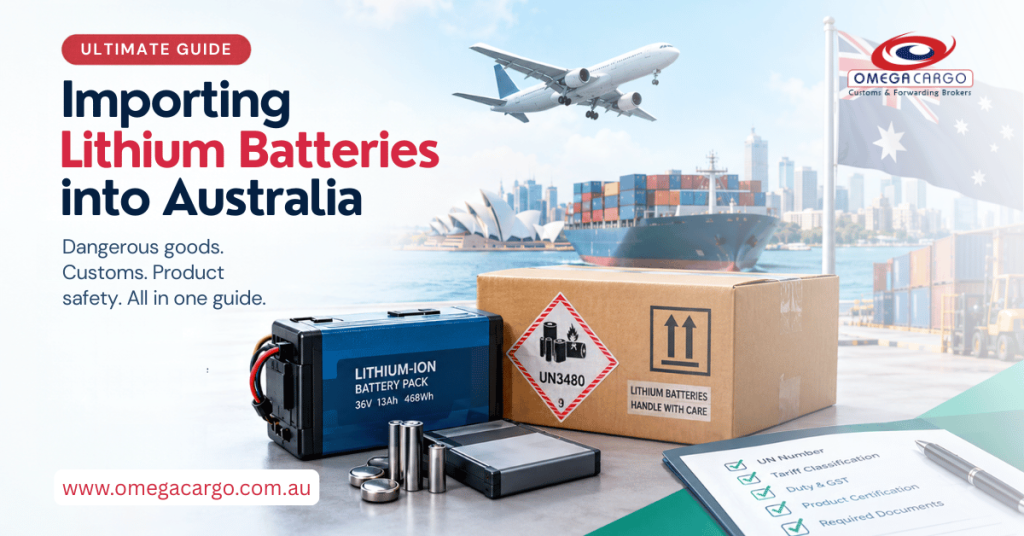
Your supplier has quoted a great price on 500 lithium battery packs, the samples tested well, and the factory says shipping is “no problem”. Then the first forwarder you ask won’t take the booking, the second wants a dangerous goods declaration you have never heard of, and the third asks what state of charge the cells will travel at.
So why does a product sold in every hardware store turn into one of the hardest things to ship?
Because importing lithium batteries into Australia is really three jobs at once. You have to get the batteries moved legally as dangerous goods, cleared through Australian customs with the right tariff classification, and then sold in a way that meets Australian product safety rules, some of which now differ from state to state. Miss any one of those and the shipment stalls at origin, gets held on arrival, or becomes stock you cannot legally sell.
This guide walks you through all three in plain language. By the end, you will know which UN number your batteries fall under, what air and sea carriers need from you, how duty and GST work, which product rules apply to e-bike, home and coin batteries, and what to have ready before you ask for a quote.
Quick answer: Importing lithium batteries into Australia means meeting three sets of rules. In transit, the batteries are Class 9 dangerous goods under the IATA Dangerous Goods Regulations (air) or the IMDG Code (sea). At the border, they need an import declaration with a correct tariff classification so duty and GST can be assessed. After clearance, they must meet Australian product safety law before they are sold.
There is no special federal import licence for new lithium batteries. That surprises a lot of first-time importers, and it is also why so many get caught out. The controls sit in other places: with the airline or shipping line that decides whether to accept the cargo, with the Australian Border Force (ABF) and its tariff, and with the product safety regulators who police what reaches shelves.
The table below shows who is involved at each stage.
| Stage | What is checked | Who sets the rules |
| Origin and transit by air | Classification, packaging, marking, state of charge, Shipper’s Declaration | IATA Dangerous Goods Regulations; Civil Aviation Safety Authority (CASA) under Part 92 of CASR for Australian aviation |
| Transit by sea | Classification, packaging, container packing, dangerous goods declaration | IMDG Code, applied in Australia by the Australian Maritime Safety Authority (AMSA) through Marine Order 41 |
| Arrival and clearance | Import declaration, tariff classification, duty, GST | Australian Border Force; Australian Taxation Office for GST |
| Sale in Australia | Product safety, certification, labelling | ACCC (national), state fair trading and electrical safety regulators |
| Used or waste batteries | Whether the goods are hazardous waste | Department of Climate Change, Energy, the Environment and Water (DCCEEW) |
If you already ship general cargo, the biggest change is the first two rows. If you are new to importing, it is worth reading our wider guide to shipping dangerous goods to Australia alongside this one.
Almost every rule in this guide flows from one question: how are the batteries packed when they travel? Carriers, regulators and customs brokers all start there, so it pays to answer it before you book anything.
| What you are shipping | Typical examples | UN number (lithium-ion) | UN number (lithium metal) |
| Batteries or cells on their own | Replacement e-bike packs, power banks, spare tool batteries, loose 18650 cells, home battery modules | UN3480 | UN3090 |
| Batteries packed in the same box as the equipment, but not installed | A drill with a spare battery in the carton, a scooter with its pack boxed alongside | UN3481 | UN3091 |
| Batteries installed in the equipment | Laptops, phones, cordless tools with battery fitted, Bluetooth speakers | UN3481 | UN3091 |
| Battery-powered vehicles | E-bikes, e-scooters, electric motorbikes | Separate battery-powered vehicle entries apply; confirm with your forwarder | As for lithium-ion |
| Large battery systems built into a shipping container | Containerised energy storage systems | UN3536 (sea) | UN3536 (sea) |
Two terms trip people up here.
Lithium-ion versus lithium metal. Lithium-ion batteries are rechargeable; they power phones, e-bikes and home storage. Lithium metal batteries are usually single-use, such as the CR2032 coin cell in a car key or a smoke alarm. They have different UN numbers and different limits, so the label on the cell matters.
Power banks are batteries, not equipment. A power bank shipped on its own is classified as a lithium-ion battery under UN3480, not as an electronic device. That single point catches out a lot of e-commerce sellers.
Sodium-ion batteries have their own UN entries too (UN3551 on their own, UN3552 in or with equipment). If your supplier is offering “sodium” cells as an alternative, they are still dangerous goods for transport.
The configuration decides which IATA packing instruction applies, whether the shipment can go on a passenger aircraft, whether it is “fully regulated” or qualifies for lighter Section II treatment, and what paperwork the carrier needs. It also feeds into tariff classification, because a battery imported on its own is classified as a battery, while one installed in a speaker is generally classified with the speaker. Get the configuration wrong and everything downstream is wrong with it. If your batteries arrive installed in finished devices, our guide to importing electronics to Australia covers the electrical safety and RCM rules for the devices themselves.
A lithium battery stores a lot of energy in a small space. If it is damaged, short-circuited, overcharged or badly made, it can overheat in a chain reaction known as thermal runaway, which can lead to fire, explosion or toxic gas. Those fires are hard to put out and can reignite.
That risk is real on the ground too. According to the ACCC’s lithium-ion batteries guide, product safety reports to the ACCC about lithium-ion batteries and products containing them rose by almost 600% between 2020 and 2025. In an aircraft hold or a container stack, there is no easy way to fight that kind of fire, which is why the transport rules are strict and why carriers enforce them hard.
All lithium batteries are therefore Class 9 (miscellaneous) dangerous goods for transport. What changes from shipment to shipment is how heavily regulated the particular consignment is.
Air is where the rules are tightest. The airline industry follows the IATA Dangerous Goods Regulations, which mirror the ICAO Technical Instructions and are updated every year. In Australia, CASA regulates the consignment and carriage of dangerous goods by air under Part 92 of the Civil Aviation Safety Regulations, including training requirements for people who prepare dangerous goods for air.
The most useful single reference for importers is IATA’s own Lithium Battery Guidance Document, which summarises the current edition. Here is what it means in practice.
| Rule | What it means for your shipment |
| Passenger aircraft ban | Lithium-ion batteries on their own (UN3480) and lithium metal batteries on their own (UN3090) are forbidden as cargo on passenger aircraft. They must go on cargo aircraft only, which narrows the routes and carriers available. |
| 30% state of charge | Lithium-ion batteries shipped on their own must be offered at no more than 30% of rated capacity. From 1 January 2026, this became mandatory for lithium-ion batteries packed with equipment (UN3481, PI 966) too. For batteries installed in equipment, a reduced state of charge is recommended but not mandatory. |
| Section II limits | Smaller batteries can qualify for lighter “Section II” treatment: lithium-ion cells up to 20 Wh and batteries up to 100 Wh; lithium metal cells up to 1 g and batteries up to 2 g of lithium. Anything larger is fully regulated. |
| UN38.3 test summary | Every cell and battery design must have passed the UN Manual of Tests and Criteria, section 38.3. Manufacturers and distributors must make the test summary available on request. |
| Lithium battery mark | Required on many Section II packages; fully regulated packages carry the Class 9 lithium battery hazard label instead. |
| Shipper’s Declaration | Fully regulated (Section I) shipments need a Shipper’s Declaration for Dangerous Goods, signed by a trained person. |
| Battery-powered vehicles | Vehicles with batteries over 100 Wh must be offered at no more than 30% state of charge (or 25% indicated capacity) unless approved otherwise. |
What this means for you: if you are importing loose battery packs, power banks or spare cells by air, you are shipping one of the most restricted categories in air cargo. Expect fewer carrier options, more checks at origin, and a booking that can be rejected for a single labelling error. Many importers decide that sea freight is the better fit for battery stock, and keep air for samples or urgent replenishment.
Carriers ask for watt-hours (Wh) because it measures how much energy the battery holds. If the label doesn’t show it, you can work it out:
Wh = nominal voltage (V) × rated capacity (Ah)
For example, a 36 V e-bike pack rated at 10 Ah is 360 Wh, which is far over the 100 Wh Section II line, so it is fully regulated. A 3.7 V phone battery rated at 3 Ah (3,000 mAh) is about 11 Wh. Always use the manufacturer’s rated figures, not a seller’s marketing claim.
Sea freight is usually the more practical route for battery stock, but it is not a way around the rules. Lithium batteries remain Class 9 dangerous goods under the International Maritime Dangerous Goods (IMDG) Code. In Australia, AMSA applies that code through Marine Order 41 (Carriage of dangerous goods), which covers dangerous goods in packaged form and the notice required before they are shipped.
In practice, a lithium battery sea shipment needs:
The IMDG Code has its own provisions for smaller cells and batteries, and they don’t line up exactly with IATA’s Section II thresholds. Don’t assume that because a shipment qualified for lighter treatment by air, it will be treated the same way by sea. Your forwarder confirms the provision that applies.
A few points that matter more by sea:
For a broader comparison of the two modes, see our guide to air freight vs sea freight.
Courier companies and postal services set their own acceptance rules for lithium batteries, often stricter than the base regulations. Many will not accept loose lithium batteries at all, and some only accept batteries installed in equipment within tight limits. If your supplier plans to send stock by express courier, check the courier’s own lithium battery policy before the goods leave, not after they are returned to the factory.
For e-commerce sellers bringing in mixed consignments, it is worth planning the battery products separately from the rest of the range. Our e-commerce logistics team can talk through how to split the flow.
When you are importing lithium batteries into Australia, the customs side works like any other commercial import. The ABF’s import declaration guidance explains that importers, or licensed customs brokers acting for them, lodge a declaration to clear goods into home consumption, and that most goods valued at AUD 1,000 or less have no duty, taxes or charges to pay. Above that line, a full import declaration is needed.
The Australian Customs Tariff, Chapter 85, separates rechargeable batteries (accumulators) from single-use ones (primary cells). The general rates the ABF lists for the main lithium lines are below; check the live tariff before you rely on them.
| Tariff item | Description | General rate shown by the ABF |
| 8507.60.00 | Electric accumulators, lithium-ion | 5% (with a free rate listed for certain preference countries) |
| 8507.90 | Parts of accumulators | 5% (with a free rate listed for certain preference countries) |
| 8506.50.00 | Primary cells and batteries, lithium | Free |
Three things can change what you actually pay:
Classification is where many disputes start. Our HS code and tariff classification guide explains how it works, and understanding duty calculation shows how the duty figure is built.
GST applies to most imported goods, including lithium batteries. According to the ATO’s guidance on GST and imported goods, GST is 10% of the value of the taxable importation, which is the sum of:
GST is generally paid before the goods are released. If you are registered for GST and eligible for the deferred GST scheme, you can defer payment to your first activity statement after import, and registered businesses can usually claim the GST back as a credit when the goods are imported for a creditable purpose.
Clearing customs doesn’t mean the batteries are ready to sell. Product safety is the part competitors’ freight guides tend to skip, and it is where requirements have changed the most.
The ACCC states plainly on its lithium-ion batteries guide that there isn’t a mandatory safety standard for lithium-ion batteries or products containing them, and that it is reviewing e-bikes, e-scooters and other e-micromobility devices with a view to regulation. That doesn’t leave importers free of obligations. Under the Australian Consumer Law, goods must be of acceptable quality, which the ACCC notes includes being safe, durable and free from defects. If you import and sell, you are the supplier the law looks to, not the overseas factory.
New South Wales has gone further. According to NSW Fair Trading’s rules for supplying e-micromobility products, e-bikes, e-scooters and similar devices, together with their lithium-ion batteries and chargers, are declared electrical articles under the Gas and Electricity (Consumer Safety) Act 2017. In NSW:
If you are importing e-bike batteries, replacement packs or complete e-bikes for sale anywhere in Australia, assume NSW buyers and retailers will ask for certification, and ask your supplier for the test reports before you place the order. State rules can change, so check the requirements in every state where you sell.
Lithium coin cells, such as the CR2032, are covered by the ACCC’s four mandatory safety and information standards for button and coin batteries. They apply to the batteries themselves and to consumer goods that use them, and they set rules for product design, packaging, warnings and safety information. If you import coin cells for retail sale, or any consumer product powered by them, the packaging and the battery compartment both need to comply before the goods are sold.
Home battery systems carry their own requirements. For a solar battery to be eligible for the Cheaper Home Batteries program, the Clean Energy Regulator says it must be on the Clean Energy Council (CEC) approved battery list, comply with AS/NZS 5139:2019 and state electrical safety laws, and be installed by a Solar Accreditation Australia (SAA) accredited installer with battery endorsement.
That has a direct consequence for importers: a home battery model that is not on the CEC approved list is much harder to sell to Australian households, however compliant the shipment was. Check the listing for the exact model before you commit to stock.
Used batteries are a different category altogether. Australia regulates the import, export and transit of hazardous waste under the Hazardous Waste (Regulation of Exports and Imports) Act 1989, which gives effect to the Basel Convention. The DCCEEW guidance on e-waste says to presume e-waste is hazardous unless you can prove it has no hazardous components or characteristics.
If what you are importing is end-of-life batteries, scrap packs or battery-containing equipment heading for recycling, you may need a hazardous waste import permit before the goods leave origin. The department lists processing timeframes of 40 days for recovery shipments to or from OECD countries and 60 days for others, and those can be extended. Talk to DCCEEW early if there is any doubt about whether your goods are “waste”.
From a transport point of view, damaged, defective or recalled batteries are handled under separate, much stricter provisions, and many carriers will not accept them at all.
If you are importing lithium batteries into Australia for the first time, use this list before you book. Missing documents are one of the most common reasons battery shipments stall, and our guide to document errors that cause customs delays covers the wider picture.
| Document | Why you need it | Who usually provides it |
| UN38.3 test summary | Proves the cell and battery design passed the UN transport tests | Manufacturer |
| Safety Data Sheet (SDS) | Describes the battery chemistry, hazards and handling | Manufacturer |
| Battery specification sheet | Shows voltage, capacity, Wh rating and lithium content | Manufacturer |
| Shipper’s Declaration for Dangerous Goods (air) or dangerous goods declaration (sea) | Declares the dangerous goods to the carrier | Trained shipper or origin agent |
| Container packing certificate (sea, where required) | Confirms the container was packed and secured correctly | Packer at origin |
| Commercial invoice and packing list | Basis for customs value and classification | Supplier |
| Bill of lading or air waybill | Transport contract and evidence of shipment | Carrier or forwarder |
| Certificate or declaration of origin | Needed to claim an FTA preferential rate | Supplier or exporter |
| Product certification and test reports | NSW e-micromobility approval, CEC listing, button battery compliance where relevant | Manufacturer, certifier |
| Hazardous waste permit | Only for used or waste batteries that are controlled | Importer, from DCCEEW |
Lithium battery freight is priced per shipment, and the dangerous goods element adds costs that general cargo doesn’t carry. Rather than a rate that will be out of date next quarter, here is what actually moves the figure.
| Cost driver | Why it moves the price |
| Battery configuration | Batteries on their own (UN3480/UN3090) are the most restricted, which limits carriers and adds handling. Installed batteries are usually simpler. |
| Section I or Section II | Fully regulated shipments need a Shipper’s Declaration, UN-specification packaging and more checks than Section II shipments. |
| Mode and aircraft type | Cargo-aircraft-only capacity is scarcer than general air cargo; sea freight usually suits volume battery stock better. |
| Carrier dangerous goods acceptance | Carriers and consolidators price and accept battery cargo differently, and some routes have fewer options. |
| FCL or LCL | A full container gives control; a shared container depends on the consolidator accepting dangerous goods. |
| Packaging and labelling at origin | UN-specification boxes, marks and labels must be supplied and fitted before pickup. |
| Tariff classification and origin | The classification sets the duty rate; valid proof of origin or a matching TCO can reduce it. |
| GST and its timing | GST is calculated on the value including duty, freight and insurance; deferral changes when you pay it. |
| Insurance | Dangerous goods cover may need to be arranged specifically. |
| Storage and onward delivery | Warehouses and road carriers that accept lithium battery stock may charge for dangerous goods handling. |
The only accurate figure is a shipment-specific quote based on your battery type, Wh rating, quantity, origin and destination.
The same logic applies to timing. Importing lithium batteries into Australia usually takes longer to arrange than general cargo, mostly because of what has to happen before the goods move.
This is a hypothetical example to show the process. It is not a real shipment or customer.
A Sydney retailer wants to import 400 replacement e-bike battery packs from a factory in Shenzhen. Each pack is rated 36 V and 13 Ah.
Step 1: classify. 36 V × 13 Ah = 468 Wh per pack. The packs ship on their own, so they are lithium-ion batteries under UN3480, and at 468 Wh they are well over the 100 Wh Section II limit. That makes them fully regulated Class 9 dangerous goods.
Step 2: choose the mode. By air, UN3480 is cargo aircraft only and must travel at no more than 30% state of charge. For a full order of stock that isn’t urgent, the retailer chooses sea freight and books a full container with a carrier that accepts the cargo.
Step 3: documents. Before paying the deposit, the retailer obtains the UN38.3 test summary, the SDS and the specification sheet. The origin agent prepares the dangerous goods declaration and the container is packed and certified by the packer.
Step 4: product compliance. Because the packs will be sold in NSW, the retailer confirms that each pack model holds a NSW Certificate of Approval and carries the safety approval mark, and that the listed e-bikes they fit are approved with that battery.
Step 5: clearance. The packs are classified as lithium-ion accumulators under 8507.60.00. The customs broker checks whether the goods qualify for a preferential rate under the China–Australia FTA with valid proof of origin, and whether a TCO covers the exact product. GST is calculated on the value of the taxable importation, and the retailer defers it under the deferred GST scheme.
Step 6: delivery. The container is delivered to a warehouse that accepts lithium battery stock, and the packs are stored away from exits and heat sources in line with the supplier’s SDS.
What changes the outcome? A different Wh rating, a decision to fly samples ahead, or packs that lack NSW certification would each change the cost, the timing and whether the stock can be sold at all. If you are clearing through Sydney, our customs clearance team in Sydney handles this kind of entry.
For a wider list, see our guide to common freight shipping mistakes by importers.
You can lodge your own import declaration, but lithium batteries are a product where one wrong entry has consequences in several places at once. A licensed customs broker works out the tariff classification, checks FTA and TCO eligibility, calculates duty and GST, and lodges the declaration. A freight forwarder arranges carrier acceptance, checks that the packaging and paperwork at origin will pass, and books the right air or sea service.
Omega Cargo’s team of licensed customs brokers handles customs and quarantine clearance at Australian ports, and our freight team arranges air freight and sea freight into Australia. If your batteries need storing once they land, talk to us about warehousing and logistics. Tell us at the start that the shipment is lithium batteries, and have the UN38.3 summary, SDS and specification sheet ready, so the quote reflects the real requirements.
Yes. Lithium batteries can be shipped to Australia by air or sea, but they travel as Class 9 dangerous goods. That means correct classification, packaging, marking and documents, and a carrier that accepts the booking. Lithium-ion batteries shipped on their own can’t go on passenger aircraft, so they must fly on cargo aircraft or travel by sea.
No federal import licence is needed for new lithium batteries. You do need to meet dangerous goods transport rules, lodge an import declaration for goods valued over AUD 1,000, and meet product safety rules before you sell. Used or waste batteries are different and may need a hazardous waste permit from DCCEEW.
The ABF tariff shows a general rate of 5% for lithium-ion accumulators under 8507.60.00 and free for lithium primary cells under 8506.50.00. A free trade agreement or a Tariff Concession Order may reduce the duty for eligible goods. Batteries installed in a product follow the product’s classification. Confirm the current rate before you rely on it.
Yes, in most cases. GST is 10% of the value of the taxable importation, which includes the customs value, any duty, and the cost of freight and insurance to Australia. GST-registered importers can usually claim it back as a credit, and eligible businesses can defer payment under the deferred GST scheme.
A power bank shipped on its own is a lithium-ion battery under UN3480, not a piece of equipment. That means it is forbidden on passenger aircraft as cargo and must be shipped at no more than 30% state of charge by air. Power banks are one of the most commonly misdeclared battery products.
Yes, and for volume stock it is often the more practical choice. Sea freight still treats lithium batteries as dangerous goods under the IMDG Code, which AMSA applies through Marine Order 41. You need a dangerous goods declaration, correct packaging and marking, and a shipping line that accepts the cargo.
Under the IATA Dangerous Goods Regulations, lithium-ion batteries shipped on their own by air must be at no more than 30% of rated capacity. From 1 January 2026, the limit also applies to lithium-ion batteries packed with equipment. For batteries installed in equipment, a reduced charge is recommended rather than required.
Yes. Every lithium cell and battery design must pass the UN38.3 transport tests, and the manufacturer or distributor must make the test summary available on request. In practice, forwarders and carriers ask for it before accepting a booking, so get it from your supplier before you pay a deposit.
Yes. Lithium batteries must be packed so they can’t short-circuit, move or be damaged, usually in strong outer packaging. Fully regulated shipments need UN-specification packaging with the correct marks and Class 9 labels, while smaller Section II shipments carry the lithium battery mark. Your forwarder confirms the exact packing instruction.
There is no single mandatory national safety standard for lithium-ion batteries, according to the ACCC. Specific rules apply to specific products: NSW requires certification of e-bike and e-scooter batteries, button and coin batteries have mandatory national standards, and home batteries need CEC listing and AS/NZS 5139 compliance to qualify for government support.
Possibly, but used, scrap or end-of-life batteries may be hazardous waste under the Hazardous Waste (Regulation of Exports and Imports) Act 1989. If they are, you need a DCCEEW permit before they ship. Damaged or defective batteries also face much stricter transport rules, and many carriers refuse them.
It is quoted per shipment. The battery configuration, Wh rating, whether the shipment is Section I or Section II, the mode, carrier acceptance, packaging, duty, GST and insurance together decide what you pay. Batteries shipped on their own by air usually cost the most to move because of cargo-aircraft-only capacity.
Importing lithium batteries into Australia rewards importers who plan. Classify them correctly, collect the test documents before you pay, choose a mode your carrier will accept, and check the product rules for every state where you sell. Do that, and a battery shipment is just another import.
If you would like a hand, send us the battery type, Wh rating, quantity, origin and destination, plus your UN38.3 summary and SDS. Our licensed customs brokers and freight team will look at the classification, the right air or sea option and what to expect at clearance, then come back with a quote built on your actual shipment.


