
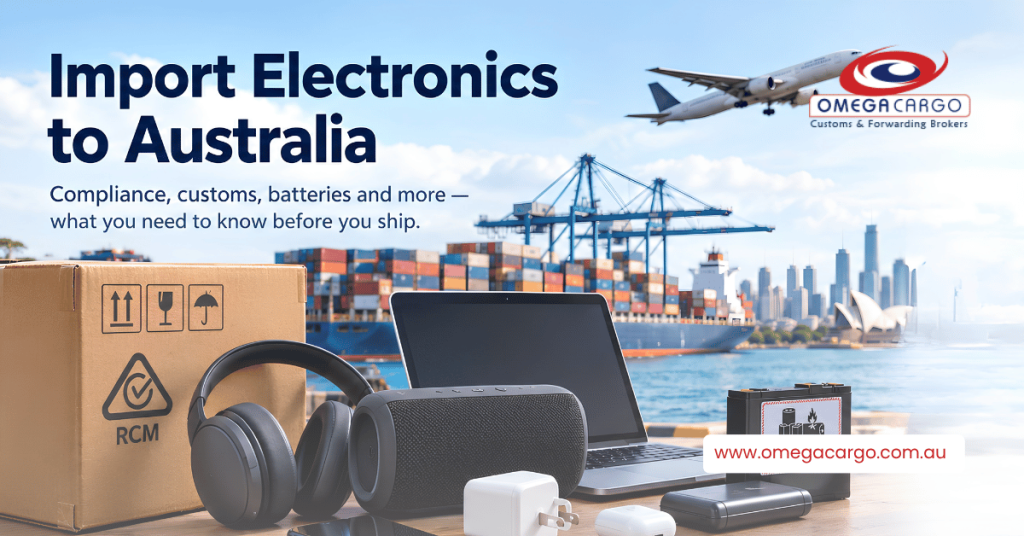
Your supplier has sent the sample, the speakers sound great, and the factory says the paperwork is “all done for Australia”. So why do so many first shipments of electronics end up stuck at the wharf, held at an airline counter, or pulled from sale a few months later?
Because importing electronics to Australia is two jobs, not one. One is moving the goods: freight, customs clearance, duty, GST and biosecurity. The other is proving the product is legal to sell here, and that one belongs to you as the importer, not to the factory. Most problems happen where the two jobs meet. A charger without the right registration. A lithium battery that was never declared. A pallet of televisions that lands in the middle of the stink bug season.
Importing electronics to Australia does not require an import licence, but you do need to meet the product rules before you sell. In most cases that means ACMA compliance and the Regulatory Compliance Mark (RCM), electrical safety rules for mains-powered equipment, correct dangerous goods handling for lithium batteries, a tariff classification for duty, and GST on the value of the goods at the border.
This guide walks through both jobs in the order you will meet them. By the end, you will know which regulator cares about your product, what has to be in place before the goods ship, how duty and GST are worked out, and where the delays and extra costs usually come from.
Electronics sit in an unusual spot. Customs only clears them. Several other regulators decide whether they can be sold, carried or even landed. It helps to see the whole cast before you start.
| Regulator | What it looks at | When it matters |
| Australian Border Force (ABF) | Import declaration, tariff classification, duty, prohibited goods | At the border |
| Australian Taxation Office (ATO) | GST on imports, low value goods, deferred GST | At the border and on your BAS |
| ACMA | Radio, telecommunications and electromagnetic compatibility rules, the RCM | Before you supply |
| EESS and state electrical safety regulators | Electrical safety of mains-powered household equipment | Before you supply |
| ACCC | Consumer product safety, mandatory standards, recalls and mandatory reporting | Before and after sale |
| GEMS Regulator (Energy Rating) | Energy efficiency rules for products such as televisions and monitors | Before you supply |
| Department of Agriculture, Fisheries and Forestry (DAFF) | Biosecurity, including BMSB seasonal measures and packaging | At the border |
| Department of Climate Change, Energy, the Environment and Water (DCCEEW) | Imports of e-waste under the hazardous waste laws | Before shipping used or scrap electronics |
Not every product touches every row. A pair of wired headphones has a far shorter list than a smart television with a mains power supply, Wi-Fi and a remote powered by a coin battery. The skill is working out which rows apply to your product before the factory starts production.
This is the single most important idea in importing electronics to Australia. ACMA treats an importer who brings a product into Australia for sale as a supplier, and it says plainly that this includes online marketplace sellers on platforms such as Amazon and Etsy. The EESS uses the term Responsible Supplier for the on-shore manufacturer or importer who first puts in-scope electrical equipment on the Australian market.
In practice, that means three things for you:
If you take one thing from this guide, make it this: ask “who in Australia is the supplier of record?” before you pay the deposit. If the answer is you, plan the compliance work as part of the product, not as an afterthought.
The Electrical Equipment Safety System regulates the supply chain of in-scope electrical equipment, meaning low voltage equipment for household, personal or similar use.
Under the EESS, equipment is in scope when it is rated above 50 V AC RMS or 120 V ripple-free DC, below 1000 V AC RMS or 1500 V ripple-free DC, and is designed or marketed for household, personal or similar use. The EESS also notes that if a regulator claims an item is in scope, it is treated that way unless the Responsible Supplier can prove otherwise. You can read the full definition on the EESS in-scope equipment page.
That voltage test produces a point many first-time importers miss. A battery-powered gadget may sit below the threshold, but the mains charger, plug pack or power adapter that ships with it often does not. In many electronics orders, the part that needs electrical safety work is the cheapest item in the box.
The EESS sorts in-scope equipment into three risk levels, with requirements that step up as the risk rises.
| Risk level | What it covers | What it means for you |
| Level 1 | Low risk or unknown risk equipment not listed as Level 2 or 3 | Must still be electrically safe, and you must be registered as a Responsible Supplier |
| Level 2 | Medium risk equipment defined in AS/NZS 4417.2 | Equipment registration on the national database is mandatory, plus supporting compliance evidence |
| Level 3 | High risk equipment defined in AS/NZS 4417.2 | Equipment registration is mandatory, with certification required before sale |
Products move between levels from time to time, so check the current Level 2 and Level 3 lists against your exact product rather than relying on a supplier’s summary.
Electrical safety law in Australia is state based. According to the EESS participating jurisdictions page, the intergovernmental agreement has been signed by Queensland, Victoria, Western Australia and Tasmania, with other jurisdictions progressing or considering implementation. If you sell nationally, including online, confirm the requirements with the electrical safety regulator in each state you sell into.
ACMA regulates products that can cause electromagnetic interference, use radio spectrum or connect to telecommunications networks. That covers a large share of modern electronics: anything with Wi-Fi, Bluetooth, mobile connectivity, a wireless charger, or circuitry that could interfere with other devices.
ACMA sets out five steps for suppliers to complete before supplying a product in Australia:
Two details are worth knowing. ACMA says registration is free if your product only has to meet ACMA’s rules, while registration under the EESS attracts fees. And ACMA has audit, investigation and enforcement powers under the Radiocommunications Act 1992 and the Telecommunications Act 1997, ranging from formal warnings to penalties.
You can appoint an Australian agent to help with testing, records and labelling. ACMA is clear that, even then, you might still be ultimately responsible for making sure the product complies.
The RCM is the tick-in-a-triangle mark on compliant Australian electrical and electronic products. It confuses importers because it is shared.
| Question | ACMA | EESS |
| What it covers | EMC, radio and telecommunications compliance | Electrical safety of in-scope household equipment |
| Who is responsible | The Australian manufacturer, importer or agent | The Responsible Supplier (on-shore manufacturer or importer) |
| Where you register | National database (EESS Platform), “ACMA only” option | National database (EESS Platform), supplier plus equipment where required |
| Registration fees | None for ACMA-only products | Fees apply |
| Marking | RCM, applied after steps 1 to 4 | RCM in line with AS/NZS 4417.1 and 4417.2 |
A product can need one regime, the other, or both. A Bluetooth speaker with a mains charger is the classic “both” case: ACMA rules for the radio and the electronics, and electrical safety rules for the charger.
Product compliance decides whether you can sell your electronics. Dangerous goods rules decide whether anyone will carry them. Lithium batteries are dangerous goods for transport, and they are the most common freight problem when importing electronics to Australia.
Under the IATA Lithium Battery Guidance Document, lithium batteries fall into three configurations, each with its own UN number:
| Configuration | Lithium ion | Lithium metal | Plain-English example |
| Batteries shipped by themselves | UN 3480 | UN 3090 | A carton of replacement power banks or loose cells |
| Batteries packed with equipment | UN 3481 | UN 3091 | A drone with a spare battery in the same box |
| Batteries contained in equipment | UN 3481 | UN 3091 | A phone or laptop with the battery fitted |
Four points matter most for an importer:
Sea freight has its own dangerous goods regime under the IMDG Code, so batteries still need declaring when they travel by container. For a deeper look at classes, packaging groups and documentation, see our guide to shipping dangerous goods to Australia.
Some of the rules that catch electronics importers have nothing to do with radio or mains power.
The ACCC has four mandatory safety and information standards covering button and coin batteries and consumer goods that use them. They cover how products and packaging are designed and the warnings that must appear. They apply to remotes, key finders, smart watches, kitchen scales, novelty lights and many other small electronics.
There are exemptions, including audio-visual and information and communications technology equipment where the battery is soldered in place, and certain professional equipment. The standards also apply to second-hand goods sold to consumers. If you are not sure whether your product counts as a consumer good, the ACCC says to assume it falls under the standards unless you have different legal advice.
Televisions are regulated under the Greenhouse and Energy Minimum Standards Act 2012, with minimum energy performance standards and an energy rating label, and the Energy Rating website also lists computer monitors among regulated products. If you import screens, check the GEMS requirements for your product type before you order.
Your obligations do not end when the goods clear. Under the Australian Consumer Law, the ACCC says a supplier must submit a mandatory report within 2 days of becoming aware that a consumer good it supplied caused or may have caused a death, serious injury or serious illness. For electronics with batteries or heating elements, build that into your customer service process from day one.
This is where the commercial invoice turns into a landed cost.
Every imported product is classified under the Australian customs tariff. Most consumer electronics sit in chapter 85 (electrical machinery and equipment), while computers and many data processing devices sit in chapter 84. Duty treatment varies even within a single chapter: the ABF tariff schedule for chapter 85 shows some subheadings with a Free general rate and others with a rate of duty. The code, not the product name, decides what you pay.
Origin matters too. Australia has free trade agreements including ChAFTA with China, AUSFTA with the United States, and others across Asia and the Pacific. The ABF explains that these agreements give access to preferential rates of duty when goods meet the rules of origin, so the right origin evidence from your supplier can change the duty outcome.
For a detailed walk-through, see our HS code and tariff classification guide and our explainer on how duty is calculated.
GST on imported goods is 10% of the value of the taxable importation. The ATO sets out what that value includes:
GST is generally payable before the goods are released. If you are registered for GST and import for a creditable purpose, you can usually claim a GST credit. Eligible GST-registered importers can also apply for the deferred GST scheme, which lets them pay the GST on their activity statement instead of at the border.
The ABF’s buying online guidance explains that goods valued at AUD 1,000 or less generally have no duty, taxes or charges at the border, while goods valued over AUD 1,000 need a full Import Declaration, with a processing charge and duty and taxes to pay. Low value goods arriving by air or sea cargo still need a Self-Assessed Clearance declaration, usually lodged by the freight forwarder or cargo company.
GST does not simply disappear below the line. Since 1 July 2018, overseas sellers of low value goods to Australian consumers may need to collect GST at the point of sale. And for a business, splitting a commercial order into small parcels to stay under the threshold creates its own risks, including a loss of control over compliance and paperwork.
This is the section most electronics guides skip, and it is one of the most practical.
During the brown marmorated stink bug (BMSB) season, DAFF applies seasonal measures to targeted goods manufactured in or shipped from target risk countries. DAFF lists the season as goods shipped between 1 September and 30 April inclusive, based on the shipped-on-board date on the ocean bill of lading. Confirm the dates and country list for the current season before you book, because DAFF reviews the measures as the season runs.
Two things make this relevant to electronics:
DAFF also states that target high risk goods shipped as airfreight from the United States and China during the season are subject to random inspections, though BMSB treatment is not required for them. For sea freight, containerised target high risk goods can be treated offshore by an approved provider or onshore at the container level. Goods that are not targets themselves become subject to the measures when packed with target goods, which matters for mixed LCL consignments.
The practical advice is simple: if you are bringing in electronics from a target risk country during the season, plan treatment with your forwarder before the goods ship, and ask whether the treatment method suits your products and their packaging.
Second-hand electronics bring a different set of questions.
Australia regulates the import of e-waste under the Hazardous Waste (Regulation of Exports and Imports) Act 1989. According to DCCEEW, e-waste includes televisions, monitors, computers, laptops, tablets, mobile phones, printers and components such as circuit boards and drives. The department says you should presume all e-waste is hazardous unless you can prove it has no hazardous components or characteristics, and importing hazardous e-waste generally requires a permit.
The line between a working used product and waste is not always obvious, especially for bulk lots of returned or untested devices. If your shipment includes anything that is not new, test-verified and intended for direct resale, get advice before it leaves origin. Used goods also need to meet the same product safety rules as new ones when sold to consumers, including the button battery standards.
A small number of electronic items fall into restricted territory. The ABF’s list of prohibited items includes categories such as Competition and Consumer Act goods, electromagnetic weapons and directed energy weapons, so check the list if your product emits energy or transmits beyond ordinary consumer use. The ABF also warns that it may seize pirated and counterfeit goods, and that importing and selling counterfeit goods is illegal. Buying “unbranded” versions of famous products from marketplace suppliers is a common way to end up with a seized shipment.
Both modes work for electronics. The right choice depends on the product, the batteries and how quickly you need the stock.
| Factor | Air freight | Sea freight |
| Best suited to | High-value, low-volume stock, samples, urgent replenishment | Larger volumes, heavier goods, planned stock |
| Lithium batteries | Strictest rules; loose batteries limited to cargo aircraft | Still dangerous goods under the IMDG Code, but more options for volume |
| Security and handling | Fewer handling points | More handling points, especially in LCL consolidation |
| BMSB season | Random inspection for target goods from the USA and China | Mandatory treatment for target goods from target risk countries |
| What drives the price | Chargeable weight, volumetric weight, carrier capacity, DG surcharges | Container type, utilisation, route, carrier capacity, origin and destination charges |
For a broader comparison, read our guide to air freight vs sea freight, and our explanation of CBM and volumetric weight, which decides how a light but bulky electronics shipment is charged.
There is no standard price for importing electronics to Australia, because each shipment combines a different product, route, mode and set of compliance steps. These are the variables that move the number:
| Cost driver | Why it varies |
| Product price and Incoterms | Whether your supplier’s price includes export clearance, freight or insurance changes what you still have to pay |
| Freight mode and volume | Air is priced on chargeable weight; sea on container type and how well you fill it |
| Dangerous goods handling | Batteries can add declaration, packaging and handling requirements |
| Customs duty | Depends on tariff classification and whether an FTA preference applies |
| GST | Calculated on the customs value plus duty, freight and insurance |
| Compliance work | Testing, registration and labelling under ACMA and the EESS, usually a one-off per model |
| Biosecurity | BMSB treatment, inspection or packaging issues, depending on origin and season |
| Storage and delivery | Port, depot or warehouse time, plus delivery to your premises or customers |
| Insurance | Electronics are high value and theft-prone, so cover matters more than for many goods |
Your Incoterms are worth agreeing early, and freight insurance is worth a serious look for any high-value electronics consignment. A landed-cost assessment for your specific product and route is the only way to get a reliable figure.
Lead time when importing electronics to Australia is shaped by a handful of factors:
If something goes wrong at the border, our guides to the customs inspection process and document errors that cause customs delays explain what happens next.
This is a hypothetical example to show the reasoning, not a real customer shipment.
A Perth retailer wants to import a container of portable Bluetooth speakers from Shenzhen. Each speaker has a built-in lithium ion battery and ships with a USB mains charger.
The lesson: one simple product touched six different rule sets. Every one of them was cheaper to deal with before production than after arrival.
| Document | Who usually provides it | Why it matters |
| Commercial invoice | Supplier | Customs value, description and origin for duty and GST |
| Packing list | Supplier | Matches cartons to contents for clearance and inspection |
| Bill of lading or air waybill | Carrier or forwarder | Shipment evidence; the bill of lading date sets BMSB timing |
| Certificate or declaration of origin | Supplier or exporter | Supports an FTA duty preference |
| Test reports | Supplier or testing laboratory | Evidence for ACMA and EESS compliance |
| Declaration of conformity | You or your agent | Required ACMA record, signed by the supplier of record |
| UN 38.3 test summary | Battery or product manufacturer | Required for lithium battery transport |
| Dangerous goods declaration | Shipper | Required for fully regulated battery shipments |
| BMSB treatment certificate | Approved treatment provider | Needed for target high risk goods treated offshore |
You can handle parts of this yourself. Plenty of importers do their own ACMA registration with help from a testing laboratory. Where things go wrong is usually in the hand-offs: the battery classification that was never passed to the airline, the BMSB treatment nobody booked, or the tariff code copied from a supplier’s invoice.
A licensed customs broker classifies the goods, applies any FTA preference, lodges the Import Declaration and calculates duty and GST. A freight forwarder plans the route around the batteries, books dangerous goods capacity, arranges BMSB treatment where needed and gets the goods to your door. When one team does both, there are fewer gaps for a problem to fall through.
Omega Cargo’s customs and quarantine clearance team includes licensed customs brokers who handle classification, valuation advice, landed costing and duty and GST across air, sea and e-commerce shipments. We also move electronics by air freight and sea freight, and our e-commerce logistics and warehousing services support online sellers once stock lands.
No. The ABF states there is no requirement for importers to hold an import licence. What you do need is to meet the product rules that apply to your electronics, such as ACMA compliance, electrical safety rules and battery transport rules, plus any permits for restricted goods, before the goods are sold or shipped.
In most cases, yes. ACMA says generally all products it regulates need a label to show compliance, and the EESS requires in-scope electrical equipment to carry the RCM. You can only apply it after completing the compliance and registration steps, and an overseas mark such as CE does not replace it.
No. ACMA states that an overseas mark does not mean a product complies with its rules or can carry the RCM. In some cases, international test reports can help show compliance, but you still need to complete the Australian steps, including the declaration, registration and labelling, as the supplier of record.
The importer. ACMA treats a business that brings a product into Australia for sale as a supplier, including online marketplace sellers. The EESS calls the on-shore importer the Responsible Supplier. Your factory can supply test reports, but the legal obligations sit with you in Australia.
Usually, yes, but the rules depend on how the batteries are packed. Batteries contained in or packed with equipment ship as UN 3481 or UN 3091, while loose batteries ship as UN 3480 or UN 3090 and are forbidden on passenger aircraft. State of charge limits and the UN 38.3 test summary also apply.
GST is 10% of the value of the taxable importation. According to the ATO, that value is the customs value plus any customs duty, plus the cost of transport to Australia and the insurance for that transport. GST-registered businesses can usually claim a GST credit, and eligible importers can defer GST to their activity statement.
It depends on the tariff classification and the country of origin. Rates vary even within chapter 85 of the tariff, with some subheadings Free and others carrying duty. A free trade agreement such as ChAFTA can reduce duty when the goods meet the rules of origin and you hold the right evidence.
Goods valued at AUD 1,000 or less generally have no duty, taxes or charges at the border, according to the ABF. However, overseas sellers to Australian consumers may collect GST at the point of sale, and low value goods arriving by air or sea cargo still need a Self-Assessed Clearance declaration.
Yes. Chapter 85 electrical equipment and chapter 84 machinery are BMSB target high risk goods. If they are manufactured in or shipped from a target risk country during the season, they need mandatory treatment. China, Japan and Korea are listed as emerging risk countries, where goods may be randomly inspected.
You can, but check carefully first. DCCEEW says e-waste should be presumed hazardous unless proven otherwise, and importing hazardous e-waste generally requires a permit. Used goods sold to consumers must also meet product safety rules, including the ACCC button battery standards.
You may not be able to sell them until they comply, and regulators such as ACMA can issue warnings or penalties. Products that are unsafe can face recalls under the Australian Consumer Law. Fixing compliance after arrival usually means relabelling, retesting or re-exporting, which is why the work belongs before production.
Not always, but for commercial shipments over the A$1,000 threshold, a licensed customs broker lodges the Import Declaration, classifies the goods, applies FTA preferences and calculates duty and GST. For electronics, a broker who also understands dangerous goods and BMSB measures can prevent the most common delays.
The safest approach to importing electronics to Australia is to plan in the right order: product compliance first, battery and freight planning second, and customs clearance last. If you are weighing up a new product line or your first container, our team can talk through your classification, batteries, mode and route, and prepare a shipment-specific quote. Have your product specifications, supplier invoice and battery details ready, and Request a freight and customs quote for your electronics shipment.
This guide is general information only. Requirements change, so confirm current rules with the relevant regulator or a licensed customs broker before you rely on them.


