
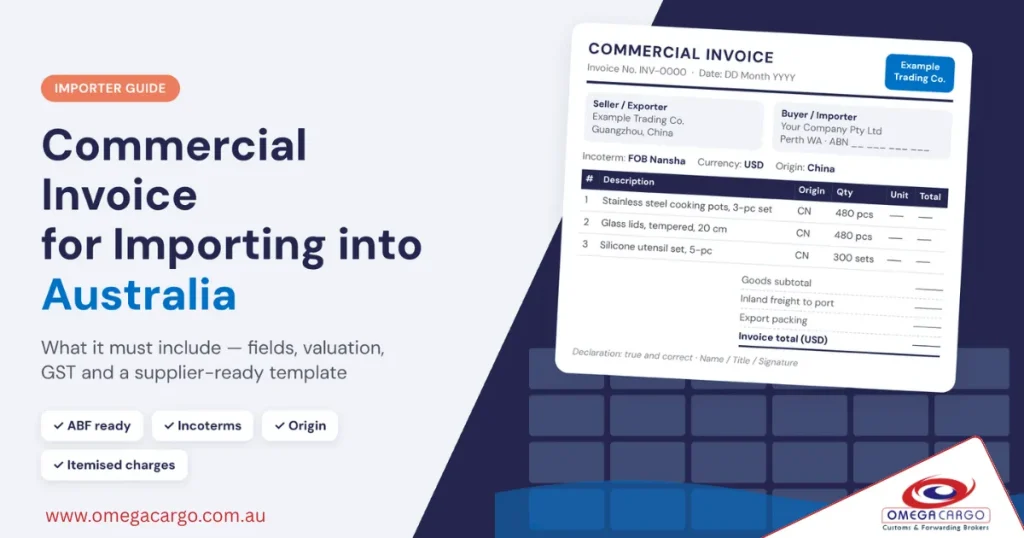
Your goods are packed, the booking is confirmed and the supplier has emailed “the invoice”. But is it the right invoice — and would it survive a question from the Australian Border Force?
For most Australian importers, the commercial invoice is the document that decides how smoothly clearance goes. Your customs broker builds the import declaration from it. The ABF relies on it to check value and origin. Biosecurity officers may read packaging statements printed on it. When the invoice is vague, incomplete or doesn’t match the rest of your paperwork, the questions start, and your container sits at the wharf while they get answered.
This guide explains what a commercial invoice is, exactly what it should include for an Australian import, how the numbers on it flow into duty and GST, and how it differs from a proforma invoice, a tax invoice and a packing list. You’ll also get a field-by-field template layout you can send to your supplier, plus a pre-dispatch checklist.
A commercial invoice for importing into Australia should identify the seller and the buyer, describe each item clearly, and show quantity, unit price, total price, currency, Incoterm, country of origin and any extra charges such as freight, insurance, packing, commissions or royalties. Your customs broker uses these details to classify the goods, work out the customs value and lodge the import declaration.
A commercial invoice is the document the overseas seller issues to the buyer for goods sold in an international transaction. It records the parties, the goods, the quantities, the price, the currency and the terms of sale. In Australia, it is the primary commercial evidence your customs broker uses to prepare the import declaration and to support the customs value declared to the Australian Border Force.
Think of it as the bridge between the commercial deal and the border. The sales contract lives between you and your supplier. The invoice turns that deal into facts officers can check.
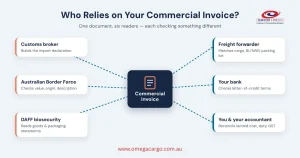
More people read your invoice than you might expect. Each one is looking for something different.
| Who reads it | What they use it for |
| Your licensed customs broker | Building the import declaration — description, tariff classification, customs value, origin and Incoterm |
| Australian Border Force (ABF) | Checking that the declared value, origin and description are correct, and asking for documents when something doesn’t add up |
| Department of Agriculture, Fisheries and Forestry (DAFF) | Reading the description of goods and, where provided on the invoice, packaging and other biosecurity statements |
| Your freight forwarder | Matching the cargo to the booking, the bill of lading or air waybill and the packing list |
| Your bank (letter of credit trades) | Checking the invoice against the credit terms before releasing payment |
| You and your accountant | Reconciling landed cost, duty and GST against what was paid to the supplier |
The ABF’s import declaration guidance lists commercial documents (invoices) among the papers you must bring when lodging a declaration in person, and states that you must keep all relevant documents for five years after the declaration is made. Most declarations are lodged electronically by brokers, but the invoice still sits behind every line of the entry.
Not every consignment goes through the same declaration. According to the ABF, goods arriving by air or sea cargo with a value of AUD 1,000 or less are generally cleared on a Self-Assessed Clearance (SAC) declaration, while consignments valued over AUD 1,000 that are entering home consumption need a full Import Declaration (N10), with duties, taxes and charges paid before release. Tobacco and alcohol are treated differently regardless of value.
Either way, the value on your invoice is what decides which path the goods take, so accuracy matters for small shipments too.
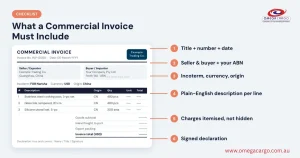
There is no single government-issued commercial invoice form that every supplier must use. What matters is that the invoice carries the information your broker needs to make an accurate declaration and that the ABF and DAFF need to verify it. The table below is the working checklist we suggest Australian importers send to every new supplier.
| Field | What to show | Why it matters for an Australian import |
| Document title | The words “Commercial Invoice” | Separates the final invoice from a proforma, quote or packing list |
| Invoice number and date | A unique reference and the issue date | Links the invoice to the payment, the bill of lading and the declaration |
| Seller / exporter | Legal name, full address, contact details | Identifies the party that sold the goods; needed for valuation and origin checks |
| Buyer / importer | Your legal entity name, Australian address and ABN | The ABN identifies you on the import declaration and links to GST |
| Consignee and notify party | If different from the buyer | Prevents confusion when the receiver isn’t the purchaser |
| Description of goods | Plain-English description: what it is, what it’s made of, what it’s used for, brand and model | Drives tariff classification, permit checks and biosecurity assessment |
| Tariff (HS) code | The supplier’s export code, if known | A useful starting point; your broker confirms the Australian classification |
| Quantity and unit of measure | Number of units, cartons, kilograms or litres per line | Must reconcile with the packing list and transport document |
| Unit price and line total | Price per unit and total per line | The base for the customs value |
| Invoice total and currency | Total amount and the currency code | Converted to AUD at the exchange rate for the day of export |
| Incoterm and named place | For example, FOB with the named port, or EXW with the named factory | Shows which costs are inside the price and which are not |
| Other charges, itemised | Freight, insurance, inland transport, packing, tooling, commissions, royalties, discounts | Each charge can be treated differently when customs value and GST are worked out |
| Country of origin | Where the goods were made or produced, per line if mixed | Determines duty rates, free trade agreement eligibility and labelling checks |
| Marks and numbers | Shipping marks, carton numbers, container or seal numbers | Lets officers find the right goods during an examination |
| Weights | Net and gross weight, ideally per line | Must match the packing list and bill of lading or air waybill |
| Payment terms | For example, telegraphic transfer, letter of credit or open account | Supports the transaction value and helps explain any later adjustments |
| Declaration and signature | A statement that the information is true and correct, with name and title | Adds accountability; required in specific situations (see the FAQ) |
Make sure the buyer on the invoice is the legal entity that’s importing the goods — the same name and ABN your broker will put on the declaration. The ABF’s import requirements page notes that if you have an ABN, you need to supply it when formally entering goods, and that you need to be registered for GST and hold an ABN to claim input tax credits or use GST deferral. A trading name on the invoice and a company name on the declaration is a common, avoidable mismatch.
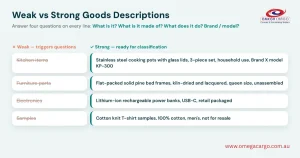
This is where most invoices fall short. “Parts”, “accessories”, “samples” or “general merchandise” tell an officer nothing. A good description answers four questions: what is it, what is it made of, what does it do, and what brand or model is it?
| Weak description | Strong description |
| Kitchen items | Stainless steel cooking pots with glass lids, 3-piece set, household use, Brand X model KP-300 |
| Furniture parts | Flat-packed solid pine bed frames, kiln-dried and lacquered, queen size, unassembled |
| Electronics | Lithium-ion rechargeable power banks, 10,000 mAh, USB-C, retail packaged |
| Samples | Cotton knit T-shirt samples, 100% cotton, men’s, assorted sizes, not for resale |
The material and use matter because Australian tariff classification is self-assessed by the importer under the Customs Tariff Act 1995, and the ABF can impose penalties for incorrect or misleading information. Your broker can only classify what the invoice describes. For a deeper look at how classification works, see our HS code and tariff classification guide.
Every line needs a unit price and a line total, and the invoice needs a clear total and a currency code. Don’t leave the currency to guesswork — a “$” sign could mean US, Australian, Hong Kong or Singapore dollars.
The Incoterm tells your broker what the price covers. An FOB price includes delivering the goods onto the vessel at the named port of export. An EXW price stops at the seller’s premises, so inland transport in the exporting country sits outside it. A CIF or DAP price includes international freight. If you’re not sure what each term means in practice, our Incoterms explainer walks through them.
Ask your supplier to list every charge on its own line rather than rolling it into the unit price: international freight, insurance, inland freight to the port, packing, tooling or moulds, design work, commissions, royalties and any discounts. This isn’t a formality. Under the ABF’s customs valuation fact sheet, inland freight and insurance to the place of export and overseas packing costs form part of customs value, while international freight and insurance from the place of export to Australia do not. If those charges are blended together, your broker can’t separate them correctly.
State where the goods were made or produced — not where they shipped from. A product made in Vietnam and shipped through a consolidator in China is of Vietnamese origin. Origin affects duty, eligibility for a preferential rate under a free trade agreement, and the ABF’s trade description and labelling checks. To claim a preferential rate, the goods must meet the rules of origin for that agreement; the invoice alone may not be enough proof. Our guide to free trade agreements for Australian importers explains what’s usually needed.
Carton marks, numbers and weights should line up exactly with the packing list and the bill of lading or air waybill. If customs or biosecurity officers need to examine the goods, these details are how they find the right cartons quickly. For what an examination looks like, see our article on the customs inspection process in Australia.
DAFF doesn’t require every invoice to be stamped and signed, but its documentary policies do apply to commercial documents. DAFF’s Minimum documentary and import declaration requirements policy explains that invoices only need to be endorsed when they’re used to carry biosecurity or imported food statements — for example, where an import permit condition or a BICON case allows a statement to be made on the invoice — while minimum requirements apply to all commercial documents.
DAFF’s Non-commodity information requirements policy also lists the invoice, alongside the packing declaration and packing list, as a place where the unacceptable packaging material statement can be made. If your supplier puts packaging statements on the invoice, they need to be complete and worded to DAFF’s requirements. When in doubt, ask your broker which document should carry each statement.
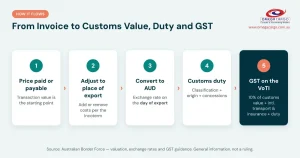
The figures on your invoice don’t go straight onto your duty bill. Your broker adjusts and converts them first. Understanding the chain helps you see why itemised charges and a clear Incoterm matter so much.
The ABF explains that the most common valuation method is transaction value, which is based on the price actually paid or payable for the goods, subject to certain adjustments. A major condition is that any relationship between buyer and seller hasn’t influenced the price. When transaction value can’t be used, the ABF works through alternative methods.
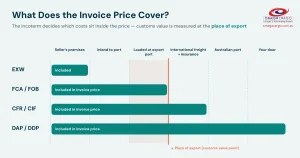
Customs value is measured at the place of export. That’s why the Incoterm matters: it tells your broker whether the invoice price stops before, at or after that point.
| Incoterm on the invoice | What the invoice price usually covers | Typical adjustment for customs value |
| EXW (Ex Works) | Goods at the seller’s premises | Inland transport and handling to the place of export are generally added |
| FCA / FOB | Goods delivered to the carrier or loaded at the port of export | Usually the closest match to customs value |
| CFR / CIF | Goods plus international freight (and insurance under CIF) to Australia | International freight and insurance are separated out of customs value |
| DAP / DDP | Delivery to a named place in Australia | International freight, Australian-side costs and (under DDP) duties are separated out |
This is a general guide, not a ruling. The ABF notes that valuation can be complex and recommends advice from a customs broker or the ABF itself. Related-party purchases, royalties, assists and commissions all need specific treatment.
The ABF’s exchange rate guidance states that customs value must be expressed in Australian dollars and that foreign currency is converted at the rate prevailing on the day the goods are exported — not the day they arrive. That’s one reason the invoice date and the shipped-on-board date both matter.
Duty depends on the tariff classification, the origin and any concession or free trade agreement that applies. GST is then worked out on a wider base. According to the ABF’s GST and other taxes page, GST on imported goods is 10% of the value of the taxable importation, which is the sum of:
So even though international freight and insurance sit outside customs value, they come back into the GST calculation. If your invoice hides freight inside the unit price, both figures can end up wrong. Eligible GST-registered businesses may be able to defer GST to their Business Activity Statement — our guide to the import GST deferral scheme explains how it works, and our page on understanding duty calculation covers the duty side.
Example (hypothetical): A Perth homewares retailer buys stainless steel cookware from a factory in Guangzhou on EXW terms, invoiced in US dollars. The supplier’s first draft shows one lump-sum price with “including delivery to port” in the notes. The broker can’t tell how much of the total is inland transport, so it asks for a revised invoice with the goods price, the inland trucking to Nansha port and the export packing each on separate lines.
With that, the broker adds the inland and packing costs to the goods price to reach customs value, converts it at the rate for the day of export, and keeps the ocean freight separate for the GST calculation. One email to the supplier before dispatch avoids a query after arrival.
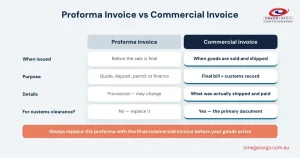
A proforma invoice is a preliminary document a seller issues before the sale is final — often as a quote, a basis for a deposit, or to support a letter of credit or import permit application. A commercial invoice is the final record of the goods actually sold and shipped. Customs clearance should be based on the final commercial invoice.
| Proforma invoice | Commercial invoice | |
| When it’s issued | Before the sale is final or before goods are produced | When the goods are sold and shipped |
| Purpose | Quote, deposit request, permit or finance application | Final bill and the commercial record for customs |
| Can details change? | Yes — prices, quantities and dates are often provisional | It should reflect what was actually shipped and paid |
| Used for customs clearance? | Not as the final basis for the declaration | Yes — the primary commercial document behind the declaration |
| What to do with it | Keep it with your purchase records | Send it to your broker before the goods arrive |
The classic mistake is a supplier sending the proforma as the shipping document and never issuing the final invoice. If quantities or prices changed after the proforma, the declaration can be wrong from the start. Our post on common documentation errors that cause customs delays covers this and other paperwork traps in more detail.
Importers often confuse these documents, especially when Australian accounting software calls everything an “invoice”.
| Document | Who issues it | What it’s for | Key point for importers |
| Commercial invoice | Overseas seller | Records the international sale for customs, payment and accounting | The primary commercial document behind your import declaration |
| Tax invoice | Australian GST-registered supplier | Supports GST credits on Australian taxable sales | An overseas supplier’s commercial invoice is not an Australian tax invoice; GST on imported goods is paid to or deferred through the ABF |
| Proforma invoice | Seller, before the sale is final | Quote or advance bill | Not a substitute for the final commercial invoice |
| Packing list | Seller or shipper | Shows how goods are packed — cartons, contents, weights, dimensions, marks | Must match the commercial invoice line by line |
The ATO’s tax invoices page sets out the details an Australian tax invoice must show, such as the seller’s ABN and the GST amount. Those rules are about domestic supplies, which is why the commercial invoice and the tax invoice do different jobs.
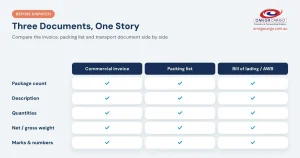
The invoice tells officers what was sold and for how much. The packing list tells them where everything is. They need to agree on:
The same figures should also match the bill of lading or air waybill. When the invoice says one quantity and the packing list says another, officers have to work out which is correct — and that question usually comes with a hold.
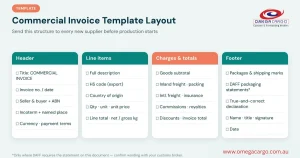
You don’t need a special form. Most suppliers generate invoices from their own systems, and that’s fine as long as the information is there. If a supplier is new to exporting to Australia, send them a layout like this and ask them to follow it.
Header
| Field | Example entry |
| Title | COMMERCIAL INVOICE |
| Invoice number / date | INV-[number] / [day month year] |
| Seller / exporter | [Legal name, full address, phone, email, export registration number if applicable] |
| Buyer / importer | [Your legal entity name, Australian address, ABN] |
| Consignee / notify party | [If different from the buyer] |
| Purchase order number | [Your PO reference] |
| Incoterm and named place | [For example, FOB Shanghai] |
| Currency | [USD / CNY / EUR / AUD] |
| Payment terms | [For example, 30% deposit, 70% before shipment by telegraphic transfer] |
| Transport | [Vessel and voyage or flight; port of loading; port of discharge] |
Line items
| Line | Description (what, material, use, brand/model) | HS code (export) | Country of origin | Qty | Unit | Unit price | Line total | Net / gross weight |
| 1 | [Full description] | [Code] | [Country] | [Qty] | [Pcs/ctn/kg] | [Price] | [Total] | [kg / kg] |
Charges and totals
| Item | Amount |
| Goods subtotal | [Amount] |
| Inland transport to port | [Amount or “included” with explanation] |
| Export packing | [Amount or “included”] |
| International freight | [Amount, if within the Incoterm] |
| Insurance | [Amount, if within the Incoterm] |
| Commissions / royalties / tooling | [Amount, if any] |
| Discounts | [Amount, if any] |
| Invoice total | [Amount and currency] |
Footer
Keep the layout, not just the template. Ask your broker to review the first invoice from any new supplier before the goods ship — fixing a template once is far cheaper in time than fixing every shipment after arrival.
Goods supplied at no charge still need a customs value. The ABF’s fact sheet on free-of-charge goods explains that where there’s a contract of sale, the total value is apportioned across all goods — including the free ones. Where there’s no contract of sale, as with many samples, transaction value can’t be used and an alternative method applies. Ask your supplier to list free items on the invoice with a realistic value and a clear note, such as “no commercial value — sample, not for resale”, rather than leaving them off.
If you buy from a parent company, subsidiary or business with shared ownership, tell your broker. Transaction value can only be used where the relationship hasn’t influenced the price, so related-party invoices may need supporting information.
When one container holds goods from several suppliers, or one supplier issues several invoices for one shipment, each invoice still needs to be complete. Make sure the totals across invoices reconcile with the packing list and the house bill of lading.
Online sellers bringing in stock often deal with many small consignments. Even when a consignment falls under the AUD 1,000 SAC threshold, the description and value still need to be accurate, and permits or biosecurity requirements can still apply. Our e-commerce logistics service is built around that kind of flow.
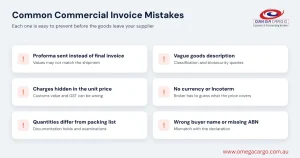
These are the issues we see most often on Australian imports. Each one is easy to prevent before the goods leave the supplier.
| Mistake | What happens | How to prevent it |
| Proforma sent instead of the final invoice | Declared values or quantities may not match what was shipped | Ask for the final commercial invoice before the vessel or flight departs |
| Vague goods description | Classification queries, permit checks or biosecurity referrals | Use what, material, use and brand/model on every line |
| Freight, packing or tooling hidden in the unit price | Customs value and GST calculation can be wrong | Itemise every charge on its own line |
| No currency or Incoterm | Broker has to guess what the price covers | Show the currency code and Incoterm with the named place |
| Undervalued or “for customs” price | Penalties for incorrect information and possible further investigation | Invoice the price actually paid or payable |
| Quantities that don’t match the packing list | Documentation holds and possible examination | Cross-check invoice, packing list and bill of lading before dispatch |
| Wrong buyer name or missing ABN | Mismatch with the declaration and GST records | Use your exact legal name and ABN |
| Free goods left off the invoice | Goods arrive that aren’t declared | List them with a value and a clear note |
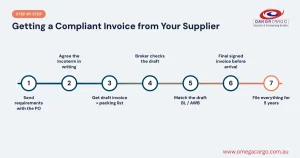
You can lodge your own declarations, but the ABF itself encourages first-time or infrequent importers to use a licensed customs broker. A broker is worth involving early when:
A broker reviewing the invoice before the goods ship is one of the simplest ways to reduce queries at the border. If you want to understand where a broker’s job ends and a forwarder’s begins, see what a customs broker does, and for the full sequence from lodgement to release, our customs clearance step-by-step guide.
A commercial invoice is the final bill an overseas seller issues for goods sold internationally. It records the seller, buyer, goods, quantities, prices, currency, Incoterm and country of origin. In Australia, your customs broker uses it to prepare the import declaration and support the customs value declared to the Australian Border Force.
A standard invoice requests payment for goods or services. A commercial invoice does that too, but it also carries the details customs needs for an international shipment — country of origin, Incoterm, tariff code, weights, marks and itemised charges. For an import into Australia, the commercial invoice is the version your broker needs.
The seller or exporter normally issues it, because it records their sale to you. As the importer, you’re responsible for making sure it’s accurate, so it’s worth telling your supplier exactly what you need before they ship and having your broker review the first invoice.
Yes. A tax invoice is an Australian GST document issued by a GST-registered supplier for a taxable sale in Australia, showing details such as the seller’s ABN and the GST amount. A commercial invoice records an international sale. GST on imported goods is paid to, or deferred through, the ABF at the border.
A proforma invoice is a preliminary quote or advance bill issued before the sale is final. A commercial invoice is the final record of what was actually sold and shipped. Customs clearance should be based on the final commercial invoice, so always replace the proforma before your goods arrive.
There’s no single rule for every shipment. DAFF requires invoices to be endorsed when they carry certain biosecurity or imported food statements, and many suppliers and carriers include a signed declaration by default. Asking your supplier to sign and date every commercial invoice with a name and title is a sensible standard.
It depends on the Incoterm. Under EXW or FOB, international freight usually sits outside the invoice price. Under CFR, CIF, DAP or DDP, it’s included. Either way, ask your supplier to show freight and insurance as separate lines, because they’re treated differently for customs value and GST.
Any currency agreed with your supplier, as long as the currency code is shown clearly. The ABF converts customs value into Australian dollars at the exchange rate prevailing on the day of export, not the day the goods arrive, so the invoice currency and shipping dates both matter.
Low-value air and sea cargo of AUD 1,000 or less is generally cleared on a Self-Assessed Clearance declaration rather than a full import declaration, but the goods still need an accurate description and value. Carriers and brokers usually ask for an invoice or similar document to support that declaration.
No. The commercial invoice shows what was sold and for how much. The packing list shows how the goods are packed — cartons, contents, weights, dimensions and marks. They work as a pair, and the quantities, descriptions and weights on both should match the bill of lading or air waybill exactly.
The ABF states that after an import declaration is made, you must keep all relevant documents for five years. That includes commercial invoices, packing lists, transport documents, permits and proof of payment. Store them so you can produce them quickly if the ABF asks.
Yes, a supplier can issue a corrected invoice, but it usually means the declaration has to be reviewed or amended and the goods may be held while that happens. It’s far easier to have your broker check a draft invoice before dispatch than to fix it after arrival.
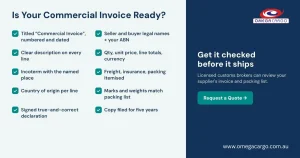
A complete, consistent commercial invoice won’t make every clearance instant, but it removes the most common reason importers end up answering questions while their cargo waits. The best time to fix an invoice is before it leaves your supplier’s office.
Omega Cargo’s licensed customs brokers can review your supplier’s invoice and packing list, advise on documentary requirements and handle the declaration through our customs and quarantine clearance service. If you’re also booking the freight, we can coordinate sea freight or air freight so the documents and the cargo move together.
Have your supplier’s draft invoice, packing list and the Incoterm handy, then request a customs clearance quote or talk to our customs team.
This guide is general information, not legal or tax advice. Import requirements can change, so confirm current requirements with the ABF, DAFF or a licensed customs broker before you ship.


