
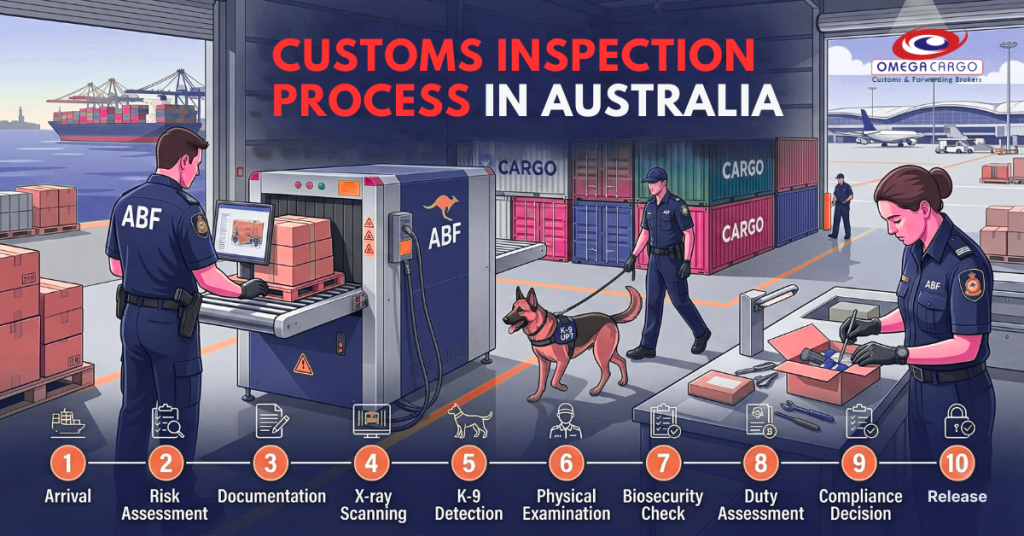
Every shipment that crosses the Australian border is risk-assessed, but only some are pulled aside for a closer look. If your goods have been held or you simply want to avoid surprises, understanding the customs inspection process in Australia helps you prepare better paperwork, set realistic expectations and respond quickly if the Australian Border Force (ABF) or biosecurity officers want to examine your cargo.
This guide explains how customs inspection works from arrival to release: who carries out inspections, what triggers them, the ten stages most shipments move through, the methods officers use, and what happens if a problem is found. It is written for Australian importers, e-commerce sellers, manufacturers and anyone receiving goods from overseas.
If you want the wider picture of clearance itself, read our step-by-step guide to customs clearance in Australia. This article focuses on the inspection side of that process.
The customs inspection process in Australia is the set of checks government officers use to confirm that goods, mail and baggage entering the country comply with Australian law. It confirms that goods are correctly declared, that the right duty and GST are paid, and that no prohibited, restricted or biosecurity-risk items get through.
An inspection can be as simple as an electronic review of your documents, or as involved as a full container being unpacked, item by item, at an examination facility.
The Australian Border Force (ABF) is the main agency responsible for customs control at airports, seaports and international mail centres. It works alongside the Department of Agriculture, Fisheries and Forestry (DAFF), which manages biosecurity. In practice, a single shipment can be checked by the ABF for customs compliance and by DAFF for pests, diseases and contamination.
The ABF's powers come mainly from the Customs Act 1901, while DAFF's biosecurity powers come from the Biosecurity Act 2015. Goods under customs control can be stopped, held, opened and examined. If you are wondering whether customs can open your package, the answer is yes: officers do not need your consent to examine goods crossing the border.
Inspections protect Australia's community, economy and environment. They help stop illegal drugs, weapons, counterfeit goods and agricultural pests from entering the country. They also support fair trade by making sure importers pay the correct duty and GST rather than undercutting compliant businesses.
Every consignment entering Australia goes through some form of risk assessment, whether it is a full container of machinery or a small online order. What changes is how deep the inspection goes, and that depends heavily on how the goods arrive.
Container cargo is reported to the ABF before the vessel arrives, so risk assessment starts early. If a container is flagged, it may be X-rayed or moved to a container examination facility, where officers break the seal, unpack some or all of the cargo and check it against the declaration. Moving and unpacking full containers takes more coordination than any other inspection type. Our sea freight team can help coordinate container movements around an examination.
Air cargo is screened with a strong focus on security. Shipments are often urgent or high-value, so documents are checked electronically and goods may be scanned or examined at the airport cargo terminal. Compliant shipments with complete paperwork are generally released more quickly than those needing follow-up. Learn more about our air freight services.
Express couriers report shipment data electronically before goods land, which helps the ABF assess risk in advance. Courier parcels are still subject to X-ray, detector dog screening and physical checks, so a vague description or missing invoice can hold up an otherwise fast delivery.
International mail is processed at mail centres where items pass through X-ray machines and detector dog screening on conveyor systems. Only a small share of parcels is physically opened, usually because of an X-ray image, a dog alert or a declaration issue.
Arriving travellers complete an incoming passenger declaration. Based on your answers, risk profiling and detector dog activity, you may be directed straight to the exit or to a baggage inspection area, where officers check declared items, duty-free allowances and biosecurity risks.
One of the most common questions importers ask is what triggers a customs inspection. The ABF uses a risk-based targeting approach rather than checking everything in the same way. These are the main factors that can put your shipment in the spotlight.
Cargo and declaration data flow through the ABF's Integrated Cargo System (ICS), where it is assessed against risk profiles and intelligence. Shipments that match higher-risk indicators are referred for documentary checks, scanning or physical examination.
Even a fully compliant shipment can be selected at random. Random checks help the ABF test compliance across the whole import population, so being selected does not mean you have done anything wrong.
Vague descriptions such as "gift", "parts" or "samples", declared values that look unusually low, handwritten or inconsistent documents, and poor packaging are common triggers for a closer document review.
The ABF works with domestic and international partners. If a sender, receiver, address or supply chain is linked to intelligence about illegal activity, an intelligence-led inspection becomes much more likely.
Importers with past undeclared goods, incorrect classifications or failed biosecurity checks can expect more frequent targeted inspections on future shipments.
Goods from origins or routes associated with drug production, counterfeiting or specific pests and diseases are treated as higher risk.
Some goods attract more scrutiny by nature, including electronics, pharmaceuticals, food, plant and animal products, timber and wooden items, and anything that could be counterfeit.
If the weight, quantity or description on the bill of lading or air waybill does not match the commercial invoice and packing list, the shipment is likely to be held until the difference is explained.
If a scan shows something unexpected, such as a hidden compartment, unusual density or organic material that was not declared, officers will usually move to a physical examination.
When narcotics or biosecurity detector dogs show interest in a parcel, bag or container, a physical check normally follows.
Many of these triggers are within your control. Our guides to common customs clearance delays in Australia and how to speed up customs clearance explain how to avoid the most frequent ones.
Not every shipment goes through every step below. A low-risk, well-documented consignment may move from risk assessment straight to release, while a flagged container could pass through all ten. Knowing the sequence helps you understand where your goods are and what you may be asked for.
The shipping line, airline, courier or postal operator reports the cargo to the ABF, ideally before arrival. The goods are manifested, and the data enters the ABF's electronic systems. Your customs broker then lodges the import declaration for the consignment.
The Integrated Cargo System screens the cargo report and declaration against risk profiles and intelligence. This decides whether the shipment can be cleared without intervention or needs further checks.
Officers may review the commercial invoice, packing list, bill of lading or air waybill, certificates of origin and any import permits. They check the tariff classification (HS code), the declared value and the origin claimed for any preferential duty rate.
Many shipments are scanned. X-ray and CT scanners show the density and shape of the contents, so officers can spot anomalies without opening the goods.
Detector dogs trained to find narcotics, explosives, currency or biosecurity risks may screen parcels, baggage or cargo. An alert usually leads to a physical examination.
If the shipment is flagged, officers open the package or container. They compare the contents with the declaration, count and inspect items, take photographs and may take samples for testing.
DAFF biosecurity officers check for pests, soil, seeds, plant and animal material, and confirm that timber packaging meets the ISPM 15 standard. Goods subject to import conditions are checked against their permit and documents.
The ABF confirms the tariff classification and customs value, and duty, GST and any other charges are calculated. Goods are generally not released until these amounts are paid.
Officers review the results of every check and confirm that permits and conditions have been met before deciding whether the goods can be released.
Possible outcomes include release, a hold while you provide more information, biosecurity treatment, re-export, seizure of prohibited goods, or destruction where the risk cannot be managed. Once released, your transport provider can collect the goods for delivery.
Officers combine several methods depending on the risk, the type of goods and the way they arrived.
The paperwork check is the foundation of every clearance. Officers look at your commercial invoice, packing list, transport document and certificates. Missing HS codes, vague descriptions and figures that do not match across documents are among the most common reasons for delays.
How does customs check packages without opening them? Non-intrusive scanning. X-ray images show differences in density, helping officers tell organic materials such as food or drugs apart from metals and other inorganic materials. CT scanners produce three-dimensional images that make complex packages easier to read.
When something needs a closer look, officers open the goods, check their condition and quantity, and search for concealed items. Officers repack goods after examination, but the shipper and importer remain responsible for packaging that can withstand handling.
Detector dog teams screen baggage, mail and cargo for narcotics, explosives, firearms, currency and biosecurity risk material. Their speed makes them valuable in busy airports and cargo terminals.
If officers suspect a substance, they may swab surfaces or use handheld analysers and vapour detection equipment to test for narcotics, explosive residues and prohibited chemicals. Samples can also be sent for laboratory analysis.
DAFF officers carry out visual and, where needed, microscopic examination focused on pests, contamination and disease risk. If they find live insects, seeds, soil or non-compliant timber, they can direct treatment such as fumigation, export or destruction of the goods.
During an inspection, officers are trained to spot specific risks, including:
A simple way to picture risk-based clearance is as three broad pathways. These are not official ABF labels, but they reflect how shipments are generally handled:
Where a shipment lands depends on factors such as the supplier and importer history, the goods and their HS codes, the origin, and the quality of the declaration. Correct classification makes a real difference to how your shipment is assessed.
A common worry for importers is how long a customs inspection takes in Australia. There is no fixed answer. Inspection and clearance times depend on how the goods arrived, the type of check selected, whether a biosecurity inspection is also needed, how complete your documents are and how busy the port, airport or mail centre is. A shipment cleared electronically with no intervention is usually released far sooner than one that needs a physical examination.
| Shipment type | What usually happens | What can extend the timeframe |
|---|---|---|
| Express courier | Data is reported before arrival and most low-risk parcels clear without intervention | Missing invoices, vague descriptions, X-ray anomalies or a detector dog alert |
| Air freight | Electronic document checks, with scanning or examination at the cargo terminal if flagged | Permit requirements, classification queries, biosecurity checks or a full physical examination |
| Sea freight (FCL or LCL) | Electronic risk assessment, with X-ray or transfer to an examination facility if selected | Moving and unpacking containers, deconsolidation of LCL cargo, biosecurity treatment and terminal congestion |
| International mail | Conveyor X-ray and detector dog screening at a mail centre | Physical opening, missing declarations or restricted items |
| Passenger baggage | Declaration review and risk profiling on arrival | Referral to secondary inspection or undeclared goods |
For a shipment-specific estimate, contact your broker once the goods are reported. Our guide on how long customs can hold a package explains what to expect if your goods are already waiting.
Being selected for inspection can bring extra charges, and these are usually borne by the importer. Depending on the shipment, they may include additional transport to and from an examination facility, unpacking and repacking, terminal storage, container detention or demurrage, biosecurity inspection fees and any treatment such as fumigation.
How much you pay depends on the shipment size and type, the kind of examination, where the goods are held, how long the inspection takes and the service providers involved. Complete, accurate paperwork is the best way to reduce the chance of these costs.
If you would like help preparing a shipment so it is less likely to be held, request a tailored quote from Omega Cargo and our customs team will review your requirements.
Australia's natural environment and agricultural industries are highly vulnerable to exotic pests and diseases, which is why biosecurity inspection is one of the strictest parts of the import process.
The Department of Agriculture, Fisheries and Forestry works alongside the ABF to manage biosecurity risk at the border. Its officers inspect goods, containers and packaging for pests, contamination and disease. Import conditions for specific goods are listed in BICON, DAFF's biosecurity import conditions system.
Declaring food, plant material, animal products, timber items or used equipment such as machinery, vehicles or outdoor gear will commonly lead to a biosecurity check. Containers and packaging can also be inspected for contamination, even when the goods themselves are low risk.
Wooden pallets, crates and dunnage should be treated and marked in line with the ISPM 15 standard. Packaging that is unmarked, damaged or shows signs of pests is likely to be held for inspection and may need treatment before release.
If pests or contamination are found, you will usually be given options such as treatment, export of the goods or destruction. Treatment and associated handling are generally at the importer's cost.
Officers also check that the right amount of duty and tax is paid.
Our guide to understanding duty calculation walks through how these amounts are worked out.
Not every inspection ends with immediate release. If officers identify an issue, the outcome depends on its seriousness:
You or your customs broker will receive notices explaining why goods are held and what is required. If your goods are seized, read what happens when customs seizes a package or shipment.
| Term | What it means |
|---|---|
| Inspection | A check (documentary, X-ray or physical) to confirm compliance |
| Hold | Goods are paused pending information, payment of duty and GST, or biosecurity clearance |
| Detention | Goods are held securely because a breach is suspected and further enquiries are under way |
| Seizure | The ABF takes the goods because they are prohibited, illegal or otherwise liable to forfeiture |
ABF officers have broad powers to protect the border, but importers and travellers also have rights.
You cannot rule out an inspection, but you can make your shipment lower risk and easier to clear. Use this checklist before goods leave origin:
| Issue | Solution |
|---|---|
| Incomplete documentation | Check all paperwork before the shipment leaves origin and have your broker review it |
| Incorrect HS codes | Check the Australian customs tariff or ask a licensed broker to classify the goods |
| Missing permits | Check BICON and ABF requirements and apply well before shipping |
| Biosecurity contamination | Ask suppliers to clean goods and use compliant, treated packaging |
| Undervalued goods | Declare the actual price paid and keep payment records as evidence |
New importers have no compliance history, so their shipments may receive closer attention. Working with a licensed broker from the first shipment helps you build a clean record and understand your obligations.
Businesses with a secure supply chain and strong compliance record can apply for the Australian Trusted Trader program. The ABF describes it as reducing red tape at the border and helping accredited traders move cargo more efficiently.
Chemicals, lithium batteries and other hazardous goods are subject to extra safety rules and specialised handling, including during examinations. See our dangerous goods compliance guide before you ship.
Once your goods pass inspection, the final steps usually follow this order:
The customs inspection process is the same across Australia, but facilities, cargo volumes and the mix of goods vary between gateways:
Wherever your goods arrive, the same ABF and DAFF rules apply, and Omega Cargo provides customs and quarantine clearance for importers across these gateways.
It depends on the shipment. Timing is driven by how the goods arrived, the type of check selected, whether biosecurity inspection or treatment is needed, how complete your documents are and how busy the port, airport or mail centre is. A shipment cleared electronically is usually released much sooner than one sent for physical examination. Ask your customs broker for a shipment-specific estimate once the goods are reported.
Every package and consignment is risk-assessed electronically, and many are X-rayed or screened by detector dogs. Only a small share is physically opened, usually because of a scan result, a dog alert, a documentation issue or random selection.
Yes. Under the Customs Act 1901, ABF officers can examine goods under customs control without your consent, and DAFF officers have similar powers for biosecurity under the Biosecurity Act 2015.
Officers check the goods against your commercial invoice, packing list and declaration, and look for prohibited items, undeclared goods and biosecurity risks. If everything is in order, the goods are repacked and released once duty, GST and any other charges are paid.
Courier and postal tracking may show a status such as "Held by Customs" or "Customs clearance in progress". For commercial freight, your customs broker can see the status of your import declaration and will tell you if officers need documents, an examination or a biosecurity inspection.
Common triggers include vague or inconsistent descriptions, declared values that look too low, mismatched documents, higher-risk goods or origins, a poor compliance history, X-ray anomalies, detector dog alerts and random selection.
Examination facilities are secure areas, so general public access is not usually allowed. For commercial cargo, ask your licensed customs broker how the examination will be handled and whether any representation can be arranged.
Officers handle goods with care, but unpacking and repacking always involves some handling. Strong, well-organised packaging reduces the risk. If you believe goods were damaged during an examination, record the condition with photos and raise it promptly through your broker.
Inspection-related charges, such as transport to an examination facility, unpacking, storage and any biosecurity treatment, are generally paid by the importer. The amount depends on the shipment, the type of examination, where the goods are held and how long the process takes.
Depending on the issue, you may need to supply missing documents, correct the declaration, pay extra duty and GST, obtain a permit or arrange biosecurity treatment. Prohibited goods can be seized, and serious breaches can lead to penalties or prosecution.
A customs inspection is not a sign that something is wrong, but it can hold up your goods and add handling costs. The best protection is accurate paperwork, correct classification, compliant packaging and a broker who checks everything before your cargo arrives.
Omega Cargo's customs team handles customs and quarantine clearance for sea freight and air freight imports. Request a tailored quote or contact our team to discuss your shipment requirements.


