
Your container has arrived in port, the customs entry has gone through, and your transport company still can’t pick it up. Why? More often than you’d expect, the missing piece is one document you never see: the EDO.
An EDO (electronic delivery order) is the digital release a shipping line, or its agent, issues to authorise a terminal, depot or container freight station to hand your cargo to a named party. It is issued once the carrier is satisfied that freight and destination charges are paid and the bill of lading has been surrendered, telex-released or covered by a sea waybill. In Australia, the EDO is the commercial release; it works alongside, not instead of, customs and biosecurity clearance.
This guide explains EDO shipping in plain English: what an electronic delivery order is, who issues it, how it fits alongside customs and biosecurity clearance in Australia, and what to do when your EDO is on hold. By the end, you’ll know exactly which “green lights” your cargo needs before it can leave the wharf, and how to keep each one from becoming a delay that eats into your free time.
An EDO in shipping is an electronic delivery order: a digital instruction from the carrier that authorises the release of imported cargo at the destination to a named consignee or their nominated agent. It tells the terminal, container yard or warehouse holding your goods, “this cargo may now be handed over to this party.”
Think of the bill of lading as the contract and the title to the goods during the voyage. The delivery order is what turns that title into physical possession at the other end. Before electronic systems, the consignee or their agent collected a paper DO from the shipping line’s office and handed it to the wharf. Today, in most Australian ports, that same authority moves between systems electronically, so the “EDO” is often something your forwarder and transport company deal with directly without a sheet of paper changing hands.
EDO stands for electronic delivery order. You may also see:
| Term | What it means | Where you’ll see it |
| DO | Delivery order, the traditional (often paper) release document | Older paperwork, overseas ports, glossaries |
| EDO | Electronic delivery order, the digital equivalent of a DO | Shipping line advices, forwarder updates, container yard bookings |
| EIDO | Electronic import delivery order, the name used by OneStop’s port community system in Australia | Terminal and shipping line systems |
| DO PIN / release PIN | A reference or PIN that lets an authorised party match the release when booking or collecting | Transport bookings and terminal systems |
| Commercial release | The carrier’s release of the cargo, which the EDO represents | Terminal and broker conversations |
If a glossary is more useful to you than a guide right now, our shipping terms and acronyms guide lists the abbreviations you’ll see on arrival notices and booking confirmations.
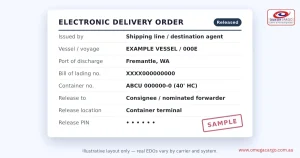
The exact layout varies between carriers, but an EDO typically identifies:
Because the EDO names a party and a container, small errors matter. A wrong container number or an outdated consignee name is enough to stop a truck at the gate.
The ocean carrier, or the carrier’s authorised agent at destination, issues the EDO for the master bill of lading. If your goods travelled under a house bill of lading issued by a freight forwarder, there are effectively two layers of release:
For EDO shipping in Australia, many shipping lines use OneStop’s Electronic Import Delivery Order (EIDO) service. According to OneStop, once a shipping line has received the required freight payments, the terminal can be sent the commercial release for the cargo, while importers or their agents receive electronic notification of delivery order PINs.
That is why your EDO usually reaches your freight forwarder, customs broker or transport operator rather than your inbox. They are the ones who need it to book the collection.
| Party | Role in the EDO process |
| Shipping line / carrier | Issues the release once its conditions are met |
| Carrier’s destination agent | Issues the release where the carrier has no local office |
| Freight forwarder (NVOCC) | Requests the carrier release on a master bill; releases to you on the house bill |
| Customs broker | Lodges the import declaration and tracks the customs and biosecurity status |
| Terminal / container freight station | Holds the cargo and releases it against the EDO and clearances |
| Transport operator | Books a collection slot and presents the release details at the gate |
| You, the importer | Pays your charges, provides documents and confirms delivery details |
This is where most of the confusion sits. Several different “releases” are happening at once, and each one is controlled by a different organisation. Understanding which is which is the fastest way to work out why your container is still sitting at the wharf.
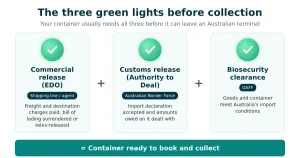
For a typical sea freight import into Australia, your cargo needs three separate approvals before a truck can take it away:
| Green light | Who gives it | What it confirms | What usually holds it up |
| Commercial release (EDO) | Shipping line or its agent (and your forwarder, for house bills) | The carrier’s charges are settled and the right party has authority to take the goods | Unpaid freight or destination charges, bill of lading not surrendered or telex-released, name mismatches |
| Customs release (Authority to Deal) | Australian Border Force, via the Integrated Cargo System | The import declaration has been accepted and any duty, GST and charges owed have been dealt with | Errors or missing information on the import declaration, unpaid duty and GST, ABF examination |
| Biosecurity clearance | Department of Agriculture, Fisheries and Forestry (DAFF) | The goods and container meet Australia’s import conditions | Missing treatment or packing declarations, documentary assessment, inspection or treatment directions |
The Australian Border Force describes its Authority to Deal as a message sent in response to an import declaration that “enables goods to be collected from Customs control” (ABF, Authority to Deal message). On the biosecurity side, the Department of Agriculture, Fisheries and Forestry states that imported goods must meet all import conditions to clear biosecurity control, and that goods and containers may be inspected on arrival (DAFF, clearance and inspection).
The important point: an EDO on its own doesn’t release your goods from customs, and customs clearance on its own doesn’t release them from the shipping line. You need both, plus biosecurity, before the terminal will let the container go. Our step-by-step guide to customs clearance in Australia walks through the ABF and DAFF side in more detail.
There is no difference in purpose between a delivery order and an electronic delivery order. Both authorise the release of cargo to a named party. The difference is the format and how it travels:
When an Australian forwarder says “we’re waiting on the DO”, they almost always mean the electronic release.
The bill of lading and the EDO are often confused because one leads to the other.
| Document | What it is | When it matters |
| Original bill of lading | The contract of carriage and a document of title; whoever holds the endorsed originals controls the goods | Must be surrendered at destination before the carrier will release |
| Telex release | A message confirming the originals were surrendered at origin, so no paper needs to travel | Lets the carrier release at destination without the originals |
| Sea waybill | A non-negotiable transport document; no originals need to be surrendered | Release is to the named consignee once charges are paid |
| EDO | The carrier’s release instruction at destination | Issued after one of the above is satisfied and charges are paid |
In short, the bill of lading (or its telex release or waybill equivalent) is what you need to earn the EDO. If your supplier hasn’t released the originals, perhaps because they’re still waiting on your payment, the carrier can’t issue the EDO no matter how quickly your customs entry clears. Your Incoterms and payment terms decide who controls that step.
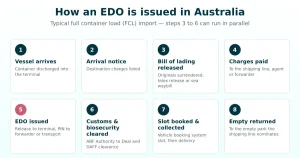
Every carrier and port has its own systems, but the sequence for a full container load (FCL) import generally looks like this:
Steps 3 to 6 do not have to happen one after the other. The fastest releases happen when your documents, payments and customs entry are all lined up before the vessel berths, so each green light switches on as soon as it can.
If your goods arrived as less than container load (LCL) cargo, they share a container with other importers’ shipments. The release then works in two stages:
That means the EDO you care about with LCL is usually the forwarder’s or consolidator’s release at the CFS, not the shipping line’s. It also means an issue with another importer’s paperwork shouldn’t hold up your cargo once the container has been unpacked. If you’re deciding between the two modes, our LCL vs FCL guide compares them for Australian imports.
When an EDO hasn’t been issued, the cause is rarely mysterious. It almost always comes back to one of these:
| Cause | What it looks like | What to do |
| Destination charges unpaid | Arrival notice issued, payment not received or not yet matched | Pay promptly and send the remittance to the shipping line or forwarder with the bill of lading number |
| Original bill of lading not surrendered | Your supplier still holds the originals, often pending payment | Arrange payment with your supplier and ask for a telex release or courier the originals |
| Telex release not yet confirmed | Origin office hasn’t sent the release message | Ask your forwarder to chase the origin agent with the bill number |
| Name or party mismatch | Consignee on the bill differs from the importer or forwarder requesting release | Correct the details before arrival; a letter of authority may be needed |
| House bill charges outstanding | The carrier has released to the forwarder, but your house bill isn’t settled | Clear the forwarder’s invoice; they can then release to you |
| Carrier credit or account issue | The party requesting release isn’t set up with the carrier | Use a forwarder or broker who already holds an account |
| Freight collect not paid | Ocean freight is payable at destination and hasn’t been paid | Confirm the freight terms on the bill and pay before arrival |
A separate set of problems can stop collection even after the EDO is out. These sit with customs or biosecurity rather than the carrier:
If your forwarder tells you “the EDO is out but the box is still on hold”, one of these is usually the reason.
Once all three green lights are on, the clock you care about changes from “waiting for release” to “getting the container moving”.
Collection and delivery. Your transport operator books a terminal slot, presents the release at the gate and delivers the container to your site or to a warehouse. If you need the goods unpacked, stored or distributed, a warehousing and logistics partner can take the container straight from the wharf.
Free time and storage. Shipping lines and terminals allow a period of free time before extra charges apply. Once it runs out, you may face terminal storage, demurrage (for full containers left at the terminal) and detention (for containers kept outside the terminal past their free time). The length of free time depends on the carrier, your contract, the container type and the port, so check it on your arrival notice or with your forwarder rather than assuming. Our container transport guide explains how wharf cartage and empty returns fit in.
Empty return. After unpacking, the empty container goes back to the empty container park the shipping line nominates. Detention usually keeps running until it’s returned, so plan unpacking around the transport booking.
This is a hypothetical example to show how the steps interact. It is not a real customer shipment.
Two importers in Perth each bring in a 40ft container of furniture from China on the same vessel, discharging at Fremantle.
Importer A paid the supplier before the vessel sailed. The supplier arranged a telex release, the forwarder paid the destination charges on the day the arrival notice came through, and the customs broker lodged the import declaration and supplied the packing declaration in advance. The EDO, the Authority to Deal and biosecurity clearance were all in place soon after discharge, and the transport operator booked a slot straight away.
Importer B planned to pay the supplier on arrival. The originals were still with the supplier when the ship berthed, the commercial invoice listed a different consignee name from the bill of lading, and the packing declaration was missing. Customs couldn’t finalise the entry, the carrier couldn’t issue the EDO, and the free time started running down while documents were chased.
Same ship, same port, same cargo. The difference was entirely in the paperwork done before arrival.
Use this before every sea freight shipment:
Omega Cargo is a West Australian family company providing sea freight, freight forwarding and customs and quarantine clearance across Perth, Fremantle, Sydney, Melbourne, Brisbane and Adelaide. When one team manages the shipping, the customs entry and the transport booking together, the three green lights are tracked side by side instead of being chased separately.
If you’re importing by sea, our sea freight service covers the international leg and destination handling, while our customs and quarantine clearance team prepares your import declaration and works through biosecurity requirements so your cargo is ready to move as soon as the EDO is out.
An EDO in shipping is an electronic delivery order: the digital release a shipping line or its agent issues so a terminal, container yard or container freight station can hand imported cargo to a named party. It’s issued after the carrier’s charges are paid and the bill of lading is surrendered, telex-released or covered by a sea waybill.
EDO stands for electronic delivery order. It is the paperless version of the traditional delivery order (DO). In Australian port systems, you may also see it called an EIDO (electronic import delivery order) or simply the “commercial release” or “DO”.
The shipping line, or its authorised agent at the destination, issues the electronic delivery order. If your goods moved on a forwarder’s house bill of lading, the forwarder obtains the carrier’s release and then releases the cargo to you once your charges and documents are in order.
No. The EDO is the carrier’s commercial release. Customs clearance is a separate approval from the Australian Border Force, given as an Authority to Deal once your import declaration is accepted and amounts owed are paid. Biosecurity clearance from DAFF is a third requirement. Your cargo usually needs all three before collection.
They serve the same purpose: both authorise release of cargo to a named party. A delivery order was traditionally a paper document collected from the carrier’s office. An EDO carries the same authority electronically to the terminal or booking system, often with a PIN, which removes the need to collect and present paper.
Only if your shipment was issued on original bills of lading. In that case the endorsed originals must be surrendered, or a telex release arranged at origin. If the shipment moved on a sea waybill, no originals are needed and the carrier releases to the named consignee once charges are paid.
The most common reasons are unpaid destination or freight charges, a bill of lading that hasn’t been surrendered or telex-released, mismatched consignee details, or outstanding house bill charges with your forwarder. Ask your forwarder which condition is missing. If the EDO is out but the container is held, check customs and biosecurity status.
An EDO PIN is a release reference that lets an authorised party match the shipping line’s release when booking or collecting cargo. In Australia, shipping lines using OneStop’s EIDO service notify importers or their agents of delivery order PINs electronically, while the terminal receives the commercial release.
Yes, but in two layers. The shipping line releases the full container to the consolidator, who unpacks it at a container freight station. Your forwarder or the consolidator then releases your individual consignment from the CFS once your house bill charges and clearances are complete.
Generally no. Terminals and depots release cargo only to an authorised party, and they need the carrier’s release as well as customs and biosecurity clearance. Your transport operator will also need a booking slot in the terminal’s vehicle booking system before the container can be collected.
Shipping lines, agents and forwarders may include release or documentation fees within their destination charges, and these vary by carrier, port, cargo type and contract. The arrival notice or your forwarder’s invoice shows what applies to your shipment, so check it before arrival and pay promptly to avoid release delays.
EOD is commonly used to mean “end of day”, for example a document or payment cut-off at the end of the business day. It’s easily confused with EDO, which means electronic delivery order. If a carrier or forwarder message is unclear, ask them to confirm which term they mean.
EDO shipping is simple once you see where it fits: it’s the shipping line’s green light, sitting alongside customs and biosecurity clearance. Most release delays come from paperwork that could have been sorted before the ship arrived, which is exactly where a coordinated forwarder and customs broker earns their keep.
If you’d like one team to manage your sea freight, customs entry and wharf collection together, request a quote from Omega Cargo. Have your supplier details, cargo description, origin port and preferred delivery address ready, and our team will come back with options for your shipment. Prefer to talk it through first? Contact our team.


