
Your container has landed. The vessel is alongside, the box is sitting in the terminal stack, and your customers are waiting for stock. So why does an invoice for demurrage arrive before the goods even reach your warehouse?
Here’s the question most importers only ask once they’ve paid for it: when does the free time on a container actually start, and who decides? The answer is rarely “when you collect it”. For most Australian imports, the clock starts with events you don’t control, such as vessel discharge, and keeps running through customs, biosecurity, transport bookings and the empty return.
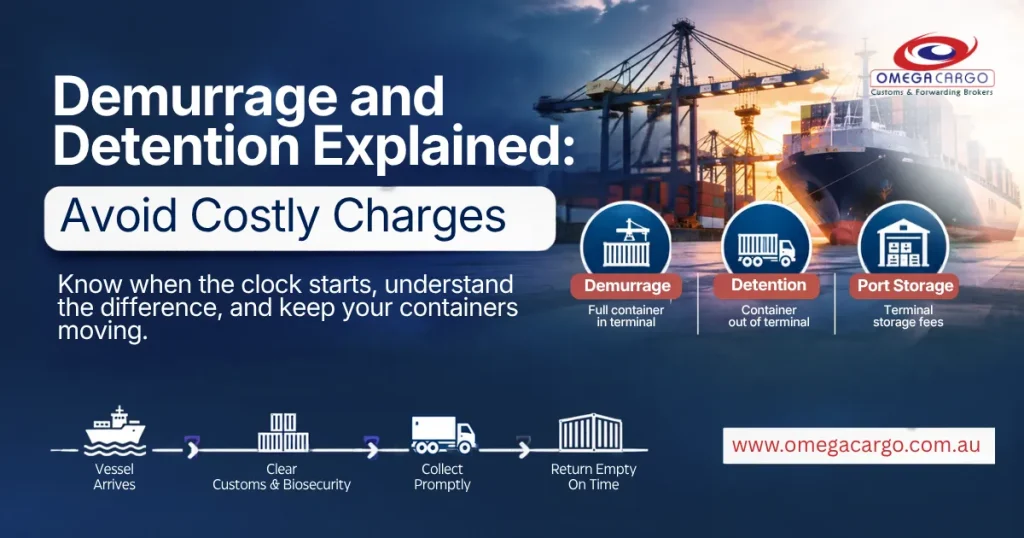
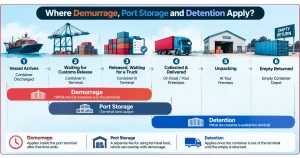
Demurrage is a charge a shipping line applies when a full container stays inside the port terminal after its free time ends. Detention is the related charge for keeping the carrier’s container outside the terminal, usually until the empty is returned. Port storage is a separate fee from the terminal operator. All three are avoided the same way: clear the goods early, collect promptly and return the empty on time.
This guide explains demurrage meaning in plain English, how detention charges differ, where port storage fits, who pays, and the practical steps that keep your shipments inside free time. By the end, you’ll be able to read a carrier’s free-time terms, spot the points where days usually leak away, and build a simple plan that protects your landed cost.
Demurrage is a time-based charge for using a carrier’s container (or, in chartering, a ship) beyond the time agreed in the contract. In container shipping, it’s charged per container, per day, once a loaded container has stayed in the terminal past its free time. The charge exists to keep containers moving, because a box sitting in a stack isn’t earning revenue for the shipping line or making space for the next vessel.
The word turns up in two quite different settings, which is why definitions online can seem to contradict each other.
| Setting | What the term means | Who usually deals with it |
| Container shipping | A charge for a full container kept at the terminal after free time ends | Importers, exporters, freight forwarders, customs brokers |
| Vessel chartering (bulk and tanker trades) | Compensation the charterer pays the shipowner when loading or unloading takes longer than the agreed laytime | Charterers, shipowners, commodity traders |
| The opposite in chartering | “Despatch” is sometimes paid to the charterer when loading or unloading finishes early | Charterers and shipowners |
For an Australian business importing containerised goods, the first row is the one that matters. The rest of this guide is about container demurrage and the charges that travel with it.
Detention charges apply when you keep the shipping line’s container outside the terminal for longer than the free time allows. On an import, the detention period usually covers the time from when the full container leaves the terminal to when the empty is returned to the depot or empty container park the carrier nominates. On an export, it usually runs from when you collect an empty container to when the packed container is received back at the terminal.
Container detention is often the charge importers underestimate. Collecting the container feels like the finish line, but the clock keeps running while the box is on a truck, waiting at your dock, being unpacked and travelling back empty.
The simplest way to tell these charges apart is to ask two questions: where is the container, and who owns the space it’s using?
| Demurrage | Detention | Port storage | |
| Where the container is | Inside the terminal, full | Outside the terminal (with you, your carrier or at the depot) | Inside the terminal |
| What you’re paying for | Extra time using the carrier’s container | Extra time using the carrier’s container | Space on the terminal’s land |
| Who sets the charge | The shipping line | The shipping line | The terminal operator (stevedore) |
| Who usually invoices you | The shipping line or your forwarder | The shipping line or your forwarder | The terminal, or your forwarder or transport company on-charging it |
| When it starts | When the carrier’s free time ends | When the carrier’s free time ends | When the terminal’s free storage period ends |
| Main way to avoid it | Clear and collect early | Unpack quickly and return the empty on time | Collect before the terminal’s free period ends |
Because the carrier charge and the terminal charge are billed by different parties, they can apply to the same days. A container stuck in the terminal waiting for a biosecurity direction can attract both at once, which is why a short delay can cost more than people expect.
Not every carrier splits the period the same way. Some Australian tariffs use one combined “demurrage and detention” allowance. Others separate them. For example, OOCL’s published Australian terms describe import detention as running from the day the container is discharged to the day the empty is returned, counted in calendar days, with free time that varies by equipment type, and they treat port storage as a matter between you and the terminal (OOCL Australia demurrage and detention free time).
The practical lesson: the name on the invoice tells you less than the carrier’s tariff does. Before you ship, ask your forwarder which structure applies to your carrier, port and container type.
Free time is the period a carrier (or terminal) allows before charges begin. It’s the number that decides whether a shipment costs what you budgeted or a lot more. Three details matter more than the headline allowance:
Here is how a typical full-container import moves through those clocks:
| Stage of your import | Where the container is | Charges that can run if free time is used up |
| Vessel arrives and container is discharged | Terminal | Clock usually starts (carrier) |
| Waiting for customs and biosecurity release | Terminal | Demurrage (carrier) and port storage (terminal) |
| Released, waiting for a truck slot | Terminal | Demurrage and port storage |
| Collected and delivered to your site | Road or your premises | Detention (carrier) |
| Waiting to be unpacked | Your premises | Detention |
| Empty waiting for a return slot | Your premises or transport yard | Detention, plus possible yard storage from your transport company |
| Empty returned to the nominated depot | Empty container park | Clock stops |
If a container needs inspection at an approved arrangement site, it leaves the terminal before release, which shifts the time you’re using from the demurrage side to the detention side. The total days still count against you.
On most imports, the importer ends up paying both charges, either directly or through their freight forwarder’s invoice. The carrier bills under its own terms, which normally name the consignee (or “merchant”) as liable at destination. Your forwarder may pay the carrier first and then pass the charge on.
Your sales terms with your supplier decide who should bear those costs commercially. Incoterms® 2020, published by the International Chamber of Commerce, set out the tasks, costs and risks between buyer and seller.
| Your Incoterm | Who usually handles destination-side charges | What it means for you |
| EXW, FCA, FOB | Buyer (you) | You control the destination process, so you carry the delay risk |
| CFR, CIF, CPT, CIP | Buyer (you), in most cases | The seller pays freight to Australia, but charges after arrival usually fall to you |
| DAP, DPU | Usually buyer, depending on the exact point of delivery | Check the named place and who unloads |
| DDP | Seller, in principle | Delays caused by your side (for example a slow unpack) may still be passed back to you |
The carrier doesn’t care what your sales contract says. It bills whoever its terms make liable. If your supplier agreed to cover a delay, you recover it from the supplier separately. That’s why our guide to Incoterms is worth reading before you sign a purchase order.
Omega Cargo doesn’t publish standard demurrage figures, because no single number holds true across carriers, ports or equipment. What you pay depends on:
The most accurate figure comes from the carrier’s tariff applied to your specific shipment. Ask for the free time and the charge structure in writing when you request a sea freight quote, not after the vessel arrives.
Demurrage rarely comes from one big mistake. It usually comes from several small delays that each take a day or two.
Goods can’t leave the terminal until they’re cleared. The Australian Border Force (ABF) requires all applicable duties, taxes and charges to be paid before the goods are released, and import declarations are lodged electronically in the Integrated Cargo System (ABF – Import Declarations). A missing commercial invoice, an unclear description or a tariff classification query can hold a container while free time runs. If you want to cut that risk, our guide on how to speed up customs clearance in Australia walks through the preparation that matters most. Our guide to documents errors that cause customs delays covers the usual problems.
The Department of Agriculture, Fisheries and Forestry (DAFF) states that imported goods must meet all import conditions to clear biosecurity control. Some goods must be inspected, either on arrival at the first port or at an approved arrangement site, and inspection fees usually apply. Some goods need treatment on arrival, and goods that don’t meet requirements must be treated, exported or destroyed at the importer’s expense (DAFF – Clearance and inspection of goods). Each of these steps uses free time, and our explainer on the customs inspection process in Australia shows what happens while a container is held. Seasonal measures, such as those for brown marmorated stink bug, add another layer for certain goods and origins.
Terminals run on booking systems. If your transport company can’t get a slot, the container waits. Peak periods, weather, industrial action and vessel bunching all tighten availability.
A container that arrives at a warehouse with no dock, no forklift or no labour simply waits on the truck or in the yard. Every hour of that is detention time.
Empty containers must go back to the depot or empty container park the carrier nominates. If that park has no available slots, the empty can sit in a transport yard while detention keeps running. Empty container park charges have drawn regulatory attention. In October 2026, Australia’s transport ministers approved updated National Voluntary Guidelines for Landside Stevedore and Empty Container Park Charges. They start on 1 January 2027 and cover empty container park operators as well as stevedores. Operators that adopt them agree to change landside charges only once a year. The ACCC also monitors container stevedoring and publishes an annual container stevedoring monitoring report.
If your carrier counts calendar days, a vessel that discharges just before a long weekend can eat into free time while nothing else is moving. State public holidays differ, so a holiday in one state may not affect a port in another.
The best way to avoid demurrage is to treat free time as a deadline you plan backwards from, not a buffer you discover on arrival. Here’s the plan we suggest, broken into four stages.
This is a hypothetical example to show how the clocks interact. It is not a real shipment, and no charges are shown because they depend on the carrier’s tariff at the time.
A homewares importer in Perth brings in one 40ft dry container from Asia through Fremantle, using a customs broker in Fremantle for clearance. The carrier allows a single combined free-time allowance from discharge to empty return.
| What happens | Where the container is | Which charge it’s using | What could have been done |
| Vessel discharges late on a Thursday before a long weekend | Terminal | Combined free time starts, and terminal storage free time begins | Ask for extended free time when booking, given the holiday |
| Commercial invoice from the supplier arrives after discharge | Terminal | Free time, plus possible port storage | Require documents before the vessel sails |
| DAFF directs the container for inspection at an approved arrangement site | Transport, then inspection site | Free time continues on the carrier side | Check BICON conditions and treatment records before shipping |
| Released and delivered, but the warehouse has no labour that day | Importer’s yard | Free time, then detention once it runs out | Book labour against the expected release date |
| Empty container park has no return slots on the planned day | Transport company’s yard | Detention | Book the return early and keep “park full” evidence |
None of the delays here is unusual on its own. Together, they can push a container well past its free time. Fixing just two of them, the late invoice and the unbooked labour, could have kept this shipment within the allowance.
If a carrier invoice for extra container days arrives, don’t just pay it or ignore it. Work through these steps:
Container demurrage and detention mainly affect full container load (FCL) shipments, because you’re the only party using the box. With less than container load (LCL), your goods share a container that’s unpacked at a container freight station (CFS). You’re not usually billed the carrier’s container charges on that box directly. Instead, the CFS may charge storage if your goods aren’t cleared and collected within its free period.
That doesn’t make LCL immune to delay costs. The same causes, late paperwork, biosecurity holds and slow collection, still apply. Our comparison of LCL vs FCL shipping to Australia explains when each makes sense.
You can manage this risk yourself if you import occasionally and your goods are simple. It usually pays to involve a forwarder and customs broker when:
In Australia, customs brokers are licensed by the Australian Border Force, and the ABF encourages first-time or infrequent importers to use one. Omega Cargo’s team of licensed customs brokers handles customs and quarantine clearance across Australian ports, alongside sea freight and warehousing, wharf transport and container unpacking. Bringing those pieces under one plan is what keeps a container moving from discharge to empty return. If you also need help planning the road leg, our guide to container transport services in Australia covers the options.
Demurrage in shipping is a charge for keeping a carrier’s full container in the port terminal after the free time ends. It’s charged per container, per day, under the shipping line’s tariff. In vessel chartering, the same word means compensation paid to a shipowner when loading or unloading takes longer than the agreed laytime.
The difference is location. Demurrage applies while the full container is still inside the terminal. Detention applies once the container has left the terminal, until the empty is returned to the nominated depot. Some carriers combine both into one free-time allowance, so check your carrier’s terms rather than relying on the label.
No. Demurrage is a shipping line charge for using its container. Port storage is a terminal charge for using the terminal’s land. They’re billed by different parties and can apply over the same days, which is why a container stuck in the terminal can attract both at once.
The importer usually pays demurrage at the Australian end, either to the shipping line or through a freight forwarder’s invoice. The carrier bills the party its terms make liable, normally the consignee. If your supplier agreed to cover delays under your sales contract, you recover that from the supplier separately.
For most imports, free time starts when the container is discharged from the vessel, not when it’s available to collect. The exact trigger, counting method and length depend on the carrier’s tariff and your contract, so confirm all three when you book.
Demurrage is calculated by multiplying the number of days a container stays in the terminal beyond its free time by the carrier’s daily charge for that container type. Many tariffs use escalating tiers, so later days cost more. Your forwarder can apply the carrier’s current tariff to your shipment.
Often, yes, if you ask before you ship. Carriers sometimes agree to extended free time for regular customers, larger volumes or goods that are likely to be inspected. Requests made after the vessel arrives are much harder to win, so build the request into your booking.
Sometimes. Carriers review waiver requests case by case, and they’re more likely to consider delays outside your control, such as terminal disruption or a full empty container park. Evidence makes the difference: booking attempts, “park full” notices and accurate timestamps. Submit the request in writing, through your forwarder if they manage the carrier relationship.
Generally, no. Free time usually keeps running while goods wait for customs release or a biosecurity inspection, and inspection fees are a separate cost. That’s why lodging documents early and meeting biosecurity import conditions before the goods ship is the most effective protection.
Not usually in the same way. LCL cargo shares a container unpacked at a container freight station, so you’re not normally billed the carrier’s container charges on that box. The station may charge storage if your goods aren’t cleared and collected within its free period.
An empty container park is a depot where shipping lines store empty containers. When you’ve unpacked an import, the empty must go back to the park the carrier nominates. If the park has no available slots, the empty can’t be returned, and detention may keep running.
These charges aren’t random penalties. They’re the predictable result of days lost between discharge and empty return. Once you know which clock is running, who’s charging and what usually causes the delay, most of these charges become avoidable with a little planning before the vessel arrives.
Before your next shipment, run through this short checklist:
Planning an FCL import and want to keep it inside free time? Tell us your origin, port, container type and expected arrival date, and Omega Cargo’s licensed customs brokers will check the carrier terms, prepare your clearance early and plan the collection and empty return with you.
Request a shipment-specific quote or talk to our team.


