
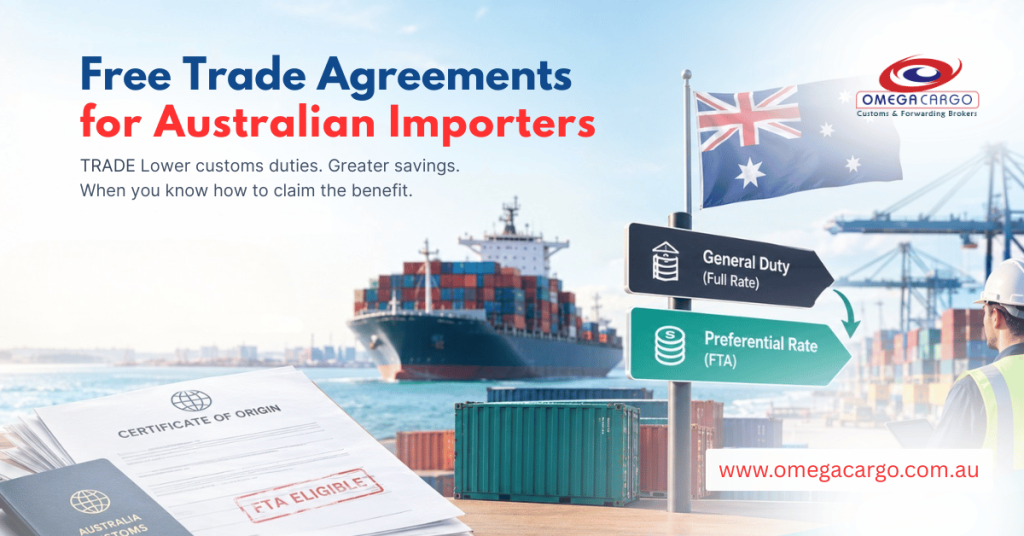
Your supplier in Vietnam says the goods are “FTA eligible”, the invoice looks clean, and the container is already on the water. Then the import declaration goes in at the general duty rate, because nobody asked for the origin paperwork before the goods left the factory.
So here is the question worth asking before your next order: if Australia has trade deals with most of the countries you buy from, why are so many importers still paying full customs duty?
The answer is that free trade agreements for Australian importers are not automatic. A lower duty rate exists on paper, but you only get it when your goods meet that agreement’s rules of origin, you hold the right proof of origin, and the claim is made correctly on the import declaration. Miss one of those three and the preferential rate does not apply.
This guide walks you through how Australia’s free trade agreements (FTAs) work from the importer’s side of the counter: which agreements are in force, what “originating” actually means, the difference between a certificate and a declaration of origin, how the claim is made in the Australian Border Force’s Integrated Cargo System, what to do if you missed a claim, and the mistakes that quietly cost importers money. By the end, you will know exactly what to ask your supplier for, and when.
Free trade agreements for Australian importers let goods that originate in a partner country enter Australia at a preferential rate of customs duty, often lower than the general rate and in many cases free. To claim it, your goods must meet the agreement’s rules of origin, you need the proof of origin that agreement requires, and the preference must be claimed on your import declaration. GST, biosecurity and other border rules still apply.
A free trade agreement is a treaty between Australia and one or more partner economies that reduces or removes tariffs on goods that originate in the member countries. For an Australian importer, the practical effect is a separate, preferential rate of customs duty for qualifying goods, set out in its own schedule of the Australian customs tariff.
That is the whole of the change. It is significant, because customs duty is calculated on the customs value of your goods and feeds directly into your landed cost. But an FTA does not switch off the rest of the import process, and importers who assume it does tend to get caught.
| What an FTA can change | What an FTA does not change |
| The rate of customs duty on goods that meet the rules of origin | GST on the taxable importation |
| Whether duty applies at all to some tariff lines | Dumping and countervailing duties — the Australian Border Force (ABF) states these still apply to goods from FTA partner countries |
| The duty component inside your GST calculation (lower duty means a slightly lower GST base) | Biosecurity requirements, inspections and treatment set by the Department of Agriculture, Fisheries and Forestry |
| Your landed cost and pricing headroom | Product safety standards, labelling laws and import permits |
| Your obligation to classify goods correctly and keep records |
Two of those rows deserve a closer look.
GST still applies, but it moves with duty. The ABF calculates GST on the value of the taxable importation, which includes the customs value, international transport and insurance, and any customs duty payable. So when an FTA reduces your duty, the GST base shrinks with it. The saving is mainly in duty, but it flows through.
Dumping duty sits on top. The ABF’s guidance on dumping and countervailing duties says these duties still apply to goods imported from countries with which Australia has free trade agreements. If your product is subject to an anti-dumping measure, an FTA certificate will not remove it.
Australia’s free trade agreements cover most of the country’s major sources of imports across Asia, the Pacific, North America, South America, the Middle East and the United Kingdom. DFAT maintains the official list of free trade agreements in force, and the ABF lists the same agreements, split into bilateral and regional deals, with a link to each agreement’s tariff schedule.
When this guide was reviewed, the in-force list included the following agreements.
| Agreement | Partner(s) |
| ANZCERTA (CER) | New Zealand |
| SAFTA | Singapore |
| AUSFTA | United States |
| TAFTA | Thailand |
| ACl-FTA | Chile |
| AANZFTA | ASEAN members and New Zealand (regional) |
| MAFTA | Malaysia |
| KAFTA | Republic of Korea |
| JAEPA | Japan |
| ChAFTA | China |
| CPTPP | Trans-Pacific partners including Canada, Mexico, Japan, Vietnam and others (regional) |
| A-HKFTA | Hong Kong, China |
| PAFTA | Peru |
| IA-CEPA | Indonesia |
| PACER Plus | Participating Pacific Island countries and New Zealand (regional) |
| RCEP | ASEAN members, China, Japan, Korea and New Zealand (regional) |
| AI-ECTA | India |
| A-UKFTA | United Kingdom |
| Australia-UAE CEPA | United Arab Emirates |
What about the European Union? DFAT reports that Australia and the EU concluded negotiations for the Australia-European Union Free Trade Agreement on 24 March 2026, and DFAT lists that agreement under agreements not yet in force. Until it enters into force, goods from EU member states cannot be entered at an A-EU FTA preferential rate. Check DFAT’s page before you plan pricing around it.
Regional agreements apply country by country. A regional deal such as RCEP or CPTPP enters into force for each member separately. The ABF notes that some agreements are not yet in force for every party, so confirm the agreement is live for your supplier’s country, not just that the country signed it.
Rules of origin are the conditions a product must meet to count as “originating” in an FTA partner country, and only originating goods can be entered at the preferential rate. The country printed on the bill of lading, or the country your supplier invoices from, does not settle the question.
Every agreement sets its own rules, but most use the same building blocks:
Because product-specific rules are written against HS codes, origin starts with classification. If the tariff classification is wrong, the rule you test against is wrong too, and the claim falls over. Omega Cargo’s HS code and tariff classification guide explains how codes are built, and the product classification resource covers the Australian tariff structure.
Picture a supplier in Vietnam assembling bluetooth speakers from circuit boards made in China and plastic housings moulded in Vietnam. The goods are shipped from Ho Chi Minh City, but whether they “originate” in Vietnam depends on the product-specific rule for the speaker’s tariff line under the agreement you choose. If that rule requires a change of tariff heading, the question is whether the imported circuit boards sit under a different heading from the finished speaker. If the rule is a value test, the question is how much of the value was added in the FTA area. The same speaker can qualify under one agreement and fail under another.
Most agreements also include a consignment or “non-alteration” rule. Under the Australia-UK FTA, for example, an originating good keeps its status if it passes through a non-party country only for operations such as unloading, reloading, storage, splitting a consignment or labelling required by the importing country, and is not released into free circulation there. If goods are processed or sold on in a third country, origin can be lost. Keep the transport and storage documents that show how the goods travelled.
A certificate of origin (COO) is a document issued by an authorised body in the exporting country confirming that specified goods meet an FTA’s rules of origin. A declaration of origin (DOO) is a statement completed by the exporter, producer or, under some agreements, the importer, without needing approval from an issuing body. Which one you need depends on the agreement.
DFAT’s guidance on how to take advantage of FTA tariff rates says most businesses obtain certification through an authorised certifying body, while some FTAs also allow an importer, exporter or producer to make a declaration of origin.
| Certificate of origin (COO) | Declaration of origin (DOO) | |
| Who completes it | An authorised issuing body in the exporting country, on application by the exporter or producer | The exporter or producer, and under some agreements the importer |
| Approval needed | Yes, by the issuing body | No formal approval, but the same supporting evidence must be retained |
| Typical use | Agreements that require third-party certification | Agreements that allow self-declaration, or only in set circumstances |
| What you should check | Correct issuing body, matching HS codes and invoice details, validity period | Required wording or template, signatory details, coverage of the shipment |
For goods from China, DFAT’s page on ChAFTA certificates of origin sets out the detail most importers need:
If you import furniture or homewares from China, Omega Cargo’s guide to importing furniture from China to Australia shows how the ChAFTA claim fits into the wider clearance process.
| Tip: Details on the certificate must match the shipment. Mismatched HS codes, product descriptions, invoice numbers or consignee details are among the most common reasons an origin document is queried. Omega Cargo’s article on document errors that cause customs delays covers the wider problem. |
Claiming an FTA preferential rate in Australia follows the same sequence for every agreement: classify the goods, confirm the preferential rate, confirm the goods originate, hold the proof of origin, and declare the preference correctly. The ABF’s guidance on claiming preference in the ICS and DFAT’s FTA guidance follow the same logic.
If you are new to the process as a whole, Omega Cargo’s customs clearance step-by-step guide shows where the FTA claim sits within clearance.
An FTA claim on an Australian import declaration is made through three preference fields on each tariff line. The codes differ by agreement, and the ABF publishes them on each agreement’s page. Using the ABF’s published codes for the Australia-India ECTA as an example:
| ICS field | What it tells the ABF | ECTA example from ABF guidance |
| Preference scheme type | Which agreement the claim is made under | IECT |
| Preference rule type | Which origin criterion the goods meet | WO (wholly obtained) or PSR (product-specific rule) |
| Preference origin country | Where the goods originate | IN (India) |
A wrong scheme type, a rule type that does not match the origin document, or an origin country that differs from the certificate can all trigger a query. This is one reason many importers hand FTA claims to a licensed customs broker rather than lodging them in-house.
Many partner countries are covered by more than one agreement. Japan, for example, appears in JAEPA, CPTPP and RCEP. Vietnam and Malaysia sit in AANZFTA, CPTPP and RCEP, and Malaysia also has MAFTA. When goods qualify under several agreements, you choose which one to claim, and the cheapest-looking rate is not always the best choice.
| Decision factor | What to compare | Why it matters |
| Preferential rate | The rate for your tariff line under each agreement | Rates can differ between agreements for the same product |
| Product-specific rule | Which rule your product can actually meet with evidence | A rule your supplier cannot document is worth nothing |
| Proof of origin | COO from an issuing body, or a declaration the exporter can sign | Some suppliers are only set up for one agreement’s paperwork |
| Supplier familiarity | Which agreement the supplier has claimed under before | Experienced suppliers produce cleaner documents |
| Trusted Trader coverage | Whether the agreement is on the ABF’s origin waiver list | Matters if you are an Australian Trusted Trader |
DFAT’s FTA Portal summary screen compares tariff rates, product-specific rules and certificate requirements side by side, which makes this comparison faster. The rule of thumb: choose the agreement whose rule your goods clearly meet and whose paperwork your supplier can produce correctly every time.
If goods were entered at the general rate when they could have qualified for a preferential rate, a refund of the duty overpaid may be possible. The ABF’s page on refunds of customs duty says that for most refunds you must apply within four years after the date you first paid the duty, and that for FTA refunds there are some circumstances where a certificate of origin must be in force when you apply.
The detail sits in each agreement’s refund items under the Customs (International Obligations) Regulation 2015, and the conditions are not identical. The ABF’s guidance for the Australia-India ECTA is a useful illustration:
What this means in practice: a refund is a recovery path, not a strategy. It costs time and administration, and some refund items depend on paperwork existing at the moment of entry. Getting the origin document before the goods arrive is almost always cheaper than fixing it afterwards.
Some imports can claim FTA preference without a formal origin document, either because the consignment is low in value or because the importer is accredited under the Australian Trusted Trader programme.
Several agreements waive the origin document for low-value consignments. Chapter 4 of the Australia-UK FTA, for example, says a party shall not require a declaration of origin where the customs value of the importation does not exceed, in Australia’s case, 1,000 Australian dollars, or any higher amount the importing party establishes. The same clause excludes importations that customs reasonably considers to be part of a series planned to avoid the origin rules, so splitting one order into several small consignments does not work. The waiver amount and conditions differ between agreements, so check the one you are using.
The ABF’s Origin Waiver Benefit means Australian Trusted Trader importers are no longer required to obtain or present certificates or declarations of origin to claim preferential rates under listed agreements. Three points matter:
Omega Cargo has a separate overview of the Australian Trusted Trader programme if you are weighing up accreditation.
An Origin Advice (OA) is a written statement from the ABF on whether specified goods meet the requirements to claim a preferential rate under an FTA. The ABF’s Origin Advice page says it is available on request to Australian importers, exporters and producers of the goods, or their authorised representatives, and that a request can be made before trade in the goods begins, provided the necessary documentation is available. The ABF publishes its target turnaround on the same page.
Origin Advice is worth considering when:
The value of an FTA claim to your business depends on the gap between the general rate and the preferential rate for your tariff line, the customs value of the goods, how often you import, and the effect of lower duty on the GST base. It also depends on what it costs to get the paperwork right: supplier charges for certificates, broker time, and the risk of a rejected claim. Omega Cargo’s explainer on how duties are calculated covers the underlying arithmetic.
| Example (hypothetical): An Australian homewares retailer imports a 40ft container of ceramic tableware from a factory in Vietnam into Fremantle every quarter. The tableware is entered at the general rate for the first two shipments because the supplier never issued origin paperwork. On review, the retailer’s customs broker finds the goods appear to meet the product-specific rule under more than one agreement.
The retailer chooses the agreement whose certificate the factory already issues for other customers, adds the certificate to every purchase order, and asks the broker to assess refund eligibility for the earlier entries. The saving on each future shipment comes from three places: the lower duty rate, the smaller GST base that follows from lower duty, and fewer queries at clearance because the documents now match. |
The drivers that decide whether a claim is worth chasing:
| Driver | How it affects the value of the claim |
| Rate gap | The difference between the general and preferential rate for your exact tariff line |
| Customs value | Duty is calculated on value, so higher-value goods gain more from a lower rate |
| Import frequency | Repeat shipments multiply the benefit of setting up the paperwork once |
| GST effect | Lower duty reduces the value of the taxable importation |
| Compliance cost | Certificate charges, broker time and supplier cooperation |
| Risk | Incorrect claims can lead to duty being recovered and penalties |
Your Incoterm decides who books freight and who carries risk, but it does not change who can produce origin paperwork. Only the exporter, the producer or an authorised issuing body in the exporting country can generate a certificate of origin, and under most agreements a declaration of origin also comes from the exporter or producer. That means even on EXW or FOB terms, where you control the main freight leg, your supplier still has to supply the origin document.
Write it into the commercial terms: name the agreement, the type of proof of origin, and the deadline for providing it (for example, with the shipping documents). If you need a refresher on terms of sale, Omega Cargo’s guide to Incoterms covers who is responsible for what, and the shipping terms and acronyms page explains abbreviations such as COO, FOB and CIF.
Most failed FTA claims come from a small set of avoidable errors:
An FTA claim is part of customs clearance, and it is usually handled by the licensed customs broker who lodges your import declaration. A broker earns their place on FTA work when you import from several partner countries, when goods could qualify under more than one agreement, when products are made from materials sourced across borders, or when you suspect you have been paying the general rate on goods that should have qualified.
What you should expect from a broker on FTA work:
Omega Cargo provides customs and quarantine clearance for importers across Australia, including customs clearance in Fremantle, Sydney and Melbourne, alongside sea freight services. If you are comparing broker options more broadly, the guide to what a customs broker does is a good starting point.
Yes. The free trade agreements for Australian importers in force cover China, the United States, Japan, Korea, the United Kingdom, India, the UAE, New Zealand, Singapore, Thailand, Malaysia, Indonesia and other ASEAN members, among others. DFAT’s in-force list is the official reference, and the ABF links each agreement to its tariff schedule.
Australia and the EU concluded negotiations on a free trade agreement on 24 March 2026, according to DFAT. DFAT lists the agreement as not yet in force, so EU goods cannot be entered at an A-EU FTA preferential rate until it enters into force. Check DFAT’s agreement page for its status before relying on it.
No. Goods only qualify for the preferential rate if they meet that agreement’s rules of origin and the claim is supported by the proof of origin the agreement requires. Some tariff lines also carry a preferential rate above zero. DFAT states that FTA tariff cuts do not apply automatically.
A certificate of origin is a document, issued by an authorised body in the exporting country, confirming that specified goods meet an FTA’s rules of origin. Australian importers use it to support a claim for a preferential rate of customs duty. The required format, issuing body and validity depend on the agreement.
You cannot issue a certificate of origin yourself; it comes from an authorised body in the exporting country. Some agreements instead accept a declaration of origin, which the exporter or producer completes, and a few allow the importer to declare origin in set circumstances. Check the agreement’s requirements on DFAT’s FTA Portal.
Yes. An FTA reduces or removes customs duty, not GST. The ABF calculates GST on the value of the taxable importation, which includes the customs value, international transport and insurance, and any duty payable. Because duty is part of that base, a lower duty rate also slightly reduces the GST payable.
Often, yes, through a refund. The ABF says most refunds must be requested within four years after the duty was first paid. Each agreement has its own refund conditions under the Customs (International Obligations) Regulation 2015, and some depend on holding a certificate of origin at the time of entry, so check the agreement before applying.
Search DFAT’s FTA Portal by product description or HS code and the partner country. It shows the general rate, the likely preferential rate under each available agreement, the product-specific rule and the type of origin document required. The ABF’s tariff schedules are the legal reference, and the ABF makes the final decision on classification and rate.
You choose which agreement to claim under. Compare the preferential rate, the product-specific rule your goods can meet with evidence, and the proof of origin your supplier can provide. The best choice is usually the agreement your supplier can document correctly on every shipment, not simply the lowest rate.
Australian Trusted Trader importers do not need to obtain or present a certificate or declaration of origin for agreements on the ABF’s origin waiver list. The goods must still meet the rules of origin, and the importer must keep evidence of origin, generally for at least five years. Not every agreement is on the list.
No. The ABF states that dumping and countervailing duties still apply to goods imported from countries with which Australia has free trade agreements. If your product is subject to an anti-dumping measure, that duty is payable on top of any preferential customs duty rate.
Yes. FTA claims can be verified after the goods are released, and you must keep the relevant import documents for five years after the import declaration. If origin cannot be supported, duty can be recovered. Keeping supplier production records and transport documents alongside the certificate makes verification far simpler.
Free trade agreements for Australian importers can reduce what you pay at the border, but the saving is decided long before the container arrives. It is decided when you choose the supplier, write the purchase order, and confirm that the origin document will travel with the goods.
If you want a second pair of eyes on a supplier, a product or a past entry, talk to Omega Cargo. Have your supplier’s country, the product description or HS code, a recent commercial invoice and any origin paperwork you already hold ready. Our customs team can look over your classification and origin documents with you, talk through which agreement looks workable, and quote the freight and clearance for your next shipment.
| Request a freight and customs quote or Contact the Omega Cargo team. |
This guide is general information about Australia’s free trade agreements. Requirements, tariff schedules and agreement status change, so confirm current details with the Australian Border Force, DFAT or a licensed customs broker before relying on them for a specific shipment.


