
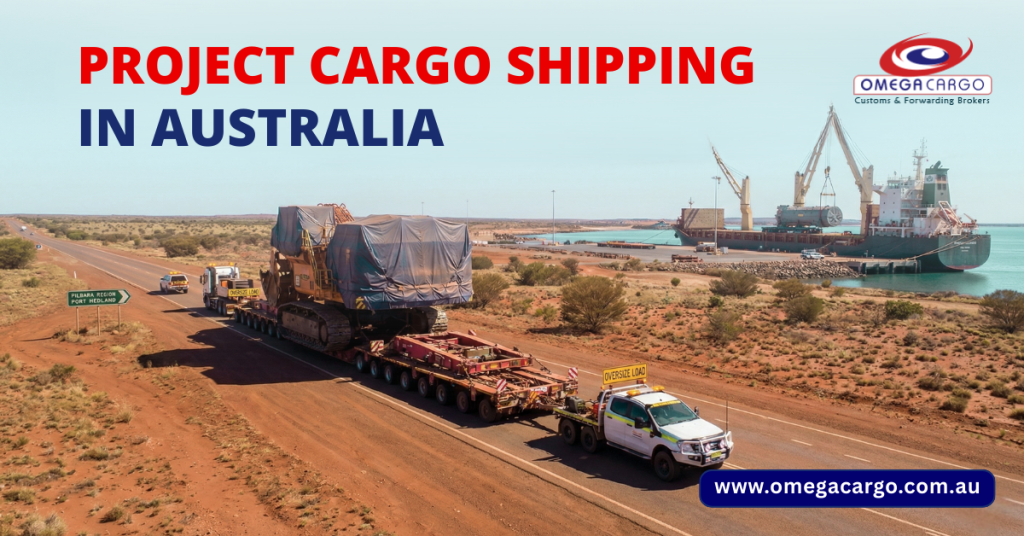
Project cargo shipping in Australia is the planning and transport of heavy, oversized and out-of-gauge cargo that cannot move in a standard container or on a standard truck. Think mining equipment heading for the Pilbara, transformers for a substation, wind turbine blades for a regional wind farm, or prefabricated modules for an infrastructure job.
These moves rarely follow a fixed formula. Each one depends on the cargo's size and weight, the route from port to site, the permits involved and the equipment available. Getting any of those wrong can hold up an entire project.
This guide explains what project cargo is, the main types, the transport methods used (breakbulk, heavy lift vessels, RoRo and heavy haulage), oversize permits and road rules, the planning process, what drives cost, customs and biosecurity, insurance and risk management, and how to choose the right logistics partner.
Project cargo shipping is the domestic or international transport of large, heavy, high-value or critical equipment destined for a specific project. Standard freight fits neatly into 20ft or 40ft containers. Project cargo is too heavy, too wide, too tall or too complex for standard logistics, so it needs a custom transport plan.
Knowing which category your shipment falls into helps you plan the right method and budget realistically.
If your shipment has one or more of these traits, you are dealing with project cargo logistics:
You can't simply book a truck and hope for the best. Project cargo shipping in Australia brings together logistics coordinators, engineers, riggers, heavy haulage operators and road authorities. The centre of gravity has to be calculated accurately. The route survey has to identify every low bridge, weak culvert, tight corner and overhead power line between the port and the site. In remote Australia, a sealed highway can turn into an unsealed track, so planning is the only way to make sure your cargo arrives in one piece.
Out-of-gauge cargo can travel on a container vessel but exceeds the internal dimensions of a container. It is usually loaded on a flat rack or open top container and may overhang the sides or top, taking up space that would otherwise hold other containers.
Heavy lift cargo is too heavy for standard port cranes. Heavy lift shipping often uses vessels fitted with their own high-capacity cranes, or floating and mobile cranes at the port.
On Australian roads, a vehicle and load that exceed the prescribed mass or dimension requirements is classed as oversize or overmass (OSOM). Moving it usually triggers oversized load permits, route conditions and, depending on size, pilot or escort vehicles.
Breakbulk cargo is loaded piece by piece rather than in containers. It is common for steel girders, structural steel, pipe and construction materials.
For self-propelled or wheeled machinery such as excavators, harvesters and mobile cranes, RoRo project cargo is often the simplest option. Your equipment is driven or towed onto the vessel, secured, and driven off at the destination port.
| Type | Typical profile | Main issue | Common transport method |
|---|---|---|---|
| Heavy lift | Very heavy single pieces | Exceeds standard crane capacity | Breakbulk or heavy lift vessel |
| Out-of-gauge (OOG) | Any weight | Exceeds container dimensions | Flat rack, open top or breakbulk |
| Over-dimensional (road) | Any weight | Exceeds road mass or dimension limits | Heavy haulage with permits |
| Breakbulk | Loose, individual pieces | Can't be containerised | Conventional general cargo vessel |
| RoRo | Wheeled or tracked machinery | Needs a ramp, not a crane | RoRo vessel |
| Modular cargo | Multiple large pieces | Sequencing and assembly on site | Combined methods |
Mining is one of the biggest users of project cargo shipping in Australia, particularly in Western Australia. Haul truck bodies, crushers, ball mills and processing equipment often travel long distances from ports such as Fremantle, Port Hedland or Geraldton to remote sites, relying on heavy machinery transport and careful route planning.
Oil and gas projects involve large modules, pipe racks, pressure vessels and subsea structures, many of which arrive through northern ports.
Major road, rail and tunnel projects depend on construction equipment shipping, from tunnel boring machine components to bridge beams and precast segments.
Transformers, generators and turbines are some of the heaviest single items moved by road. They need detailed project logistics, structural assessments of bridges and, often, specialised trailers.
Wind turbine transport involves blades, tower sections and nacelles. Blades are extremely long, which makes them some of the most difficult dimensional cargo to move through regional towns and around tight corners.
Industrial plant relocation can involve dismantling a factory overseas and shipping it to Australia, or the reverse, with careful tagging and sequencing so it can be rebuilt.
Defence and aerospace cargo is often sensitive and high priority, so it comes with extra security, handling and documentation requirements.
If you are bringing in heavy equipment, our guide to importing machinery into Australia covers the compliance side in more detail.
Ideally, this happens before you buy or finalise the design of the equipment. The feasibility stage checks whether the cargo can physically be moved from the factory to the site, and whether ports, roads and bridges along the way can take the weight and size.
A physical survey of the route checks bridge heights and capacities, turning circles, road surfaces, roundabouts, overhead power lines and street furniture that may need to be removed.
Applications go to the relevant road authority, and often to local councils, utility owners, rail operators and police. Approval times depend on the size of the load, the number of road managers along the route, whether bridge assessments are needed and how complete the application is. Start this step early.
Choose between heavy lift vessels, breakbulk shipping, RoRo, flat racks or a combination, then match the road leg to suitable trailers.
The cargo is prepared for the voyage and road leg. This may involve preservation, shrink-wrapping, cradles, skids and sea-fastening points.
Heavy lift crane services or ship's gear place the cargo on board according to the lift plan and stowage plan.
The cargo moves by sea and road, with tracking and, where required, pilot or escort vehicles.
The cargo is delivered to its final foundation or laydown area, ready for installation and commissioning.
There is no standard timeframe for a project cargo move. Each phase depends on the cargo, the route and the approvals involved.
| Phase | Main activities | What affects how long it takes |
|---|---|---|
| Planning | Feasibility, route survey, permits | Cargo size and weight, number of road managers, bridge assessments, completeness of information |
| Preparation | Engineering, procurement, packaging | Manufacturing schedule, design changes, availability of trailers, cranes and specialist crews |
| Execution | Loading, voyage, road transport, delivery | Vessel schedules, port conditions, weather, travel-time restrictions and escort availability |
| Installation | Unloading, positioning, commissioning | Site readiness, ground conditions, crane access and project sequencing |
Note: Timelines for project cargo are not fixed. They depend on the route, carrier and vessel schedules, port conditions, permit approvals, weather and site readiness. Talk to your logistics provider for a project-specific schedule.
Used for breakbulk cargo that doesn't need extreme heavy lift gear, such as steel, pipe and smaller machinery.
Geared heavy lift vessels carry their own cranes. They are important for ports where shore cranes may not have the required capacity, such as some regional and northern ports.
A practical option for heavy machinery transport. Equipment rolls on and off via a ramp, which reduces the need for heavy crane lifts.
For OOG cargo that is slightly too big for a standard container. This keeps the shipment in the container network, which can mean more sailing options. Our article on container transport services in Australia explains how the road leg works for containers.
Barges can reach shallow-draft locations, coastal sites and remote landings, particularly in northern Australia, or move modules from a regional hub to a project site.
The backbone of inland project cargo transport, using heavy-duty prime movers with low loaders, extendable trailers and modular platform trailers. For general road freight between states, see our interstate transport service.
Rail is used occasionally for heavy items where suitable sidings and loading gauges are available at both ends.
Many projects combine ship, barge, rail and truck. A well-planned multimodal move can reduce total cost or risk, but it increases the coordination needed at every handover.
Permits and approvals are often the most time-consuming part of project logistics in Australia.
The National Heavy Vehicle Regulator (NHVR) administers oversize overmass (OSOM) access under the Heavy Vehicle National Law in participating states and territories. Western Australia and the Northern Territory run their own systems. In WA, Main Roads WA Heavy Vehicle Services handles permits and traffic escorts for oversize and overmass movements.
Under the national law, a vehicle carrying a large indivisible item – something that can't be divided without extreme effort, expense or risk of damage – and exceeding the prescribed mass or dimension requirements is treated as a Class 1 load-carrying vehicle. It needs either a notice that covers the movement or a permit.
Each jurisdiction applies its own notices, conditions and approved routes for oversize loads, so the limits that trigger a permit, the routes you can use and the escort requirements can differ from state to state. Rather than relying on a single table, check the current requirements with the relevant road authority for every state your load passes through.
| Jurisdiction | Who manages OSOM access | What to check |
|---|---|---|
| NSW, VIC, QLD, SA, TAS, ACT | NHVR, with input from state and local road managers | Applicable national and state notices, permit conditions, approved routes, bridge assessments |
| WA | Main Roads WA Heavy Vehicle Services | Permits and orders, access requirements, traffic escorts |
| NT | Northern Territory Government | Territory permit requirements and route conditions |
Note: Road limits, notices and permit conditions change from time to time and vary by jurisdiction. Always confirm the current requirements with the NHVR or the relevant state or territory authority before planning a move.
You usually need to submit vehicle configuration drawings, load details and a proposed route. For heavier heavy haul transport in Australia, bridge and structural assessments may also be required.
Tall loads may need approval from electricity and telecommunications providers to raise or move overhead lines, and rail operators may need to be involved at level crossings.
Pilot and escort requirements scale with the width, length and height of the load and the route. Larger loads may need several pilots, and the largest may need police or authorised traffic escorts. The permit or notice sets out what is required.
Oversize movements are often restricted during peak traffic, school zones, public holidays or at night. Some very large moves are scheduled at night to reduce disruption. The applicable conditions depend on the permit and jurisdiction.
Heavy haulage prime movers are built with high-torque engines, heavy-duty drivelines and reinforced chassis to pull loads well beyond normal freight.
Low loader transport lowers the overall height of the load so it can pass under bridges and overhead structures. Multi-axle trailers spread the weight across more axles.
For the heaviest and most awkward loads, SPMT transport uses computer-controlled platform trailers with their own propulsion that can move in any direction and be joined together for larger loads.
Hydraulic suspension lets the deck height be adjusted to clear obstacles, keep the load level on uneven ground or pass under low structures.
In remote areas, approved road train configurations may be used to move multiple project modules or components in one trip, subject to access approvals.
Not every port is set up for heavy lift shipping. You need suitable wharf capacity, cranes or vessel gear, and laydown areas for staging. For an overview of the country's main gateways, see our guide to the major shipping ports in Australia.
The main gateway for project cargo into Perth and much of the WA mining sector, with the Kwinana Bulk Terminal handling many bulkier items. Learn more about our sea freight services in Fremantle.
An important port for project cargo in Queensland, serving resources, energy, agriculture and infrastructure projects.
Port Kembla is a key NSW hub for RoRo and project cargo, while Port Botany is mainly focused on containers.
One of Australia's busiest container ports. Specialised breakbulk cargo may also be handled at Geelong or at dedicated berths.
A strategic hub for oil and gas equipment shipping and Northern Territory resources projects.
Used for loading and unloading at site. Crane hire is often one of the larger items in a project cargo budget, especially when large cranes have to be mobilised to remote locations.
Used in manufacturing facilities and some specialised terminals.
Used for lifting or lowering extremely heavy items, such as bridge sections, where cranes are impractical.
Certified riggers attach and manage the heavy lift gear safely, following the approved lift plan.
Engineers often model the move digitally before anything turns a wheel, identifying risks and the controls needed for each stage.
The survey identifies pinch points where signs, lights or other street furniture may need to be removed and reinstated, and checks site access and ground conditions.
Compares options, such as shipping a machine whole by RoRo versus dismantling it for container shipping, weighing cost, risk and reassembly time.
Confirms the centre of gravity, axle loads and stability so the load doesn't shift or tip during heavy haul transport.
A detailed lift plan shows crane positions, boom radius, rigging arrangement and ground bearing pressure.
On Australian roads, load restraint must meet the national loading performance standards. The NHVR's Load Restraint Guide sets out best-practice restraint methods. At sea, cargo securing follows International Maritime Organization (IMO) guidance and the vessel's cargo securing manual.
Common materials include chains, turnbuckles, wire rope, webbing, friction mats and welded stoppers.
Dynamic forces at sea are significant. Heavy cargo may be welded to the deck or secured with heavy-duty lashings designed by engineers.
Timber dunnage spreads the load, protects the deck and cargo, and reduces movement. Any timber used must meet Australian biosecurity requirements.
There is no standard price for project cargo shipping in Australia. Every move is quoted individually because the cargo, route, equipment and approvals are different each time. Project cargo shipping rates also move with fuel prices, vessel and equipment availability, and broader market conditions.
Here is how a project cargo quote is usually broken down, for example when moving a 150-tonne transformer from Fremantle to a remote mine site.
| Cost item | What it covers | What drives the cost |
|---|---|---|
| Ocean freight | Port-to-port carriage | Vessel type, cargo size and weight, origin port, sailing options, market conditions |
| Heavy haul road transport | Port to site | Distance, trailer configuration, road conditions, travel restrictions |
| Permits and approvals | Road, utility and council approvals | Number of jurisdictions and road managers, bridge assessments |
| Route engineering | Route survey, structural checks | Route length, number of structures, complexity of the load |
| Crane services | Lifting on and off | Lift weight, crane size, mobilisation distance, site conditions |
| Escort vehicles | Pilots and traffic escorts | Load dimensions, route, permit conditions, duration of the move |
| Insurance | Marine cargo and transit cover | Cargo value, level of cover, risk profile |
| Project management | Coordination and supervision | Number of parties, handovers and stages |
Note: The information above is general guidance only and is not a quote. Project cargo costs depend on the cargo, route, equipment, permits, carrier availability and market conditions at the time of shipping. Contact our team for a shipment-specific quotation.
If you have a project move coming up, request a quote with your cargo dimensions, weights, origin and destination so we can discuss your requirements.
The bill of lading is the contract of carriage and receipt for the goods. Make sure the descriptions, dimensions and weights match the packing list exactly.
These record that the cargo was loaded and secured correctly, which is important evidence if you need to make an insurance claim.
Required permits and notices must be in place before the load moves, and carried or accessible as the conditions require.
Customs clearance for project cargo needs accurate commercial invoices, packing lists, tariff classification and valuation. Large shipments may arrive in several parts, so documents need to be consistent across every consignment.
The Department of Agriculture, Fisheries and Forestry (DAFF) states that it is the importer's responsibility to make sure machinery and machinery parts arrive clean and free from biosecurity risks such as soil, seeds, plant material and insects. Used mining and construction equipment needs thorough cleaning before export, and may be inspected on arrival. Our customs and quarantine clearance team can help you prepare.
Imported capital equipment may attract customs duty and GST, depending on its tariff classification, origin and value. Getting the classification right is essential – see our customs tariff and product classification guide. Where there are no known Australian manufacturers of substitutable goods, a Tariff Concession Order (TCO) administered by the Australian Border Force may apply. Check eligibility before the goods ship.
Standard cover may not be enough for heavy lift shipping. Look for marine cargo insurance that specifically covers loading, discharge, lifting and the road leg. Our guide to freight insurance explains the main policy types.
If a critical item is damaged and the project start is delayed, DSU insurance can cover the financial loss of the project not operating as planned, subject to the policy terms.
Delivering project cargo in Australia often means travelling long distances from the nearest port, sometimes on unsealed roads with limited services along the way.
A single move can involve NHVR or state permits, council approvals, utility approvals and rail interfaces. Coordinating them all takes time and experience.
Cyclones in the north and floods in the east can close roads and ports, leaving heavy haul transport waiting until conditions improve.
| Risk category | Common issues | Mitigation |
|---|---|---|
| Transport | Route obstacles, delays | Detailed route survey, contingency routes |
| Loading/unloading | Equipment failure, damage | Lift plans, experienced operators, certified rigging |
| Weather | Cyclones, flooding | Weather monitoring, flexible scheduling |
| Regulatory | Permit delays | Apply as early as possible with complete information |
| Financial | Cost overruns | Detailed budgeting, contingency allowances, clear quote inclusions |
When you compare providers for project cargo logistics, ask:
Many projects use a mix of these. A freight forwarder often coordinates the international shipping and sea freight, customs clearance and the hand-off to specialist heavy haul and crane contractors.
A fleet of haul trucks may be shipped by RoRo to Fremantle, cleared through customs and biosecurity, and then moved by heavy haulage to a mine in the Pilbara, with permits and escorts arranged for each leg.
A wind farm project may need many oversize permits to move long blades, tower sections and nacelles from the port to site, with route modifications at tight corners and carefully scheduled convoys.
CAD and 3D modelling simulate the load on the trailer or vessel, checking axle weight distribution and clearances before the move.
Tracking gives you visibility of high-value cargo throughout the move, and sensors can record shock or tilt where needed.
Ongoing public and private investment in transport, energy and resources infrastructure continues to create demand for project logistics.
The shift to renewable energy is a major source of out-of-gauge cargo, as wind turbine components, transformers and grid equipment keep growing in size.
Project cargo shipping is the transport of large, heavy, high-value or complex equipment that is critical to a specific project. It usually combines sea and road transport, and sometimes rail or barge, with detailed engineering and planning.
It works through a phased process:
General cargo fits into standard ISO containers (20ft or 40ft) and is handled with standard equipment. Project cargo is out-of-gauge, heavy or irregular, so it needs specialised handling, lashing and transport.
Breakbulk is a shipping method where items are loaded individually rather than in containers. Project cargo is a broader term for the logistics of moving project equipment, which is often shipped as breakbulk.
There is no fixed rate. Costs depend on the cargo's dimensions and weight, origin and destination, the vessel type, the road route, permits and escorts, crane services, insurance and market conditions. Ask for a detailed quote that lists all inclusions and surcharges.
A load is oversize or overmass when the vehicle and load together exceed the prescribed mass or dimension requirements under the Heavy Vehicle National Law, or the equivalent rules in WA and the NT. Check the current limits with the NHVR or your state road authority.
Usually, yes. Unless a notice covers the movement, an oversize or overmass vehicle needs a permit from the NHVR or the relevant state or territory authority, along with any conditions such as approved routes, travel times and escorts.
Out-of-gauge cargo is freight that can travel on a flat rack or platform on a container ship but exceeds standard container dimensions, so it takes up extra space on the vessel.
Oversized loads are secured with chains, turnbuckles, webbing, friction mats and, at sea, welded seafastening. Engineers calculate the lashing arrangement to withstand the forces of road and sea transport.
You need marine cargo insurance that covers loading, unloading and the full transit, and you may also consider Delay in Start-Up (DSU) insurance to protect against the financial impact of project delays.
Project cargo shipping in Australia takes engineering precision, regulatory knowledge and careful coordination. Whether you are moving mining equipment to the Pilbara or wind turbine components to a regional site, the success of your project depends on planning early and choosing the right partners.
Omega Cargo can help with the sea freight, freight forwarding, customs and quarantine clearance and interstate transport parts of your move, and talk through what your project needs. Have your cargo dimensions, weights, drawings, origin and site location ready.
Request a project cargo quote or contact our team to discuss your shipment requirements.
Disclaimer: Heavy vehicle, biosecurity and customs requirements can change. This article is general information only. Always confirm current requirements with the relevant authority or a qualified freight forwarder before shipping.


