
Pallet transport is how most Australian businesses move stock between states. You build a pallet, book a carrier and hand it over. Then the invoice arrives higher than the quote, or the pallet waits at a depot with a “re-measured” note on it. Sound familiar?
That usually happens because nobody explained the rules behind the booking. Carriers charge on space as well as weight. Pallets travel through depots, not straight from your door to your customer’s. Western Australia checks some freight at its border. And the way your pallet is built decides how it is measured, handled and charged.
This guide explains how pallet transport works in Australia, from the size of a standard pallet to what happens on a Melbourne to Perth run. Each section starts with a short, direct answer, followed by the detail you need to plan, book and budget with confidence.
Pallet transport is the movement of goods stacked and secured on a pallet, so a forklift can handle the whole load as one unit. For interstate pallet delivery, a carrier collects your pallet, takes it to a depot, moves it to another state by road or rail, and delivers it from a local depot. You pay based on the pallet’s size, weight, route and service level.
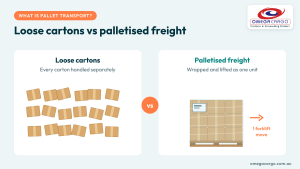
Pallet transport means moving goods that are stacked on a flat platform and secured with stretch wrap or strapping, so the load can be lifted and moved as one unit. One forklift movement replaces dozens of carton lifts, which cuts handling time and lowers the risk of damage.
You will hear several terms for the same service. They overlap, but each has a slightly different use:
|
Term |
What it usually means |
|---|---|
| Pallet transport | The general movement of palletised goods by road, rail or air |
| Pallet freight | Palletised goods moving through a carrier’s network, usually shared with other customers’ freight |
| Palletised freight | Any freight packed onto pallets rather than sent as loose cartons |
| Pallet delivery | Collection and delivery of one or more pallets, often used for metro jobs |
| Interstate pallet delivery | Pallet freight that crosses a state or territory border |
| Less-than-truckload (LTL) | Your pallets share space on a truck with other consignments |
| Full truckload (FTL) | A whole truck or trailer booked for your freight |
For most small and medium businesses, pallet delivery across Australia means LTL. Your pallets join other customers’ freight on a shared linehaul, which is why depots, cut-off times and accurate measurements matter so much.
The Australian standard pallet measures 1165 × 1165 mm, as set out in Australian Standard AS 4068, Flat pallets for materials handling. It is square because it was sized to fit the RACE container used on Australian railways (reference). That is why it suits domestic trucks, rail wagons and warehouse racking so well.
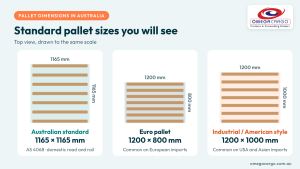
If you import, your goods may arrive on different pallet dimensions. Common footprints include (TNT Australia):
|
Pallet type |
Footprint |
Where you usually see it |
|---|---|---|
| Australian standard | 1165 × 1165 mm | Domestic warehousing, road and rail freight |
| Euro pallet | 1200 × 800 mm | Goods imported from Europe |
| Industrial / American style | 1200 × 1000 mm | Goods from the USA and many Asian suppliers |
Pallet dimensions affect more than fit. A non-standard footprint can load less efficiently on an Australian trailer, may not suit the receiver’s racking, and changes the cubic weight the carrier calculates. If imported goods arrive on mixed pallets, ask whether re-palletising onto Australian standard pallets would make the interstate leg simpler.
Many businesses use pooled pallets hired from pallet pool operators, while others use their own timber or plastic pallets that travel one way. If you send a hire pallet interstate, its movement usually has to be recorded in the hire company’s system, or your business may keep paying for it. Agree with your receiver who accounts for the pallet before it leaves.
Whether you book pallet transport interstate once a year or every week, interstate pallet delivery follows the same basic path with most carriers: quote, preparation, collection, origin depot, linehaul, destination depot, delivery and proof of delivery. Almost every delay or extra charge can be traced back to one of these steps.
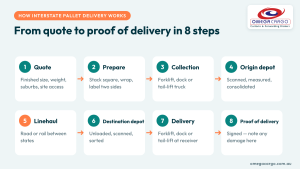
Get step 1 right and most problems never happen. Re-measure charges, failed deliveries and missed departures usually start with incomplete details at booking.
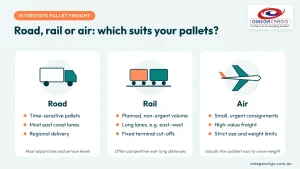
Most interstate pallet freight moves by road or rail. Road suits time-sensitive freight and most east coast lanes. Rail suits planned, non-urgent volume on long lanes. Air is reserved for small, urgent consignments, because full pallets are expensive to fly and must meet strict size limits.
|
Factor |
Road | Rail |
Air |
|---|---|---|---|
| Best for | Time-sensitive pallets, east coast lanes, regional delivery | Planned volume on long lanes | Small, urgent, high-value freight |
| Flexibility | High, with more departures and service levels | Lower, tied to train schedules and terminal cut-offs | Limited by aircraft space and airline cut-offs |
| Cost profile | Varies with service level and route | Often competitive for long-distance volume | Usually the most expensive way to move weight |
| Main watch-out | Express and general services differ | Missing a cut-off means waiting for the next service | Volumetric charges on bulky pallets |
A good provider asks about your deadline and your goods before recommending a mode. If you are shipping pallets regularly or are flexible on timing, ask for road and rail options side by side.
Pallet transport in Australia is priced per shipment, not from one standard rate. The price depends on the pallet’s dimensions and weight, the route, road or rail, the service level, access at both ends, whether the pallet can be stacked, fuel levies and carrier capacity at the time of booking. Cubic weight is often the factor that decides the final figure.
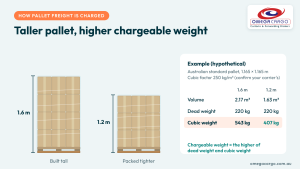
Most carriers charge on chargeable weight: the greater of the pallet’s actual (dead) weight and its cubic weight. Cubic weight turns the space your pallet occupies into an equivalent weight:
Cubic weight = length (m) × width (m) × height (m) × the carrier’s cubic conversion factor
Many Australian road networks use a factor of 250 kg per cubic metre, but each carrier sets its own, so confirm it in your quote or terms. Our guide to CBM and volumetric weight calculations covers the measuring side, and our article on how to estimate freight costs accurately shows how to sense-check an online pallet freight calculator.
Example (hypothetical): You send one Australian standard pallet of homewares from Melbourne to Perth. It is 1.165 m × 1.165 m, built to 1.6 m high including the base, and weighs 220 kg.
Packed more tightly to 1.2 m high, the same goods take up about 1.63 m³, and the cubic weight falls to about 407 kg.
That is why light, bulky goods often cost more to move than their weight suggests, and why an under-declared height is a common cause of re-measure charges.
| Cost driver | Why it matters |
|---|---|
| Dimensions and weight | Decide the chargeable weight |
| Number of pallets | More pallets can shift the job towards a dedicated truck |
| Route and distance | Long lanes and remote areas cost more to service |
| Metro, regional or remote address | Postcodes are often priced differently |
| Service level | Express usually costs more than general |
| Road, rail or air | Each mode prices differently |
| Stackability | Non-stackable pallets use space that cannot be shared |
| Site access | Tail-lifts, residential addresses and timeslots can add charges |
| Fuel levies and surcharges | Move with carrier and market conditions |
| Type of goods | Dangerous, fragile, oversized or temperature-controlled goods need special handling |
| Insurance | Usually separate from the freight rate |
| Carrier capacity | Rates reflect space and demand on the lane when you book |
For the bigger picture across domestic and international freight, see how much it costs to ship cargo in Australia.
Interstate pallet delivery time depends on the service level, road or rail, the route, whether your pallet makes the depot’s cut-off, any transfers along the way and the delivery area. There is no single fixed transit time, so ask your provider for the expected timeframe on your route and what it assumes.
The factors that move it:
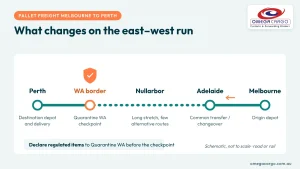
Pallet freight from Melbourne to Perth crosses South Australia and the Nullarbor, so it is one of the longest regular domestic lanes in the country. There are fewer alternative routes if a road closes, the choice between road and rail matters more, and freight entering WA may need a biosecurity declaration.
What to plan for:
The same applies in reverse from Perth to the eastern states, and on Sydney to Perth or Brisbane to Perth. Omega Cargo is a West Australian business, so east–west freight is familiar ground for our team. Our freight forwarding team in Perth can compare road and rail options for your goods.
To prepare a pallet for transport, use a sound pallet, stack heavy items at the bottom, keep cartons square within the edges, stretch wrap the load to the pallet base, measure and weigh the finished pallet, and label at least two sides. A well-built pallet is cheaper to move and less likely to be damaged or re-measured.
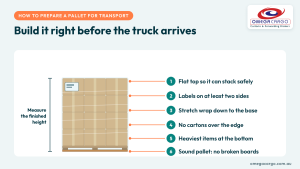
Use this checklist every time you transport pallets interstate:
Tip: If your pallet cannot be stacked on, say so when you book. Finding out at the depot can mean a surcharge, and a pallet stacked on when it should not be is a damage risk.
Several frameworks apply to pallet shipping. They include the Chain of Responsibility under the Heavy Vehicle National Law, load restraint performance standards, the Australian Dangerous Goods Code and each state’s interstate biosecurity rules. Some of these place duties on the business sending the freight, not just the carrier.
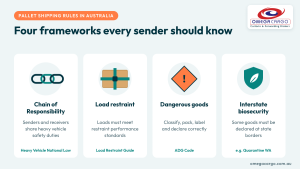
The Chain of Responsibility makes parties other than the driver responsible for heavy vehicle safety, including the business that sends or receives the goods, according to the National Heavy Vehicle Regulator. If you pack, load or consign pallets, declare accurate weights and dimensions and present loads that can be restrained safely. The Heavy Vehicle National Law applies in the ACT, NSW, Queensland, South Australia, Tasmania and Victoria. It has not commenced in Western Australia or the Northern Territory (NHVR).
Loads must be restrained to meet performance standards. The eastern states and the ACT refer to the 2018 Load Restraint Guide, while WA and the NT apply the 2004 edition (National Transport Commission). A square, stable, well-wrapped pallet is much easier to restrain properly.
The Australian Dangerous Goods Code sets the requirements for moving dangerous goods by road and rail, and has legal force in every state and territory. Dangerous goods must be classified, packed, labelled and declared correctly, and not every service accepts them. Our dangerous goods compliance guide covers the import side.
Every state and territory has its own interstate quarantine rules. Check the receiving state’s requirements before sending plants, plant products, animal products, soil-contaminated items or used equipment.
The most common pallet delivery mistakes are quoting on carton sizes instead of the finished pallet, under-declaring weight, forgetting tail-lift requirements, letting cartons overhang, and missing the depot cut-off. Each one adds cost or delay, and each is easy to avoid.
| Mistake | What happens | How to avoid it |
|---|---|---|
| Quoting on carton sizes | Re-measure and an adjustment charge | Measure the built pallet, including the base |
| Under-declaring weight | Re-weigh charges and a safety issue | Weigh the pallet or add up cartons plus the pallet |
| Forgetting a tail-lift | Failed or repeat delivery | Confirm forklift and dock access at both ends |
| Overhanging cartons | Crushed goods and a bigger chargeable size | Stack within the pallet edges |
| Sending a hire pallet without arranging transfer | Ongoing hire charges | Agree pallet accounting before dispatch |
| Missing the cut-off | Pallet waits for the next departure | Book collection with the cut-off in mind |
| Not declaring dangerous goods | Rejected freight and compliance risk | Check the goods against the ADG Code |
| Ignoring WA quarantine rules | Goods detained at the border | Check WA import requirements first |
| Assuming the freight is insured | Limited recovery after loss or damage | Ask about cargo insurance for the full value |
Carrier liability is often limited, so read our guide to freight insurance and what it covers before sending high-value pallets.
Imported goods become interstate pallet freight in four steps: the container is cleared at the port, unpacked at a warehouse, the cartons are palletised and labelled for domestic transport, and the pallets are stored or sent interstate. Planning these steps together avoids container waiting charges and repeat handling.
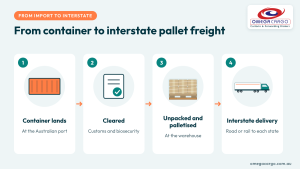
For many importers, the port is not the final destination. Your stock lands in one city, but your customers or stores are spread across several states. If the container clears quickly but then waits for a warehouse slot, extra container charges can build up. And pallets built without the interstate leg in mind may need to be rebuilt later.
Omega Cargo handles the full chain. Our customs and quarantine clearance team clears the goods, our warehousing and logistics service handles container unpacking, palletising and storage, and our interstate transport service moves palletised and loose interstate freight across Australia. If a whole container is moving interstate, see our guide to container transport services in Australia.
Choose a pallet transport company that covers your lanes and delivery areas, explains how it charges, can handle your type of goods, offers road and rail on long routes, and gives you one point of contact. If you import, a provider that also handles clearance and warehousing reduces hand-offs.
Questions worth asking before you book:
Yes. Most interstate pallet freight services carry single pallets on shared linehauls, so you only pay for the space and weight your pallet uses. A single pallet still needs accurate dimensions, a forklift, dock or tail-lift at each end, and secure wrapping, because it travels alongside other customers’ freight.
You need a forklift, a pallet jack with a loading dock, or a carrier truck with a tail-lift. If either address has no forklift or dock, tell the carrier when you book so a tail-lift truck can be arranged. Leaving it until collection or delivery day often leads to a failed attempt.
A non-stackable pallet is one that nothing can be placed on top of, usually because the goods are fragile or the top is uneven. Because it uses space that cannot be shared, carriers often apply a surcharge. Declare it at booking and label the pallet “Do not stack”.
Yes, most carriers accept non-standard pallets, but their dimensions affect how they load and how the cubic weight is calculated. Some receivers’ racking only suits Australian standard pallets, so check with the receiver before sending a 1200 × 800 mm or 1200 × 1000 mm pallet.
Not always. Quarantine WA applies its own biosecurity rules. Commercial transporters must declare regulated items before reaching a WA checkpoint, and goods posing a biosecurity risk can be detained. Plants, seeds, animal products and used machinery all carry conditions, so check the WA import requirements first.
Responsibility is shared. Under the Chain of Responsibility in the Heavy Vehicle National Law, businesses that send and receive goods are accountable for heavy vehicle safety alongside the carrier. For senders, that means accurate weights and dimensions, safe packing and loads that can be restrained properly.
Yes, on services that accept them and only when they are classified, packed, labelled and declared under the Australian Dangerous Goods Code. Lithium batteries, aerosols, paints and some cleaning chemicals can all be dangerous goods, so check before booking rather than after collection.
You need the number of pallets, each pallet’s length, width, height and weight, the pick-up and delivery suburbs, a description of the goods, whether they can be stacked or are dangerous, and whether there is a forklift or dock at each end. Add the goods’ value if you want insurance.
Not automatically for its full value. Carrier liability is usually limited by its terms and conditions, so lost or damaged goods may not be fully recovered without separate cargo insurance. Ask about insurance when you request your quote and check what the cover includes.
Most carriers scan pallets at collection, at each depot and on delivery, so you can follow progress through a tracking reference. Tracking often shows where the pallet was last scanned rather than its live location, so a long linehaul leg may show no update until the next scan.
Good pallet transport starts before the truck arrives. Measure the finished pallet, choose road or rail to suit your deadline, confirm access at both ends, and check border and dangerous goods rules early. Do that, and the usual surprises rarely happen.
If you need interstate pallet transport for your business, or need to clear, unpack and distribute imported goods interstate, Omega Cargo can help. Send your pallet count, dimensions, weights and suburbs through our interstate transport quote form, and our team will come back with options for your route and timeframe. Prefer to talk first? Contact our team.


