
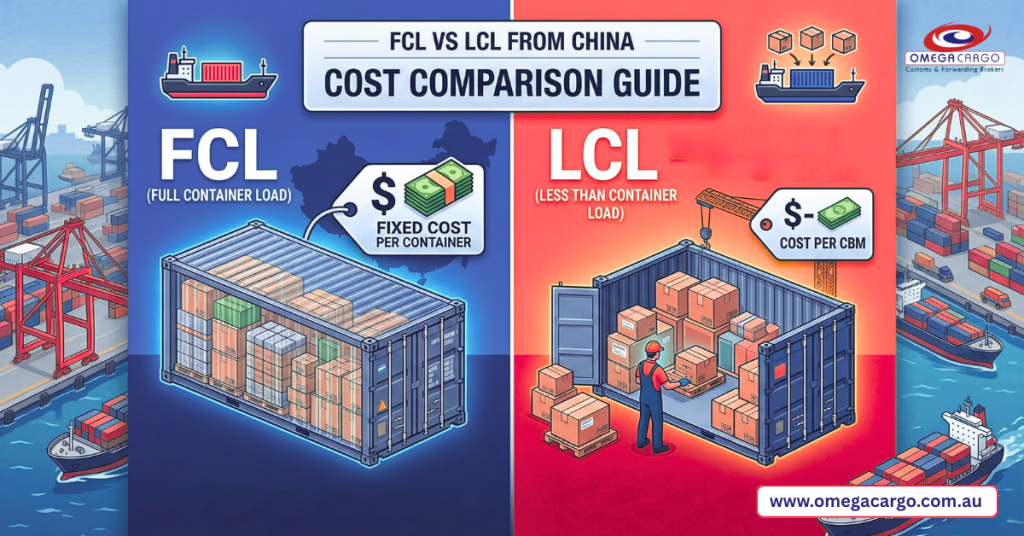
Choosing between FCL vs LCL shipping from China is one of the biggest cost decisions you make every time you place an order with a Chinese supplier. Book the wrong option and you either pay to ship empty space in a full container, or you pay a stack of per-cubic-metre and handling charges that quietly add up to more than a container would have cost.
China is a major source of sea freight imports for Australian businesses, and most shipments leave from large ports such as Shenzhen, Shanghai, Ningbo, Qingdao and Guangzhou. Whether you sell online, run a retail store, import parts for manufacturing or buy stock for a wholesale business, the same question comes up: should you share a container or book your own?
This guide gives you a practical cost comparison without guesswork. You will learn how each option is priced, where the extra charges sit, how to find your break-even volume in cubic metres (CBM), and how transit time, cargo risk, Incoterms and Australian import rules change the answer.
Quick answer: LCL (Less than Container Load) is usually the cheaper choice for smaller shipments because you pay only for the space you use. FCL (Full Container Load) usually becomes better value as your volume grows, because a container is priced as a single unit no matter how full it is. The exact crossover depends on your all-in quotes, the destination port, the season and your cargo, so always compare a full door-to-door quote for both options.
Both are forms of sea freight. The difference is whether you have a container to yourself or share one with other importers. If you come across unfamiliar terms along the way, our shipping terms and acronyms guide explains them in plain English.
With FCL, you book an entire shipping container for your goods only. It does not matter whether the container is packed to the roof or only half full; the space belongs to you.
Think of FCL like hiring a private removal truck. You pay for the whole truck, you don't share it with anyone else's furniture, and once the door is locked it stays locked until it reaches your door.
The most common container sizes used for shipments from China are:
| Container type | Typical usable volume | Best suited to |
|---|---|---|
| 20ft standard (20GP) | About 28 to 33 CBM | Dense or heavy goods and medium-sized orders |
| 40ft standard (40GP) | About 58 to 67 CBM | Larger orders of general cargo |
| 40ft High Cube (40HC) | About 68 to 76 CBM | Bulky, lightweight goods such as furniture, bedding or soft toys (it is taller than a standard 40ft) |
Usable volume depends on carton sizes, pallet use and how well the container is packed. Very dense goods may reach the container's weight limit before its volume limit.
LCL is for orders that are too small to fill a container. Instead of paying for empty air, you share a container with other importers.
Your freight forwarder receives your cartons or pallets at a Container Freight Station (CFS) in China, combines (consolidates) them with other businesses' goods and packs them into one container. When the container arrives in Australia, it goes to a destination CFS where it is unpacked (deconsolidated) so each importer can collect their own cargo.
Think of LCL like catching a bus. You only pay for your seat, but you share the ride, make extra stops and wait for others to get on and off.
CBM stands for cubic metre, the standard unit for measuring cargo volume. It drives your LCL charges and tells you whether LCL or FCL is likely to suit your shipment. You will find a step-by-step calculation later in this guide, and our guide to CBM and volumetric weight calculations goes into more detail.
A fair cost comparison starts with one fact: the two options use completely different pricing structures. It is not an apples-to-apples comparison.
LCL ocean freight is charged per cubic metre. Double your volume and your ocean freight roughly doubles too. The cost rises in a straight line as your shipment grows.
Sea freight LCL is technically charged on a weight-or-measure (W/M) basis: one revenue tonne is either 1 CBM or 1,000 kg, whichever gives the higher figure. Most general commercial goods reach their volume before their weight, so CBM is usually what you pay on. Heavy goods such as tiles, steel parts or liquids may be charged on weight instead.
FCL ocean freight is charged per container. The shipping line charges the same container rate whether you load a modest volume or fill the box completely. Once you have booked the container, filling more of it does not increase the ocean freight.
Because LCL is charged per unit and FCL is charged per container, there is always a volume where buying the whole container becomes cheaper than paying for each cubic metre, even if you are shipping some empty space. That volume is your break-even point, and finding it is the heart of any FCL vs LCL cost comparison.
| Cost element | LCL | FCL |
|---|---|---|
| Ocean freight | Charged per CBM or per tonne (W/M), usually with a minimum charge | Charged per container |
| Origin handling in China | CFS receiving and consolidation charges | Export handling, terminal and documentation charges |
| Destination handling in Australia | CFS deconsolidation and handling charges | Terminal handling and port-related charges |
| Bill of lading | House bill of lading for your share of the container | Master or house bill of lading for the whole container |
| Customs brokerage | Usually charged per import declaration | Usually charged per import declaration |
| Local delivery | Cartons or pallets delivered from the CFS | Container delivered to your premises (or unpacked at a depot) and the empty returned |
| Predictability | More line items and more room for surprises | Fewer line items and usually easier to budget |
If you take away only one idea from this guide, make it this: the break-even point is the volume at which your total all-in LCL cost equals your total all-in FCL cost. Below it, LCL usually wins. Above it, FCL usually wins.
Many forwarders start comparing both options seriously once a shipment reaches the low-to-mid teens of CBM for a 20ft container. Treat that as a prompt to get quotes, not a rule. The real crossover moves with freight rates, destination charges, the season, your origin and destination ports and the nature of your cargo.
You can find your own break-even point with two all-in, door-to-door quotes from your freight forwarder: one for LCL and one for a 20ft FCL container.
The answer is your break-even volume in CBM. If your shipment is below that number, LCL should cost less. If it is above, FCL should cost less, even though you will be paying for some empty space.
Worked example (volume only): say your forwarder's all-in quote for a 20ft container works out to the same total as shipping 14 CBM under the LCL quote. Your break-even volume is therefore 14 CBM. A 9.6 CBM order would sit comfortably in LCL territory, while an 18 CBM order would almost certainly be better value in a 20ft container, which can hold roughly 28 to 33 CBM.
Use this table as a starting point before you request quotes. The bands are based on how full a 20ft container would be, not on any particular rate.
| Shipment volume | How full a 20ft container would be | What usually works best | What to do |
|---|---|---|---|
| Under about 10 CBM | About a third full or less | LCL | Book LCL unless speed or fragility outweighs cost |
| About 10 to 15 CBM | Roughly a third to half full | Grey zone | Get all-in quotes for both and compare them side by side |
| About 15 to 28 CBM | Half full to nearly full | FCL 20ft | A 20ft container is usually the better value |
| About 28 to 33 CBM | Full | FCL 20ft (check fit) | Confirm the cargo physically fits; otherwise move up to a 40ft |
| Above about 33 CBM | Too much for one 20ft | FCL 40ft or 40HC | Compare a 40ft or 40HC with a 20ft plus an LCL top-up |
In the grey zone, small differences in destination charges, the season or your delivery requirements can tip the result either way. Destination CFS charges in Australia can be significant, which sometimes pulls the break-even point lower than importers expect. Ask for quotes for both options to the specific Australian port you use. For a reusable costing method, see our freight cost calculator guide.
The ocean freight rate is never the final price. Both options carry extra charges, but LCL usually carries more of them, and they are harder to predict. This is where many importers come unstuck: they compare ocean rates, see that LCL looks far cheaper, book it, and then receive a larger-than-expected invoice when the goods arrive.
Customs duty and GST apply to both options in the same way, because they are based on the goods rather than the shipping method. They don't change which method is cheaper, but they do affect your total landed cost. Our guide to duty calculation explains how they are worked out.
Some providers attract LCL bookings with an extremely low ocean freight rate and then recover their margin through high destination handling or deconsolidation fees once the cargo arrives. You only see the true cost when you are asked to pay to release your goods.
FCL largely avoids this trap. The container is lifted off the ship and trucked to your premises without being sorted in a shared warehouse, so destination charges are usually fewer and easier to predict. If you value budget certainty, FCL offers a simpler pricing structure.
The fix is simple: always ask for an all-in, door-to-door quote that lists every origin, ocean, destination, customs and delivery charge, and ask the forwarder to confirm what is excluded. You can request a tailored freight quotation from Omega Cargo for both LCL and FCL so you can compare them on the same basis.
Please note: this guide explains how charges are structured. It is not a quotation. Your actual costs depend on your cargo, volume, route, carrier, season, Incoterms and service requirements, and on market conditions at the time of booking.
Here is how to lay out two quotes for a 10 CBM shipment from Shenzhen to Melbourne so you can compare them fairly. The aim is to make sure every charge is accounted for in both quotes before you compare totals.
| Line item | FCL: 20ft container (about a third full) | LCL: 10 CBM in a shared container |
|---|---|---|
| Ocean freight | One container rate | Per-CBM rate × 10 CBM |
| Origin charges | Export documents and terminal handling | CFS consolidation, often charged per CBM |
| Surcharges | Fuel and any peak season surcharges | Fuel and any peak season surcharges, often charged per CBM |
| Documentation | Bill of lading and release | House bill of lading and release |
| Destination handling (Melbourne) | Terminal handling and port charges | CFS deconsolidation and handling |
| Customs brokerage | One import declaration | One import declaration |
| Local delivery | Container delivered and empty returned | Cartons or pallets delivered from the CFS |
| Duty and GST | Same for both options (based on the value of the goods) | Same for both options (based on the value of the goods) |
At 10 CBM, LCL usually comes out cheaper, because you are paying for around a third of a container rather than all of it. As the volume grows towards your break-even point, the gap narrows. Run the same comparison at your typical order volume and you will see where FCL starts to win for your business.
Cost is not the only thing that matters. Transit time is just as important if you manage tight stock levels, respond to sales spikes or import time-sensitive goods.
With a full container, your supplier loads it at the factory, seals it, and a truck takes it to the departure port, such as Shenzhen, Shanghai or Ningbo. When it arrives in Australia, it is cleared and delivered to you. There is no waiting for other shippers.
LCL is generally slower. Your goods must reach the origin CFS before the consolidation cut-off, wait for the container to be packed with other shippers' cargo, and then go through deconsolidation at a destination CFS before they are released. Each step adds time, and a problem with any co-loaded shipment can hold up the whole container.
Transit times for both options depend on the origin and destination ports, carrier schedules, direct or transhipment routing, port congestion, the season, CFS processing and customs or biosecurity clearance. For a shipment-specific estimate, talk to your forwarder, and see our guide to how long it takes to ship from China to Australia for the factors involved. Choosing the right origin and destination ports also matters.
The extra time LCL can add never shows up on the freight invoice, but it has a real cost. If you run lean inventory, a slower arrival can mean stockouts, lost sales, lost marketplace rankings or paying for urgent air freight to fill the gap. A retailer who misses the start of a selling season may not get those sales back.
So a true FCL vs LCL shipping from China cost comparison must include the value of time. Work out what each day of delay costs your business in lost margin or holding costs, and weigh that against any saving LCL offers. Sometimes paying more for a container that arrives sooner is the smarter commercial decision.
Cost is not just what you pay the carrier. It is also the money you lose if goods arrive crushed, wet, contaminated or short. This third dimension of the FCL vs LCL decision is often overlooked until something goes wrong.
An FCL container is loaded at your supplier's premises and secured with a bolt seal. That seal normally stays intact until the container reaches your dock, unless authorities choose to inspect it. Your goods are handled mainly at loading and unloading, so the risk of damage, theft or lost cartons is lower. FCL is well suited to:
LCL cargo is handled many more times. It is trucked to a CFS in China, moved by forklift, packed beside other shippers' goods, unpacked at a CFS in Australia and loaded onto another truck. You don't control what your cargo travels next to, so delicate cartons may sit beside heavy crates. Good packaging reduces the risk, but if you choose LCL you should budget for stronger export packaging and suitable freight insurance.
| Factor | FCL | LCL | Advantage |
|---|---|---|---|
| Main handling points | 2 (load and unload) | 4 to 6 (CFS, load, unload, CFS and transfers) | FCL |
| Damage risk | Lower | Moderate to higher | FCL |
| Contamination risk | Minimal (your goods only) | Possible in a shared container | FCL |
| Customs or biosecurity hold risk | Affects only your shipment | Any co-loaded shipment can delay the container | FCL |
| Visibility and tracking | Full container tracking | Ocean tracking plus CFS updates | Comparable |
| Insurance claims | More straightforward | Harder to prove where damage happened | FCL |
| Fragile goods | Well suited | Use with caution and strong packaging | FCL |
| Small, low-value orders | Often uneconomical | Well suited | LCL |
Now that you understand the costs, transit factors and risk profiles, here is a practical guide to choosing between the two.
You can't compare shipping quotes accurately without knowing your Incoterm. Incoterms are the three-letter trade terms, published by the International Chamber of Commerce, that set out who pays for each part of the journey and when responsibility for the goods passes from seller to buyer. Most Chinese suppliers quote on FOB or EXW terms. Our guide to Incoterms covers the full set.
If your supplier quotes "FOB Shenzhen", the supplier pays to make the goods, move them to the port in Shenzhen, clear Chinese export customs and load them onto the vessel. Your cost and responsibility start once the goods are on board.
FOB is a popular choice with importers because it leaves Chinese export formalities and origin port handling with the supplier, while you choose your own forwarder for the ocean leg and the Australian end. It also makes it easier to compare forwarder quotes on the same basis.
Under EXW, the supplier simply makes the goods available at its premises. You arrange and pay for pickup in China, export clearance and origin port charges.
EXW affects LCL and FCL differently. With LCL, your forwarder has to arrange local trucking of a part load to the consolidation warehouse, which adds a separate pickup charge and another handling step. With FCL, an empty container is delivered to the factory, loaded and trucked to the port, which is often a smoother origin process. Either way, make sure every origin charge is included before you compare an EXW quote with an FOB quote.
If you are importing into Australia, a few local factors can shift the comparison.
Deconsolidation at an Australian CFS is a significant part of the LCL cost, and it is charged on top of the ocean freight. The higher these destination charges are relative to the ocean rate, the sooner FCL becomes competitive. This is why Australian importers should always compare door-to-door quotes rather than origin or port-to-port quotes.
The Department of Agriculture, Fisheries and Forestry (DAFF) applies seasonal measures for brown marmorated stink bug (BMSB) to targeted goods shipped from target risk countries between 1 September and 30 April (inclusive), based on the shipped-on-board date. In DAFF's published measures, China is listed for heightened vessel surveillance and as an emerging risk country, which means goods shipped from China during the season may be selected for random onshore inspection. Country lists and measures are reviewed each season, so check the DAFF page before you ship.
BMSB measures matter more for LCL. DAFF manages LCL and Freight All Kinds (FAK) containers carrying target high-risk goods from target risk countries at the container level before deconsolidation. That means one non-compliant consignment in a shared container can affect everyone's cargo. With FCL, only your own goods and paperwork are in play. Outside the BMSB season, normal biosecurity rules still apply, including import conditions listed in BICON and rules for timber packaging. Our customs and quarantine clearance team can help you prepare.
The China-Australia Free Trade Agreement (ChAFTA) can reduce or remove customs duty on eligible goods that meet the agreement's rules of origin, provided you hold valid origin documentation from your supplier. The duty treatment is the same whether you ship FCL or LCL, so it doesn't change which method is cheaper, but it can make a real difference to your landed cost. Ask your supplier to arrange the Certificate of Origin before the goods leave China, and confirm your tariff classification with your customs broker.
GST is payable on taxable importations whichever shipping method you choose, and the Australian Border Force explains how it is calculated on its GST and other taxes page. GST-registered businesses may be able to claim input tax credits; check with your accountant.
Here is a simple process you can follow for every order.
The formula is length × width × height, with every measurement in metres. Then multiply by the number of cartons.
Example: you are importing 100 cartons of shoes, and each carton measures 60 cm × 40 cm × 40 cm.
At 9.6 CBM, a 20ft container would be about a third full, so this order would normally suit LCL.
Tip: ask your supplier for the packing list before you book. It shows carton dimensions, gross weights and total CBM, so you can check the numbers rather than estimate them.
Use the volume table earlier in this guide to see whether you are clearly in LCL territory, clearly in FCL territory or in the grey zone.
Ask for two quotes, one for LCL and one for FCL, each including origin charges, ocean freight, destination port or CFS charges, customs brokerage and local delivery. Never compare the ocean rate alone.
If LCL is cheaper on paper but slower, estimate what the extra time could cost you in delayed revenue, holding costs or stockout risk. The full picture often shifts the decision.
If your goods are fragile, high value or easily contaminated, add a risk allowance to the LCL option. One damaged shipment can wipe out the savings from many LCL bookings.
Before Christmas and Chinese New Year, both LCL consolidation space and FCL container availability can tighten. Talk to your forwarder well ahead of these periods so your cargo makes the sailing you need.
Once you understand the break-even logic, you can shape your shipments to land on the right side of it.
Say you buy from three Chinese suppliers with 5 CBM, 6 CBM and 4 CBM ready at the same time. Shipped separately as LCL, you would pay minimum charges, destination handling, customs brokerage and delivery three times over.
Some forwarders offer buyer's consolidation: they collect goods from several suppliers at one warehouse in China and ship them together. In this example, 5 + 6 + 4 = 15 CBM, which could be loaded into a single 20ft container under one bill of lading, with one customs entry and one delivery. Even where the combined volume stays below your break-even point, one larger LCL shipment usually costs less than several small ones. Ask your forwarder whether this service is available for your suppliers' locations.
LCL charges you for the space you take up. Oversized cartons, excess void fill and unnecessary inner boxes mean you are paying to ship air. Work with your manufacturer on carton sizes, flat-packing and vacuum-packing soft goods where practical. Every reduction in carton volume flows straight through to a lower chargeable volume, on every order.
Freight rates from China move with supply and demand. They tend to rise in the lead-up to Christmas, when importers rush in holiday stock, and before Chinese New Year, when factories close and shippers try to move goods out first. FCL and LCL rates don't always move by the same amount, so a volume that suits FCL in a quieter month might suit LCL in a peak month, or the other way around. Get fresh quotes for each shipment rather than relying on last time's result.
If you ship on the same lane regularly, ask your forwarder whether it can offer pricing based on your expected annual volume rather than one-off spot quotes. Regular, predictable volumes are easier for a forwarder to plan around.
A valid ChAFTA Certificate of Origin, an accurate commercial invoice and a correct packing list help you claim the duty treatment you are entitled to and reduce the risk of costly clearance delays.
These illustrative profiles show how the decision framework applies to common types of Australian importers.
An online seller is launching a new range of yoga mats and orders a small test batch of around 4 CBM. Decision: LCL. At this volume, a full container would be mostly empty, and the seller needs to protect cash flow. LCL is slower and carries CFS charges, but the overall cost is far lower than paying for a whole 20ft container.
A Melbourne furniture store orders solid timber dining tables from Ningbo, with a typical order of around 12 CBM. Decision: FCL (20ft). The volume sits in the grey zone, but the goods are heavy, high value and easily scratched. A sealed container avoids repeated forklift handling at two CFS warehouses, gets the stock to the store without waiting for deconsolidation and makes any insurance claim simpler. For this retailer, lower risk and a more direct journey justify the container.
A Sydney wholesaler's Shenzhen supplier has an order of about 28 CBM of electronics accessories ready. Decision: FCL (20ft). A 20ft container holds roughly 28 to 33 CBM, so the order uses nearly all of the space. That gives the lowest freight cost per unit and the security of a sealed container.
Whichever option you choose, your goods must clear export formalities in China and customs and biosecurity in Australia. The core documents are the same:
With FCL, the bill of lading covers the whole container. With LCL, you usually receive a house bill of lading for your share of a consolidated container, issued by the forwarder.
Customs brokerage is usually charged per import declaration, whether the shipment is a single pallet or a full container. So if you split a quarter's stock into several small LCL shipments, you pay for several declarations, deliveries and sets of destination charges. Combining orders into fewer, larger shipments reduces those repeated costs.
Ocean freight is generally a lower-emission way to move goods internationally than air freight. Within ocean freight, the key is how well container space is used. LCL consolidation fills containers with several importers' goods, while an FCL container that is only partly full still takes up a full container slot on the vessel.
If sustainability matters to your brand, aim to either fill your FCL containers well or use LCL consolidation for smaller loads. Better packaging helps on both counts.
For small shipments, LCL is usually cheaper because you pay only for the space you use. As your volume grows, FCL becomes better value because the container is priced as one unit. The point where they cross depends on your all-in quotes, cargo, ports and the season, so compare door-to-door quotes for both.
It depends on size and urgency. For very small, light consignments, air freight can sometimes be competitive once sea freight minimum charges and CFS fees are added. For medium-sized shipments, LCL sea freight is often the most economical. For larger volumes, FCL usually gives the lowest cost per unit. Our guide to the cheapest shipping from China to Australia compares the options in more detail.
Container rates change often. They depend on the container size, origin and destination ports, carrier, season, fuel costs, available capacity and wider market conditions. Origin charges, destination charges, customs brokerage and delivery are added on top. Ask for an all-in quote for your specific shipment.
In practice, yes. LCL is offered by freight forwarders and consolidators (often operating as NVOCCs) who book container space with shipping lines and combine cargo from many shippers. A forwarder also coordinates the CFS handling, documentation and Australian clearance.
You can, but it is rarely sensible. A 20ft container holds roughly 28 to 33 CBM and is usually cheaper than a 40ft. As a general rule, choose the smallest container your cargo fits into safely, unless the goods are unusually long or bulky.
Yes. Volume is the limiting factor for most goods, but dense cargo such as ceramic tiles, steel parts or liquids can reach a container's maximum payload before it is full. Each container's rated limits are marked on the container, and road weight limits for trucking at either end can be lower. Confirm the gross weight with your forwarder before loading.
Door-to-door means your forwarder arranges the whole journey: pickup from the supplier in China, export handling, ocean freight, Australian customs and biosecurity clearance, and delivery to your premises. You can get door-to-door quotes for both LCL and FCL, and it is the best basis for comparing them.
Clearance time depends on the accuracy of your documents, tariff classification, any permits required, biosecurity requirements and whether the ABF or DAFF selects the shipment for inspection. Complete paperwork lodged early is the best way to avoid delays. Your customs broker can tell you what your shipment needs before it arrives.
There is no single best method for every shipment. The right choice depends on your volume, cargo, deadlines and budget. Before each order:
For a broader view of the China trade lane, read our guide to freight shipping from China to Australia.
Not sure whether your next order from China should travel LCL or FCL? Omega Cargo can quote both options for your shipment, including origin charges, sea freight, customs and quarantine clearance and delivery, so you can compare them on the same basis.
Request a tailored freight quotation with your cargo details, or contact our team to talk through your shipment requirements.


