
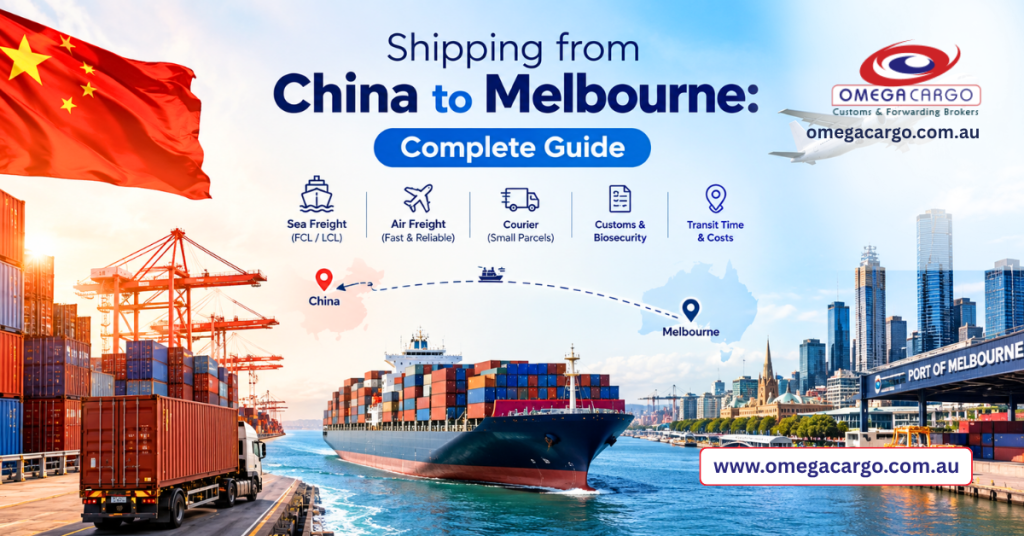
Your supplier in Shenzhen has the goods packed and ready to go, but nobody has told you what actually happens between them leaving the factory floor and turning up at your Melbourne warehouse. Which port do they come into? Why does everyone say Melbourne takes a little longer than Sydney? And who is actually responsible for getting your cargo through Australian customs once it lands?
Shipping from China to Melbourne isn’t a single, simple journey — it’s a chain of decisions about mode, routing, documentation and clearance, and each one changes your cost, your timeline and how much you can go wrong. Melbourne is also a slightly different destination to plan around than Sydney or Brisbane, because of how shipping lines route their vessels and how Victoria’s own biosecurity and customs processing works in practice.
This guide walks through how sea, air and courier shipments actually reach Melbourne from China, what genuinely drives your transit time on this specific route, the customs and biosecurity steps your cargo goes through once it arrives, and the practical mistakes that turn a straightforward import into a costly one.
There’s no single transit time or cost for shipping from China to Melbourne — it depends on your mode (sea, air or courier), whether your cargo travels FCL or LCL, which Chinese port you’re shipping from, and how your shipment clears Australian customs and biosecurity on arrival. Sea freight is the standard choice for anything beyond a few dozen kilograms; air freight suits urgent or high-value cargo; and Melbourne’s position in a vessel’s Australian port rotation is one of the biggest, least-discussed factors in how long your shipment actually takes to land.
Key takeaways:
Melbourne is the destination for an enormous share of Australia’s imports from China, and understanding why helps explain some of the route’s quirks. According to the Port of Melbourne’s own description of its operations, it is “Australasia’s largest maritime hub for containerised, automotive and general cargo” — which means the shipping lines running Asia–Australia services treat it as a core stop, not an afterthought. If your supplier can ship from more than one Chinese port, it’s worth reading our guide to the best ports to ship from China to Australia alongside this one.
That scale cuts both ways for importers. On one hand, competition among carriers and forwarders on the Melbourne leg is strong, and consolidation options for LCL cargo are generally good because there’s enough volume moving through to fill containers regularly. On the other hand, a busy port means more vessels, more berths in use, and more variability in how quickly your specific container gets unloaded and made available once the ship actually arrives.
Melbourne is also Victoria’s principal entry point, so if your customers, warehouse or distribution network sit in Melbourne or regional Victoria, importing directly there — rather than into Sydney and trucking the cargo down — usually keeps your total supply chain simpler, even if the ocean leg itself isn’t always the fastest option on the map.
Most shipments from China to Melbourne move by one of three methods, and the right one depends on weight, volume, value and how urgently you need the goods.
Sea freight is the default for anything beyond a small parcel. Within sea freight, you’re choosing between a full container load (FCL) — an entire sealed container booked for your cargo alone — or less than container load (LCL), where your goods share space and cost with other importers’ cargo in the same container. FCL suits larger, regular volumes; LCL suits smaller shipments that don’t yet justify a whole container.
Air freight moves goods in days rather than weeks, at a proportionally higher cost per kilogram. It makes sense for time-sensitive stock, high-value goods where storage and delay costs outweigh the freight premium, or samples and small commercial quantities where speed matters more than unit cost.
Express courier (the DHL/FedEx/UPS style door-to-door service) suits small parcels and documents where tracking and simplicity matter more than cost efficiency — it’s rarely the cheapest way to move any real volume of commercial cargo. Our air freight in Melbourne service page covers what that option looks like in practice for Melbourne-bound cargo.
| Mode | Best suited to | Trade-off |
| Sea freight — FCL | Larger, regular-volume shipments filling most of a container | Slowest, but most cost-efficient per unit at volume |
| Sea freight — LCL | Smaller shipments not yet justifying a full container | Shares space with other cargo, which can add consolidation and deconsolidation time |
| Air freight | Urgent, high-value, or lightweight/low-volume cargo | Fast, but priced per kilogram or volumetric weight, whichever is greater |
| Express courier | Parcels, samples, and low-volume e-commerce stock | Simple and trackable, but the least cost-efficient at any real scale |
The genuinely correct answer for your shipment depends on how it compares against these trade-offs, not on which mode sounds cheapest in isolation — a rushed air shipment booked to save a week can easily cost more overall than sea freight booked with proper lead time.
The FCL-versus-LCL decision matters just as much on the Melbourne leg as anywhere else, and the underlying logic doesn’t change by destination city: once your cargo volume approaches or fills a container’s practical capacity, FCL usually becomes more cost-efficient, because you stop paying a share of costs for space you don’t use. Below that threshold, LCL lets you pay only for the volume you actually ship — our FCL vs LCL cost comparison walks through that breakeven point in more detail than this section can.
What does change slightly for Melbourne specifically is consolidation timing. Because Melbourne carries such a high volume of LCL traffic, forwarders can usually fill a shared container without a long wait — but your cargo still has to go through deconsolidation once it lands, which adds a processing step (and, on occasion, a day or two) that a full container skips. If your shipment sits close to the FCL/LCL breakeven point, ask your forwarder to model both options against your actual volume rather than defaulting to whichever one they quote first.
This is the question every importer asks, and the honest answer is that it depends on more variables than most guides admit — with one factor specific to Melbourne that’s easy to miss.
Mode is the biggest lever. Air freight measures in days, sea freight in weeks. Within sea freight, whether the service is direct or transhipped (routed via an intermediate port rather than sailing straight to Melbourne) makes a real difference, because a transhipped route adds an extra port call and a cargo transfer.
Melbourne’s position in the vessel’s port rotation matters more than most importers realise. Ships on Asia–Australia routes typically call at several Australian ports in a single rotation — commonly Fremantle, Adelaide, Melbourne, Sydney and Brisbane in some order — before heading back to Asia. Depending on the specific service and shipping line, Melbourne isn’t always the first Australian port of call.
A vessel that visits Sydney or Brisbane before Melbourne will simply take longer to reach Melbourne than an identical sailing that calls there first. This is a scheduling reality of how carriers run their networks, not something specific to your shipment, but it’s one of the most overlooked reasons two “China to Australia” quotes for the same sailing date can carry different Melbourne arrival estimates.
Customs and biosecurity processing at the destination is the other major variable, and it happens after the vessel has already arrived — a shipment can sit dockside for longer than the ocean voyage itself took if documentation is incomplete or the cargo is selected for a biosecurity inspection.
Seasonal demand also plays a role: the lead-up to Chinese New Year and the Australian retail peak season both compress available capacity and can extend the whole chain, from booking to berth availability to trucking out of the port.
None of these factors can be reduced to a single number that stays accurate for long — carrier schedules, port congestion and seasonal demand all shift constantly. What you can do is ask your forwarder for the specific service’s routing (direct or transhipped) and its typical Melbourne port-of-call position, rather than accepting a generic “China to Australia” transit estimate that was never calculated for Melbourne specifically.
Two separate government processes have to be satisfied before your cargo leaves the wharf or airport, and conflating them is one of the most common importer mistakes.
Australian Border Force (ABF) administers customs clearance — checking that your import declaration, tariff classification and any duty or GST liability are all correctly lodged through the Integrated Cargo System. Most commercial shipments go through a formal import declaration prepared by a customs broker, who classifies your goods against the right tariff code and calculates what’s owed. Our Melbourne customs and quarantine clearance team handles this side of the process day to day.
The Department of Agriculture, Fisheries and Forestry (DAFF) administers biosecurity — Australia’s quarantine system, which exists to keep pests, diseases and contaminated packaging out of the country regardless of where the cargo enters. DAFF’s Biosecurity Import Conditions system (BICON) is the official database importers and brokers use to check which conditions and permits apply to a specific commodity, searchable by commodity name or tariff code. Goods arriving from China are assessed under the same national biosecurity framework as goods from anywhere else — Melbourne doesn’t have different rules, but a busy port does mean more inspections happening in parallel, which can affect how quickly your specific shipment is processed once it’s selected.
Common reasons a Melbourne-bound shipment gets held at either stage include an incomplete or inconsistent commercial invoice, a tariff classification that doesn’t match the goods actually shipped (our tariff classification guide covers how this is worked out), wooden packaging or dunnage that hasn’t been treated to the required standard, or a random or risk-based biosecurity inspection that simply takes time to schedule and complete. None of these are unique to Melbourne, but a high-volume port processing many shipments in parallel makes it easier for a paperwork gap to add real delay while your container waits its turn.
Before your cargo can clear at either stage, a customs broker needs a complete and accurate document set. At minimum, that means a commercial invoice with an accurate description and tariff classification, a packing list, and the bill of lading (sea freight) or air waybill (air freight). Depending on the goods, you may also need a permit or treatment certificate identified through BICON.
Incoterms — the standardised international trade terms — decide who is responsible for what along the journey, and getting this wrong is a frequent source of confusion between Chinese suppliers and Australian importers. Our Incoterms explained resource covers all eleven terms if you want the full set rather than just the two most relevant here. Under FOB (Free on Board), your supplier’s responsibility ends once the goods are loaded onto the vessel at the Chinese port, and you (or your forwarder) arrange and pay for the ocean freight, insurance and Melbourne-end clearance.
Under DDP (Delivered Duty Paid), your supplier arranges and pays for the entire journey, including Australian duty and GST, and simply delivers the goods to you — which is simpler for you but puts you at the mercy of your supplier’s chosen (and sometimes inexperienced) freight arrangements into Australia. Neither term is inherently cheaper; each just shifts who manages and pays for which leg of the journey, which is worth negotiating explicitly with your supplier before the shipment leaves China.
Consider a hypothetical Melbourne-based homewares retailer importing a shipment of ceramic tableware from a supplier in Ningbo. The retailer has enough stock to fill roughly a third of a standard container — well under FCL breakeven — so their forwarder books it as LCL, consolidated with other importers’ cargo bound for the same port.
Before the goods leave China, the retailer confirms the Incoterm with their supplier (FOB, in this case, so the retailer’s forwarder handles the ocean leg and Melbourne-end clearance) and provides a complete commercial invoice with an accurate tariff classification for ceramic tableware. Their customs broker checks BICON in advance and confirms the goods don’t carry a specific biosecurity permit requirement beyond standard packaging conditions, and separately confirms that the wooden pallets used for the shipment carry the required treatment certification.
Once the vessel arrives in Melbourne, the shipment goes through deconsolidation — because it travelled LCL — and then through the standard customs and biosecurity checks. Because the paperwork was complete and consistent before the ship even left China, the shipment clears without being flagged for further inspection, and the retailer’s forwarder arranges local delivery to their Melbourne warehouse. The retailer never sees a single “cost” figure quoted in advance that turns out to be final — what they get is a shipment-specific quote covering freight, clearance and delivery, based on their actual cargo and paperwork.
Not every shipment needs a forwarder’s full involvement, but the value becomes clear once your cargo is palletised or containerised, involves a customs broker’s formal declaration, carries any biosecurity risk, or is valuable enough that a clearance delay would genuinely cost you money. On the China-to-Melbourne route specifically, a forwarder who actively manages your booking can also tell you which services are direct versus transhipped, which matters more here than it might sound — because it’s one of the few factors within your control that measurably affects how long your cargo sits between departure and delivery.
A good freight forwarder in Melbourne also handles the coordination between your Chinese supplier, the shipping line, your customs broker and final-mile delivery in Melbourne, so you’re not personally chasing five different parties across two time zones every time something needs confirming.
Before the FAQ below, our general FAQ page covers broader questions about Omega Cargo’s services if the ones here don’t cover your situation.
How long does shipping from China to Melbourne take? It depends on your mode, whether the sea freight service is direct or transhipped, and where Melbourne sits in that vessel’s Australian port rotation — plus however long customs and biosecurity clearance takes once the cargo arrives. Air freight is measured in days; sea freight in weeks, with Melbourne sometimes taking a little longer than Sydney or Brisbane on the same sailing, depending on the port-calling order.
Is Melbourne slower to ship to than Sydney? Not inherently — but Melbourne doesn’t always sit first in a vessel’s Australian port rotation, so some services do reach Sydney before Melbourne on the same sailing. Ask your forwarder about the specific service’s routing rather than assuming either city is always faster.
Which port does cargo from China arrive at in Melbourne? Sea freight arrives through the Port of Melbourne, Australasia’s largest hub for containerised, automotive and general cargo, according to the port’s own description of its operations. Air freight arrives through Melbourne’s international airport.
Do I need a customs broker to import from China to Melbourne? It isn’t legally required for every shipment, but it becomes genuinely valuable once your goods are palletised or containerised, carry any biosecurity risk, or are commercially valuable enough that a clearance delay would cost more than the broker’s fee.
Is FCL or LCL cheaper for shipping to Melbourne? It depends on your volume. LCL lets you pay only for the space you use, which suits smaller shipments; once your cargo approaches or fills a container’s practical capacity, FCL usually becomes more cost-efficient because you’re no longer sharing costs for space you don’t need.
What documents do I need to import goods from China to Melbourne? At minimum, a commercial invoice with an accurate tariff classification, a packing list, and the bill of lading or air waybill. Depending on the goods, you may also need a permit or treatment certificate identified through DAFF’s Biosecurity Import Conditions system (BICON).
Do imports from China to Melbourne attract GST? Most commercial imports into Australia attract GST, generally calculated on the customs value of the goods plus freight and insurance, alongside any applicable duty. The exact calculation depends on your goods’ tariff classification, so it’s worth confirming with your customs broker or the Australian Taxation Office’s current guidance for your specific shipment.
Why would my shipment be held at customs or biosecurity in Melbourne? The most common reasons are an incomplete or inconsistent commercial invoice, an incorrect tariff classification, untreated wooden packaging, or a risk-based biosecurity inspection — none of which are unique to Melbourne, but a high-volume port processing many shipments in parallel can mean a paperwork gap adds more waiting time before it’s resolved.
Is DDP or FOB better for shipping from China to Melbourne? Neither is inherently better — the Incoterm decides who manages and pays for the ocean freight, insurance and Melbourne-end clearance. FOB puts your own forwarder in control of the Australian leg; DDP hands that control to your supplier, which is simpler but means you’re relying on arrangements you don’t manage directly.
How does volumetric weight affect air freight to Melbourne? Air freight is priced on whichever is greater: actual weight or volumetric weight, calculated from your shipment’s dimensions. A bulky but light shipment can cost as much to move as a smaller, denser one, so efficient packing directly affects what you’re quoted.
Can I track my shipment from China to Melbourne? Most freight forwarders and all major courier services provide tracking, though the level of detail varies — a full container booking typically gives vessel and port-call visibility, while an LCL or courier shipment usually tracks at the consignment level.
How do I get an accurate quote instead of a generic estimate? Provide your freight forwarder with your actual cargo weight, dimensions, packaging type, tariff classification and preferred Incoterm. A generic online estimate is built around averages and won’t reflect current carrier capacity, your specific routing, or the clearance requirements your goods actually carry.
☐ Confirmed the Incoterm (FOB, DDP or otherwise) with your supplier in writing
☐ Checked whether FCL or LCL suits your actual shipment volume
☐ Asked your forwarder whether the sailing is direct or transhipped, and where Melbourne sits in the vessel’s port rotation
☐ Confirmed the correct tariff classification for your goods before the commercial invoice is finalised
☐ Checked BICON (or asked your customs broker to check it) for any permit or treatment requirement specific to your cargo
☐ Confirmed any wooden packaging or dunnage carries the required treatment certification
☐ Budgeted for duty and GST separately from the freight cost
☐ Requested a shipment-specific quote rather than relying on a generic online estimate
Every general figure in this guide — including any transit-time pattern or cost driver — is a starting point for planning, not a number you can book against. The only way to know what your specific shipment will actually cost and how long it will take is to get it quoted against your real cargo, your chosen Incoterm, and current carrier capacity into Melbourne.
If you’re importing from China and want your sea freight, air freight and customs clearance handled by a team familiar with the Melbourne route specifically, request a quote from Omega Cargo and have your cargo details, tariff classification and preferred Incoterm ready — that’s what turns a generic estimate into an accurate one. If you’d like to talk through Melbourne-specific freight forwarding, sea freight, air freight or customs and quarantine clearance first, our Melbourne freight forwarding team can walk you through the options for your shipment.


