
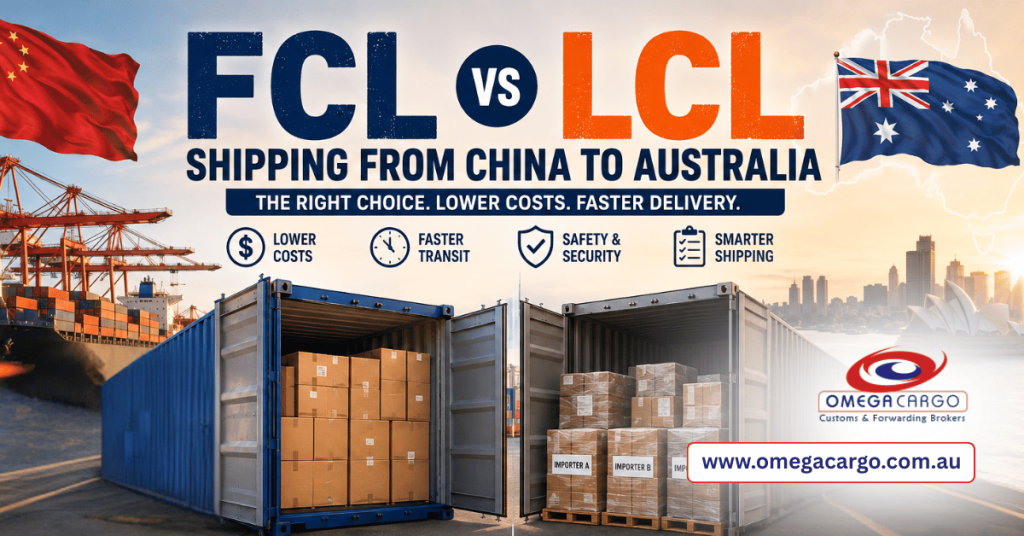
Are you silently losing thousands of dollars on hidden freight charges just because you chose the wrong container type for your imports?
When you run an e-commerce brand, a wholesale business, or a retail store, managing your supply chain effectively is the lifeblood of your profit margins. If you are bringing goods in from overseas, you will inevitably face one major logistical crossroad: deciding between FCL vs LCL Shipping from China to Australia.
Choosing the right shipping method isn't just about getting your products from Point A to Point B. It is about balancing costs, protecting your goods, managing transit times, and navigating Australian customs smoothly. If you guess wrong, you could end up paying for empty air in a container, or worse, dealing with damaged goods and delayed shipments.
Every week, Australian importers face the exact same costly question: "I've got stock ready in Guangzhou, Shenzhen or Ningbo — should I book FCL or LCL?" Get it wrong, and you could pay significantly more than you needed to, or wait considerably longer for stock than your schedule allows. With Australia importing an enormous volume of goods from China every year, this single decision affects your cash flow, your lead time, and your stress levels every single time a shipment hits a delay. Here's the complete, honest breakdown — how rates actually work, how transit times compare, and the exact break-even point that tells you which one to book.
When comparing FCL vs LCL shipping from China to Australia: FCL (Full Container Load) means you book an entire sealed container — best for shipments over roughly 14–16 cubic metres (CBM), with faster transit and no third-party handling. LCL (Less than Container Load) means your cargo shares a container with other shipments — best for smaller volumes, charged per CBM, but it adds extra transit time for consolidation and deconsolidation at both ends. FCL is priced as a flat rate per container and LCL per cubic metre, so the cheaper option flips once your volume passes the break-even point. Rates on this lane move constantly, so always compare current all-in quotes for both options. The right choice depends on your exact cargo volume, timeline and budget.
If you've sourced products from a factory in Shenzhen, Ningbo or Shanghai and you're staring at a shipping quote wondering whether "FCL" or "LCL" is the right box to tick, you're facing one of the most consequential decisions in the entire import process. Choose FCL for a small shipment and you'll pay for empty container space you'll never use. Choose LCL for a large shipment and you could end up paying more per cubic metre than a whole container would have cost — while also waiting weeks longer for your goods to clear consolidation and deconsolidation.
This isn't a decision you can make with a rough guess. The China-to-Australia trade lane is one of the busiest and most closely tracked shipping corridors in the world — and it is genuinely volatile, with peak-season capacity crunches capable of pushing FCL rates sharply higher in a very short space of time. Getting your FCL vs LCL strategy right on this specific lane can genuinely save — or cost — a substantial amount per shipment.
In this comprehensive guide, we will break down exactly what FCL and LCL mean, how to choose the perfect option for your specific cargo, and everything you need to know about the China to Australia trade route.
Whether you are a seasoned importer bringing in heavy machinery or a startup ordering your first batch of custom apparel, this guide is built for you. Let’s dive in and optimize your shipping strategy!
FCL stands for Full Container Load, meaning you rent an entire shipping container just for your goods. LCL stands for Less than Container Load, meaning your goods share space inside a single container with products belonging to other businesses.
Let's break these down in more detail so you can see how they function in the real world.
FCL — Full Container Load
When you choose FCL shipping, you are paying for the exclusive rights to use a 20-foot, 40-foot, or 40-foot High Cube (HC) shipping container.
Think of LCL shipping like taking a public bus, while FCL is like renting a private car. With LCL, you are only paying for the specific volume (measured in cubic meters, or CBM) that your goods take up inside a shared container.
Here's the simplest way to think about it: FCL is renting an entire moving truck for your furniture. LCL is booking space in a shared moving truck alongside three other households' furniture, with everyone's boxes carefully separated, labelled and delivered to the right address at the end. Both get the job done — the right choice depends entirely on how much you're moving.
(Looking for a reliable partner to handle your cargo? View our Sea Freight Services to see how we can streamline your supply chain.)
Now that we have the definitions out of the way, how do you actually decide between FCL vs LCL shipping from China to Australia? The decision usually comes down to four major factors: Volume, Cost, Speed, and Security.
The most mathematical way to choose between FCL and LCL is by looking at the volume of your cargo. Volume in sea freight is measured in Cubic Meters (CBM).
Cost is usually the biggest deciding factor for Australian businesses.
Pro Tip: If your LCL shipment is getting close to 13 CBM, ask your freight forwarder to quote you for both LCL and a 20-foot FCL. You might be surprised to find the FCL is cheaper once all destination handling fees are calculated!
How fast do you need your products on the shelves in Australia?
How fragile are your goods?
The China-to-Australia trade lane runs through a handful of major gateway ports on each side. Your choice of origin and destination port directly affects your transit time, inland trucking cost, and how quickly your goods clear Australian customs.
When managing your FCL vs LCL shipping from China to Australia, geography matters. China is massive, and Australia is a vast island. Shipping from the right port in China to the closest port in Australia will save you time and money on domestic trucking.
Your Chinese supplier will usually suggest a port based on where their factory is located. The busiest and most efficient ports for exporting to Australia include:
Where is your warehouse located? You should always aim to ship to the port closest to your final destination to avoid massive domestic trucking fees.
Port Choice Affects More Than the Ocean Leg
In Australia, your destination port affects your inland cost more than the ocean voyage itself. Sydney and Melbourne are the primary ports of discharge on this lane, but also the most exposed to congestion and storage pressure during peak periods. If you're based in Perth, understand that Fremantle-bound cargo typically has longer sailing times from China than East Coast ports — factor this into your planning, particularly for time-sensitive shipments.
Omega Cargo's in-house customs brokers manage clearance across all major Australian ports.
(Not sure which ports are best for your supply chain? Get a Free Freight Quote and our logistics experts will map out the most cost-effective route for you.)
FCL vs LCL Transit Times — China to Australia (Port-to-Port, Relative)
| Route | FCL Transit | LCL Transit | Notes |
| Shenzhen → Sydney | Fastest on the lane | Longer — adds consolidation time | Busiest South China corridor |
| Shanghai / Ningbo → Sydney | Standard | Longer — adds consolidation time | Strong FCL availability, reliable sailings |
| Shanghai / Ningbo → Melbourne | Standard | Longer — adds consolidation time | Comparable to Sydney routing |
| Ningbo → Brisbane (LCL) | — | Can be faster than average — confirm current sailings | Can be faster than average — confirm current sailings |
| Guangzhou / Shenzhen → Fremantle | Longer — fewer direct services | Longer again | Longer sailing to WA; fewer direct services |
| Tianjin → Sydney | Longest — northern China routing | Longest | North China — longer coastal routing, fewer direct sailings |
| General China → Australia average | Faster of the two | Longer of the two | Industry-wide average across all major ports |
Door-to-door timelines (including origin trucking, export customs, Australian import clearance, and final delivery) add meaningfully on top of port-to-port transit for both options — and proportionally more for LCL, because of consolidation at origin and deconsolidation on arrival. Peak season can extend all timelines further. Always ask your Freight Forwarder for a current door-to-door estimate for your specific route. |
|||
Time is money. Understanding transit times is critical for your inventory planning.
When we talk about "transit time," we are usually talking about Port-to-Port time (the time the ship is actually on the water). However, you need to plan for Door-to-Door time (from the factory in China to your warehouse in Australia).
Relative Port-to-Port Sea Freight Times (China to Australia):
FCL vs LCL Door-to-Door Reality:
If you are running a tight promotional schedule (like Black Friday or Christmas sales), you must factor in this extra LCL padding time so you aren't caught without inventory.
The China-Australia lane is subject to periodic capacity crunches, where an Oceania peak-season surge tightens vessel space and equipment availability across Pacific routes. This pushes both rates and transit reliability in a less favourable direction, sometimes for months at a time. If you're planning a shipment during a traditional peak window — ahead of the Christmas retail season, or around Chinese New Year (when Chinese factories close for an extended period) — build in extra buffer time and lock in your booking earlier than you normally would. Rate quotes on this lane should generally be treated as short-dated given ongoing market volatility.
When analyzing FCL vs LCL shipping from China to Australia, the invoice can look like a foreign language. Here is a transparent breakdown of what you are actually paying for.
Regardless of whether you choose FCL or LCL, the Australian government will want their share.
(Need help navigating ChAFTA and customs duties? Check out our Customs Brokerage solutions and let our licensed brokers handle the red tape for you.)
If you have decided that a Full Container Load is the best move for your business, here is exactly how the process works from start to finish.
Select between a 20' Standard, 40' Standard, or 40' High Cube. Your supplier can help calculate which container fits your order.
Incoterms define who pays for what. For FCL, FOB (Free on Board) is the most common. This means your Chinese supplier pays to load the container and get it onto the ship in China. You pay for the sea freight to Australia and everything thereafter.
Contact your Australian freight forwarder. They will coordinate with the shipping line to secure a container and book space on a vessel.
An empty container is driven to your supplier’s factory in China. They load the goods, seal the doors, and the container is driven back to the Chinese port.
The Chinese customs clear the goods for export. The container is loaded onto the vessel and begins its voyage to Australia (sailing time varies by origin and destination port pair).
While the ship is on the water, your customs broker will lodge your paperwork with the Australian Border Force (ABF) and pay your GST and import duties.
Once the ship arrives and the container is discharged from the vessel, a truck picks up your sealed container and delivers it directly to your warehouse. You will generally have a "live unload" (where you have a few hours to unpack it while the driver waits) or a "drop and pick" (where they leave the container for a few days).
If you are shipping smaller volumes, LCL is your go-to. Here is what the LCL process looks like.
Ask your supplier for the exact dimensions and weight of your packaged goods. This will dictate your LCL costs.
Because your goods will be handled multiple times, ensure your supplier uses strong, export-grade boxes and secures them onto pallets. Crucial for Australia: All timber pallets must be ISPM15 treated to pass biosecurity!
Under FOB terms, your supplier will arrange to truck your pallets to the freight forwarder’s warehouse at the Chinese port (e.g., in Shenzhen).
The forwarder carefully packs your pallets into a container alongside goods from other businesses headed to the same Australian port.
The shared container is loaded onto the ship and sails to Australia.
When the container arrives in Sydney or Melbourne, it doesn't go to you immediately. It goes to a bonded deconsolidation warehouse. The container is opened, and the goods are separated by company.
Your customs broker clears your specific goods. Once cleared, a local courier or truck picks up your pallets from the deconsolidation warehouse and delivers them to your door.
Not Sure If FCL or LCL Is Right for Your Shipment?
Omega Cargo will run a side-by-side FCL vs LCL comparison quote for your exact cargo volume and route — so you know exactly which option saves you money.
Get Your Free Comparison Quote or Freight Forwarding Services
Whether you choose FCL or LCL, there's a significant cost-saving opportunity that applies to both: the China-Australia Free Trade Agreement (ChAFTA). This is one of the most under-utilised duty concessions among Australian importers sourcing from China.
Under ChAFTA, Australian import tariffs were set to zero on the large majority of China's exports from the agreement's start, with tariffs on the remaining eligible goods phased down to full elimination over the agreement's implementation period. For eligible goods manufactured in China, this means
instead of the standard Most Favoured Nation (MFN) rate, which varies depending on the HS tariff code. On a substantial shipment, eliminating duty entirely is a meaningful saving — money that goes straight back into your margin, every single shipment, for as long as you keep importing from China.
To claim ChAFTA's duty-free or reduced-duty treatment, you must obtain a ChAFTA Certificate of Origin — a formal document issued by an approved body in China confirming your goods qualify as originating from China under the agreement's rules. Without this certificate, your goods will be assessed at the standard MFN duty rate regardless of whether they would otherwise qualify. This is a document you need to request from your Chinese supplier before the shipment departs — it cannot always be obtained retroactively once the goods have already arrived in Australia.
Before every shipment from China, ask your supplier: "Can you provide a ChAFTA Certificate of Origin for this order?" Then confirm with your customs broker that your specific HS tariff code is eligible for ChAFTA concession. This applies equally to FCL and LCL shipments; the duty saving has nothing to do with your container choice, only your goods' country of origin and correct documentation.
Regardless of whether you choose FCL or LCL, every shipment from China to Australia must clear the same two government authorities: the Australian Border Force (ABF) for customs, and the Department of Agriculture, Fisheries and Forestry (DAFF) for biosecurity.
China-Australia Import Compliance Essentials
| Requirement | Applies To | Key Detail |
| Import Declaration (N10) | All commercial shipments above the customs value threshold | Lodged by licensed customs broker via ABF ICS |
| GST | Most imported goods | Applied to Value of Taxable Importation — claimable if GST-registered |
| Customs Duty | Non-ChAFTA-eligible goods | Rate depends on your HS code — nil rate for eligible ChAFTA goods |
| ChAFTA Certificate of Origin | Goods claiming duty-free treatment | Must be obtained from supplier before departure |
| Packing Declaration | All sea freight shipments (FCL and LCL) | Confirms packing materials meet DAFF biosecurity standards |
| ISPM 15 Wood Packaging | Any wooden pallets, crates or dunnage | Must be heat-treated and stamped — untreated wood risks DAFF hold |
| Correct HS Tariff Code | Every imported item | Determines duty rate, FTA eligibility and permit requirements |
| DAFF biosecurity requirements apply to both FCL and LCL shipments equally. However, LCL shipments involve additional handling during consolidation and deconsolidation, which can occasionally increase the chance of biosecurity flags related to packing material or cross-contamination risk from other cargo in the shared container. | ||
One of the most common — and entirely preventable — causes of DAFF holds on China-Australia shipments is untreated wooden packaging material: pallets, crates, or dunnage that hasn't been properly heat-treated and stamped under the international ISPM 15 standard. Before your goods are loaded in China, confirm with your supplier that any wood packaging carries the correct ISPM 15 stamp. This applies equally whether you're shipping FCL or LCL — and it's one of the simplest compliance checks that prevents a costly and completely avoidable biosecurity hold.
You import consistently and your typical order comfortably exceeds 16 CBM per shipment. Predictability and speed matter for your supply chain.
FCL Recommended
You're trialling a new product or supplier with a smaller initial order under 10 CBM. Minimising upfront cost matters more than speed right now.
LCL Recommended
Electronics, glassware, or precision equipment where handling risk and contamination concerns outweigh the cost savings of sharing a container.
FCL Recommended
Your orders are growing but still sit in the 8–14 CBM "gray zone." Request both FCL and LCL quotes side by side before every shipment.
Compare Both Quotes
Whether you ship FCL or LCL, you need a freight forwarder. A forwarder acts as your travel agent for cargo. They don't own the ships, but they buy space on them and manage the logistics.
To ensure your FCL vs LCL shipping from China to Australia goes off without a hitch, look for a forwarder that offers:
To wrap up the strategic section of this guide, here are five insider tips that experienced importers use to save money and avoid headaches:
FCL (Full Container Load) means you book and pay for an entire shipping container — 20-foot or 40-foot — exclusively for your cargo, which is sealed at your supplier's facility in China and stays sealed until it reaches your Australian warehouse or door. LCL (Less than Container Load) means your cargo shares a container with other importers' goods, and you pay only for the cubic metres (CBM) your cargo actually occupies. FCL offers faster transit, no third-party handling of your goods, and lower per-unit cost for larger shipments. LCL offers lower upfront cost for smaller shipments, but adds transit time for consolidation and deconsolidation, and carries a small risk of cross-contamination or damage from other cargo in the shared container.
It depends on your volume. For cargo under 13 CBM, LCL is cheaper. For cargo over 15 CBM, FCL becomes more cost-effective because you avoid the high handling and deconsolidation fees associated with LCL.
Yes, both methods can be used for personal effects. LCL is common for moving a few boxes or furniture pieces, while FCL is used for moving a whole house. However, be aware that the Australian Border Force strictly inspects personal effects for biosecurity risks (soil, untreated wood, plant matter).
No, Australia does not require a general import license for businesses or individuals. However, depending on the type of goods you are importing (e.g., alcohol, tobacco, chemicals, certain foods), you may need specific permits from relevant government departments.
You can legally avoid standard import duty by utilizing the China-Australia Free Trade Agreement (ChAFTA). You must ask your Chinese supplier to provide a formally certified "ChAFTA Certif
If damage occurs during transit, you will need to file a claim with your cargo insurance provider. Because LCL goods are handled multiple times, damage is slightly more common than with FCL. This is why having comprehensive marine cargo insurance is essential; do not rely on the freight forwarder's limited liability coverage.
If your paperwork is submitted correctly by your customs broker before the ship arrives, customs clearance is usually granted quickly after the vessel docks. If customs flags your cargo for an X-ray or physical inspection, expect it to delay delivery further.
DAFF publishes the Brown Marmorated Stink Bug (BMSB) risk season dates each year, along with the list of target risk countries. During the risk season, Australia enforces strict fumigation rules on certain high-risk goods coming from or passing through target risk countries. While China is generally not a target risk country for BMSB, if your ship transits through a risk area, or if you are importing specific manufactured goods, you may be subject to mandatory fumigation. Always check current DAFF guidelines with your forwarder.
Mastering the dynamics of FCL vs LCL shipping from China to Australia is a superpower for your business.
By taking the time to understand your cargo volume, evaluating your required transit times, and partnering with the right local freight forwarder, you can strip unnecessary costs out of your supply chain and increase your profit on every single product you sell.
Remember the golden rule: If you are shipping less than 13 CBM, book LCL. If you are shipping 15 CBM or more, book an FCL container. And above all, never let your supplier control your freight all the way to Australia—take control of your shipping via FOB terms and use an Australian-based logistics partner.
Ready to import with confidence?
Stop guessing with your shipping costs. Whether you have a few pallets or multiple 40-foot containers ready to leave China, our team of Australian logistics experts and licensed customs brokers is here to provide you with a transparent, cost-effective solution.
Get Your Free, No-Obligation Freight Quote Today and let us optimize your next shipment from China to Australia!
The FCL vs LCL decision on the China-Australia lane ultimately comes down to one number: your cargo volume in cubic metres, compared against current market rates for your specific route. Below roughly 14–16 CBM, LCL usually wins on cost. Above that threshold, FCL usually wins on both cost and speed. In the "gray zone" between 8 and 16 CBM, the only reliable answer is a direct side-by-side quote comparison for your exact shipment.
But the decision doesn't stop at cost. Speed matters if you're managing tight retail deadlines. Cargo sensitivity matters if you're shipping anything fragile, high-value or contamination-sensitive. And regardless of which option you choose, claiming your ChAFTA duty concession and getting your biosecurity documentation right — correct HS codes, ISPM 15-compliant wood packaging, complete Packing Declarations — determines whether your shipment clears Australian customs in hours or gets held for weeks.
Omega Cargo has managed the China-Australia trade lane for decades — with in-house licensed customs brokers, ChAFTA expertise, and both FCL and LCL consolidation programs across all major Chinese and Australian ports. Whether your next shipment is 3 CBM or a full 40-foot container, we'll help you choose the option that actually saves you money.
Ready to Ship from China to Australia?
Omega Cargo — decades of experience on the China-Australia lane. FCL, LCL, in-house ABF-licensed customs brokers, and ChAFTA duty concession expertise across all major ports.


