
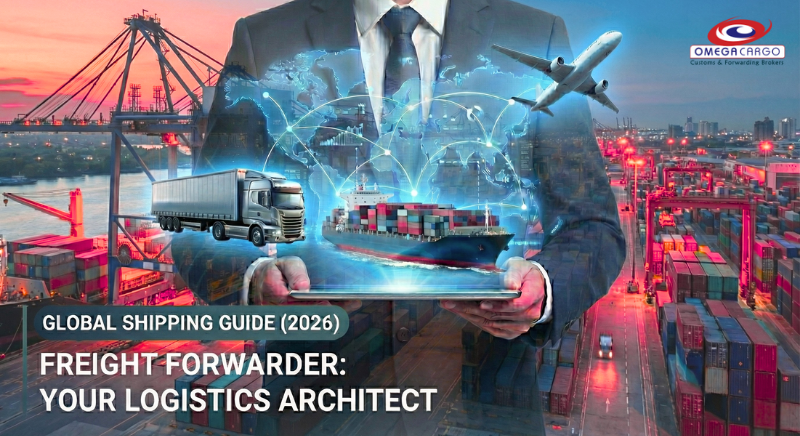
Imagine you have a pallet of handmade furniture in a warehouse in Vietnam, and a customer waiting for it in a storefront in Chicago. Between point A and point B lies a vast, complex maze: trucks, ports, cranes, a massive ocean, customs inspectors, taxes, more trucks, and a mountain of paperwork.
How do you get your goods across the world without losing your mind—or your money?
This is where the heroes of the global supply chain step in. Welcome to your complete global shipping guide (2026). In this article, we are going to answer the big question: What is a freight forwarder?
We will break down exactly what they do, why you need them, and how the freight forwarding industry trends of 2026 are changing the game. Whether you are a small business owner shipping your first box or a logistics manager looking for better logistics solutions, this guide is for you.
Global trade is moving faster than ever. In 2026, the world will be more connected, but international logistics has also become more complicated. New regulations, environmental rules, and shifting trade routes mean that moving goods is no longer just about putting a box on a boat.
If you are involved in import and export, you know that one missing document or one missed connection can result in your cargo sitting at a port for weeks, racking up storage fees.
This is why freight forwarding companies are essential. They are the architects of the shipping world. They don't usually own the ships or the planes, but they know exactly how to use them to get your cargo transportation done right. They are the glue that holds the global supply chain together.
In this guide, you will learn everything you need to navigate the waters of global shipping and transportation. We will keep it simple, friendly, and packed with actionable advice.
A freight forwarder is an intermediary—a middleman—between you (the shipper) and the transportation services that move your goods (like shipping lines, airlines, and trucking companies).
Think of a freight forwarder as a travel agent for your cargo.
When you want to go on a complex vacation to three different countries, you could book every flight, bus, hotel, and tour guide yourself. But it would be stressful, and if one flight is delayed, your whole trip will be ruined. Instead, you hire a travel agent who books everything, finds you the best routes, gets you deals, and fixes problems if they happen.
Freight forwarding services work the same way:
A freight forwarder definition often includes the fact that they are experts in import export regulations. They know the rules so you don’t have to.
Usually, no. Most freight forwarders do not own the massive container ships or the Boeing 747 cargo planes. Instead, they use their massive buying power to negotiate low rates with the carriers who do own the assets. Then, they pass those savings and services on to you.
In the world of international freight forwarding, terms often get confused. You might hear "broker" or "3PL" and wonder if they are the same thing. They are not. Here is the breakdown so you can choose the right partner.
In 2026, the lines are blurring. Many freight forwarding companies now offer 3PL services like warehousing, and many 3PLs offer freight forwarding services. However, if your main need is moving bulk goods internationally, a forwarder is your best bet.
You might be thinking, "Can't I just call the airline or the shipping line myself?"
Technically, yes. But here is why freight forwarder benefits usually outweigh the DIY approach.
Freight forwarders ship huge volumes of cargo. Because they ship so much, they get "bulk discounts" from carriers. They can offer you a shipping rate that is much lower than what you would get if you called the shipping line directly.
International logistics is a headache. You have to deal with Incoterms, HS codes, port authorities, and foreign languages. A forwarder speaks this language fluently. They manage the complexity so you can focus on making and selling your product.
What happens if your goods get stuck in the Suez Canal? Or if a strike shuts down a port in Germany? A freight forwarder has a global network of agents. They can re-route your cargo, find alternative transport, and solve problems you didn't even know existed.
Getting your goods detained at the border is a nightmare. Customs documentation is strict. If you miss a comma or use the wrong code, you face fines or delays. Forwarders ensure your paperwork is perfect before the goods ever leave the factory.
Do you need freight handling services for hazardous materials? Or perhaps you need a refrigerated container (reefer) for food? Forwarders have access to specialized equipment and services for any type of cargo.
To understand freight forwarding services, you need to know the different ways cargo moves. A good global shipping guide covers the "Big Four" modes of transport plus the essential support services.
Air freight is the race car of logistics.
Pro Tip for 2026: Air freight rates are becoming more dynamic with AI pricing. Ask your forwarder about "spot rates" vs. "contract rates."
Sea freight is the workhorse of the global economy. 90% of world trade moves by sea.
Ships and planes don't land at your warehouse door. You need freight handling services on the ground.
This is perhaps the most critical service. Customs clearance involves declaring your goods to the government to pay duties and taxes (tariffs).
Sometimes you aren't ready to receive the goods yet. Forwarders offer:
Carriers have limited liability. If a ship sinks, the shipping line might only owe you $500 for a container worth $50,000. Freight forwarders offer cargo insurance to protect the full value of your goods against loss, theft, or damage.
Let’s walk through the international shipping process. This is the lifecycle of a shipment handled by a forwarder.
Your forwarder arranges a truck to pick up the empty container from the port and drive it to your supplier's factory. The supplier loads the goods. The truck takes the full container back to the port.
Before the goods can leave the country of origin, they must be cleared by local customs. The forwarder submits the details to ensure nothing illegal is leaving and all licenses are in place.
At the port or airport, the cargo is unloaded from the truck, inspected, and prepared for loading onto the vessel or plane. This includes validation of the customs documentation.
This is the main leg of the journey. Your forwarder has booked a "slot" on a ship or plane. The carrier takes over and moves the goods across the ocean or sky.
Before the goods arrive (or as soon as they land), the forwarder begins the import clearance process. They submit the paperwork to the destination country's customs. You pay the duties and taxes here.
The ship arrives. Cranes lift the container off the ship. The port workers handle the cargo and prepare it for the final truck.
The final mile. The forwarder arranges a truck to pick up your goods from the port and deliver them to your warehouse door.
To help you understand how this works in practice, let's look at a hypothetical scenario using freight forwarding services in 2026.
The Situation: You own a tech company in California. You need to import 5,000 wireless headphones from a factory in Hanoi, Vietnam.
Without a forwarder, you would have had to coordinate a Vietnamese trucker, a shipping line, a warehouse in Dubai, an airline, a US customs broker, and a US trucking company. The forwarder did it all with one email.
In import export logistics, paperwork is king. If you don't have the right paper, you don't have your cargo. Here are the documents your forwarder will help you manage:
This is the bill of sale from the seller to the buyer. It lists what the goods are, how much they cost, and the Incoterms (who pays for shipping). Customs uses this to calculate taxes.
This tells you exactly what is in each box. It includes weight, dimensions, and item counts. It does not include prices.
This is the most important document. It is three things in one:
A document declaring where the goods were manufactured. This is crucial for trade agreements. For example, if you are importing from a country with a Free Trade Agreement, this document can make your import tax-free.
Similar to a Bill of Lading, but for Air Freight. Unlike a BOL, an AWB is not a document of title—it’s just a receipt and contract.
If you are shipping batteries, chemicals, or liquids, you need this to prove the cargo is safe to handle.
The world of Global shipping and transportation is changing. As we look at the freight forwarding industry trends for 2026, here is what you need to watch out for.
The days of fax machines are gone. In 2026, the best freight forwarding companies use Artificial Intelligence.
Environmental regulations are getting stricter.
After the supply chain crisis of the early 2020s, companies are prioritizing safety over just low cost.
Forwarders are becoming more like tech companies. They are integrating their software directly with platforms like Shopify and Amazon. This means when you sell a product, the shipping order is created automatically.
With thousands of companies out there, freight forwarding company selection can be tough. Here is a checklist to help you pick the right partner in 2026.
Does the forwarder know your industry? If you ship frozen food, don't use a forwarder who specializes in dry clothes. Ask for case studies of clients in your specific sector.
Do they have their own offices in the country you are importing from, or do they use third-party agents? A forwarder with their own office in the origin country usually has better control and communication.
Ask for a demo of their customer portal.
Shipping costs money. If your forwarder goes bankrupt while your goods are on the water, your cargo could be held hostage by the carrier. Check their reputation and financial health.
When things go wrong (and they will), you need a human to talk to. Call their support line. Do you get a robot or a person? Do they seem friendly and helpful?
Be careful of "hidden fees." A bad forwarder will give you a cheap quote but hit you with extra charges like "documentation fees," "handling fees," or "chassis fees" later. Ask for an "All-In" quote.
Navigating the world of import and export doesn't have to be scary. While the international shipping process is filled with steps, rules, and potential pitfalls, you don't have to walk it alone.
A good freight forwarder is more than just a vendor; they are a strategic partner in your business. They turn the chaos of global supply chain logistics into a smooth, predictable process. They save you time, reduce your costs, and ensure your goods arrive safely.
As we move through 2026, leverage the new freight forwarding services available to you. Use the digital tools, explore green shipping options, and build a relationship with a forwarder who understands your vision.
Whether you are shipping via Air Freight or Sea Freight, the world is open for business. Now that you have this global shipping guide, you are ready to ship with confidence.
Ready to move your cargo? Start by vetting your potential partners using the checklist above, and take control of your logistics today.
Disclaimer: This guide is for informational purposes. Import and export regulations change frequently. Always consult with a licensed customs broker or legal professional for specific advice regarding your shipments.
In the United States, international freight forwarding involves compliance with U.S. Customs and Border Protection (CBP) regulations. A freight forwarder helps you file import and export declarations, manage customs clearance, calculate duties, and ensure compliance with U.S. trade laws for air freight and sea freight shipments.
Freight forwarding in Europe requires compliance with EU customs rules, VAT regulations, and cross‑border trade policies. A freight forwarder helps you manage customs documentation, Intrastat reporting, and smooth cargo transportation between EU member states and non‑EU countries.
In Asia and the Middle East, freight forwarding often involves complex port operations, free trade zones, and region‑specific import export regulations. A local‑experienced freight forwarder ensures smooth customs clearance, port handling, and inland transportation across countries such as China, India, UAE, and Saudi Arabia.
Yes. In developing markets, freight forwarding may involve additional documentation checks, port congestion, and regulatory delays. An experienced international freight forwarding partner helps you reduce risk, manage customs inspections, and maintain predictable delivery timelines.
The best method depends on your priorities. Air freight forwarding is best for urgent or high‑value goods, while sea freight forwarding is ideal for bulk cargo and cost‑efficient global shipping. A freight forwarder helps you choose the right option based on destination, budget, and delivery time.
Freight forwarders connect manufacturers, suppliers, ports, carriers, and customs authorities. By coordinating transportation, documentation, and compliance, they strengthen the global supply chain and reduce disruptions in international logistics.
Common customs documentation includes commercial invoices, packing lists, certificates of origin, bills of lading, and import or export licenses. Your freight forwarder prepares and verifies these documents to ensure smooth customs clearance in any country.
You should choose a freight forwarder based on global coverage, experience in your target regions, knowledge of local regulations, transparent pricing, and reliable customer support. Strong freight forwarding company selection improves long‑term shipping performance.
Freight forwarding services are global but often supported by local offices or partners. This local expertise helps manage country‑specific regulations, port procedures, and customs clearance requirements.
In 2026, global shipping faces stricter regulations, digital customs systems, and sustainability requirements. Freight forwarders help you adapt to these changes while keeping your cargo compliant, cost‑efficient, and competitive worldwide.


