
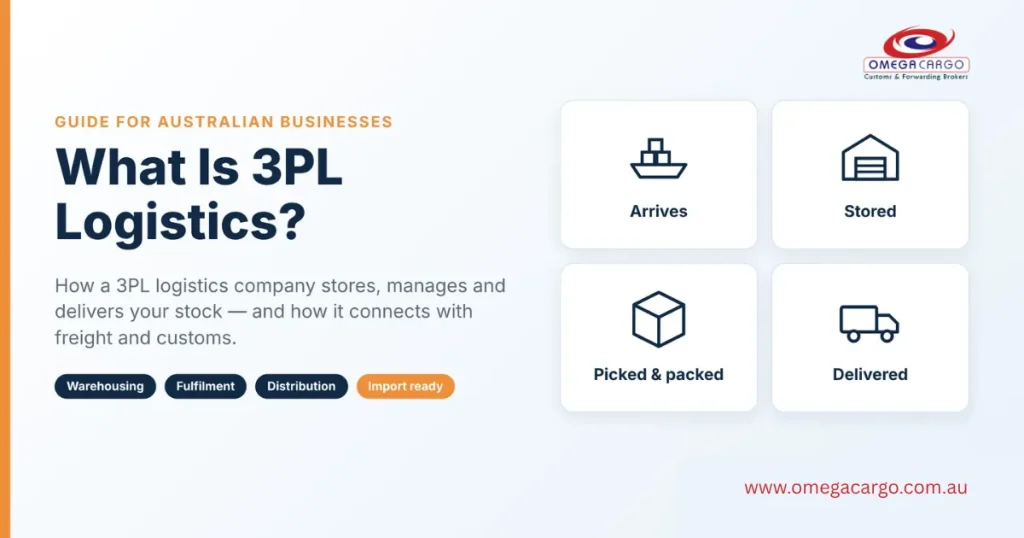
Your container has cleared customs. The pallets are sitting at a depot in Fremantle or Port Botany. Now what? Who unpacks them, where does the stock live, and who sends out the orders when your customers start buying?
For a growing number of Australian importers, the answer is a 3PL logistics company an outside business that stores, manages and dispatches your goods so you don’t have to run a warehouse yourself. But is handing your stock to someone else actually the smart move, or just another layer of cost?
3PL (third-party logistics) means outsourcing some or all of your physical logistics receiving, storage, inventory control, order picking and packing, transport and returns to a specialist provider. A 3PL logistics company runs those operations on your behalf using its own warehouses, systems and transport network, so you pay for the capacity you use instead of building it yourself.
This guide explains how 3PL logistics in Australia works, what third party logistics services really include, and how a 3PL fits into the import journey alongside your freight forwarder and customs broker. You’ll also see what drives 3PL pricing, how to tell whether your business is ready, and the questions to ask before you sign anything.
The 3PL meaning is straightforward: it stands for third-party logistics, sometimes written as 3rd party logistics (3PL). The “third party” is the outside provider that sits between you (the first party, who owns the goods) and your customer or the transport carrier (the second party). Instead of renting a warehouse, hiring staff and buying forklifts and software, you contract those functions out to a third party logistics provider.
In practice, 3PL logistics usually covers everything that happens to your goods once they reach Australia and before they reach your customer: receiving, storing, tracking, picking, packing, dispatching and processing returns.
A 3PL logistics company operates the physical infrastructure warehouse space, racking, materials handling equipment, a warehouse management system (WMS) and transport links and shares it across many clients. You get access to that capacity without the fixed overhead.
The arrangement is usually set out in a service agreement covering the activities the 3PL performs, the service levels it commits to, how it charges, and who is liable for loss or damage. Some businesses outsource everything. Others keep their own warehouse and use a 3PL only for overflow during peak season, or for a second location interstate.
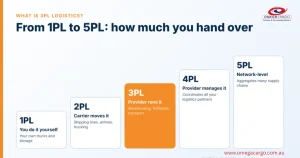
You’ll often see 3PL mentioned alongside 2PL and 4PL. The numbers describe how much of the supply chain you hand over.
| Model | Who does the work | Typical example |
| 1PL | You move and store your own goods | A manufacturer delivering with its own trucks |
| 2PL | A carrier moves goods you’ve booked | A shipping line, airline or trucking company |
| 3PL | A provider runs warehousing, fulfilment and transport for you | A contract warehouse that stores, picks, packs and dispatches your stock |
| 4PL | A lead provider manages your whole supply chain, including other 3PLs and carriers | A logistics manager that plans and coordinates multiple providers on your behalf |
| 5PL | A provider aggregates supply chains across many clients, often technology-led | Network-level planning across several businesses’ volumes |
For most Australian small and medium-sized businesses, the practical choice is between doing it yourself and using a 3PL. A 4PL usually only makes sense once your supply chain spans multiple warehouses, carriers and markets that need a single point of management.
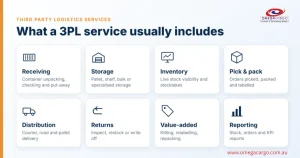
Icons showing third party logistics services: receiving, storage, inventory, pick and pack, distribution, returns
Not every provider offers the same 3PL services, and the mix you need depends on your goods and sales channels. These are the core third party logistics services you’ll come across. Many providers package them as bundled 3PL solutions, but it helps to know what each part does.
The 3PL accepts your inbound freight, checks it against the advance shipping notice or packing list, records any damage or shortages, and puts the stock away. For importers, this often starts with a container: devanning (unpacking) it, sorting cartons by SKU, palletising loose cartons and returning the empty container before detention charges start.
With 3PL warehousing, your stock is held on pallet racking, in shelving or bulk floor space, depending on what it is and how fast it moves. Specialised storage temperature controlled, climate controlled, dangerous goods or bonded is available from some providers and not others, so check this early if your products need it.
A 3PL warehouse is usually shared by many clients, so you pay for the space your goods occupy rather than a whole building. How 3PL storage is charged is covered in the cost section below.
A 3PL’s warehouse management system tracks what you have, where it sits and how fast it’s moving. Good providers give you live stock visibility through an online portal or an integration with your inventory or e-commerce platform, along with regular stocktake reconciliation.
When an order comes in, the 3PL picks the items, packs them with the right packaging and labelling, and hands them to a courier or freight carrier. This is the heart of a 3PL service for online retailers. For wholesale customers, 3PL fulfilment works the same way at carton or pallet level instead of individual units.
Many 3PLs arrange outbound delivery, either through their own fleet or through carrier contracts metro courier, interstate road or rail freight, or pallet delivery to retail distribution centres. Some also handle inbound transport from the wharf or airport.
Returned items are received, inspected and either restocked, refurbished, returned to the supplier or written off according to your instructions. For e-commerce businesses, a smooth returns process is part of the customer experience, so it’s worth asking how quickly returned stock is processed and made available to sell again.
Depending on the provider, extras may include kitting and bundling, relabelling, repacking into retail-ready packaging, shrink-wrapping and pallet build-downs.
| Service | What it covers | Most useful for |
| Receiving and devanning | Unpacking containers, checking and recording inbound stock | Importers bringing in FCL or LCL freight |
| Storage | Pallet, shelf, bulk or specialised storage | Any business holding stock |
| Inventory management | Stock tracking, reporting and stocktakes | Businesses with many SKUs or several sales channels |
| Pick and pack | Order picking, packing and labelling | E-commerce and B2B order fulfilment |
| Distribution | Delivery to customers, stores or other warehouses | Businesses selling nationally |
| Returns | Receiving, inspecting and restocking returned goods | Online retailers and consumer brands |
| Value-added services | Kitting, relabelling, repacking, palletising | Seasonal campaigns and retail compliance |
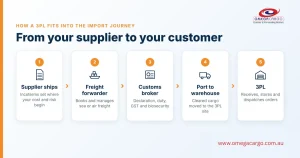
Five-step flow from supplier to freight forwarder, customs broker, port transport and 3PL warehouse
Most guides to 3PL logistics start at the warehouse door. For Australian importers, that leaves out the part where things most often go wrong: the handover between international freight, border clearance and warehousing.
Here’s how the pieces connect when you import goods and hold them with a 3PL.
| Provider | Main role | Typical responsibilities |
| Freight forwarder | Organises the international movement | Booking sea or air freight, consolidation, documentation, origin and destination coordination |
| Customs broker | Manages border compliance | Tariff classification, import declarations, duty and GST, biosecurity lodgements |
| 3PL logistics company | Runs warehousing and fulfilment | Receiving, storage, inventory, pick and pack, dispatch, returns |
| Carrier | Physically moves the goods | Shipping lines, airlines, trucking and courier companies |
Some businesses provide more than one of these roles. When the forwarder, customs broker and warehouse work from the same plan, you avoid the gaps that cause delays a container waiting at the terminal because nobody has booked the unpack, or stock arriving at a warehouse that hasn’t been told it’s coming. If you’d like a refresher on the first two roles, see what a freight forwarder does and the difference between a freight forwarder and a customs broker.
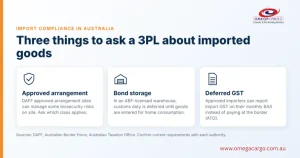
In Australia, imported containers and goods can carry biosecurity risks insects, seeds, soil or contaminated packaging. DAFF allows operators to manage some of these risks at their own sites through approved arrangements, which were previously known as Quarantine Approved Premises and Compliance Agreements.
According to DAFF, approved arrangements let operators manage biosecurity risks or carry out documentary assessment using their own sites, facilities and people, without constant departmental supervision, subject to compliance monitoring and audits. Each arrangement is assigned a class based on the activities carried out at the site and the risks involved.
Why does this matter when you’re choosing a 3PL? A warehouse operating under a suitable approved arrangement can unpack containers that are still subject to biosecurity control, inspect them and manage them on site. That can mean fewer moves between depots and less time for your container to sit idle. Not every 3PL holds one, and the class matters, so ask which arrangement covers the site your goods will go to.
The Australian Border Force licenses warehouses under section 79 of the Customs Act 1901. Goods held in a licensed customs warehouse are “underbond” — they stay under customs control.
The ABF’s fact sheet on customs warehouses explains that warehouse licensing allows owners of imported goods to defer customs duty while the goods are stored, with duty payable when the goods are entered for home consumption. Goods can also leave customs control by being exported instead. The ABF also restricts what can happen inside a licensed warehouse: storage, unpacking, repacking and packaging of certain goods are permitted, but value-adding activities are not.
For importers of high-duty goods, or goods that may be re-exported, a 3PL with access to bond storage can help manage cash flow. Your customs broker can tell you whether it’s worthwhile for your products.
GST on imports is normally paid at the border. Approved businesses can instead use the ATO’s deferred GST scheme and report the GST on their monthly business activity statement. To be eligible, you generally need an ABN, GST registration, and to lodge your BAS monthly and online, among other conditions. Deferred GST isn’t a 3PL service, but it’s worth sorting out alongside your warehousing plan because it affects your cash flow on every shipment. Our guide to how the import GST deferral scheme works explains the process.
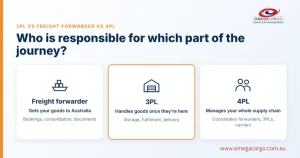
These terms get mixed up constantly, partly because many logistics businesses offer more than one service. The simplest way to separate them is to ask: what part of the journey is this provider responsible for?
| Freight forwarder | 3PL | 4PL | |
| Main focus | Moving goods between countries | Storing and distributing goods within a market | Managing the whole supply chain |
| Owns or runs assets | Usually coordinates carriers rather than owning ships or aircraft | Runs warehouses and often transport | Usually asset-light; manages other providers |
| Where it works | Origin, international transit, destination | Destination warehouse and domestic distribution | End to end |
| Typical client question | “How do I get my goods here?” | “Where do I keep my stock and who sends my orders?” | “Who manages all my logistics partners?” |
In short, a freight forwarder gets your goods to Australia, and a 3PL handles them once they’re here. When weighing 3PL vs 4PL, the question is whether you want a provider to run your warehouse or one to manage all your logistics partners for you. For many importers, the most efficient setup is a forwarder and a 3PL that already work together, with a customs broker coordinating the clearance in between.
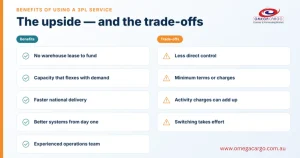
The case for working with a 3PL logistics company is strongest when warehousing and fulfilment are distracting you from the work that grows your business. Third party logistics providers tend to add value in five areas.
A 3PL isn’t automatically the better option, and an honest assessment includes the downsides.
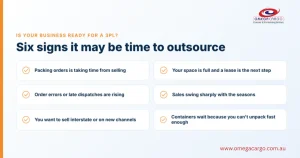
There’s no single volume at which bringing in a 3PL logistics company becomes the right call. Instead, look for these signs:
| Factor | Keep it in-house | Consider a 3PL |
| Order volume | Low and steady | Growing, or with sharp seasonal peaks |
| Product range | A handful of SKUs | Many SKUs or several sales channels |
| Customer locations | Mostly local | Spread across states |
| Control needs | Highly customised handling you must supervise personally | Standard handling that can be documented |
| Capital | Already own suitable space and equipment | Prefer not to tie up capital in a warehouse |
| Import volumes | Occasional small shipments | Regular containers that need unpacking and storage |
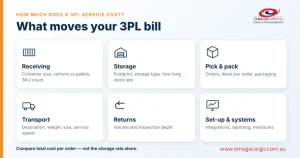
Factors that drive 3PL service costs: receiving, storage, pick and pack, transport, returns, set-up
There’s no standard price for a 3PL service, because every 3PL logistics company builds its charges from the activities your goods actually need. What is consistent is the structure. Once you understand the charge types and what moves each one, you can compare quotes properly.
| Charge type | What it covers | What moves it |
| Receiving and devanning | Unloading containers or trucks, checking and putting away stock | Container size, loose cartons versus pallets, number of SKUs, labelling quality |
| Storage | Holding your stock | Pallet or bin footprint, storage type (ambient, climate-controlled, bond, dangerous goods), how long stock sits |
| Pick and pack | Picking and packing each order | Number of orders, items per order, packaging requirements, special instructions |
| Outbound transport | Delivering orders to customers or stores | Destination, weight and dimensions, service speed, carrier, regional or remote delivery |
| Returns processing | Receiving and inspecting returned items | Return volume, inspection depth, refurbishment or relabelling needed |
| Value-added services | Kitting, relabelling, repacking | Labour time and materials per unit |
| Set-up, account and systems | Onboarding, integrations, account management | Integration complexity, reporting requirements, any minimum monthly charge |
Two points matter more than any individual rate:
For importers, the warehouse charges are only part of the landed picture. Freight, duty, GST, clearance, terminal charges and transport from the port all sit alongside them. A shipment-specific quote that covers the freight, clearance and delivery legs together is the only way to see the full figure for your goods.
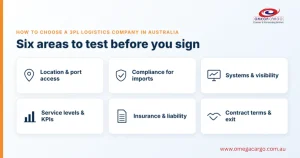
Six areas to check when choosing a 3PL logistics company in Australia
If you’re working out how to choose a 3PL in Australia, treat it as choosing a business partner rather than buying a service. 3PL companies vary widely in size, specialty and the type of goods they handle, so these are the areas worth testing before you commit.
Where is the warehouse relative to your main port or airport, and to your customers? A site close to the port can reduce wharf cartage time for import containers. A site close to your customer base reduces outbound delivery time. For national businesses, ask whether the provider has more than one site, or partners in other states — when comparing 3PL services Australia-wide, a small network of well-placed sites often beats one large warehouse.
Ask whether the site operates under a DAFF approved arrangement, and which class. Ask whether the provider has access to a licensed customs warehouse if bond storage could help you. If you import dangerous goods, food, cosmetics or temperature-sensitive products, confirm the provider is set up and licensed to handle them. When you compare 3PL Australia providers, this compliance capability is often what separates a general warehouse from one that suits importers.
Ask how you’ll see your stock and orders. Most third party logistics companies offer an online portal, but quality varies a lot. Look for real-time inventory visibility, integration with your e-commerce or accounting platform, order tracking and regular reporting. Ask for a demonstration rather than a feature list.
A good service agreement sets measurable targets — for example, how quickly inbound stock is received and available to sell, order dispatch cut-off times, picking accuracy, and stock accuracy at stocktake. Ask how each one is measured and reported, and what happens when a target is missed.
Check what the 3PL is liable for if stock is lost or damaged, and the limits that apply. Don’t assume their insurance covers the full value of your goods. You may need your own cover, and our guide to freight insurance explains how cargo cover works during transit.
Read the minimum term, notice period, minimum charges, annual price review mechanism and the process for removing your stock if you leave. A clear exit process is a sign of a provider confident in its service.
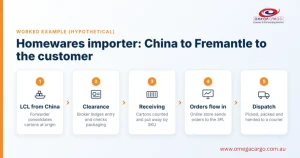
Example flow of an imported LCL shipment from China through Fremantle to a 3PL and the customer
This is a hypothetical scenario to show how the pieces fit together.
A Perth homewares retailer imports a mixed LCL consignment of cushions, throws and ceramic vases from China into Fremantle. Until now, the owner has collected each shipment, unpacked it at a rented storage unit and packed online orders at night.
With a 3PL logistics company in place, the flow changes:
What changes for the business isn’t just space. The owner gets back the time spent unpacking and packing, the import and warehouse steps are planned together, and stock reaches customers in a more consistent way. The charges involved are receiving, storage, pick and pack, courier delivery and returns — each moving with the volume and type of goods, as the cost table above explains.
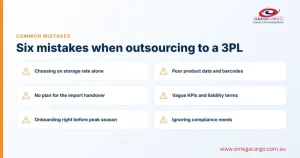
Six common mistakes when outsourcing to a 3PL
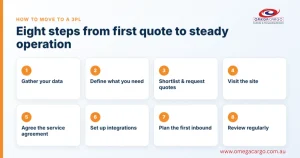
Eight steps to move your business to a 3PL
A 3PL logistics company is an outside provider that runs logistics operations for other businesses — usually receiving, warehousing, inventory management, order picking and packing, transport and returns. You pay for the services you use instead of operating your own warehouse, staff and systems.
3PL means third-party logistics. The third party is the outside provider that handles storage, fulfilment and distribution on behalf of the business that owns the goods.
A third party logistics provider is a business that runs logistics operations for other companies under contract — typically receiving, storage, inventory management, order fulfilment, transport and returns. The provider supplies the warehouse, staff and systems, and charges for the services you use.
A 3PL warehouse is a facility run by a third-party logistics provider where several businesses store their stock. The provider receives, stores, picks, packs and dispatches goods for each client, and charges for the space and handling each one uses.
Third party logistics services are the logistics activities a 3PL performs for you. The most common are receiving and container unpacking, storage, inventory management, pick and pack, outbound delivery and returns processing. Some providers also offer value-added services such as kitting, relabelling and specialised storage.
A freight forwarder organises the international movement of your goods — booking sea or air freight and managing the shipping documents. A 3PL looks after the goods once they’re in Australia, storing them and fulfilling your orders. Importers often use both, with a customs broker handling clearance in between.
A 3PL performs logistics activities such as warehousing and distribution. A 4PL manages your supply chain as a whole, including coordinating several 3PLs, carriers and forwarders on your behalf. Most small and medium-sized businesses work directly with a 3PL.
There’s no standard price. 3PL charges are built from separate activities — receiving, storage, pick and pack, transport, returns and set-up — and each one moves with your product size, storage needs, order volume and delivery destinations. The most accurate way to compare is to give each provider the same data and compare the total cost per order.
Many can. If your container is still subject to biosecurity control, it must be unpacked at a site operating under a suitable DAFF approved arrangement. Ask the provider which arrangement and class apply to the site your goods will be delivered to.
Bond storage means holding imported goods in a warehouse licensed by the Australian Border Force under the Customs Act 1901. The goods stay under customs control, and customs duty is deferred until they’re entered for home consumption. Goods can also be exported from customs control instead.
It can be, particularly if packing orders is taking time away from selling, your space is running out, or your sales vary by season. The trade-offs are less direct control and contract commitments. Comparing your current in-house costs, including your own time, with a 3PL’s total quote will show whether it makes sense.
Start with location, compliance capability and systems — the three areas where one 3PL logistics company differs most from another. Then compare service levels, liability, insurance and contract terms. Visit the site, ask how inbound stock is received and how quickly it becomes available to sell, and check that the provider handles goods like yours.
A 3PL agreement should set out the services provided, how each is charged, the service levels and how they’re measured, liability and insurance, minimum terms or charges, the price review process, and how stock is returned if the agreement ends.
Before your goods ship. Planning the warehouse receipt alongside the freight and customs clearance reduces the risk of containers waiting at the terminal, and gives the 3PL time to prepare for your products.
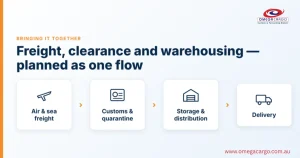
Choosing a 3PL logistics company is ultimately about letting your business focus on selling while specialists look after the stock. For importers, though, the warehouse is only one part of the journey. The real gains come when the international freight, customs clearance and warehousing are planned as one flow, so goods move from the vessel or aircraft into storage without sitting idle in between.
Omega Cargo works on both sides of that handover. Our warehousing and logistics service works with agents operating Customs and Quarantine approved premises, which unpack FCL and consolidated containers and handle storage, distribution and delivery — including general and bond storage, stock control and reporting, palletising and repacking, and climate-controlled storage. That sits alongside our sea freight, air freight, customs and quarantine clearance and interstate transport services, and our e-commerce shipping network for parcel delivery.
Planning your next import and need somewhere for the stock to go? Send us your origin, the type and volume of goods, and where they need to end up, and we’ll map out the freight, clearance and storage together. Request a quote or talk to our team.


