
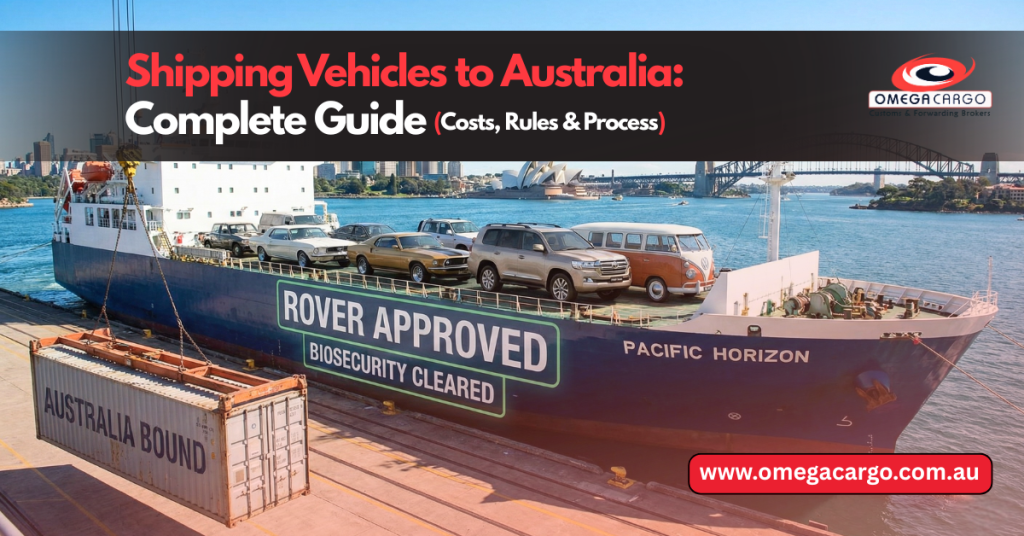
Picture your car sitting on a wharf in Melbourne, fully paid for, insured and just a short drive from home, and still not allowed to leave. That happens more often than you’d think, and the ship is rarely the reason. So what actually decides whether your vehicle rolls out of the port in days or sits in storage for weeks?
The short answer: paperwork and preparation that happens before it ever leaves the overseas port. Shipping vehicles to Australia involves three government agencies, a strict “approval first, ship second” rule, zero tolerance for asbestos and some of the toughest biosecurity cleanliness checks anywhere. Get the order wrong and you pay storage while you fix it. Get it right and the process is very manageable.
This guide walks you through the whole journey, from checking your car is eligible to registering it in your state. You’ll learn which import pathway fits your situation, how RoRo and container shipping compare, what really drives the cost, how duty, GST and Luxury Car Tax are worked out, and the mistakes that cost importers the most time and money.
To ship a vehicle to Australia, you first get an import approval from the Department of Infrastructure through its ROVER portal. Then you have the car cleaned and checked for asbestos, ship it by RoRo or container, clear customs and biosecurity on arrival, pay duty, GST and any Luxury Car Tax, and finally meet any approval conditions before registering it in your state.
Shipping a car to Australia is not just a booking with a shipping line. Three Australian Government agencies each control one part of the process, and your vehicle needs a green light from all of them.
| Agency | What it controls | When it matters |
| Department of Infrastructure, Transport, Regional Development, Communications, Sport and the Arts | Vehicle import approvals under the Road Vehicle Standards (RVS) laws, the ROVER portal and the Register of Approved Vehicles (RAV) | Before the car ships, and again when approval conditions are met |
| Australian Border Force (ABF) | Import declaration, customs duty, GST, Luxury Car Tax and asbestos controls | From the moment the car is in transit until release |
| Department of Agriculture, Fisheries and Forestry (DAFF) | Biosecurity cleanliness, inspection and seasonal pest measures | Before loading (cleaning and treatment) and on arrival (inspection) |
After those three, your state or territory registration authority decides whether the car can go on the road. It sets its own rules, and it is not bound by the Commonwealth approval.
Before you look at a single shipping quote, confirm your car can actually be imported. The Department of Infrastructure explains that most single vehicles come in through a concessional RAV entry approval, a non-RAV entry approval or a reimportation approval. Each has its own eligibility criteria.
| Your situation | Likely pathway | What to know |
| The car was built (or significantly modified) more than 25 years ago | Older vehicle (concessional RAV entry) | Covers passenger cars, vans, motorcycles and light commercials. Anyone can apply. Significant modifications made in the last 25 years can remove it from this pathway |
| The car is under 25 years old and was never sold new in Australia | Specialist and Enthusiast Vehicles (SEVs) Register, modified by a Registered Automotive Workshop (RAW) | The model must be on the SEVs Register. A RAW modifies the car to meet Australian standards before it is entered on the RAV |
| You are migrating to Australia or returning permanently after time overseas, and bringing your own car | Personal effects (concessional RAV entry) | The applicant must be the vehicle’s owner, and ownership and use criteria apply. Check the department’s personal effects overview before you commit |
| You are bringing back a car you previously exported from Australia | Reimportation approval | The car must already be on the RAV or carry a plate approval under the previous Motor Vehicle Standards Act. Duty concessions may apply to returned Australian goods |
| The car is for racing, exhibition, film work or testing, not everyday road use | Non-RAV entry approval | Suits vehicles that will not be used on public roads, or only in exceptional circumstances |
| You are visiting temporarily | Temporary import (for example, under a carnet) | The ABF allows tourists and temporary residents to bring a road vehicle in for up to 12 months without duty and taxes, provided conditions are met |
A newer car that was sold new in Australia in the same specification usually does not qualify as an enthusiast import. That is exactly why buying overseas before checking eligibility is the most expensive mistake on this list. For a deeper look at each pathway, read our guide on how to import a motor vehicle to Australia.
Every road vehicle needs an import approval, regardless of its value. According to the Department of Infrastructure, “it is an offence to import a road vehicle into Australia without approval”, and applications are made only through ROVER, the department’s online portal.
Here is how the application works in practice:
The ABF is blunt about what happens if you jump ahead: a car that arrives before approval is not released, storage and other charges build up, and you may be required to export or destroy the vehicle at your own expense.
Tip: Check the VIN on your application against the car itself, character by character. A mismatch between the approval, the shipping documents and the vehicle is one of the fastest ways to stall a clearance.
Australia bans all types of asbestos, and the ABF enforces that ban at the border. The rule applies to private and commercial imports alike, and it applies even when the country of origin has its own asbestos ban, because some vehicle parts and components can still contain it.
According to the Australian Border Force, the importer is responsible for making sure the vehicle contains no asbestos. Older vehicles deserve the closest look, particularly brake and clutch components, gaskets and heat shielding.
Three points catch people out:
If you are importing an older vehicle, budget for a pre-shipment assessment by a qualified specialist and keep the paperwork with your shipping documents. Our customs and quarantine clearance team can tell you what evidence the ABF is likely to expect for your vehicle.
Australia’s biosecurity system exists to keep out soil, seeds, insects and plant material that could harm local agriculture. DAFF says it is the importer’s responsibility to make sure the vehicle is clean and free of biosecurity risk before it arrives.
Think professional steam clean, not car wash. DAFF points to wheels, mudguards, the underside, the engine bay and window seals on the outside, and storage compartments, under the seats and vents on the inside. You’ll also need to supply the keys so officers can open every compartment.
Vehicles fall within the goods DAFF classes as target high risk for BMSB, which means mandatory treatment when they come from a target risk country during the season. Under DAFF’s BMSB seasonal measures, the measures apply to targeted goods shipped between 1 September and 30 April (inclusive), and the shipped-on-board date on the ocean bill of lading is the date that counts.
The United States, Canada and much of Europe are on the target risk list. The United Kingdom, China, Japan and the Republic of Korea are listed as emerging risk countries, where goods may be selected for random inspection. RoRo vessels that have called at target risk ports, or ports in China, Japan or Korea, also face heightened vessel surveillance. How treatment is handled differs between containerised cargo (directed for onshore treatment if it arrives untreated) and break bulk (which must be treated offshore before arrival). The lists, dates and treatment options are reviewed each season, so confirm the current measures with your forwarder before you book.
The ABF notes that a vehicle with an air-conditioner might need an import licence for ozone depleting substances and synthetic greenhouse gases. Before shipping, find out the type and quantity of gas in the system. The Department of Infrastructure’s own checklist says to remove the gas before shipping where necessary.
Once your approval is in hand and the car is prepared, you can book the freight. There are two main methods for shipping vehicles to Australia.
Roll-on/roll-off (RoRo). Your car is driven onto a purpose-built vehicle carrier at the origin port and driven off in Australia. It suits standard, running vehicles on routes with regular RoRo services. Most RoRo carriers require the car to be empty of personal belongings, apart from standard items such as the spare wheel and jack.
Container shipping. Your car is loaded and secured inside a steel container, either on its own (sole use) or shared with other vehicles. It suits high-value or classic cars, vehicles that don’t run, and people moving house who want to ship household goods with the car (declared, and still subject to inspection).
| Factor | RoRo | Shared container | Sole-use container |
| Relative cost | Often the lowest for a single running car | Can approach RoRo when the container is filled | Usually the highest |
| Protection | Parked below deck, handled by drivers | Sealed and secured | Sealed and secured, no other cargo |
| Personal items | Generally not allowed | Possible, if declared and allowed by the carrier | Possible, if declared |
| Non-running vehicles | Limited, depends on carrier | Suitable | Suitable |
| Schedule | Depends on RoRo sailings on your route | Can wait for the container to be filled | Ships when you are ready |
| Arrival handling | Vehicle terminal | Unpacking at a depot adds steps | Unpacking at a depot adds steps |
Neither option is “best” in general. The right one depends on your car’s value and condition, your route and how quickly you need it. Our explainer on RoRo shipping to Australia goes deeper into how vehicle carriers work, and our guide to LCL vs FCL shipping explains the shared-versus-sole-use trade-off for containers.
The cost of shipping vehicles to Australia is set per shipment rather than by a standard rate. What you pay depends on your origin port and route, the shipping method, your vehicle’s size and value, the season and carrier capacity at the time of booking, and the taxes and charges that apply once it lands. Freight is usually just one part of the final bill.
The ABF lists the cost categories you should expect when importing a vehicle. Here is what moves each one:
| Cost component | What makes it go up or down |
| Pre-shipment preparation | The car’s condition, how much cleaning it needs, asbestos assessment or parts replacement, and BMSB treatment if shipped in season from a target risk country |
| Ocean freight | Origin port and route, RoRo versus container, sole versus shared container, vehicle dimensions, carrier capacity and seasonal demand at the time of booking |
| Marine insurance | The insured value of the vehicle, the cover level you choose and the route |
| Origin charges | Pick-up distance to the port, export paperwork, terminal handling and container packing |
| Customs duty, GST and LCT | Customs value, tariff classification, country of origin and any free trade agreement, and whether the car’s value is over the Luxury Car Tax threshold |
| Australian port and terminal charges | The arrival terminal, container unpacking, and how quickly the car is cleared and collected |
| Biosecurity inspection | New or used vehicle, how clean it arrives, and whether cleaning or treatment is ordered |
| Customs brokerage and import processing | The complexity of the entry, the pathway and any concessions claimed |
| Storage | Any delay caused by missing approval, missing documents, asbestos queries or contamination |
| Compliance and registration | RAW modification work (for SEVs), approval conditions, roadworthy or safety inspection, and your state’s registration and insurance rules |
| Delivery | Distance from the port to your door, or to a compliance workshop |
The biggest swings usually come from three places: the pathway (a SEVs car needing RAW work costs far more to bring to the road than an older vehicle), the car’s value (which drives duty, GST and possibly LCT), and avoidable delays that turn into storage.
Important: Freight, port and inspection costs change with market conditions and carrier capacity, and taxes depend on your vehicle’s value and origin. Treat everything in this section as an explanation of the drivers, not a price. A shipment-specific quote is the only accurate figure for your car.
When you compare quotes, ask each provider which of the lines above are included. A quote that covers ocean freight only can look much cheaper than one that covers the car all the way to your driveway.
Government charges are paid to the ABF as part of customs clearance, and the car is not released until they are paid. You don’t have to calculate them yourself, because the ABF issues an Outstanding Payment Advice once your import declaration is processed. Understanding how they stack up, though, helps you budget before you buy.
Duty is charged on the vehicle’s customs value at the rate set by its tariff classification in Chapter 87 of the Customs Tariff. Most passenger motor vehicle classifications carry a 5% general rate in the ABF’s current tariff, but preferential rates under Australia’s free trade agreements can reduce this, including to free, for vehicles that meet the rules of origin. Agreements with the United States, Japan, the United Kingdom, Korea and Thailand are among those in force. Our guide to free trade agreements for Australian importers explains how to claim a preferential rate.
According to the ATO, GST is 10% of the value of the taxable importation, which adds together:
In other words, you pay GST on the freight and insurance as well as the car. Private importers pay it too, whether or not they are registered for GST.
The ABF explains that LCT applies to cars designed to carry a load of less than two tonnes and fewer than nine passengers, when their value is above the LCT threshold, and that it is imposed at 33% on the amount above that threshold. For an imported car, the ATO uses this formula:
(LCT value − LCT threshold) × 10 ÷ 11 × 33%
The LCT value of an imported car includes its customs value, international transport and insurance not already counted, customs duty, and GST.
Two things surprise many importers:
For how duty is worked out on other goods, see our resource on understanding duty calculation.
Because each charge builds on the one before, the order matters:
Missing paperwork is one of the most common reasons a vehicle sits at the port, and it is the easiest part of shipping vehicles to Australia to get right. Have these ready before the car sails:
| Document | Why it’s needed |
| Vehicle import approval from ROVER | Without it, the ABF will not release the car |
| Bill of sale or commercial invoice | Shows what you paid, the seller and the VIN, and supports the customs value |
| Overseas registration or title document | Proves ownership and identity of the vehicle |
| Proof of build date (older vehicles) | Supports eligibility under the 25-year pathway |
| Ownership and use evidence (personal effects vehicles) | Supports the personal effects criteria |
| Bill of lading | Issued by the carrier, and shows the shipped-on-board date used for BMSB measures |
| Passport or photo ID | Needed for the import declaration and ROVER identity checks |
| Asbestos evidence | Assessment or testing records for at-risk vehicles |
| BMSB treatment certificate (if applicable) | From an approved treatment provider when shipped in season from a target risk country |
| Certificate or declaration of origin (if claiming an FTA rate) | Supports a preferential duty rate |
There is no single answer, because the voyage is only part of the journey. Your total timeline depends on the import approval assessment, the route and whether it is direct or transhipped, RoRo sailing frequency or how quickly a shared container fills, BMSB treatment in season, how clean the car arrives and how quickly any compliance work and registration can be completed.
| Stage | What decides how long it takes |
| Import approval | How complete your application is, the pathway and the department’s workload. The department says assessment may take up to 60 business days |
| Preparation | Cleaning, asbestos assessment, gas removal and BMSB treatment if it applies |
| Waiting for a sailing | RoRo schedules on your route, or the time to fill a shared container |
| Ocean transit | The port pair, direct versus transhipped service, and carrier schedules |
| Customs and biosecurity | Document accuracy, payment of duty and taxes, inspection booking and whether cleaning is ordered |
| Compliance and registration | RAW workshop capacity (for SEVs), approval conditions and your state’s inspection process |
The fastest imports are the ones where the approval is granted early and nothing has to be fixed on arrival. If your car comes from the United States, our guide to shipping from the USA to Australia covers that route in more detail.
Once the car is in transit, an import declaration is lodged with the ABF and a biosecurity entry is lodged with DAFF. Your customs broker usually handles both. On arrival:
You can read more about what happens during an inspection in our guide to the customs inspection process in Australia.
Release from the port doesn’t mean you can drive home. Depending on your pathway, you may need to:
Many importers use interstate transport to move an unregistered car from the port to a workshop, or to another state.
Since the RVS laws took effect on 1 July 2021, the older vehicle pathway has given enthusiasts a wider choice. Your vehicle must have been built, or significantly modified, more than 25 years ago. The department assumes December of the build year if the month isn’t known. Anyone can apply, and an agent can apply for you.
Newer used vehicles generally need to be on the SEVs Register and modified by a RAW. The RAW does the work needed to meet Australian standards before the car goes on the RAV, and charges for that work. Get a RAW’s assessment of your specific vehicle before you buy.
An approval doesn’t guarantee registration, and the department specifically flags left-hand-drive vehicles as a reason to check with your state or territory registration authority before you import. Rules on which left-hand-drive vehicles can be registered, and on what terms, differ between states. Some limit them to older vehicles or to conditional and club registration schemes. Check with your state authority first.
This is a hypothetical scenario to show how the rules interact. It is not a real customer shipment.
Say you’ve found a left-hand-drive American pickup built in the early 1990s, and you want to ship it from Los Angeles to Melbourne in November.
None of these steps involves a fixed price, which is why the quote stage matters so much. Every line depends on this particular truck, this route and this sailing.
You don’t need a broker to import a car, but most people use one because the process involves several agencies with strict timing. When you compare providers, look for:
Omega Cargo manages customs and quarantine clearance for commercial and personal shipments into Australia, along with sea freight and domestic transport. If you’d like your vehicle’s pathway, paperwork and landed cost checked before you commit, our team can talk you through it.
Usually only in a container. Most RoRo carriers require the car to be empty apart from standard items like the spare wheel and jack. In a container, household goods can travel with the car if the carrier allows it, but everything must be declared and is subject to biosecurity inspection, which can add time at the border.
Yes. Under the Road Vehicle Standards Act 2018, importing a road vehicle without approval is an offence. You apply through the Department of Infrastructure’s ROVER portal, and the ABF will not release a car that arrives without approval. Storage and other charges then build up at your cost.
The older vehicle pathway lets you import a vehicle built, or significantly modified, more than 25 years ago through a concessional RAV entry approval. It covers passenger cars, vans, motorcycles and light commercial vehicles. Approval lets you import the car, but registration still depends on your state’s rules.
Duty depends on your vehicle’s tariff classification and origin. Most passenger vehicle classifications carry a 5% general rate on the customs value, but free trade agreements can reduce it, including to free, for vehicles that meet the rules of origin. GST of 10% then applies on the value of the taxable importation.
It can. LCT is based on the car’s value, not its age. If an imported car’s LCT value is above the threshold, LCT of 33% applies to the amount above it, worked out with the ATO’s import formula. The ATO’s own example applies LCT to an imported 1970s classic.
Possibly, under the personal effects pathway. It is for migrants settling in Australia and Australians returning permanently after time overseas. The applicant must own the vehicle, and ownership and use criteria apply. Check the Department of Infrastructure’s personal effects overview before you ship.
Yes. Used vehicles get a full internal and external biosecurity inspection, and any soil, seeds, insects or plant material must be dealt with at your expense. Options include cleaning, fumigation, export or destruction. A professional clean before shipping, covering the underside, engine bay and interior, is the best way to avoid delays.
DAFF’s seasonal measures apply to target goods, including vehicles, shipped from target risk countries between 1 September and 30 April inclusive, based on the shipped-on-board date on the bill of lading. Vehicles are target high risk goods, so treatment is mandatory. DAFF reviews the countries and measures each season.
It depends on the approval assessment, your route, sailing frequency, BMSB treatment, clearance and any compliance work. The Department of Infrastructure says approval assessment alone may take up to 60 business days. Plan the whole journey, from application to registration, rather than just the voyage.
RoRo often suits a standard running car on a route with regular vehicle carrier sailings. Containers suit high-value, classic or non-running vehicles, or when you’re shipping household goods with the car. Compare total landed cost and protection, not just the freight line.
No. Australia prohibits importing goods that contain asbestos, and the ABF says any asbestos content must be addressed before the vehicle is shipped. If the ABF suspects asbestos, it can hold the car for sampling and testing at your cost. Replace at-risk parts and keep the evidence before the car sails.
Shipping vehicles to Australia is a sequence: approval, preparation, shipping, clearance, compliance and registration. Most of the cost and delay comes from steps done in the wrong order or skipped entirely. If you’d like someone to check your vehicle’s pathway, documents and the charges likely to apply before you buy or book, our team can help.
Request a shipment-specific vehicle import quote. Tell us the vehicle, where it is now and where it needs to go in Australia, and have the VIN, build date and purchase details handy.
Import rules, tax thresholds and biosecurity measures are set by the Australian Government and change over time. Always confirm current requirements with the relevant agency or a licensed customs broker before you buy or ship a vehicle.


