
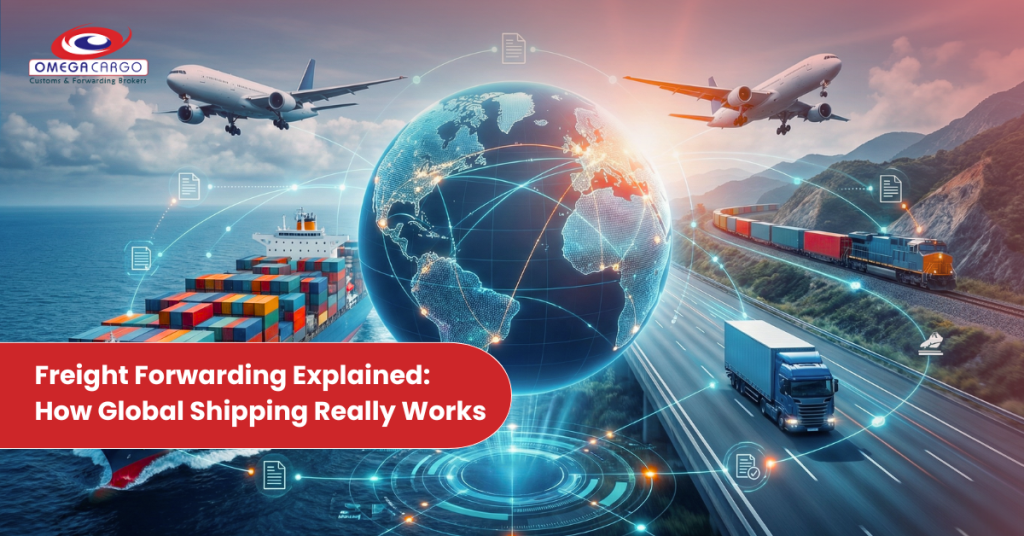
Have you ever wondered how a product made in a factory overseas ends up on a shelf in Perth or at a customer's door in Melbourne? Between the supplier's loading dock and the final delivery, your goods may cross several borders, change hands many times and travel by truck, ship, plane or train. The business that plans and coordinates that whole journey is a freight forwarder, and the service is called freight forwarding.
This guide explains freight forwarding in plain English. You will learn what a forwarder actually does, how the international shipping process works step by step, which transport modes you can choose, which documents matter and where customs clearance fits in. It is written for Australian importers, exporters, e-commerce sellers and manufacturers who want to understand how global shipping really works before booking their next consignment.
Imagine planning a complicated overseas trip. You need a taxi to the airport, an international flight, a train to a regional city and a hotel. You could book each one yourself, dealing with different companies, languages and currencies. Or you could use a travel agent who puts the whole itinerary together for you.
In global shipping, a freight forwarder is that travel agent for cargo.
Freight forwarding is the service of organising the movement of goods from origin to destination, usually across international borders, on behalf of a shipper or importer. Most forwarders do not own the ships, aircraft or trucks that carry your cargo. Instead, they act as the intermediary between you and the businesses that do: shipping lines, airlines, road transport operators and rail operators, along with ports, warehouses, customs brokers and government agencies.
Think of an international shipment as a puzzle with many pieces. The freight forwarder is the person who puts the puzzle together. They use their relationships with carriers to secure cargo space and competitive freight rates, and they plan a route that balances cost, speed and reliability for your particular shipment.
Whether your goods move by air, sea, road or rail, the forwarder handles the logistics management so you can focus on running your business. Their job is to keep your cargo moving, deal with problems as they come up and get your goods to their destination in good condition.
The terms below are often confused. This quick table shows how the main parties fit together.
| Party | What they do |
|---|---|
| Shipper (exporter) | Sells or sends the goods and prepares them for collection. |
| Consignee (importer) | Receives the goods at destination and is usually responsible for import duties and taxes. |
| Carrier | Owns or operates the ship, aircraft, truck or train that physically moves the cargo. |
| Freight forwarder | Plans the route, books space with carriers, coordinates documents and manages the shipment from start to finish. |
| Customs broker | A licensed professional who classifies goods, calculates duties and taxes, and lodges customs declarations with the authorities. |
A freight forwarder plays a central role in logistics management by coordinating every moving part of your shipment. Depending on the service you choose, your forwarder may handle:
Instead of juggling several service providers, you deal with one point of contact for the whole international shipping process. If you want an Australian-focused look at what a forwarder does locally and how to compare companies, read our guide to choosing a freight forwarder in Australia.
You might be thinking, "Can't I just book space on a ship myself?" Technically, sometimes you can. In practice, it is difficult, time-consuming and risky if you do not know the system.
Moving goods across borders involves a lot of paperwork. Every country has its own rules, taxes and restricted items. In Australia, imported goods must be reported to and cleared by the Australian Border Force (ABF), and many goods also need biosecurity clearance from the Department of Agriculture, Fisheries and Forestry (DAFF).
A small mistake on a form can see your goods held at the border while the problem is fixed, and storage or demurrage charges can build up in the meantime. Experienced forwarders and customs brokers know the rules and the common traps, so you are far less likely to get caught out.
Shipping in bulk is usually more economical per unit. If you only have enough goods to fill part of a container, paying for a whole container may not make sense. A freight forwarder can combine your cargo with goods from other customers to fill a shared container. This is called consolidation, or LCL (less than container load) shipping, and it is a key part of effective cargo management. Our article on FCL vs LCL shipping explains how to decide which option suits your volume.
What happens if the ship meets a storm, or a truck breaks down? International logistics carries real risks. Many forwarders can help you arrange cargo insurance and have contingency plans for when things go wrong. If a problem occurs, your forwarder is the one on the phone working it out with carriers and agents.
To understand freight forwarding properly, it helps to follow a shipment from start to finish. Not every consignment goes through every stage, and the responsibilities depend on the Incoterms you agree with your supplier or buyer. But this is broadly how global shipping really works.
The journey begins at the supplier's factory or warehouse. Export haulage is the transfer of the goods from that location to the forwarder's warehouse, a container yard, the port or the airport, usually by truck and sometimes by rail. It sounds simple, but it takes coordination to make sure the goods are packed, labelled and ready when the truck arrives.
Before goods can leave the country of origin, they generally need to be declared to that country's customs authority. The declaration states what is being shipped, its value and where it is going. Your forwarder or their agent prepares and lodges this documentation. When you export from Australia, many consignments require an export declaration to the ABF, and some goods need permits; the ABF's how to export page sets out the requirements.
At the port, airport or forwarder's depot, the cargo is received, checked, and loaded into a container or prepared as an air freight consignment if this has not already happened. Many parties are involved at this stage, from warehouse staff to terminal operators, and your forwarder coordinates them.
This is the main international leg. Your forwarder books space with a shipping line for sea freight or an airline for air freight. While the cargo is on the water or in the air, the forwarder monitors its progress and keeps you informed about any schedule changes.
This is often the most demanding part of the shipping process. Before goods can enter the destination country, they must be cleared by customs and any other border agencies. For imports into Australia, this usually involves:
Good logistics management means having accurate paperwork ready before the cargo arrives so this stage goes as smoothly as possible. For a closer look at how forwarders and brokers handle this stage, see our guide to freight forwarding customs clearance, or visit the ABF's how to import page.
Once the ship berths or the plane lands, the cargo is unloaded and moved to a terminal, depot or warehouse. LCL containers are unpacked (deconsolidated) so each customer's goods can be separated. This is similar to origin handling, but in reverse.
Finally, the goods are delivered by truck, or sometimes rail, to their final destination: your warehouse, distribution centre, retail store or customer. If you need storage or onward distribution around the country, warehousing and logistics services can bridge the gap between arrival and final delivery.
| Stage | What happens | Who is usually involved |
|---|---|---|
| Export haulage | Goods move from the supplier to the port, airport or depot | Supplier, transport operator, forwarder |
| Export clearance | Goods are declared for export | Forwarder or origin agent, export customs |
| Origin handling | Cargo is received, checked and loaded | Depot, terminal or airline handling staff |
| Main carriage | The international sea or air leg | Shipping line or airline, forwarder |
| Import clearance | Declaration, duty, GST and biosecurity checks | Customs broker, ABF, DAFF |
| Destination handling | Cargo is unloaded and, for LCL, deconsolidated | Terminal, depot, forwarder |
| Import haulage | Goods are delivered to the final address | Transport operator, forwarder |
When you work with a forwarder, you will hear a lot about transport modes. Choosing the right one is a big part of good supply chain management.
Sea freight is the backbone of global trade, and most of the world's traded goods by volume travel by ship.
Find out more about our sea freight services.
When speed matters most, air freight is usually the answer.
Find out more about our air freight services.
Trucks are the most flexible mode and can deliver door to door.
Rail is an often-overlooked part of international logistics.
| Mode | Generally best for | Relative speed | Relative cost |
|---|---|---|---|
| Sea | Heavy, bulky or large-volume cargo | Slower | Lower per unit of cargo |
| Air | Urgent, high-value or perishable goods | Fastest | Higher per kilogram |
| Road | First and last mile, shorter domestic distances | Flexible | Depends on distance and load |
| Rail | Large volumes over long land routes | Moderate | Often competitive for long-haul volume |
You cannot explain freight forwarding without talking about paperwork. In import and export, the documents are just as important as the cargo. If the papers are missing or wrong, your goods can be stuck no matter how quickly they travelled.
The bill of lading is the key document in sea freight. It serves three purposes:
For air freight, the equivalent is the air waybill (AWB). It acts as a contract and receipt, but it is not a document of title.
The commercial invoice is issued by the seller to the buyer. It describes the goods, their quantity and their price. Customs uses it to help establish the customs value for duty and GST, so it must be accurate and complete.
The packing list shows how the goods are packed: the number of cartons or pallets, their contents, weights and dimensions. Handlers use it to manage the cargo safely, and customs and biosecurity officers may use it during an inspection.
Australia has free trade agreements with a number of countries. To claim a preferential (reduced or nil) rate of duty under one of these agreements, you generally need evidence that the goods meet that agreement's rules of origin, such as a certificate or declaration of origin.
Depending on what you import, you may also need import permits, treatment certificates or packing declarations. These requirements are set by the relevant Australian authorities, and your forwarder or customs broker can tell you which ones apply to your goods.
Customs clearance is the gatekeeper of global shipping. Every country wants to protect its borders, enforce its laws and collect revenue.
Many freight forwarders employ licensed customs brokers or work closely with them. In Australia, customs brokers are licensed by the ABF. They classify your goods under the customs tariff, work out duty and GST, and lodge your import declaration.
Classification matters more than you might think. Is a product a toy, a tool or a piece of sporting equipment? Choosing the wrong tariff code can change the duty payable and may lead to penalties. Our article on what a customs broker does goes into more detail. Omega Cargo provides customs and quarantine clearance for imports into Australia.
If you buy or sell internationally, you will see three-letter codes such as EXW, FOB, CIF and DDP. These are Incoterms rules, published by the International Chamber of Commerce (ICC), with the Incoterms 2020 rules being the edition most contracts refer to. They define who arranges and pays for each part of the journey, and the point where risk passes from seller to buyer.
Choosing the right Incoterm is a critical part of supply chain operations. It decides who books and pays the freight forwarder, and who bears the loss if the goods are damaged or lost along the way. Read our full guide to what Incoterms are for more examples.
Why do so many businesses rely on forwarders for logistics management? It goes well beyond booking space on a ship.
A good forwarder works with agents or partners in major ports and airports around the world. If your shipment runs into trouble overseas, they have people on the ground who speak the language and know the local system.
Some forwarders offer warehousing. They can hold your goods in a convenient location and release them when you need them, which helps you manage cash flow and storage space.
Many freight services use tracking systems that show where your cargo is in its journey. Better visibility helps you plan inventory and keep your own customers informed.
When you are small, you might ship a single pallet. As you grow, you might ship multiple containers. A freight forwarder can scale with you, so you do not need to build your own logistics department.
The international shipping process rarely runs perfectly. Here are some challenges you may face and how a forwarder can help.
Weather, industrial action, port congestion, equipment shortages, schedule changes and customs holds can all slow a shipment down.
Containers can be lost at sea in rough weather, and goods can be crushed or damaged in handling.
Trade rules change. New trade agreements, sanctions, tariff changes and biosecurity requirements can all affect what you can import and what you pay.
Technology is reshaping cargo management, and freight forwarding is evolving with it.
Online platforms let shippers request quotes and book shipments digitally, in a similar way to booking a ride-share. This is making logistics management faster and more transparent, although complex shipments still benefit from experienced people who understand the details.
Global shipping has a significant environmental footprint, and the industry is under pressure to cut emissions. Some carriers and forwarders offer lower-emission options, such as cleaner fuels or carbon offset programs. If sustainability matters to your brand, ask your forwarder what options are available on your route.
Electronic bills of lading and blockchain-based platforms are being used to secure and share shipping documents. They aim to reduce fraud and speed up the release of goods, making supply chain operations more secure.
Once you know you need a forwarder, how do you choose one? Start with these questions:
For a detailed checklist, read how to choose the best freight forwarder in Australia.
Freight forwarding means using a professional company to organise the shipping of your goods for you. A freight forwarder plans the route, books transport with carriers, prepares documents, arranges customs clearance and coordinates each stage so your goods move from origin to destination.
A carrier, such as a shipping line or airline, owns or operates the ships or aircraft. A freight forwarder books space with those carriers for you and manages the paperwork, handovers and logistics around the journey.
A freight forwarder manages the physical movement of your goods. A customs broker is licensed to lodge customs declarations and handle duty and tax on your behalf. Many forwarders offer both services.
For a small parcel, a courier or postal service is often the simplest choice. For larger consignments, such as personal effects shipped by sea or air, a forwarder can help, because they still need to go through customs and biosecurity clearance in Australia and the documentation can be detailed.
Logistics management is the planning, carrying out and control of the flow of goods. It covers transport, warehousing, inventory, documentation and order fulfilment.
It depends on the transport mode, the route, carrier schedules, transhipment, port and airport conditions, and how quickly customs and biosecurity clearance is completed. Air freight is generally much faster than sea freight. Contact our team for a transit estimate based on your specific shipment.
There is no single price. The cost depends on the cargo type, weight and volume, origin and destination, transport mode, carrier availability, the services you need (such as customs clearance, storage or delivery) and market conditions at the time of booking. A tailored freight quotation is the most reliable way to know your cost.
It is strongly recommended for most shipments. A carrier's liability for loss or damage is limited by its contract terms and by international conventions, so it may cover only part of your goods' value. Cargo insurance is designed to protect the value of your shipment.
Common documents include a commercial invoice, packing list, bill of lading or air waybill, and any export or import declarations. Depending on the goods, you may also need a certificate of origin, import permits or biosecurity documents. Accurate documents are essential for smooth customs clearance.
Freight forwarding is really about partnership: connecting where a product is made with where it needs to be. A good forwarder manages logistics, handles import and export procedures and keeps your supply chain operations moving, so you can focus on your business.
Omega Cargo helps Australian businesses with air freight, sea freight, customs and quarantine clearance, warehousing and interstate transport. Contact Omega Cargo to discuss your shipment requirements and request a tailored freight quotation, or get in touch with our team if you have questions about your next import or export.


