
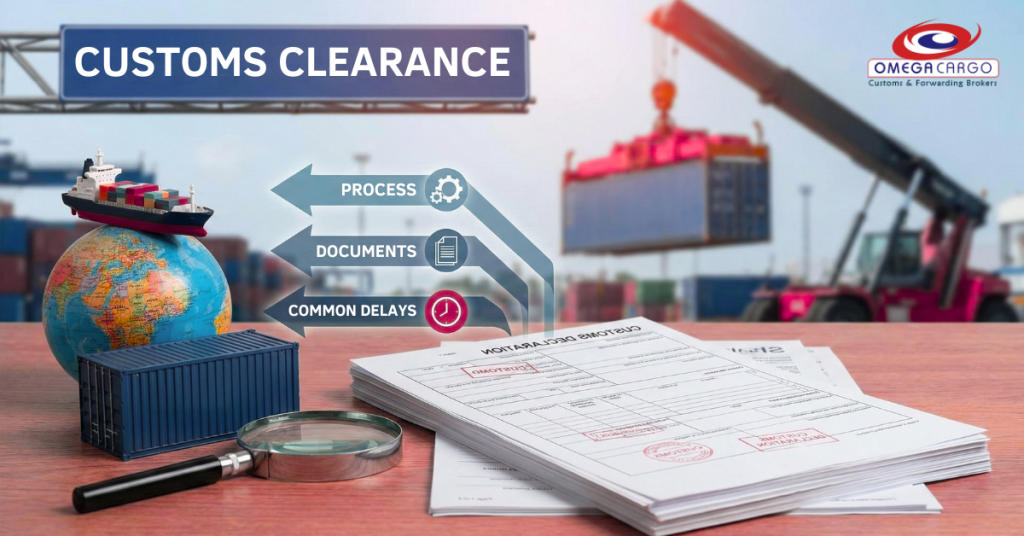
Your goods have landed in Australia, but you still can't get to them. Why?
You did the hard work. You found the right supplier, agreed on a price, made the sale and booked the shipment. The ship has berthed and your container is on the wharf, yet your stock is still sitting at the terminal. In most cases, the hold-up is not the voyage. It is the border.
That is where freight forwarding customs clearance comes in. This guide explains how your freight forwarder and customs broker get your goods legally into (or out of) Australia, which documents you need, and what causes the most common customs delays. Whether you are an e-commerce seller bringing in your first pallet or a manufacturer managing regular container imports, you will finish with a clear picture of the process and the practical steps that keep your cargo moving.
When you move goods across an international border, you are asking the destination country for permission to bring them in. To understand how that works, it helps to separate two things: the physical movement of the goods and their legal entry.
Freight forwarding is the organisation of the physical shipment. Think of your freight forwarder as a travel agent for cargo. They book space with shipping lines and airlines, arrange pick-up and delivery trucks, and manage the itinerary from the factory floor overseas to your warehouse in Australia. They look after the "how" and the "when".
Customs clearance is the official permission from a country's border authority for goods to be imported or exported. In Australia, that means the Australian Border Force (ABF) for customs, and the Department of Agriculture, Fisheries and Forestry (DAFF) for biosecurity. Clearance involves declaring exactly what you are bringing in, paying any duty, GST and charges, and showing that your goods are safe, legal and compliant. It answers the "if" and the "how much".
Put together, freight forwarding customs clearance is the coordinated management of moving your goods from origin to destination while meeting every legal requirement at the border. Logistics and compliance are closely linked: a problem with one can stop the other.
If you treat customs clearance requirements as an afterthought, the consequences go well beyond a late delivery:
Several parties work together to move and clear a single shipment. Knowing who does what makes it much easier to keep things on track.
You are usually listed as the shipper (when exporting) or the consignee (when importing). As the owner of the goods, you are ultimately responsible for the accuracy of the information given to customs. Even when a professional lodges the paperwork for you, errors that stem from the information you supplied can still come back to you.
Your forwarder organises the physical movement of the cargo. They book space with carriers, consolidate shipments, arrange transport at both ends and keep the documents flowing between your supplier, the carrier and the broker. Many freight forwarders also offer customs clearance, so you have a single point of contact, but not all do. Some focus only on transport, so always ask.
A licensed customs broker is authorised by the ABF to act on your behalf. Sometimes called a clearing agent, the broker classifies your goods, prepares and lodges the import declaration, calculates duty and GST, and deals with customs and biosecurity officers when questions arise. In short, they translate government requirements into practical steps for you. Learn more in our guide to what a customs broker does.
The ABF manages Australia's border. Its role in trade is twofold: collecting duty, taxes and charges on imported goods, and protecting the community from prohibited, dangerous or counterfeit items. Import declarations are lodged electronically with the ABF through the Integrated Cargo System (ICS).
Customs isn't the only check at the border. Depending on what you import, other agencies may be involved:
Your customs broker helps coordinate these requirements so they are met before your goods arrive, not after.
Here is how the customs clearance process generally works for goods entering Australia, whether they arrive by sea or air. The exact path depends on the goods, the transport mode and whether any checks are triggered. For a more detailed walkthrough, see our step-by-step guide to customs clearance in Australia.
The process starts before your goods leave the factory. You, your supplier and your freight forwarder gather the shipping documents, and accuracy is critical. If the invoice says "blue shirts" but the cartons contain "red shoes", you have a problem. This stage also covers classifying your goods under the correct tariff code and confirming whether you need any permits, certificates or treatments.
The carrier and forwarder report the cargo to the ABF ahead of arrival. Your customs broker then lodges the import declaration electronically through the ICS. The declaration tells the government what is arriving, what it is worth, where it was made and who owns it. Lodging early, once the documents are complete, gives customs and biosecurity time to assess the shipment before it lands.
Every product is classified using the Harmonized System (HS), an international product coding system. Australia extends the six-digit HS code into a more detailed tariff classification. The classification, the customs value and the country of origin together determine the duty rate and GST that apply. Rates vary widely depending on the product, any free trade agreement that applies, and any concessions you are eligible for. Our customs tariff and product classification guide and our explainer on how duty is calculated cover this in more depth.
Goods are generally not released until duty, GST and any applicable charges are paid. You can pay directly, or your broker may pay on your behalf and invoice you. Ask how this works before your first shipment, so payment never becomes the reason your cargo is held.
This is where many customs clearance challenges arise. Authorities don't physically check every consignment. Instead, they assess risk. A shipment may be selected because you are a new importer, the supplier or goods are considered higher risk, the paperwork is inconsistent, or simply at random. Checks can include:
Our article on the customs inspection process in Australia explains what happens at each stage.
Once duty is paid and customs and biosecurity requirements are met, the goods are cleared for release. Your freight forwarder then arranges collection from the terminal or depot, once any carrier and terminal requirements are also met, and delivers the goods to your premises.
If one thing causes delays in freight forwarding, it is missing, unclear or incorrect paperwork. These are the core documents for most imports, and why each one matters.
The commercial invoice is more than a bill. It is a declaration of value. It should show the buyer, the seller, a detailed description of the goods, the unit value, the total value, the currency and the agreed Incoterms.
The packing list shows exactly what is in each carton, including weights, dimensions and contents. It must match the commercial invoice.
The bill of lading (for sea freight) or air waybill (for air freight) is the carrier's receipt for the goods and the contract of carriage. For sea freight, an original bill of lading also acts as the document of title.
Australia has free trade agreements with many trading partners, including China, the United States, the United Kingdom and Japan. To claim a preferential (lower or nil) duty rate, you usually need evidence of where the goods were actually made, not just where they were shipped from.
You don't create this one; you receive it. The carrier or forwarder sends an arrival notice to tell you the goods have arrived or are about to.
Depending on your goods, you may also need import permits, treatment or fumigation certificates, packing declarations, manufacturer's declarations, test reports or compliance certificates. Your broker can confirm exactly what applies to your product before it ships.
The shipment was due on Tuesday. Now it is Friday, or the Friday after. Common delays in freight forwarding usually come down to a handful of causes. For a deeper look, read our guide to common customs clearance delays in Australia.
This is one of the most common causes of freight forwarding delays.
Every product has a specific HS code. For example, cotton T-shirts fall under HS subheading 6109.10.
Sometimes the problem isn't your paperwork; it's the infrastructure.
Want to reduce hold-ups on future shipments? Our guide on how to speed up customs clearance in Australia has more practical tips.
Most of the focus is on bringing goods in, but import and export procedures are two sides of the same coin. Remember that goods clear customs twice: once to leave the origin country and once to enter the destination country. A delay at export can mean your cargo misses its booked vessel or flight.
Export clearance: Governments generally want to encourage exports, but they still check:
For many general goods, export clearance is simpler than import clearance, but controlled goods, food and agricultural products can carry extra requirements.
Import clearance: This is usually where bottlenecks happen, because the government acts as a gatekeeper:
You don't need to memorise every term, but knowing the basics helps you understand quotes and conversations with your forwarder. Our guide to Incoterms covers delivery terms in more detail.
Customs rules and trade conditions keep changing. These habits help you stay ahead of customs clearance challenges.
Paper gets lost, damaged or stuck in the post. Share documents electronically with your supplier, freight forwarder and broker, so everyone works from the same version and problems are spotted early.
Customs regulations, duty rates and import conditions change from time to time. Tariffs may shift, new free trade agreements may come into force and biosecurity conditions may be updated. You don't need to be a lawyer, but you should check official sources such as the ABF's How to import guidance and ask your logistics partners to flag changes that affect your goods. Not knowing the rules is not a defence.
Don't treat your customs broker as a one-off service. If you plan to import a new product line, talk to them early. They can flag permits, biosecurity conditions or compliance requirements, such as RCM for electronics or TGA requirements for health products, before you commit to inventory.
Build a buffer for common delays in freight forwarding into your pricing and planning. If one inspection or a short delay would wipe out your margin, your margins may be too thin for international trade. Plan for the worst case so it doesn't sink you.
When you review a quote for freight forwarding customs clearance, you will usually see a customs brokerage or clearance fee. It is easy to assume that is the whole cost of clearance.
It isn't. The brokerage fee covers the broker's service of preparing and lodging your declaration. It usually does not include amounts payable to the government or third parties, such as:
The figure that really matters is your total landed cost: the price of the goods plus freight, insurance, duty, taxes and all clearance and delivery charges. Ask your freight forwarder for a landed cost estimate before you ship, and request a tailored freight quotation based on your actual goods and route.
Can you lodge your own import declaration? In Australia, importers can register with the ABF to lodge their own declarations. Should you? For most businesses, it is rarely worth the risk.
The customs clearance process has plenty of traps. A simple error in a tariff classification or customs value can trigger penalties, delays or an audit. Any money you save on brokerage can disappear quickly with the first penalty or held container.
Licensed customs brokers work with these rules every day. They use systems that connect to the ABF's Integrated Cargo System, keep up with changes to tariffs and import conditions, and know how to respond when customs or biosecurity officers raise a query. When you engage one, you are paying for expertise, accuracy and peace of mind.
Freight forwarding customs clearance doesn't have to be stressful. It is a series of logical steps that reward preparation and attention to detail.
Get these right and you move from reacting to supply chain problems to managing them, which means keeping your promises to your customers.
It depends on your shipment. When documents are complete and the declaration is lodged before arrival, clearance can be straightforward. Timing is affected by the accuracy of your paperwork, the type of goods, whether customs or biosecurity inspections are needed, how quickly duty and charges are paid, and port conditions. Contact our team for a shipment-specific estimate.
Usually the importer (consignee) pays duty, GST and clearance charges. However, this depends on the Incoterms agreed with your supplier. Under DDP, the seller arranges and pays import clearance. Under terms such as FOB, CIF or EXW, the buyer is generally responsible for import clearance in Australia.
Many full-service freight forwarders offer customs clearance through in-house licensed customs brokers or trusted partners. Always confirm this when you book. Ask directly whether customs brokerage, biosecurity clearance and delivery are included in your quote.
Customs clearance, managed by the ABF, deals with declaring your goods and paying duty and taxes. Biosecurity clearance, managed by DAFF, deals with pest and disease risk, including food, plant and animal products, timber packaging and container cleanliness. Many shipments need both before they can be released.
You are not always legally required to use one, as importers can register to lodge their own declarations. In practice, most businesses use a licensed customs broker because classification, valuation and biosecurity rules are complex, and mistakes can lead to penalties and delays.
Options depend on the reason. Goods may be treated to meet biosecurity requirements, re-exported to the supplier, or destroyed under supervision, usually at the importer's cost. Prohibited goods may be seized. Your broker can explain the options for your situation.
Most imports need a commercial invoice, packing list and bill of lading or air waybill. Depending on the goods, you may also need a certificate of origin, import permits, treatment certificates, packing declarations or compliance certificates.
Omega Cargo provides freight forwarding together with customs and quarantine clearance for importers and exporters across Australia. Share your goods, origin and destination with our team, and we will help you understand the documents, compliance steps and costs involved.
Request a quote for your next shipment, or contact Omega Cargo to discuss your customs clearance requirements.


