
A staggering 95% of all new shipping containers in the world are manufactured in China? In 2024 alone, Chinese factories pumped out over 8 million TEUs (Twenty-foot Equivalent Units) just to keep global supply chains moving. Every single day, thousands of these steel boxes leave Chinese ports packed with electronics, furniture, clothing, and machinery bound for businesses all over the globe.
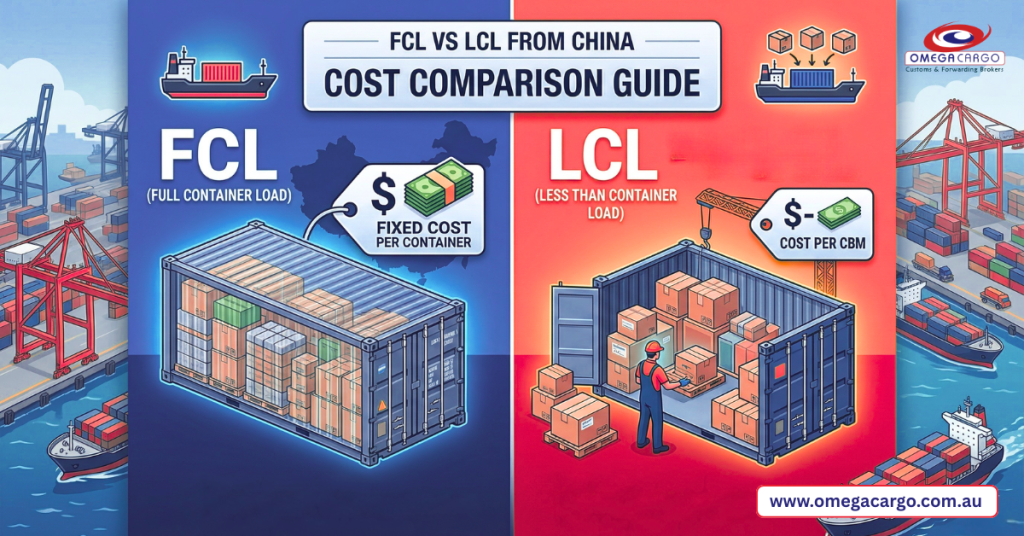
In the FCL vs LCL from China cost comparison guide, LCL (Less than Container Load) is cheaper for shipments under 14–15 CBM, costing approximately USD $50–$150 per CBM. FCL (Full Container Load) is cheaper above 15 CBM, with a 20ft container at a flat USD $1,380 and a 40ft at USD $2,680 (2026 rates, port-to-port). LCL is 40–70% cheaper for small loads but adds 5–15 extra transit days and carries hidden CFS fees. FCL is faster, safer and more cost-effective as your volume grows.
If you are importing goods for your business, you are part of this massive global movement. But as a business owner, you face a critical financial decision every time you place an order with your supplier. How do you get your goods across the ocean without wiping out your profit margins?
This brings us to the most common debate in international trade. To make the best decision for your bottom line, you need a deep dive into an FCL vs LCL from China – Cost Comparison. Understanding exactly how these two shipping methods differ, where the hidden fees live, and when to switch from one to the other can save you thousands of dollars on a single shipment.
In this massive, easy-to-understand guide, we are going to break down everything you need to know. Grab a cup of coffee, and let’s turn you into a shipping logistics expert so you can protect your profits and grow your business.
Before we dive into the heavy math and cost comparisons, let's make sure we are on the same page with the basic terminology. The shipping industry loves acronyms, but they are actually quite simple once you break them down.
FCL stands for Full Container Load. When you book an FCL shipment, you are renting an entire shipping container exclusively for your goods. It does not matter if the container is stuffed to the roof or only half full; the space belongs entirely to you.
Think of FCL like renting a private moving truck. You pay a flat rate for the truck. You don't share the space with anyone else's furniture, and once you lock the door, it stays locked until it reaches your new house.
The most common container sizes from China are:
LCL stands for Less than Container Load. If your order from your Chinese supplier is too small to fill a whole container, you don't want to pay for a bunch of empty air. Instead, you use LCL.
With LCL, you share a container with other importers. Your freight forwarder will take your pallets, combine (consolidate) them with goods belonging to other businesses, and stuff them all into one container. Once the container arrives at your destination port, it has to be opened and unpacked (deconsolidated) so everyone can get their specific goods.
Think of LCL like buying a ticket on a public bus. You only pay for the seat you take up, but you have to share the ride, make a few extra stops, and wait for others to get on and off.
CBM stands for Cubic Metre — the standard unit for measuring LCL cargo volume. You calculate it by multiplying each carton's length × width × height in metres. For example, a carton measuring 0.6m × 0.4m × 0.4m = 0.096 CBM. Add up all your cartons to get your total shipment CBM. This number determines your LCL cost and tells you whether LCL or FCL is cheaper for your shipment.
Let's look at what you actually pay for each option in 2026. These are indicative market rates for the major China shipping lanes. Your actual rate depends on your specific route, carrier, season and freight forwarder. Always get a full all-in quote before making your final decision.
FCL vs LCL from China — 2026 Base Rate Comparison
| Option | Unit | China → Australia | China → USA | China → UK/Europe | Rate Type |
| LCL Ocean Freight | Per CBM | USD $50–$150 | USD $80–$150 | USD $100–$200 | Variable |
| FCL 20ft Container | Flat rate | USD $1,380–$1,800 | USD $1,500–$3,000 | USD $1,800–$3,500 | Flat |
| FCL 40ft Container | Flat rate | USD $2,680–$3,500 | USD $2,000–$3,500 | USD $2,500–$4,500 | Flat |
| FCL 40ft High Cube | Flat rate | USD $2,800–$3,800 | USD $2,200–$4,000 | USD $2,800–$5,000 | Flat |
| Rates are port-to-port indicative figures for Q1–Q2 2026. Excludes origin charges, destination THC, customs clearance, GST/duties and inland delivery. Rates fluctuate significantly with season and market conditions. | |||||
Looking at those numbers alone, LCL at $50–$150/CBM looks very affordable. But these are base ocean freight rates only. Both FCL and LCL carry additional charges that must be added to get your true total cost. This is where the comparison gets interesting — and where most importers make expensive mistakes.
Now that you know what the terms mean, let's get to the heart of the matter. When doing an FCL vs LCL from China – Cost Comparison, you have to understand how the pricing structures differ fundamentally. It is not an apples-to-apples comparison.
LCL is priced based on volume, specifically by the Cubic Meter (CBM). You pay a variable rate. If the rate is $100 per CBM, and you have 5 CBM of goods, your base ocean freight is $500. If you have 10 CBM, it is $1,000. The cost goes up in a straight line as your volume increases.
(Note: Sea freight is technically billed based on volume or weight, whichever is greater. However, because ocean freight can hold immense weight, 99% of regular commercial goods max out the volume before they max out the weight limit. So, we focus heavily on CBM).
FCL is priced as a flat, fixed fee for the container. The shipping line does not care if you put 10 CBM or 30 CBM inside a 20-foot container. The price is the price.
If the current market rate for a 20-foot container from Shenzhen, China, to Los Angeles, USA, is $2,000, you will pay exactly $2,000.
Because LCL is priced per unit and FCL is a flat rate, there will mathematically always be a point where the lines cross. There is a specific volume where buying the whole container becomes cheaper than paying per CBM, even if you are shipping empty space!
This brings us to the most important rule in international shipping.
If you take only one piece of advice away from this entire article, let it be this: The industry standard break-even point between LCL and FCL is roughly 15 CBM.
In 2025 and 2026, freight analysts and forwarders agree that for most major routes (like China to the USA, China to Europe, or China to Australia), the 13 to 15 CBM mark is where you must stop and rethink your strategy.
Imagine you are importing sports equipment from Guangzhou. Your supplier tells you your order totals 15 CBM. You ask your freight forwarder for two quotes.
Scenario A: The LCL Quote
Scenario B: The FCL Quote (20-foot container)
In this real-world scenario, booking a full 20-foot container is actually $200 cheaper than shipping LCL, even though a 20-foot container holds 33 CBM and you are only using 15 CBM! You are paying to ship 18 CBM of completely empty air, and you are still saving money.
Keep this simple framework taped to your desk:
The single most important concept in the FCL vs LCL from China cost comparison is the break-even point. This is the cargo volume at which the total all-in cost of LCL equals the total all-in cost of FCL. Above this volume, FCL is cheaper. Below it, LCL wins.
The standard industry break-even is widely quoted as 14–15 CBM. Here's why that number makes sense mathematically:
FCL vs LCL Cost at Different Cargo Volumes — China to Australia 2026
| Cargo Volume | LCL All-In Cost (AUD est.) | FCL 20ft All-In Cost (AUD est.) | Winner | Savings |
| 3 CBM | ~$950 | ~$3,800 | LCL ✓ | LCL saves ~$2,850 |
| 5 CBM | ~$1,200 | ~$3,800 | LCL ✓ | LCL saves ~$2,600 |
| 8 CBM | ~$1,650 | ~$3,800 | LCL ✓ | LCL saves ~$2,150 |
| 10 CBM | ~$2,680 | ~$3,800 | LCL ✓ | LCL saves ~$1,120 |
| 12 CBM | ~$3,300 | ~$3,800 | LCL ✓ (marginal) | LCL saves ~$500 |
| 14 CBM | ~$3,750 | ~$3,800 | Roughly equal | Get quotes for both |
| 16 CBM | ~$4,200 | ~$3,800 | FCL ✓ | FCL saves ~$400 |
| 20 CBM | ~$5,000 | ~$3,800 | FCL ✓ | FCL saves ~$1,200 |
| 25 CBM | ~$6,100 | ~$3,800 | FCL ✓ | FCL saves ~$2,300 |
| Figures are all-in door-to-door indicative estimates for China–Melbourne lane, 2026. Excludes GST (identical for both). Get actual quotes from your forwarder for your specific shipment. | ||||
The 12–15 CBM Grey Zone
Between 12 and 15 CBM, the cost difference between LCL and FCL is small enough that other factors — transit speed, cargo fragility, schedule flexibility — often make the decision for you. At this volume, always get a full door-to-door quote for both options and compare them side by side. On the China-Australia lane specifically, high Australian deconsolidation fees sometimes make FCL competitive as early as 13 CBM.
Many new importers fall into a very common trap. They look at a quote for ocean freight from China, see that LCL is wildly cheaper than FCL, and immediately book it. Weeks later, the goods arrive at their home port, and they are hit with a massive, unexpected invoice.
Why does this happen? Because LCL looks cheap on the ocean, but it is expensive at the port.
When you ship LCL, your goods do not just magically load themselves onto the ship.
All of this extra handling costs money. These are known as Destination Handling Charges (DHC) or Deconsolidation Fees.
Some freight forwarders lure you in with a "zero dollar" or extremely cheap ocean freight rate for LCL. They make their profit by marking up the deconsolidation fees when the cargo arrives. You might pay $0 for the ocean journey, but suddenly face a $150 per CBM fee to get your goods released from the destination warehouse. If you have 10 CBM, that's $1,500 in hidden fees!
With FCL, you avoid the deconsolidation nightmare. The container is lifted off the ship, placed onto a truck chassis, and driven straight to your warehouse. There is no sorting, no separating, and no shared warehouse fees. The destination fees for FCL are usually fixed, flat, and highly predictable.
If you crave predictable budgeting, FCL offers a much safer pricing structure.
Here's the most important thing to understand about the FCL vs LCL cost comparison: the ocean freight rate is never the final price. Both options carry mandatory additional charges. But LCL carries significantly more of them — and they're less predictable.
LCL looks cheap on the surface because the per-CBM rate is low. But here are the fees that get added — often after you've already committed to a booking.
FCL is simpler — fewer line items, more predictable. But it still carries charges beyond the ocean rate.
The #1 LCL Trap: Destination Deconsolidation Fees
Many importers compare LCL and FCL based on the origin quote alone. But destination deconsolidation fees in countries like Australia, the USA and UK can be 2–5 times higher than what the origin forwarder quotes. A "cheap" LCL ocean rate of $80/CBM on a 10 CBM shipment becomes much less attractive once you add $350 destination deconsolidation, $150 documentation, $200 customs brokerage and $350 delivery. Always ask for a door-to-door all-in quote before comparing options.
Let's bring this to life with a real-world worked example. Below, you'll see exactly what a 10 CBM shipment from Shenzhen to Melbourne actually costs under each option in 2026, with all fees included.
FCL — 20ft Container (10 CBM shipment, container 36% full)
| Ocean freight (20ft flat rate) | USD $1,380 |
| Origin charges (export docs + THC) | USD $320 |
| Destination THC + port charges (Melbourne) | AUD $680 |
| Customs brokerage | AUD $280 |
| Local cartage (port → warehouse) | AUD $320 |
| GST (10% on VoTI — product value $15K) | AUD ~$1,680 |
| Total Landed Cost (excl. GST*) | AUD ~$3,800 |
LCL — 10 CBM Shipment (shared container)
| Ocean freight (10 CBM × $90/CBM) | USD $900 |
| Origin CFS consolidation (10 CBM × $30) | USD $300 |
| Fuel surcharge (10% on ocean rate) | USD $90 |
| Documentation (B/L + surrender) | USD $65 |
| Destination deconsolidation (Melbourne CFS) | AUD $320 |
| Customs brokerage | AUD $280 |
| Local delivery (CFS → warehouse) | AUD $280 |
| GST (10% on VoTI — product value $15K) | AUD ~$1,680 |
| Total Landed Cost (excl. GST*) | AUD ~$2,680 |
GST is identical in both options and is claimable as an Input Tax Credit by GST-registered businesses. Rates are indicative 2026 figures. Your actual cost varies by forwarder, route and season.
In this example, for a 10 CBM shipment, LCL saves approximately AUD $1,120 compared to FCL — about 30% less. That's a meaningful saving, and it shows why LCL is the right choice for smaller loads. But now watch what happens as the volume increases.
Cost isn't the only thing that matters. Transit time is often just as important — especially if you're managing inventory levels, responding to sales spikes, or importing time-sensitive goods. Here's how FCL and LCL compare on speed.
Transit Time: FCL vs LCL from China — Key Routes 2026
| Route | FCL Port-to-Port | FCL Door-to-Door | LCL Port-to-Port | LCL Door-to-Door | Extra LCL Days |
| China → Melbourne | 18–24 days | 25–33 days | 22–30 days | 30–42 days | +5–15 days |
| China → Sydney | 20–25 days | 27–34 days | 24–32 days | 32–45 days | +5–15 days |
| China → Brisbane | 20–26 days | 27–35 days | 24–34 days | 32–46 days | +5–15 days |
| China → Fremantle (Perth) | 16–22 days | 22–30 days | 20–28 days | 28–40 days | +5–12 days |
| China → USA West Coast | 14–18 days | 20–26 days | 18–26 days | 28–38 days | +6–14 days |
| China → UK/Europe | 28–35 days | 35–44 days | 33–42 days | 42–55 days | +7–14 days |
| LCL extra time comes from origin CFS consolidation (3–5 days) + destination CFS deconsolidation (2–7 days). Seasonal port congestion and customs delays can add 3–10 additional days to any shipment. | |||||
The extra 5–15 days that LCL adds to your delivery time has a real cost that doesn't show up in the freight quote. If you're running lean inventory, those extra days could mean stockouts, lost sales or emergency air freight to fill the gap. When you calculate the true cost of LCL, factor in the value of time as well as the freight bill.
In the world of e-commerce and retail, running out of stock is a disaster. If your listing on Amazon FBA goes out of stock, your ranking plummets. If your boutique runs out of summer dresses in June, you lose those sales forever.
Therefore, a true FCL vs LCL from China – Cost Comparison must factor in the cost of time.
When you book a full container, your supplier loads it at their factory, seals the door with a bolt seal, and a truck takes it straight to the departure port in China (like Ningbo, Shenzhen, or Shanghai). It gets loaded onto the ship. When it arrives at your local port, it clears customs and goes straight to you.
LCL is inherently slower. Because you are sharing a container, your goods have to wait at the origin warehouse until enough cargo arrives from other businesses to fill the box. This can take several days. Once the container arrives at your destination port, it has to be moved to an off-site warehouse, unpacked, and sorted. This deconsolidation process can easily add a week to your timeline.
The Business Cost: If your goods are delayed by 10 days in an LCL warehouse, how many daily sales are you missing out on? If you make $200 in profit a day, a 10-day delay costs you $2,000 in lost opportunity. Suddenly, spending an extra $500 to upgrade to an FCL container looks like an incredibly smart investment.
Cost isn't just about what you pay the shipping line; it is also about the money you lose if your products arrive crushed, wet, or broken. Beyond cost and speed, there's a third dimension to the FCL vs LCL decision that many importers overlook until it's too late: cargo risk.
FCL is incredibly secure. The container is loaded at your supplier's factory in China. A heavy metal bolt seal is locked onto the door doors. That seal is not broken until the container backs up to your loading dock (unless customs decides to do a random inspection, which is rare). Your goods are handled exactly twice: once when loaded, and once when unloaded.
Because of this, the risk of damage, theft, or lost cartons is incredibly low. FCL is highly recommended if you are shipping:
LCL cargo goes through a lot. Your pallets are loaded onto a truck at the factory, unloaded at a warehouse in China, moved around by forklifts, squeezed into a container next to potentially heavy or awkward cargo, unloaded at a warehouse in your country, and loaded onto another truck.
That is a lot of handling. Furthermore, you don't control what your goods travel with. Your delicate boxes of electronics might be sitting right next to a heavy crate of auto parts. If the ship hits rough seas, things shift.
While good packaging mitigates this, the damage rate for LCL is statistically higher than FCL. If you choose LCL, you must invest more money in heavy-duty export packaging and robust cargo insurance, which adds to your overall LCL costs.
FCL vs LCL Risk & Security Comparison
| Factor | FCL | LCL | Advantage |
| Number of cargo handling points | 2 (load + unload) | 4–6 (CFS + load + unload + CFS) | FCL |
| Damage risk | Low | Moderate to High | FCL |
| Contamination risk | None | Possible (shared container) | FCL |
| Customs delay risk | Only affects your shipment | Any co-loader can delay the container | FCL |
| Visibility and tracking | Full container tracking | Ocean tracking + CFS updates | Comparable |
| Cargo insurance complexity | Straightforward | Harder to prove damage cause | FCL |
| Best for fragile goods | Yes ✓ | Use with caution | FCL |
| Best for low-value bulk goods | Good for large volumes | Good for small volumes | Depends on volume |
Now that you understand the costs, transit times and risk profiles, here's a practical guide to exactly when you should choose each option.
LCL is almost always the cheaper choice for shipments under 12 CBM. You pay only for what you use — there's no sense in paying for an entire container you'd only fill a fraction of.
When you're ordering a small initial batch to test demand or validate a product, LCL gives you the flexibility to ship without committing to a full container of stock you're not sure will sell.
If you source from multiple Chinese suppliers and regularly receive small top-up orders, LCL lets you ship on a flexible schedule without waiting to accumulate enough volume for FCL.
LCL means lower upfront freight cost even if it's not the most cost-efficient per CBM at higher volumes. If preserving working capital is critical, smaller LCL shipments spread your freight spend over time.
Once your volume consistently hits 14–15 CBM, FCL becomes cheaper per CBM, faster and less risky. This is the most important threshold in the FCL vs LCL cost comparison.
If your cargo can't afford damage — think electronics, glassware, ceramics, furniture, precision equipment or premium branded products — FCL's sealed container gives you the protection you need.
FCL is consistently faster than LCL on every route. If you have a fixed product launch, seasonal selling window or retail delivery deadline, FCL's predictable transit time is far less risky.
Once your business matures and you're shipping consistent volumes, FCL simplifies your logistics — fewer handling steps, easier customs, better supplier coordination and lower per-unit freight costs.
You cannot accurately compare shipping costs without understanding Incoterms. Incoterms (International Commercial Terms) are three-letter acronyms that define exactly who pays for what, and who is responsible for the goods at each step of the journey.
When you ask your Chinese supplier for a product price, they will usually quote you based on an Incoterm. The two most common are FOB and EXW.
If your supplier quotes you "FOB Shenzhen," it means the supplier is paying all the costs to manufacture the goods, transport them to the port in Shenzhen, clear Chinese export customs, and load them onto the ship.
Your responsibility (and your cost) only starts after the goods are on the boat. FOB is the most highly recommended Incoterm for importers because it gives you control over the ocean freight and keeps local Chinese port fees in the hands of your supplier.
If your supplier quotes you "EXW," it means they are just leaving the goods on the floor of their factory. You have to hire a trucking company in China to pick them up, you have to pay for Chinese export customs clearance, and you have to pay the port fees in China.
How this impacts LCL vs FCL: If you buy under EXW terms, shipping LCL becomes much more expensive. Why? Because you have to pay a local Chinese truck to drive a partial load all the way to the port warehouse. If you buy EXW and use FCL, a truck brings an empty container to the factory, loads it, and drives it back—a much smoother and often more cost-effective local logistics process.
Always ask your suppliers for FOB quotes. It makes comparing your freight forwarder quotes significantly easier.
If you're importing to Australia specifically, there are a few additional factors that shift the FCL vs LCL cost comparison compared to other trade lanes.
Australian port CFS (Container Freight Station) fees are notably higher than in many other countries. Destination deconsolidation at Australian CFS facilities typically costs AUD $280–$450 — higher than the equivalent charges in the USA or much of Europe. This means the LCL cost advantage erodes faster on the China-Australia lane, and many Australian importers find the FCL break-even kicks in closer to 13–14 CBM rather than the standard 15 CBM rule.
During the Brown Marmorated Stink Bug (BMSB) season (1 September to 30 April), all sea freight imports from China must comply with Australian biosecurity requirements. Target risk goods must be treated and certified in China before the vessel departs. This applies equally to FCL and LCL — but for LCL, the treatment and documentation process involves your freight forwarder coordinating across multiple shippers in the same container, which adds complexity and risk of delays if any co-loader's cargo isn't compliant.
Under the China-Australia Free Trade Agreement (ChAFTA), most goods from China enter Australia at 0% import duty — as long as you have a valid Certificate of Origin (COO). This applies regardless of whether you ship FCL or LCL. Always make sure your supplier provides the COO before your cargo departs China. Without it, you pay up to 5% import duty on declared value — a significant cost on any sizable shipment.
Australian Importers: The LCL-to-FCL Switch Happens Earlier
On the China–Australia lane, the effective break-even point is often
13–14 CBM
rather than the standard 15 CBM — because Australian destination CFS deconsolidation fees are higher than average. If your regular shipment volume is between 12 and 16 CBM, get full all-in door-to-door quotes for both options on the specific Australian port you use. The result will likely surprise you.
To make the right choice between FCL and LCL, you need to know your CBM (Cubic Meters). CBM is simply the volume of your cargo.
Here is exactly how you calculate it, step-by-step.
The Formula: Length (in meters) x Width (in meters) x Height (in meters) = CBM.
Example Calculation: Let's say you are importing 100 cartons of shoes. First, measure one standard carton in centimeters. Let's assume it is 60cm long, 40cm wide, and 40cm high.
Since 9.6 CBM is well below the 15 CBM break-even point, you would choose LCL shipping for this order.
Under 12 CBM → LCL is almost certainly cheaper. Between 12–15 CBM → get quotes for both. Over 15 CBM → FCL is very likely cheaper. This gives you a starting point before requesting quotes.
Ask your freight forwarder for two quotes — one all-in LCL quote and one all-in FCL quote — both including origin charges, ocean freight, destination port fees, customs brokerage, and local delivery. Never compare just the ocean rate.
If LCL saves $400 but adds 12 days of transit time, calculate what those 12 days cost you in delayed revenue, inventory holding costs or stockout risk. The total picture often shifts the decision.
If your goods are fragile, high-value or perishable, add a risk premium to the LCL option in your comparison. The cost of even one damaged shipment can eliminate years of LCL freight savings.
During peak season (September–January), both LCL consolidation space and FCL container availability tighten. Book at least 3–4 weeks in advance and 6–8 weeks for pre-CNY shipments.
Pro Tip: Always ask your supplier for the "Packing List" before you book shipping. The packing list will have the exact carton dimensions, gross weight, and total CBM already calculated for you.
If you want to move from a beginner importer to a supply chain pro, you need to use advanced strategies to manipulate your volume and manipulate the rules. Here are three commercial tactics you can use today.
What happens if you have three different suppliers in China? Supplier A has 5 CBM, Supplier B has 6 CBM, and Supplier C has 4 CBM.
If you ship them all separately as LCL, you will pay destination handling fees, customs clearance fees, and delivery fees three separate times. It will cost a fortune.
Instead, use a freight forwarder who offers "Buyer's Consolidation." The forwarder will collect the goods from all three suppliers, hold them in a warehouse in China, and combine them together. 5 + 6 + 4 = 15 CBM.
Congratulations! You just hit the magic break-even point. The forwarder loads all your goods into one single 20-foot FCL container. You ship it under one Bill of Lading, do one customs entry, and pay one flat delivery fee. This strategy regularly saves importers 30% to 50% on their total shipping bill.
Remember, LCL charges you for the space you take up. If your products are shipped in oversized boxes filled with bubble wrap and empty air, you are literally paying to ship air across the Pacific Ocean.
Work with your Chinese manufacturer to redesign your packaging. Can the retail box be made 2 inches thinner? Can the product be disassembled slightly?
If you can reduce the size of your master carton by just 15%, you reduce your total CBM by 15%. On an LCL shipment, that translates directly to a 15% reduction in your ocean freight bill, every single time you order.
Shipping rates from China are not static; they fluctuate based on supply and demand. The two biggest spikes in prices occur:
During these peak seasons, FCL container rates can skyrocket. A $2,000 container might jump to $4,000. Interestingly, LCL rates usually rise much slower than FCL rates.
If you are shipping 14 CBM during the off-season (May), FCL is probably cheaper. But if you are shipping that same 14 CBM during Peak Season in September, the FCL flat rate might be so high that LCL actually becomes the cheaper option again. Always get fresh quotes!
Let’s look at three very common profiles of e-commerce and retail buyers to see how the decision matrix applies in the real world.
The Situation: Sarah is launching a new brand of yoga mats on Amazon. She doesn't have a massive budget, so she is only ordering 500 units to test the market. Her total volume is 4 CBM. The Decision: LCL. Why: At 4 CBM, a full container makes zero financial sense. She needs to preserve her capital. Even though LCL takes a few days longer and has some destination fees, the overall cost is thousands of dollars cheaper than renting a 20ft box. She accepts the longer transit time to protect her cash flow.
The Situation: Marcus runs a boutique furniture store in Melbourne, Australia. He orders custom wooden dining tables from Ningbo, China. His current monthly order is 12 CBM. The Decision: FCL (20-foot container). Why: Even though 12 CBM is slightly below the strict 15 CBM break-even rule, Marcus is shipping high-value, heavy, and easily scratchable wooden furniture. If he uses LCL, forklifts will move his tables multiple times, increasing the risk of damage. By paying slightly more for FCL, he ensures the container is sealed in China and opened at his store. He also gets the furniture 10 days faster, allowing him to turn his inventory over quicker. For Marcus, the safety and speed easily justify the FCL cost.
The Situation: David supplies tech gadgets to small retail shops across Europe. His supplier in Shenzhen just finished an order of 28 CBM of Bluetooth speakers and phone accessories. The Decision: FCL (20-foot container). Why: This is a no-brainer. A 20-foot standard container holds about 28 to 33 CBM. David's order perfectly maximizes the space of the container. He will get the absolute lowest cost per unit possible by utilizing almost 100% of the FCL capacity.
Whether you choose FCL or LCL, your goods must clear customs when they leave China and clear customs again when they arrive in your country. However, there are slight administrative differences.
Both methods require the exact same core documents:
With FCL, you will receive a Master Bill of Lading directly associated with the entire container. With LCL, you will receive a House Bill of Lading, which represents your specific fraction of the cargo inside the consolidated container.
Customs brokers generally charge a flat fee to process your paperwork, regardless of whether it is an LCL pallet or a full FCL container. A standard customs entry fee in the USA is around $125 to $150.
Therefore, importing five small LCL shipments over three months means paying that customs fee five times ($750 total). Importing one large FCL container covering three months of inventory means paying that customs fee only once ($150). Consolidating your orders into larger FCL loads saves heavily on administrative and brokerage fees over the course of a year.
Never compare the ocean rate alone. Get full door-to-door quotes including every fee — origin, ocean, destination, customs, delivery — before deciding between FCL and LCL.
The moment your shipments consistently hit 14–15 CBM, switch to FCL. You'll pay less, wait less and receive goods in better condition. Staying on LCL past this point costs you money every time.
LCL is priced on CBM. Compact packing, vacuum sealing soft goods and removing unnecessary inner boxes can meaningfully reduce your declared volume and freight bill.
Instead of shipping three 3 CBM orders from different suppliers separately, consolidate them into one 9 CBM LCL shipment. You pay one minimum charge instead of three, and your per-CBM rate improves.
spike 20–40% during October–December (pre-Christmas peak) and January–February (pre-Chinese New Year). April–August is typically the lowest-cost LCL window. Plan ahead to take advantage of it.
Some freight forwarders offer buyer's consolidation — they collect goods from multiple Chinese suppliers, consolidate them at one CFS, and ship as a single FCL. This can save significant money if you source from multiple factories.
Whether shipping FCL or LCL to Australia, always get a ChAFTA Certificate of Origin from your supplier. It eliminates import duty (saves up to 5% of declared value) — on a $50,000 shipment, that's $2,500 saved per container.
If you ship LCL monthly on the same lane, ask your forwarder for a volume-based rate card. Regular shippers committing to 50+ CBM per year can often negotiate 15–25% below spot market rates.
As global consumers become more environmentally conscious, businesses are looking to reduce their carbon footprint. How do FCL and LCL compare regarding sustainability?
Ocean freight is already the most carbon-efficient method of international transport (far vastly superior to air freight). However, within ocean freight, LCL is generally considered more eco-friendly on a macro scale.
Because LCL forwarders ensure that every single cubic meter of a container is tightly packed with multiple companies' goods, the shipping lines are moving fewer "empty" containers across the ocean. When you book a 20ft FCL container for only 12 CBM of goods, you are forcing the ship to carry 20 CBM of empty space, increasing the carbon emission per unit of your product.
If corporate social responsibility and sustainability are core to your brand, optimizing your shipments to either maximize FCL space or utilizing LCL consolidation networks is a great step forward.
To wrap up our ultimate guide, let's answer the most common questions importers type into Google when researching shipping containers from China to the USA, Europe, or Australia.
For very small, lightweight shipments (under 150 kg or 1 CBM), Express Courier (DHL, FedEx) is cheapest. For medium shipments (1 to 14 CBM), LCL sea freight is the cheapest. For large shipments (15+ CBM), FCL sea freight is the most economical.
Rates fluctuate wildly based on global economics. Pre-pandemic, a 40ft container from China to the US West Coast was $1,500. During the pandemic peak, it hit $20,000. In 2025/2026, standard rates have stabilized generally between $2,000 and $4,500 depending on the season and specific destination port.
Yes, absolutely. You cannot book LCL directly with a massive shipping line like Maersk or MSC. You must use a freight forwarder (or NVOCC) who buys container space in bulk and acts as the middleman to consolidate your goods with others.
You can, but you shouldn't. A 20-foot container holds up to 33 CBM and is significantly cheaper than a 40-foot container. Always match your volume to the smallest possible FCL container to save money.
Door-to-door means the freight forwarder handles everything: picking the goods up at the Chinese factory, ocean freight, customs clearance, and trucking it directly to your office or warehouse. You can get door-to-door quotes for both LCL and FCL shipments. It is the most stress-free way to import.
Yes. While volume (CBM) is usually the limiting factor for most goods, incredibly dense items (like ceramic tiles, steel parts, or liquids) can hit the legal weight limit of a container before filling the space. A standard 20ft container can hold a maximum cargo weight of roughly 28,000 kg (61,000 lbs). If you exceed this, you face massive fines or the port will refuse to load it.
If your paperwork is perfect (Commercial Invoice, Packing List, HS Codes are accurate), customs clearance usually takes 1 to 3 days. Delays only happen if customs flags your shipment for a random exam, or if you are missing required licenses (like FDA approvals for medical devices).
Mastering the logistics of international trade is one of the most powerful ways to increase your profit margins. As you have seen in this comprehensive FCL vs LCL from China – Cost Comparison, there is no single "best" method. It entirely depends on your specific business situation.
To summarize your action plan:
Shipping from China doesn't have to be intimidating. By understanding the math, knowing the right questions to ask your freight forwarder, and optimizing your cargo volumes, you can navigate the global supply chain like a seasoned professional. Happy importing, and may your profit margins be wide and your transit times be short!


