
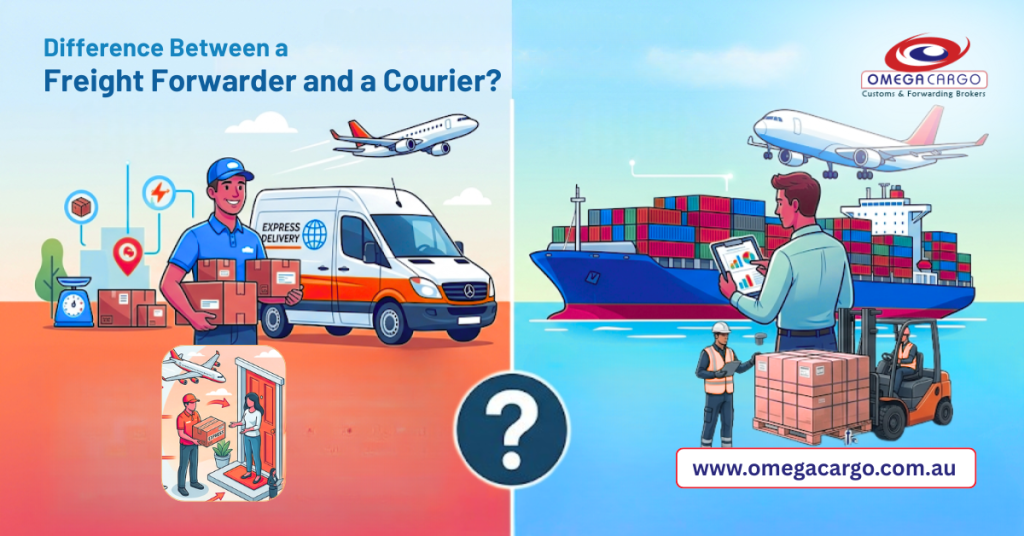
You’ve got goods to move and two familiar options in front of you: book a courier pickup online in a few clicks, or ask a freight forwarder for a quote. Both promise to get your shipment from A to B. So does it really matter which one you call? It does — and the difference between a freight forwarder and a courier is one of the most useful things an Australian business can understand before it books its next shipment.
Pick the wrong one and the cost shows up quickly. Send a few hundred kilos of commercial stock through an express parcel network and you’ll usually pay a premium for speed you didn’t need. Send a single small sample through a freight forwarder and you’ll pay for paperwork, handling and minimum charges built for much bigger cargo. Neither service is better than the other. They’re built for different jobs.
This guide explains what each one does, how they price and move goods, how Australian customs treats a courier parcel compared with a forwarded commercial shipment, and a simple five-question test you can use to choose the right option every time.
Key Takeaways
The main difference is scale and scope. A courier moves small parcels and documents through its own express network, door to door, priced per parcel. A freight forwarder arranges the transport of larger commercial shipments using other companies’ aircraft, ships and trucks, and manages the customs clearance, documentation and compliance that bigger international consignments need.
Put simply: use a courier for one laptop. Use a freight forwarder for a pallet — or a container — of laptops.
| Courier | Freight forwarder | |
| Built for | Parcels and documents | Commercial cargo: cartons, pallets, crates, containers |
| Owns the transport? | Usually runs its own aircraft, hubs and delivery fleet | Usually books space with carriers on your behalf |
| Main strength | Speed and simplicity | Cost efficiency at scale, flexibility and compliance management |
| Typical customer | Online sellers, individuals, businesses sending small or urgent items | Importers and exporters moving stock, equipment and regulated goods |
A courier service is a company that collects individual parcels and documents from a sender and delivers them to a recipient’s door through its own integrated network. When you print a label, book a pickup and track the parcel from your screen, you’re using a courier.
The courier controls almost every step. Your parcel is collected by the courier’s driver, sorted at the courier’s hub, flown on aircraft the courier operates or controls, sorted again at a destination hub and delivered by the courier’s last-mile driver. One booking reference follows it the whole way.
That end-to-end control is what makes couriers fast and predictable. It’s also why they work best within a tight set of rules. Every courier sets limits on the weight and dimensions of a single piece, standard packaging expectations, and what it will and won’t carry. Step outside those rules and you’ll usually see surcharges, delays or a refused booking.
You’ll recognise most of these names:
Several of these companies also run separate freight divisions, which is where much of the confusion between couriers and forwarders comes from. We’ll come back to that below.
A courier is usually the better choice when you’re sending:
A freight forwarder is a logistics company that organises the movement of commercial cargo from origin to destination on your behalf. Instead of running its own aircraft or ships, a freight forwarder books space with airlines, shipping lines, rail operators and road transport companies, then coordinates every handover between them.
The transport booking is only part of the job. For an Australian importer, the bigger value is usually everything around the transport: preparing and checking documents, arranging customs clearance, coordinating biosecurity inspections and treatments, organising wharf cartage from the port, and solving problems when something goes wrong. Many forwarders also employ licensed customs brokers, so customs and freight sit with one provider. Our guide to what a freight forwarder does covers the full role in more detail.
A freight forwarder is usually the better choice when:
Laid out factor by factor, the difference between a freight forwarder and a courier becomes much easier to see. Use the table as a quick reference.
| Factor | Courier service | Freight forwarder | Usually the better fit |
| What it moves | Parcels, documents, small cartons | Cartons, pallets, crates, LCL and FCL containers, oversized cargo | Depends on size |
| Transport modes | Its own express air and road network | Sea, air, road and rail, often combined | Forwarder for flexibility |
| How it’s priced | Per parcel, using published rate cards and online calculators | Per shipment, quoted on chargeable weight or volume, route and services | Courier for small; forwarder for bulk |
| Speed | Built for fast door-to-door delivery | Depends on mode — air or sea — and the service chosen | Courier for urgent small items |
| Customs clearance | Built-in, streamlined clearance for routine low-value parcels | Full clearance management, including tariff classification, duty and GST, and permits | Forwarder for commercial imports |
| Biosecurity | Standard parcel screening | Coordinates DAFF inspections, treatments and documentation | Forwarder for regulated goods |
| Dangerous goods | Often restricted or declined | Specialist handling and documentation | Forwarder |
| Insurance | Limited carrier liability or declared-value cover | Marine and air cargo insurance can be arranged | Forwarder for high-value cargo |
| Booking | Instant online booking, often no account needed | Quote-based, with a contact who manages the shipment | Courier for simplicity |
| Tracking | Detailed scan-by-scan tracking | Milestone tracking — departed, arrived, cleared, delivered — plus a person to ask | Both work; different style |
Cost is where the wrong choice hurts most, so it’s worth understanding why the two services price so differently. Exact figures change with the route, the cargo and market conditions, but the logic behind them stays the same.
Couriers price for convenience. You’re paying for a premium, door-to-door express network and the handling of each individual parcel. That works out well for a small box. As weight climbs, though, a per-parcel model gets expensive quickly, and pieces that break the courier’s size or weight rules attract extra handling charges.
Freight forwarders price for scale. A forwarder quotes your shipment as a whole and spreads the cost of aircraft or vessel space across a much larger volume. For air freight, the price is based on chargeable weight — whichever is greater of the actual weight and the volumetric weight, which reflects how much space the goods take up. For sea freight, it’s driven by volume in cubic metres or by the container you book. Our CBM and volumetric weight guide shows how to calculate both.
On top of transport, a forwarder’s quote may include origin charges, destination port charges, customs clearance, duty and GST, biosecurity costs and final delivery. That’s why a forwarder can look expensive on a tiny shipment — those fixed costs don’t shrink much for a single carton — and much cheaper per kilo on a larger one.
The point where a forwarder becomes cheaper than a courier isn’t a fixed weight. It moves with:
The only reliable way to find your crossover point is to compare a courier quote and a freight quote for the same shipment.
Couriers are built for speed on small parcels, and for urgent documents or samples they’re hard to beat. But “courier equals fast, forwarder equals slow” is too simple.
A forwarder booking air freight often uses the same kinds of passenger and freighter aircraft that carry express cargo. What changes the door-to-door time is everything around the flight: how quickly the cargo is collected and lodged, the flight schedule on that route, how documents are prepared, how fast customs and biosecurity clearance happen, and how the goods are delivered after landing. Sea freight trades time for cost, and its transit depends on the port pair, whether the service is direct or transhipped, vessel schedules and port congestion.
So the real question isn’t “which is faster?” It’s “how much speed does this shipment actually need, and what am I willing to pay for it?” Our comparison of air freight vs sea freight goes deeper on that trade-off.
This is where the difference between a freight forwarder and a courier matters most for importers. The rules don’t change depending on who carries your goods — but how much help you get with them does.
According to the Australian Border Force, air and sea cargo valued at AUD 1,000 or less is cleared using a Self-Assessed Clearance (SAC) declaration. For most goods at this value there are no duties, taxes or charges to pay at the border, although tobacco and alcohol are taxed regardless of value. SAC declarations can be lodged by a cargo reporter, a licensed customs broker or another person with access to the system.
That’s why a low-value courier parcel usually feels effortless: the courier reports the cargo and handles routine clearance as part of its service. Two points catch people out:
When a consignment has a combined value of more than AUD 1,000 and is being cleared for home consumption, the ABF requires a full Import Declaration (N10). All applicable duties, taxes and charges — including an import processing charge — must be paid before the goods are released.
Under the Customs Act 1901, only the owner of the goods or a customs broker licensed by the ABF can submit an import declaration. The ABF encourages first-time and infrequent importers to use a licensed broker.
Here’s a detail many comparison articles get wrong: major express couriers can arrange formal clearance too. DHL Express, for example, lists formal “non-routine entry” clearance for goods above the formal entry threshold as an added customs service. The practical difference is the depth of support. A courier’s process is designed around high volumes of routine parcels. A freight forwarder with customs brokers works through your specific consignment: checking the tariff classification, valuation, origin and any free trade agreement preference, permits and biosecurity requirements before the goods arrive. For a regular commercial importer, that preparation is usually what prevents holds, amendments and storage charges. See our guide to what a customs broker does.
The Department of Agriculture, Fisheries and Forestry (DAFF) states that its biosecurity requirements apply to all goods imported into Australia. Timber packaging, foodstuffs, plant and animal products, used machinery and seasonal pest measures can all trigger documentation checks, inspection or treatment — whether the goods arrive in a courier bag or a shipping container.
| Important: Customs thresholds, charges and biosecurity conditions can change. Treat the rules above as a general guide, and confirm the current requirements for your goods with the ABF, DAFF or your customs broker before you ship. |
| Pro Tip: Before you ship anything commercial, ask your provider: “Who will lodge my import declaration, and who will deal with biosecurity if the goods are held?” A clear, named answer tells you more about the service you’ll get than any brochure. |
If your parcels are already stuck, our explainers on DHL clearance delays and FedEx clearance delays walk through the common causes.
Real shipping decisions aren’t always one or the other.
Big brands run both models. DHL is the classic example: DHL Express is its courier business, while DHL Global Forwarding handles air and ocean freight. In Australia, Australia Post’s parcel network sits alongside StarTrack, which offers business freight and courier services. When someone asks “is DHL a courier or a freight forwarder?”, the honest answer is that it depends which part of DHL you’re dealing with.
Express freight sits between the two. Heavier express services and consolidated air freight fill the gap between a parcel and a full commercial shipment. They suit urgent cargo that’s too heavy for standard parcel pricing.
Many businesses use both — on purpose. A common and sensible pattern looks like this:
That’s the logic behind e-commerce logistics: freight economics for the inbound bulk shipment, parcel convenience for the outbound orders. Omega Cargo’s e-commerce logistics service is set up around exactly this split.
A furniture maker regularly couriers small replacement parts, so when a customer interstate orders a full dining table, the business books the same courier. The crate breaks the network’s size and weight rules. The result is a stack of oversize and special handling surcharges, a likely delay — and a final bill far above what a road freight or interstate transport booking would have cost.
How to avoid it: Once a single piece goes beyond what one person can comfortably lift, or arrives on a pallet, get a freight quote as well as a courier quote.
A business needs to send a handful of small sample boxes to a trade show and hands them to a freight forwarder. The forwarder treats them as commercial cargo: palletising, documents, origin and destination handling. The business ends up paying minimum charges designed for much larger freight.
How to avoid it: If the shipment is a few light boxes going to one address and it’s low value, a courier is usually simpler and cheaper.
| Example: A Perth homewares retailer is launching a new range from a supplier in China. The supplier couriers three sample units, so the retailer can check quality without waiting. Once approved, the full order — several pallets of boxed stock — is booked with a freight forwarder in a shared container into Fremantle. The forwarder arranges the Import Declaration, checks the timber packaging meets biosecurity requirements, and books container transport to the retailer’s warehouse. From there, individual online orders go out by courier. Each service does the part it’s best at, and the retailer avoids paying express rates on a full production run. |
Myth: “DHL and a freight forwarder do the same thing.” Fact: DHL Express is a courier network. A freight forwarder manages commercial cargo across multiple carriers and handles the compliance around it. DHL does run a separate forwarding division, but it’s a different service with a different booking process.
Myth: “Using a freight forwarder always means slower delivery.” Fact: Air freight booked through a forwarder can move quickly. Door-to-door time depends far more on flight schedules, document quality and clearance than on whether a courier or a forwarder made the booking.
Myth: “Couriers can’t handle formal customs clearance.” Fact: Large express couriers can arrange formal entries for higher-value goods. The difference is the level of shipment-specific advice and preparation, not whether clearance is possible.
Myth: “Freight forwarders are only for big corporations.” Fact: Forwarders work with small and medium businesses every day. If you import commercial stock — even a few pallets a year — a forwarder is worth talking to.
Myth: “A freight forwarder is more hassle than a courier.” Fact: With the right forwarder, it’s usually less hassle for commercial cargo. You supply the commercial invoice and packing list, and your forwarder coordinates carriers, customs, biosecurity and delivery. Our guide on how to choose the best freight forwarder in Australia explains what to look for.
Work through these questions in order. The first “yes” usually gives you your answer.
| Question | If yes | If no | |
| 1. Is it documents, a sample or a small, light parcel going to one address? | Courier | Go to question 2 | |
| 2. Is it palletised, crated, bulky or too heavy for one person to lift? | Freight forwarder | Go to question 3 | |
| 3. Is it commercial goods valued over AUD 1,000 that will need a full Import Declaration? | Freight forwarder, or a provider with licensed customs brokers | Go to question 4 | |
| 4. Is it regulated, dangerous, food, plant or animal-based, or likely to need permits or biosecurity treatment? | Freight forwarder | Go to question 5 | |
| 5. Is it urgent, small and worth paying a premium to move quickly? | Courier or express freight | Get a courier quote and a freight quote, and compare | |
| Note: When a shipment sits in the grey zone — heavier than a parcel but smaller than a pallet load — get both quotes for the same goods, route and delivery address. Compare the total landed cost, not just the transport line. | |||
Omega Cargo is a freight forwarder, not an express courier network. We’re a West Australian family company founded in 2000, and our work centres on freight forwarding in Perth and across Australia: air freight, sea freight, customs and quarantine clearance, warehousing, interstate transport, and vessel and aircraft imports.
That means we don’t run our own fleet of parcel aircraft or offer a walk-in express counter. If you need to send one urgent document overseas, a courier is the right tool, and we’ll tell you so.
Where we do help with smaller items, it’s as part of a wider logistics setup. Our e-commerce service can arrange collection and delivery of parcels from your warehouse to your customers through courier partners, and we also clear cargo that arrives into Australia through the postal system.
If your goods are commercial, heavy, bulky, regulated or need formal Australian customs clearance, that’s the work we’re set up for.
No. A courier moves small parcels and documents through its own express network, door to door. A freight forwarder arranges the transport of larger commercial cargo using airlines, shipping lines and transport operators, and manages the customs clearance, documents and compliance around it. The two overlap only at the edges, such as heavier express freight.
Not in the usual sense. Australia Post is a postal and parcel delivery operator, and its StarTrack brand offers business freight and courier services. A freight forwarder, by comparison, organises international cargo across multiple carriers and manages customs and biosecurity clearance. For commercial imports, a freight forwarder or customs broker is usually the better fit.
Sometimes, contractually. Most freight forwarders don’t own ships or aircraft, but many issue their own house bills of lading or house air waybills, which makes them the contracting carrier to you while the physical transport is performed by a shipping line or airline. Some forwarders also operate their own trucks for pickup and delivery.
For larger, heavier or bulkier shipments, usually yes, because forwarders price on chargeable weight or volume and spread carrier costs across consolidated cargo. For small, light parcels, a courier is usually cheaper, because a forwarder’s fixed handling and documentation costs don’t shrink much for a single carton. Comparing quotes for the same goods is the only reliable test.
Both, through separate businesses. DHL Express is the courier service for documents and parcels. DHL Global Forwarding handles air and ocean freight for larger commercial shipments. They have different booking processes, pricing models and service levels, so it’s worth checking which one you’re actually dealing with.
Yes, for routine shipments. Couriers typically lodge clearance for low-value parcels as part of their service, and major express couriers can arrange formal entries for higher-value goods, often as an added service. For commercial goods valued over AUD 1,000, an Import Declaration must be lodged by the owner or a licensed customs broker, and regulated goods may need permits and biosecurity clearance.
Often not separately. Many Australian freight forwarders employ licensed customs brokers or partner closely with one, so clearance is handled as part of the shipment. Ask your forwarder directly who lodges the Import Declaration and who manages biosecurity, so you know exactly who is responsible if goods are held.
There isn’t one universal limit. Each courier sets its own maximum weight and dimensions per piece, and the limits vary by service and destination. Pieces that exceed them may attract oversize surcharges or be refused. If your goods are palletised or too heavy for one person to lift, a freight forwarder is usually the better option.
Yes. A freight forwarder can arrange pickup from your supplier’s premises, export clearance, international air or sea freight, Australian customs and biosecurity clearance, and delivery to your warehouse or business address. You can also choose port-to-port or door-to-port arrangements, depending on your Incoterms and how much of the journey you want managed.
Sometimes, but with tight limits. Many courier services restrict or decline dangerous goods such as lithium batteries, flammable liquids, aerosols and chemicals. Anything accepted by air must comply with the IATA Dangerous Goods Regulations. For regular or larger dangerous goods shipments, a freight forwarder with dangerous goods experience is usually the safer choice.
Courier tracking is detailed and automated, showing each scan as the parcel moves through the network. Freight forwarder tracking focuses on milestones, such as cargo collected, departed, arrived, cleared and delivered, and you also have a contact person who can explain what’s happening and act if there’s a problem.
The difference between a freight forwarder and a courier isn’t about which one is better. It’s about matching the service to the shipment. Couriers are brilliant at moving small parcels and documents quickly and simply. Freight forwarders are built for commercial cargo, where weight, volume, value and compliance make planning more important than a quick online booking.
Most expensive mistakes happen at the edges: big shipments squeezed into a parcel network, or tiny shipments loaded with freight paperwork they never needed. Use the five-question guide, compare quotes when you’re in the grey zone, and keep the customs and biosecurity rules in view whatever you choose.
| Moving commercial cargo into or out of Australia? Tell us what you’re shipping, where it’s coming from and where it needs to go, and our team will recommend the right mode and give you a shipment-specific quote. Have your commercial invoice, packing list, weights and dimensions handy. |


