
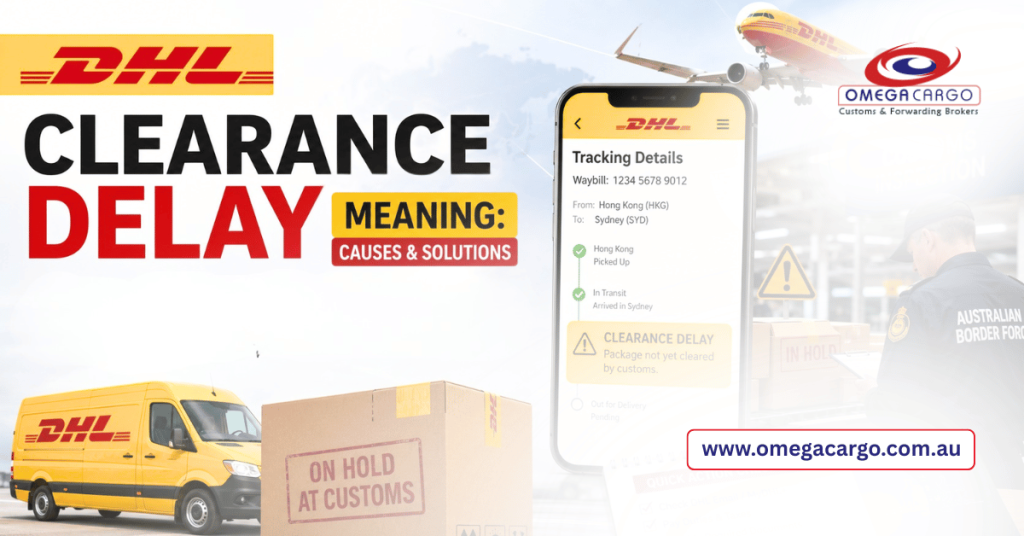
Your DHL tracking suddenly shows 'Clearance Delay.' Does that mean your package is stuck, seized, or simply waiting for customs approval?
If you are a business owner, e-commerce seller, or an online shopper waiting for an urgent package, seeing a yellow alert on your tracking page is incredibly frustrating. You need answers, and you need them fast. Understanding the exact DHL Clearance Delay Meaning: Causes & Solutions is the key to getting your shipment released from customs and back on the road to your doorstep.
You've been refreshing your DHL tracking for a while now. The package left the origin fine. It landed in Sydney. And then — nothing. Just a line that reads: "Clearance delay — package not yet cleared by customs." What exactly does that mean? Is it stuck? Is something wrong? Is it about to be seized? And most importantly — is there anything you can actually do about it right now? This complete guide answers every one of those questions, covers every DHL clearance delay message you're likely to see, and gives you the exact steps to resolve it as fast as possible.
A DHL clearance delay means your shipment has been held at customs — either at DHL's clearance facility or the official customs authority — and cannot be delivered until the clearance process is completed. It is not the same as a seizure. Common causes include missing or incorrect documentation, unpaid duties and taxes, random customs inspection, biosecurity requirements, or restricted goods. Most DHL clearance delays resolve relatively quickly once the underlying issue is addressed. Your immediate actions: check your email for DHL contact about duties or documents; log into DHL MyDHL+; and if there's no update after a few days, call DHL Express customer service. For commercial shipments, engage a licensed customs broker for the fastest resolution.
Here's something DHL's tracking system doesn't tell you when it shows "clearance delay": that message covers an enormous range of situations — from a routine paperwork check that resolves by itself quickly, to a serious biosecurity hold that can take a considerable amount of time to clear, to a compliance issue that could, in rare cases, end in seizure. The generic status message gives you almost no information about which of those situations you're actually in.
That gap — between what the tracking page says and what's actually happening — is what this guide is designed to close. By the time you've read it, you'll understand what every DHL clearance status message actually means, exactly why clearance delays happen and how common each cause is, the realistic relative resolution profile for each scenario, and precisely what you need to do to either fix it yourself or get the right people involved to fix it for you.
DHL operates one of the world's largest express customs brokerage networks — processing a very large volume of shipments through customs across a global network spanning well over 200 countries and territories. Understanding how their clearance process works, and where it can get stuck, is genuinely useful knowledge whether you're a regular online shopper waiting for a parcel or a business importing commercial goods at scale.
A DHL Clearance Delay means your international shipment has temporarily stopped moving because it requires further review, additional documentation, or payment of taxes before the local customs authority will release it. It does not mean your package is lost or seized; it simply requires administrative action from the shipper, receiver, or customs broker before delivery can continue.
When you investigate the DHL Clearance Delay Meaning: Causes & Solutions, you will find that "clearance" refers to the legal process of importing or exporting goods. Every country, including Australia via the Australian Border Force, heavily regulates what crosses its borders. DHL acts as your carrier and often your default customs broker, but they cannot legally bypass government border controls.
When a delay triggers, your tracking status will update, and DHL will usually send an automated email or SMS notification to the consignee (receiver) outlining the specific issue.
Most of the time, a DHL clearance delay is not serious. It is a routine administrative hurdle. However, the severity of the delay entirely depends on the root cause.
Expert Tip: Never ignore a clearance delay notification. The longer you wait to provide the requested information, the higher the chance DHL will charge you "storage fees" for keeping your package in their bonded warehouse — and these charges accumulate the longer the shipment sits.
To understand a clearance delay, you first need to understand what DHL's clearance process looks like when it's working normally. DHL Express provides end-to-end customs brokerage as part of its express service — meaning for most shipments, DHL acts as the importer of record's customs broker, filing the necessary declarations and paying duties on the recipient's behalf (then billing them).
Here's the typical flow for a DHL Express international shipment into Australia:
Standard DHL Express Clearance Process — Australia
| Stage | What Happens | Relative Timing | What Can Go Wrong |
| Origin acceptance | DHL scans and accepts shipment; shipper provides commercial invoice and customs documentation | Immediate | Incomplete documentation provided by shipper |
| Origin customs export | Export declaration filed in origin country; DHL clears goods for export | Fast | Export restrictions, embargoes, or missing export permits |
| Origin departure | Shipment loaded on aircraft; departs origin hub | Same or next available flight | Flight delays, capacity, weather |
| Destination arrival | Aircraft arrives at Australian DHL hub (Sydney, Melbourne, Brisbane) | Depends on route | Aviation delays, diverted flights |
| Pre-clearance data submission | DHL submits advance cargo data to ABF before arrival; ABF risk assesses shipment | Ahead of landing | Data discrepancies trigger Red Line |
| Customs clearance | DHL files Import Declaration; ABF assigns Green or Red Lane; DAFF assesses biosecurity | Fast (Green Lane) / meaningfully slower (Red Line) | All clearance delay causes |
| Duty payment | DHL calculates duties/GST; sends invoice to recipient; recipient pays; DHL pays ABF | Fast once invoiced | Recipient doesn't pay promptly |
| Customs release | ABF and DAFF issue clearance; DHL given authority to deliver | Same day as clearance | Payment or documentation still pending |
| Final delivery | DHL delivers to recipient address | Soon after release | Address issues, delivery exceptions |
A "clearance delay" can occur at any stage from pre-clearance data submission through to final customs release. The nature of the delay determines how long it lasts and what action is required — contact DHL or your broker for a current estimate on your specific shipment.
Understanding the background mechanics of international shipping helps clarify the DHL Clearance Delay Meaning: Causes & Solutions.
To fully grasp the DHL Clearance Delay Meaning: Causes & Solutions, you must understand the terminology used in DHL's tracking system. Here is a breakdown of what each status truly means.
| DHL Tracking Status | What It Actually Means | Required Action |
| Customs Status Updated | The package paperwork has been submitted to customs digitally before the flight lands. | None. This is a routine update. |
| Clearance Event | Customs needs more information to process the shipment. This is the beginning of a delay. | Check your email/SMS. Contact DHL to see what is missing. |
| Clearance Delay | The package is officially paused in the customs queue due to an issue (missing docs, unpaid fees, inspection). | Urgent Action Required. Provide documents or pay duties immediately. |
| Shipment on Hold | The package is waiting for the next available flight, truck, or facility slot. It is usually logistical, not customs-related. | Wait a short period. Usually resolves automatically. |
| Processed for Clearance | Customs has received all necessary data and is currently reviewing it. | None. Wait for the final release. |
| Clearance Processing Complete | Success! Customs has released the package, and it is handed back to DHL for delivery. | Get ready to receive your package. |
DHL's tracking system uses a range of status messages during the clearance process. Here's exactly what each one means and what action you should take.
Customs clearance is taking longer than expected.
The most common and most generic DHL clearance message. Means your shipment is in the customs clearance process but has not yet been cleared. Could be routine processing backlog, documentation review, or the beginning of a more specific issue. Check for DHL contact about duties or additional information.
Action: Check email/DHL app for duty invoice or document request.
Relative resolution speed: typically among the faster-resolving categories.
Active hold placed — cannot proceed until resolved.
More specific than "clearance delay" — means a deliberate hold has been placed on your shipment. Could be from DHL pending duty payment, from customs authorities pending inspection or documentation, or from biosecurity authorities. DHL should notify you of the specific reason via email or SMS.
Action: Check all contact channels; call DHL if no communication is received.
Relative resolution speed: highly variable depending on the underlying cause.
Something occurred during customs processing.
A broader category message. "Clearance event" without "delay" may simply mean a normal clearance milestone was recorded — not necessarily a problem. "Clearance event" combined with "delay" or "on hold" indicates an issue requiring action. Read the full status context carefully before assuming a problem exists.
Action: Review full tracking history; look for accompanying delay/hold messages.
Relative resolution speed: normal cases resolve quickly; delayed/held cases vary.
Customs is asking for more information.
A specific and actionable message. Customs authorities have reviewed your shipment and require documents beyond what was already provided — this could be a detailed commercial invoice, HS code justification, certificate of origin, proof of value, or an import permit. Time to act is critical — each day the document isn't provided, costs can accumulate.
Action: Obtain required document from sender; provide to DHL immediately.
Relative resolution speed: resolves soon after documents are received.
Duties payable before DHL can deliver.
DHL has calculated the import duty and GST owing on your shipment and is waiting for you to pay before releasing the goods. This is extremely common for international e-commerce parcels. The DHL system sends you an email or app notification with the amount and a payment link. Once paid, clearance typically proceeds quickly.
Action: Pay duty invoice immediately via MyDHL+ or DHL payment link.
Relative resolution speed: fast — usually resolves shortly after payment clears.
A regulatory or permit issue is preventing clearance.
Your goods may be subject to regulatory controls beyond standard customs duty — such as TGA (therapeutic goods), FSANZ (food), AICIS (industrial chemicals), or biosecurity (DAFF) requirements. A permit, licence, or compliance certificate may be needed before customs will clear the goods. This typically requires an import permit from the relevant Australian regulatory authority.
Action: Identify the specific regulatory requirement; obtain permit through relevant authority.
Relative resolution speed: among the slower categories, and dependent on how quickly the permit can be obtained.
Your shipment has been cleared — delivery coming.
The positive resolution message. Customs authorities have cleared your shipment and DHL has authority to proceed with delivery. If delivery doesn't occur within a reasonable follow-up window of this status, contact DHL.
Action: None required — delivery imminent. Confirm delivery address is correct.
Relative resolution speed: fastest — delivery generally follows soon after.
Physical inspection of your shipment is underway.
Customs authorities — either the ABF in Australia or DHL's inspection team — are physically opening and examining your package. This can be triggered by risk-based selection, X-ray anomalies, or random compliance programs. If inspection finds no issues, the shipment is cleared. If issues are found, a more specific hold notice will follow.
Action: Wait — nothing to do during inspection. Prepare documents if requested afterward.
Relative resolution speed: among the slower categories, since it involves both examination and assessment.
You must dive deeply into the "Causes." Customs clearance is a strict, legally binding process. The slightest error in paperwork or procedure will stop a shipment in its tracks. Here are the most common reasons your DHL shipment is delayed.
Very High Frequency. The single most common cause. The commercial invoice may be missing, incomplete, contain an incorrect value, lack product descriptions, or be inconsistent with the packing list. The HS (Harmonized System) code may be missing or wrong. DHL's automated system flags documentation issues before or during clearance.
International trade runs on paperwork. If a shipment arrives without the required documentation attached (either physically or electronically via DHL Paperless Trade), customs will halt the clearance process. The most frequently missing documents include the Commercial Invoice, Packing List, or Certificates of Origin.
The Commercial Invoice is the most important document in international shipping. Customs officers use it to determine the value, classification, and legality of your goods.
Very High Frequency. DHL calculates import duties and GST/VAT on your behalf and sends a payment request before releasing the goods. If you don't pay — or don't see the notification because it went to spam — your shipment waits. This is the fastest-resolved delay: pay the invoice and your goods are typically released soon after.
When goods enter a country, they are often subject to Import Duty and local taxes (such as GST in Australia). If the Incoterms on the shipment are DAP (Delivered at Place) or DDU (Delivered Duty Unpaid), the receiver is legally responsible for paying these fees before customs will release the cargo. DHL will typically send you a link to pay this online.
High Frequency (Seasonal). For goods arriving in Australia during the DAFF-designated BMSB risk season each year from BMSB-targeted countries (a list that has previously included the USA, Italy, Japan, South Korea and others — the list and dates are reviewed by DAFF and can change, so always confirm current requirements on BICON), missing treatment certificates trigger an automatic DAFF biosecurity hold. DHL cannot release the goods until treatment is arranged and DAFF issues clearance. This is one of the most time-consuming delay types for Australian importers.
If you are importing into Australia, you must deal with the Department of Agriculture, Fisheries and Forestry. Items made of raw wood, plant materials, animal products, or agricultural goods may be flagged for a biosecurity inspection. This ensures no foreign pests or diseases enter the local ecosystem. This type of clearance delay can add significant time to your shipping timeline.
High Frequency. Customs authorities in Australia and many other countries conduct random inspection programs on express courier shipments — including DHL. Your documentation may be perfect, your goods entirely compliant, and you can still be selected. A portion of DHL Express consignments are selected for some form of additional examination.
Sometimes, you did everything right, but you still get a delay. Customs agencies worldwide use risk-assessment algorithms and randomised selection to physically inspect a share of all incoming freight. If your package is chosen for a random X-ray or physical unboxing, you simply have to wait it out.
The World Customs Organization (WCO) uses HS Codes to classify traded products globally. Every product has a specific code that dictates the import duty rate. If the sender uses the wrong HS code, customs may reject the clearance, demanding a correction and potentially issuing a fine for misclassification.
Certain highly regulated products require the importer to hold a specific licence. Examples include commercial quantities of alcohol, tobacco, chemicals, and medical devices. If the receiver does not hold the required licence, the goods cannot clear customs.
Medium Frequency. Your shipment may contain goods that are prohibited outright in the destination country, or that require import permits or licences that weren't obtained before shipping. Common examples: certain foods, therapeutic products, supplements, chemicals, plants, animal products, and items covered by trade sanctions. DHL's automated screening system often flags these at pre-clearance.
Items classified as Dangerous Goods (DG) — such as lithium batteries, perfumes, aerosols, and flammable liquids — require extensive, specialised paperwork (like a Material Safety Data Sheet - MSDS) and specific packaging. If this documentation is incomplete, the shipment will not clear export or import customs.
Medium Frequency. Customs authorities compare your declared value against databases of typical market prices for similar goods. If your declared value appears too low — a common issue when shippers try to reduce duty liability by undervaluing goods — customs will query the value and request transaction documentation to verify the true price paid.
If customs suspects the declared value on the commercial invoice is artificially low (to avoid paying high taxes), they will place the shipment on hold. They will request proof of purchase, such as a bank transfer receipt, payment platform invoice, or a link to the website where the item was purchased, to verify the true transaction value.
High Frequency (Australia). Even outside BMSB season, DAFF reviews biosecurity risk for many goods entering Australia — particularly those containing plant material, animal products, wood, soil traces, or organic matter. Goods may be held for document assessment or physical inspection regardless of season if they present a biosecurity risk profile.
Lower Frequency. Shipments from certain countries, involving certain entities, or of certain goods may be subject to Australian trade sanctions, foreign re-export controls, or international trade restrictions. DHL's compliance screening systems check shipments against sanctions lists, and matches can trigger a compliance hold pending further investigation.
A common question regarding the DHL Clearance Delay Meaning: Causes & Solutions is: how long is this going to take?
There is no one-size-fits-all answer, but here is a realistic relative profile based on the cause of the delay:
| Cause of Delay | Relative Resolution Speed |
| Unpaid Duties/Taxes | Fastest — releases shortly after payment clears |
| Missing Commercial Invoice | Fast — after you provide the document |
| Random X-Ray Inspection | Moderate |
| Customs Valuation Dispute | Slower — requires reviewing supporting financial records |
| Biosecurity/Quarantine Inspection | Slowest of the resolvable categories — depends on backlog at the agricultural department |
| Missing Import Permits | Indefinite until the permit is legally acquired |
Warning: After a period specified in DHL's terms, DHL will begin charging you Bonded Storage Fees for every day your package sits in their warehouse waiting for you to resolve the customs issue. Confirm the applicable free period and charges directly with DHL, as they vary and can change.
Once the issue causing the delay is resolved, the tracking status will update. There are four potential outcomes following a customs delay:
You need an actionable strategy. When that yellow delay notification hits, do not panic. Follow these exact steps:
The first thing to do is read your DHL tracking status carefully — not just the headline message but the full status description and any accompanying notes. "Clearance delay" is generic; "Additional documentation required" or "Import duties/taxes pending" are specific and tell you exactly what action is needed. Log into the DHL tracking portal at dhl.com or the DHL Express mobile app with your waybill number and read the most recent tracking events in full, including any sub-status descriptions that accompany the main message.
Do not just look at the words "Clearance Delay." Click on the "Further Detail" or "Next Steps" dropdown within the DHL tracking page. It will usually state exactly what is wrong (e.g., "A Commercial Invoice is required for clearance.").
DHL almost always sends an automated email with a secure link to upload documents or pay customs fees. Check the inbox and spam folder of the email address associated with the receiver.
When DHL needs action from you — typically to pay duties or provide documents — they contact you via email, SMS, and in-app notification. Check your email inbox thoroughly, including spam and junk folders. Check your SMS messages. Check the DHL app notifications. The DHL duty payment email often comes from a DHL billing or clearance address that can be mistakenly filtered as spam. If you find a duty invoice or documentation request, this is likely the reason for your delay — and resolving it is now within your control.
If you are the buyer, contact the seller right away. Often, the delay is due to an error they made on the export documents. Ask them to provide:
If DHL has sent you a duty invoice, pay it immediately. This is the fastest-resolved type of DHL clearance delay. Log into MyDHL+ (mydhl.express.dhl) or use the payment link in DHL's email notification. Payment methods typically include credit card, PayPal and bank transfer depending on your country. Once DHL receives your payment, they pay the customs authority on your behalf and clearance typically proceeds soon after. Delaying payment means an extended clearance delay — and for commercial shipments, potentially accumulating storage charges.
If the delay is due to unpaid Import Duty or GST, use the secure payment link provided by DHL. Paying promptly is the fastest way to clear a financial delay. Never pay via random links sent in unsolicited text messages (beware of phishing scams); always navigate to the official DHL website and enter your tracking number.
If DHL or customs authorities are requesting additional documentation, contact the sender immediately to obtain whatever is required. The most commonly requested additional documents are: a detailed commercial invoice with item-level descriptions, values, HS codes and country of origin; a packing list consistent with the invoice; a certificate of origin (especially for FTA claims); product specifications or test reports; and import permits for regulated goods. Once you have the documents, forward them directly to DHL's clearance team using the email or portal link provided in DHL's communication. Do not wait — each day without the document is another day of delay.
If the shipment is complex, involves biosecurity, or you are importing commercial freight that DHL's default brokerage cannot easily handle, it is time to bring in the experts. Hiring an independent Customs Broker or Freight Forwarder allows a licensed professional to take over the communication with the Australian Border Force, ensuring your complex shipment clears legally and swiftly.
If your DHL clearance delay is caused by a DAFF biosecurity hold — which is particularly common for Australian imports during the BMSB risk season — this is the point where a licensed customs broker adds enormous value. DHL's own clearance team may not be best placed to arrange BMSB treatment with DAFF-approved providers, and the process of arranging treatment, obtaining certificates, and submitting them to DAFF in the correct format requires specialist knowledge.
If your DHL tracking has shown no movement for several business days and you have not received any communication from DHL, it's time to call DHL Express customer service directly. Have your waybill number ready. Ask specifically: what is the current status in the DHL system? What is the specific reason for the clearance delay? What is the exact next step required to resolve it? What is the expected resolution window? Get a reference number for your call.
If your DHL clearance delay has run for an extended period and DHL's standard customer service hasn't been able to resolve it, escalate within DHL. Ask to speak with the customs clearance team specifically — not just the general customer service team. For business customers with DHL account numbers, request escalation to your account manager. For complex regulatory or compliance issues, DHL has specialist customs teams who handle non-standard clearance situations. Reference your waybill number and document the timeline of contacts you've made so far.
For commercial shipments of significant value, a licensed customs broker can liaise directly with the ABF and DAFF on your behalf — accessing the ABF's Integrated Cargo System to see the exact hold reason, responding formally to any notices within prescribed timeframes, arranging required treatment, obtaining permits through the right channels, and preventing the hold from escalating. A customs broker typically resolves issues faster than a recipient trying to navigate DHL's customer service channels and customs agencies simultaneously.
See Omega Cargo's Freight Forwarding and Customs Clearance Services for commercial import support across all Australian ports.
Get Urgent Customs Help — Customs Clearance Services
DHL clearance delay patterns vary significantly by destination country. Here's a quick reference for the major Australian trading partner countries and their typical DHL clearance scenarios.
Australia (Importing) — ABF + DAFF dual clearance. The BMSB risk season adds significant delay risk for goods from targeted countries. An AEP-accredited broker expedites biosecurity.
United States — CBP clearance. Routine shipments are generally efficient. FDA-regulated goods (food, medical) tend to take noticeably longer.
United Kingdom — HMRC clearance. Post-Brexit documentation requirements are stricter. Commodity-specific permits can add significant delays.
Germany / EU — EU Customs Union. CE marking requirements and VAT pre-registration for e-commerce apply. REACH chemical compliance can delay clearance.
Japan — Japan Customs. Generally efficient. Food and cosmetics face stricter regulatory requirements. Peak season delays are common.
India — CBIC customs. BIS certification required for many electronics. High-value goods face stricter documentation scrutiny and tend to clear more slowly.
Relative clearance speed and requirements shift over time as each country's regulations and customs workload change — contact our team for a current, country-specific estimate rather than relying on a fixed figure.
Australia Clearance Is Uniquely Complex — Here's Why
Importing into Australia via DHL involves two separate government authorities — the Australian Border Force (ABF) for customs and the Department of Agriculture, Fisheries and Forestry (DAFF) for biosecurity. This means your DHL shipment must receive clearance from both before it can be released. Even if the ABF clears your goods immediately, a DAFF biosecurity hold can keep them waiting. This dual-clearance requirement makes Australian customs clearance more complex than most countries — and makes AEP (DAFF) accreditation particularly valuable for Australian importers, as it allows certain biosecurity documents to be self-assessed without the DAFF queue.
One of the most common sources of confusion is understanding when DHL is causing your delay versus when the customs authority is causing it. These are distinct situations with different resolution pathways.
DHL Delays vs Customs Authority Delays — Who Controls What
| Situation | Who Holds the Goods | Who Resolves It | Your Action |
| Duties pending payment | DHL — waiting for your payment | You — pay the invoice | Pay duty invoice via MyDHL+ immediately |
| Documentation required by DHL customs team | DHL — awaiting documents to file declaration | You + sender — provide documents | Contact sender; provide docs to DHL |
| ABF has placed a Red Line hold | Port terminal — ABF authority | ABF — based on your broker's response | Engage licensed customs broker urgently |
| DAFF biosecurity hold | Port terminal / DHL facility — DAFF authority | DAFF — after treatment or document assessment | Arrange treatment via DAFF-approved provider |
| Random ABF physical inspection | ABF examination facility | ABF — after examination complete | Wait; ensure your broker is engaged |
| Import permit required | DHL bonded warehouse / customs | You — obtain permit from relevant authority | Apply for permit; provide to DHL customs team |
| DHL system or processing backlog | DHL internal | DHL internally | Monitor tracking; escalate if it persists |
In many cases, DHL and customs authorities are both involved simultaneously — DHL filing the declaration while customs assesses it. Your broker is the most effective intermediary with both parties for commercial shipments.
The commercial invoice must include: shipper and consignee full names and addresses; detailed description of goods (not "gift" or "samples"); quantity and unit of measure; accurate declared value per item and total in a specific currency; country of manufacture; and HS code. Missing any of these triggers a documentary clearance delay.
Incorrect HS codes are one of the most common causes of clearance delays for commercial shipments. Verify the correct HS code for every product you import before the shipment is booked. Your customs broker can advise on correct HS classification for complex or unusual goods.
For goods shipping from BMSB-targeted countries to Australia during the DAFF-designated risk season, ensure your supplier arranges approved treatment before loading. The treatment certificate must be issued by a DAFF-approved overseas provider and reference the specific container or shipment. This is completely preventable — it just requires planning ahead. Confirm the current season dates and country list on BICON, as DAFF reviews these regularly.
Before importing any goods into Australia, check whether they require import permits from TGA (therapeutic products), FSANZ (certain foods), AICIS (industrial chemicals), or DAFF (animal and plant products). Permit applications can take a considerable amount of time — don't start the process after the goods have already shipped.
Never ask suppliers to undervalue goods to reduce duty liability. Australian customs authorities have access to pricing databases, and undervaluation is a common trigger for compliance holds and investigations. The duty saved rarely justifies the cost and delays of a valuation query.
Create a DHL MyDHL+ account and link your waybill numbers to it. Enable all notification preferences — email, SMS, and app push notifications. The most common resolvable clearance delay — unpaid duty invoice — often goes unresolved simply because the recipient didn't see DHL's notification in time.
Before booking a DHL shipment, check the DHL prohibited items list AND the destination country's customs restrictions. Items that are legal in the origin country may be prohibited or require permits in Australia. DHL publishes commodity-specific guidelines for express shipments.
DHL Trade Automation (formerly Global Trade Services) allows commercial shippers to submit customs declarations before shipment departure, enabling pre-clearance and significantly reducing clearance delays. Ask your DHL account manager about pre-clearance options for regular commercial lanes.
For businesses regularly importing via DHL, having a licensed customs broker on retainer means faster resolution of any clearance issues that arise, proactive advice on documentation requirements, and HS code / compliance review before problems reach the border.
See Omega Cargo's customs clearance services for Australian imports via all carriers.
DHL Express vs DHL Freight/Global Forwarding — Clearance Comparison
| Factor | DHL Express (Courier) | DHL Freight / Global Forwarding |
| Typical goods | Documents, small parcels, express commercial shipments | Full container loads, LCL, air freight pallet shipments |
| Customs filing | DHL files as importer's customs broker by default | DHL or separate customs broker files; importer may arrange own broker |
| Relative clearance speed (no issues) | Fast | Slower, though pre-clearance narrows the gap |
| Duty payment method | DHL invoices recipient directly; pays customs on your behalf | Customs broker pays ABF; invoices importer separately |
| Impact of clearance delay | Tracking shows "clearance delay"; DHL notifies recipient | Storage and demurrage charges can begin accumulating once free time expires |
| DAFF biosecurity | DHL coordinates DAFF assessment for most express goods | Licensed customs broker + DAFF direct coordination required |
| Who to call if delayed | DHL Express customer service | Your freight forwarder or licensed customs broker first |
| Resolution pathway | Primarily through DHL clearance team | Through licensed customs broker liaising with ABF/DAFF |
(These examples are illustrative composites of typical scenarios, not a guarantee of what your own shipment will experience.)
The Situation: A shopper ordered a batch of designer dresses from a boutique overseas, with a total value above Australia's duty-free threshold. Her DHL tracking shows "Clearance Delay." The Cause: Because her order exceeded the applicable low-value threshold, it triggered formal customs clearance, and she now owes Import Duty and GST. The Solution: DHL emails her a secure payment link. She pays the duties and taxes via credit card. Her package clears customs shortly after and is delivered soon.
The Situation: A local tech repair shop imports a batch of lithium-ion replacement batteries from overseas. The tracking halts at "Clearance Event." The Cause: Lithium batteries are Dangerous Goods. The supplier failed to attach the mandatory Material Safety Data Sheet (MSDS). The Solution: The importer emails the supplier, who provides the MSDS. The importer uploads the PDF to DHL's portal. Customs reviews the safety data, approves it, and releases the shipment a short time later.
When analysing the DHL Clearance Delay Meaning: Causes & Solutions, we see the same avoidable errors happening daily. Avoid these critical mistakes:
Mastering the DHL Clearance Delay Meaning: Causes & Solutions isn't just about fixing the problem — it's about preventing it.
A DHL Clearance Delay means your package has been temporarily held by the destination country's customs authority. This is usually because they require additional paperwork, payment of import taxes, or need to physically inspect the shipment before allowing it to enter the country.
The most common reasons for a customs delay include a missing commercial invoice, vague product descriptions, incorrect HS classification codes, unpaid import duties and taxes, or the package containing restricted/prohibited items requiring special permits.
Standard DHL customs clearance is generally quick. However, if there is a clearance delay due to missing documents or a physical biosecurity inspection, the process can take considerably longer. Contact DHL or your customs broker for a current estimate.
Yes, DHL acts as a customs broker and will automatically attempt to clear standard shipments on your behalf. However, they rely entirely on the accuracy of the paperwork provided by the shipper. For complex commercial freight, you may need to hire an independent customs broker.
Usually, customs will not contact you directly. They communicate through your customs broker or carrier (DHL). DHL will then send you an email or SMS notification explaining what customs requires from you to release the shipment.
You cannot force a government agency to work faster, but you can prevent delays by ensuring your supplier provides a flawless, highly detailed commercial invoice with correct HS codes, and by paying any requested import duties immediately upon receiving the notification.
No. A clearance delay is usually an administrative pause to check paperwork or collect taxes. A package is only seized if you are attempting to import illegal, prohibited, or counterfeit goods, or if you refuse to provide mandatory import permits.
You should first check the DHL tracking page for specific instructions. Then, check your email for a message from DHL Customs. If you need to provide documents, contact the original shipper to obtain them, then upload them via the DHL portal.
A Commercial Invoice is the primary legal document used in international trade. It details the buyer, seller, exact goods being shipped, their unit value, total value, currency, and origin. Customs uses this document to calculate taxes and assess safety.
If you refuse to pay the requested import duties and taxes, customs will not release your package. After a holding period defined by DHL and the customs authority, the package will either be returned to the sender at their expense or abandoned and destroyed by customs.
"Clearance Event" is DHL's terminology indicating that the customs clearance process requires further information. It is the precursor to a "Clearance Delay." You should proactively check your email or contact DHL to see what data is missing.
Yes. When a package is delayed by customs, DHL must store it in a highly regulated bonded warehouse. If you take too long to provide documents or pay taxes, DHL will charge you a daily storage fee to cover the cost of holding your freight — confirm the current fee structure with DHL.
A Customs Broker is a licensed professional who specialises in clearing goods through customs on behalf of importers and exporters. They ensure all legal requirements, HS codes, and tax calculations are completely accurate to prevent delays.
The ABF holds packages that pose a risk to border security, economy, or environment. This includes under-valued goods, intellectual property violations (fake goods), prohibited weapons, or items requiring Department of Agriculture biosecurity screening.
The Harmonized System (HS) Code is an internationally standardised system of names and numbers used to classify traded products. Customs uses these codes to determine exactly how much import duty you must pay.
A DHL clearance delay is one of the most commonly Googled tracking situations — and one of the most frequently misunderstood. The headline message is vague, but the underlying situation is almost always specific, addressable, and resolvable — as long as you know what you're looking for and take the right action.
The bottom line is this: most DHL clearance delays are caused by one of three things — missing documentation, unpaid duties, or biosecurity compliance gaps. Each of these is within your control, either right now (check for DHL notifications, pay any duty invoice) or on future shipments (get documentation right before shipping, arrange BMSB treatment, check for permit requirements in advance).
For personal parcels, following the steps in this guide will resolve the vast majority of situations. For commercial shipments of significant value — where every day of delay means accumulating storage costs and business impact — engaging a licensed customs broker is the fastest and most cost-effective approach. The broker's fee is often recovered many times over in the time saved.
Omega Cargo — decades of experience handling customs clearance delays across all Australian ports.
Get Urgent Help — Customs Clearance Services
Disclaimer: The statuses, timeframes and processes outlined in this guide reflect typical DHL and Australian customs patterns and are provided for general planning purposes only. Actual clearance times, fees, thresholds and outcomes depend on your specific shipment, documentation, and independent assessments by DHL, the Australian Border Force (ABF) and DAFF, none of which any third party controls. We do not promise specific clearance dates, prices, rates, fees or charges in this article. Always confirm current timelines and charges directly with DHL or a licensed customs broker for your specific shipment.


