
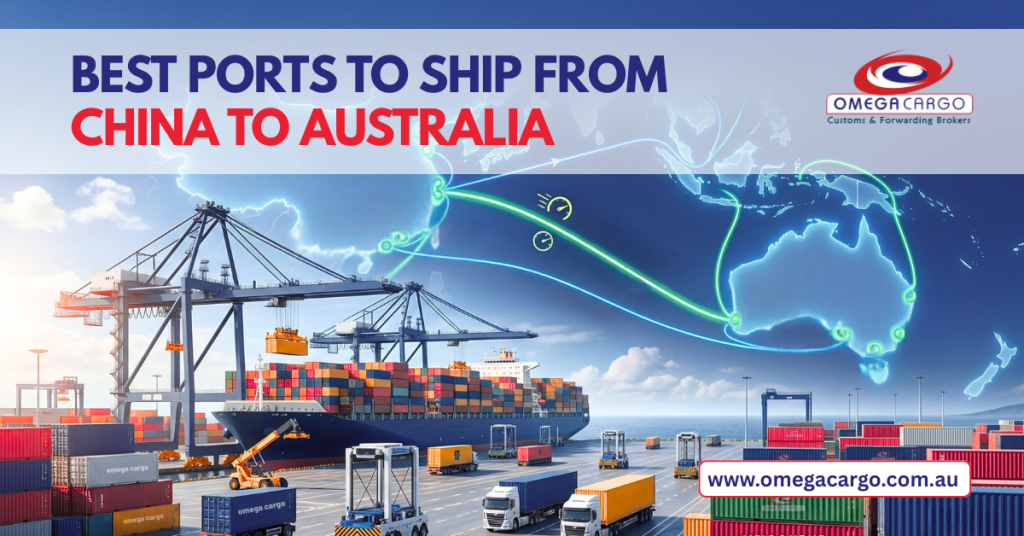
Did you know that 9.1 million shipping containers pass through Australia's five major ports every single year — and more than a third of them come directly from China? With cargo moving through dozens of possible port combinations, choosing the wrong origin or destination port can add thousands of dollars and weeks of extra transit time to your shipment. This guide tells you exactly which ports to use, which routes are fastest, and how to match your cargo to the right gateway — every time.
The best ports to ship from China to Australia depend on where your supplier is based and where your goods are going. For East China suppliers, Shanghai or Ningbo are your best origin ports. For South China electronics and consumer goods, use Shenzhen or Guangzhou. For North China manufacturers, Qingdao is your strongest option. On the Australian side, match the destination port to your final delivery city: Port of Melbourne for Victoria, Port Botany (Sydney) for NSW, Brisbane for Queensland, Fremantle for Western Australia, and Adelaide for South Australia.
Here's something that surprises many first-time importers: the port you choose on each end of your shipment can affect your total cost just as much as your freight rate. Pick the right combination, and your cargo arrives faster, clears customs more smoothly, and costs you less at the door. Pick the wrong one, and you could be looking at expensive transshipment delays, higher port handling fees, and inland cartage costs that eat into your margins.
In this guide, you'll get a clear, practical breakdown of the best ports to ship from China to Australia in 2026. You'll understand what each Chinese port is best for, which Australian ports suit your destination city, how the main shipping routes connect them, and exactly what to consider when making your decision. Whether you're a first-time importer or a seasoned supply chain manager, you'll finish this page knowing exactly which ports belong in your shipping plan.
Most importers focus almost entirely on freight rates when planning a shipment from China to Australia. That's understandable — ocean freight costs are visible and easy to compare. But the port pairing you choose affects several other factors that are just as important to your bottom line.
Your choice of origin port in China affects how far your goods need to travel from the factory to the dock. A Guangzhou-based manufacturer shipping through Shanghai instead of nearby Shenzhen will pay significantly more for inland trucking — sometimes AUD $300–600 per container more. On the other side, your destination port in Australia determines your inland cartage cost from the port to your warehouse. Importing to a Melbourne business through Fremantle would add thousands in delivery costs for most cargo types.
Port choice also affects transit time, vessel frequency, carrier options, port handling fees, and customs congestion levels. All of these feed directly into your total landed cost and your ability to keep shelves stocked on time. That's why experienced importers treat port selection as a strategic decision — not an afterthought.
The Golden Rule of Port Selection
Always choose the origin port closest to your supplier's factory and the destination port closest to your final delivery address. These two decisions alone reduce your total landed cost more reliably than almost any other single factor in your shipping plan.
You might be wondering, "Does it really matter which port my goods leave from as long as they get here?" The short answer is: absolutely.
In the digital world, we often talk about resilience and scalability. Just as top cloud infrastructure trends focus on resilience, scalability, and digital growth to keep websites and apps running smoothly during traffic spikes, your physical supply chain requires that exact same level of resilience. If your digital storefront is highly optimized but your physical products are stuck in a congested port on the other side of the world, your business growth will stall.
Choosing the right port impacts your business in three major ways:
By matching your supplier’s location with the most efficient export port and your ideal destination port in Australia, you build a resilient, cost-effective supply chain that scales with your business.
China boasts some of the largest, busiest, and most technologically advanced ports in the world. When you are arranging sea freight from China to Australia, your freight forwarder will usually recommend a port based on your supplier’s address.
Let’s take a deep dive into the Best Ports to Ship from China to Australia and see what makes each of them a strategic powerhouse for your imports.
It is impossible to talk about global shipping without starting with the Port of Shanghai. Consistently ranked as the busiest container port in the world, Shanghai handles tens of millions of TEUs (Twenty-Foot Equivalent Units) every year.
Shanghai is the world's busiest container port — and it has held that title for over 15 years running. With an annual throughput of 51.5 million TEU in 2024, it processes more containers every year than the entire output of many mid-sized countries. If your supplier is based anywhere in the Yangtze River Delta region — including Shanghai itself, Jiangsu Province or parts of Zhejiang — this is almost certainly your best origin port.
For Australian importers, Shanghai offers the most direct sailings, the highest carrier variety, and strong weekly departure frequency to all major Australian ports. Most of the world's top 20 shipping lines operate regular services from Shanghai to Sydney, Melbourne, and Brisbane. You'll find good FCL and LCL availability year-round, with competitive rates due to the sheer volume of competition among carriers and freight forwarders on this lane.
The newest development is MSC's "Kangaroo" direct service, launched in January 2026, which connects Qingdao, Shanghai and Ningbo directly to Brisbane and Sydney with transit times of approximately 12–15 days — significantly faster than the traditional 20–25 day routing via transshipment hubs.
Located in the Guangdong province in southern China, the Port of Shenzhen is actually a collective of several smaller ports, with Yantian and Shekou being the most prominent for international shipping.
Shenzhen is the dominant port for South China's massive electronics and consumer goods manufacturing sector. Comprising three main terminal areas — Yantian, Shekou and Chiwan — it is the preferred origin for goods manufactured in Guangdong Province and the Pearl River Delta. It set an all-time record in 2025 with 35 million TEU, driven largely by surging exports of new energy vehicles (+37%) and consumer electronics. If your supplier is in Shenzhen itself, Dongguan, Foshan or surrounding Guangdong factory towns, this is your most efficient and competitive origin port.
Shenzhen is also one of the most technologically advanced ports in China, using AI-driven scheduling and automated stacking cranes that keep turnaround times fast even at peak volumes. For Australian eCommerce importers buying electronics, homewares and consumer goods through Alibaba or direct factory sourcing, Shenzhen is typically the cheapest and most reliable origin port to use.
Just a few hours south of Shanghai lies the Port of Ningbo-Zhoushan. While it might not have the mainstream name recognition of Shanghai, it is an absolute titan in the shipping industry and often handles more total cargo tonnage than any other port globally.
Ningbo-Zhoushan is the world's number one port by total cargo volume — a distinction it has held for 17 consecutive years. It handled over 1.4 billion tonnes of cargo in 2025. For Australian importers sourcing from factories in Zhejiang Province (home to massive manufacturing hubs in Yiwu, Hangzhou, Wenzhou and Ningbo itself), this port is typically faster and cheaper to access than Shanghai, with shorter inland trucking distances from most Zhejiang factories.
Ningbo offers excellent deep-water berths, advanced Meishan Terminal infrastructure, and a strong network of LCL consolidators. Its container volume exceeded 43 million TEU in 2025, reflecting major infrastructure investment and rising direct services to Australia and other Oceania destinations. The MSC Kangaroo direct service also calls at Ningbo, making it a key stop on one of the fastest China-Australia routes operating today.
Guangzhou is the capital of the Guangdong province and serves as a massive commercial and manufacturing hub. Its main deep-water port, Nansha, is rapidly growing in popularity among Australian importers.
Guangzhou is the largest and most comprehensive port hub in South China, connecting to more than 300 ports in nearly 100 countries worldwide. The Nansha Port Area — its deep-water container terminal — serves as the main gateway for goods from Guangdong's broader manufacturing hinterland. With 26.1 million TEU in 2024, it is one of China's top five container ports. All of the world's top 20 shipping lines operate at Guangzhou, giving you a strong carrier variety.
For Australian importers, Guangzhou is particularly well-suited for bulk goods, industrial equipment, building materials and automotive parts. Its significant ro-ro (roll-on/roll-off) terminal makes it China's second-largest ro-ro port, handling large volumes of vehicles destined for Australia. If your supplier is in the wider Guangzhou metro area or you're importing from multiple South China manufacturers consolidated at a single port, Guangzhou/Nansha is an excellent choice.
Moving up to northern China, the Port of Qingdao is the premier maritime hub for the region. It is highly automated and heavily involved in international trade routes spanning the globe.
Qingdao is the dominant port for North China exporters and the most important shipping gateway in Shandong Province. With 30.9 million TEU in 2024 and nearly 240 international routes connecting to over 700 ports worldwide, it is one of the most globally connected ports in China. In January 2026, Qingdao made headlines with the launch of MSC's "Kangaroo" direct service — the first direct link from Northern China to Australia — connecting Qingdao to Brisbane and Sydney in approximately 20 and 25 days respectively, without transshipment.
Cross-border trade between Qingdao and Australia was worth approximately 100.57 billion yuan (USD $14.4 billion) from January to November 2025, with exports growing 10.6% year-on-year. If your suppliers are based in Shandong, Shanxi, Henan, Hebei or other North China provinces, Qingdao eliminates the need to truck goods all the way south to Shanghai and is now a legitimate direct gateway to Australia.
Finally, we have the Port of Xiamen. While smaller than Shanghai or Shenzhen, Xiamen punches well above its weight class when it comes to specific retail sectors.
Tianjin is the main port for Beijing and the wider interior of Northern China, handling 22+ million TEU annually. If your supplier is in Tianjin, Hebei Province, or the capital region, Tianjin can save significant inland trucking compared to routing through Qingdao or Shanghai. Regular services connect Tianjin to Sydney, Melbourne and Brisbane with transit times of 22–28 days. It is a solid supporting option for North China cargo, particularly heavy machinery, chemicals and agricultural goods.
On the Australian side, five major container ports receive the bulk of imports from China. Picking the right one for your delivery city is one of the most important decisions you'll make — because inland cartage from the wrong port can easily add AUD $500–$2,000 to your landed cost per container.
Shipping is a two-way street. Knowing the Best Ports to Ship from China to Australia also requires understanding where your goods will land. Australia is a massive continent, and domestic freight can be incredibly expensive. To keep your profit margins healthy, you must route your cargo to the Australian port closest to your warehouse or final customer.
Here is a quick look at the primary destination ports down under:
The Port of Melbourne is Australia’s largest container and general cargo port. It serves as the vital gateway for the southeastern part of the country. If your distribution center is located in Victoria or South Australia, Melbourne is your primary target. It boasts excellent rail and road networks, ensuring that once your container is unloaded, it gets to your warehouse quickly.
processing around 3 million TEU in 2025. It handles approximately 36% of all Australian container trade and is the most connected Australian port for services from China. If you're delivering to anywhere in Victoria, Tasmania, or the border regions of South Australia and New South Wales, Melbourne is almost always your best destination port.
The port operates 24/7 with multiple stevedore operators including DP World and Patrick Terminals. It has excellent road and rail connections to Melbourne's freight hubs and beyond. Carriers like COSCO, Maersk, MSC, CMA CGM, Evergreen and ANL all operate regular weekly sailings between China's main ports and Melbourne, giving you strong service frequency and competitive rates throughout the year.
Best For
Watch Out For
Port Botany is the premier port for New South Wales. Because Sydney is Australia’s largest consumer market, a massive percentage of e-commerce goods imported from China land here. Shipping from Shanghai or Shenzhen to Sydney often offers the fastest sea freight transit times, usually clocking in between 13 and 18 days for direct routes.
Port Botany in Sydney is Australia's second-largest container port, handling approximately 2.8 million TEU per year. Located on Botany Bay just south of the Sydney CBD, it serves as the critical gateway for New South Wales — Australia's most populous state and largest economy. Around 1,600 ships visit Port Botany each year, carrying goods that support 8+ million people across greater Sydney and regional NSW.
The port has three container terminals operated by DP World, Patrick and Hutchison Ports, with on-dock rail connections that reduce road congestion and provide efficient delivery to Sydney's inland freight hubs. Port Botany is a key call port on almost every major China-Australia shipping service. Its strategic position for NSW deliveries means that for the majority of east coast Australian businesses, Sydney is their primary import gateway from China.
Best For
Watch Out For
Serving the rapidly growing state of Queensland, the Port of Brisbane is highly automated and extremely efficient. If your customers are located along the Gold Coast, Sunshine Coast, or up into northern Queensland, routing your cargo through Brisbane will save you thousands of dollars in domestic trucking fees compared to landing your goods in Sydney.
The Port of Brisbane is Queensland's primary container gateway and one of Australia's fastest-growing import ports, handling 1.6 million TEU in 2023 across 34.1 million tonnes of total cargo. It is also frequently cited by freight forwarders as one of the smoothest ports for discharge and customs clearance in Australia — experiencing fewer congestion delays than Sydney and Melbourne during peak seasons. For businesses delivering anywhere in Queensland, Brisbane is your natural destination port.
Brisbane is a key destination on the new MSC Kangaroo direct service from Qingdao, Shanghai and Ningbo, making it one of the best-served Queensland ports for direct China imports in 2026. The port handles strong volumes of agricultural goods, building materials, consumer goods and industrial equipment, all of which are in high demand from Queensland's growing population and mining sector.
Best For
Watch Out For
Fremantle is the principal port for Western Australia. Because Perth is geographically isolated from the eastern seaboard, it is absolutely crucial that you route Western Australian orders directly to Fremantle. Shipping a container to Sydney and putting it on a train to Perth is an incredibly costly and time-consuming mistake. Interestingly, because it faces the Indian Ocean, transit times from southern Chinese ports to Fremantle are often faster than to the eastern Australian ports.
Fremantle is Western Australia's principal container port and the fastest Australian destination from South China. The direct route from Ningbo or Shenzhen to Fremantle takes just 16–22 days — up to a week faster than the equivalent sailing to Sydney or Melbourne. For WA importers, this speed advantage, combined with lower inland cartage to Perth delivery addresses, makes Fremantle the most cost-effective option by a significant margin.
The port manages 40 million+ tonnes of total cargo in 2025 and is anchored by Western Australia's enormous resources sector, which generates massive export volumes of iron ore, wheat and wool. On the import side, it receives growing volumes of consumer goods, vehicles, building materials and industrial equipment from China. If you're importing to Perth, regional WA, or delivering anywhere in Western Australia, Fremantle should be your default destination port — using Sydney or Melbourne would add prohibitive inland trucking costs.
Best For
Watch Out For
While smaller than the others, the Port of Adelaide serves South Australia. Many businesses choose to ship to Melbourne and truck goods to Adelaide, but direct sailings to Adelaide are available and can be highly cost-effective for larger, bulkier FCL (Full Container Load) shipments.
Port Adelaide is South Australia's primary container port and the gateway for a region known for its wine industry, food production, defence manufacturing and growing technology sector. While smaller than Melbourne and Sydney, it handles a critical volume of imports for SA's 1.8 million people and serves as the most cost-effective port for businesses delivering throughout South Australia. Bringing goods through Melbourne and then trucking them to Adelaide adds significant cost compared to direct Port Adelaide discharge.
Port Adelaide operates Monday to Friday (unlike most other major ports which are open Saturday) — a factor you need to account for when planning collection times. The port connects to China through regular services from Shanghai, Ningbo and Qingdao, with transit times of approximately 22–28 days. It's particularly strong for agricultural inputs, industrial machinery, automotive components and food-sector goods that serve SA's diverse economy.
Best For
Watch Out For
Now that you know the individual ports, here's how they pair up on the routes that Australian importers actually use. These are the most popular and efficient route combinations on the China–Australia trade lane in 2026.
Best Port Pairings — China to Australia 2026
| Origin (China) | Destination (Australia) | Transit Time | Best Cargo Type | Notes |
| Shanghai | Sydney (Port Botany) | 20–25 days | General cargo, mixed goods | Most popular AU route — high frequency |
| Shanghai / Ningbo | Melbourne | 20–26 days | Consumer goods, textiles | Best for Zhejiang factory goods to VIC |
| Shenzhen / Guangzhou | Melbourne | 18–24 days | Electronics, consumer goods | Fastest from South China to east coast AU |
| Ningbo | Fremantle (Perth) | 16–22 days | General cargo, WA bound | Fastest route to AU by sea overall |
| Shenzhen | Brisbane | 20–25 days | eCommerce, retail goods | Strong for QLD importers via South China |
| Qingdao / Shanghai / Ningbo | Brisbane → Sydney | 20–25 days | Machinery, chemicals, textiles | New MSC Kangaroo direct service 2026 |
| Guangzhou (Nansha) | Adelaide | 22–28 days | Agricultural inputs, industrial | Best for SA importers from South China |
| Tianjin | Melbourne / Sydney | 22–28 days | Northern China goods | Good for Beijing-region manufacturer goods |
🇨🇳 Ningbo
→Indian Ocean→
🇦🇺 Fremantle
16–22 days — Fastest route
🇨🇳 Shenzhen
→South China Sea→
🇦🇺 Melbourne
18–24 days — South China fastest
🇨🇳 Shanghai
→via Singapore→
🇦🇺 Sydney
20–25 days — Most popular
🇨🇳 Qingdao → Ningbo
→Direct MSC Kangaroo→
🇦🇺 Brisbane → Sydney
12–15 days — NEW 2026 direct
2026's Fastest Direct Service: The MSC Kangaroo Route
Launched in January 2026, the MSC Kangaroo direct service connects Qingdao → Shanghai → Ningbo → Brisbane → Sydney with transit times of approximately 12–15 days — cutting traditional transshipment times in half. If you're sourcing from Eastern or Northern China and delivering to Queensland or NSW, this new direct route is a genuine game-changer for transit speed. Ask your freight forwarder specifically about the Kangaroo service.
Knowing which ports exist is one thing. Knowing how to choose the right combination for your shipment is what actually saves you money. Here's a simple decision process to use every time you plan a new China-Australia shipment.
Before anything else, figure out where your supplier's factory is. That's your starting point for choosing your origin port in China. The closest major port to the factory minimises your inland trucking cost in China — which is often a bigger cost variable than you'd expect. Use this quick guide: East China (Shanghai, Jiangsu, Zhejiang) → Shanghai or Ningbo. South China (Guangdong, Fujian) → Shenzhen or Guangzhou. North China (Shandong, Hebei, Beijing) → Qingdao or Tianjin.
Your delivery city almost always determines your destination port. Melbourne for Victoria, Sydney for NSW, Brisbane for Queensland, Fremantle for Western Australia, Adelaide for South Australia. The only time you might deviate is if there's a strong rate incentive, but in most cases the savings are wiped out by inland cartage costs from the wrong port. Always calculate the full door-to-door cost, not just the ocean leg.
If you're shipping FCL (full container load), carrier frequency and rate are your main concerns. Both Shanghai and Shenzhen have the highest frequency of FCL services to Australian ports. If you're shipping LCL (less than container load), consolidation centre location matters — Shenzhen and Shanghai have the most LCL consolidators. For perishables or temperature-controlled cargo, Melbourne and Brisbane have the strongest cold chain infrastructure on the Australian side.
If speed is critical, the South China → Fremantle route (16–22 days) or the MSC Kangaroo direct service (12–15 days, East China → QLD/NSW) are your fastest options. If cost is the priority, standard FCL services on the established Shanghai → Melbourne or Shenzhen → Sydney lanes offer the most competitive rates due to the volume of carrier competition on those routes.
Quick Port Matching Guide — China to Australia
| If Your Supplier Is In... | Use This China Port | If Delivering To... | Use This AU Port |
| Shanghai / Jiangsu / Anhui | Port of Shanghai | Victoria (VIC) | Port of Melbourne |
| Zhejiang (Yiwu / Hangzhou) | Port of Ningbo | New South Wales (NSW) | Port Botany (Sydney) |
| Shenzhen / Dongguan / Foshan | Port of Shenzhen | Queensland (QLD) | Port of Brisbane |
| Wider Guangdong / Pearl River Delta | Port of Guangzhou | Western Australia (WA) | Fremantle Port |
| Shandong / Hebei / Northern China | Port of Qingdao | South Australia (SA) | Port Adelaide |
| Beijing / Tianjin / Inner North China | Port of Tianjin | Tasmania (TAS) | Port of Melbourne then road |
Whichever port combination you choose, Australian customs compliance is non-negotiable. Australia operates one of the world's strictest biosecurity regimes, and the consequences of non-compliance at the port of arrival can be severe. Here's what you need to know.
Port Selection Doesn't Change Your Compliance Obligations
It doesn't matter whether your goods arrive at Melbourne, Fremantle or Brisbane — Australian biosecurity, customs clearance and GST requirements are identical at every port. The advantage of choosing an experienced China-Australia freight forwarder is that they handle all of this for you, at whichever port combination you use.
Your origin port should be the closest major port to your supplier's factory. This saves more on inland trucking than almost any rate negotiation will on the ocean leg.
Never compare ports based on ocean freight alone. Always get a full landed cost quote including origin charges, ocean freight, destination THC, customs, GST and local delivery.
For East and North China cargo to QLD or NSW, the new direct MSC Kangaroo service (2026) cuts transit to 12–15 days. Ask your forwarder specifically if this service is available for your next shipment.
If you're delivering to Perth or anywhere in WA, Fremantle is always your port. It's the fastest route from South China and avoids thousands in east-coast-to-WA cartage costs.
If you're between Brisbane and Sydney for a QLD/Northern NSW delivery, Brisbane often offers faster port discharge and fewer congestion delays than Sydney during peak season.
Every major Chinese port faces capacity constraints before CNY. For 2026 CNY (January 29), you needed to book by mid-December. For CNY 2027, start planning in November 2026.
For sea freight from China during September–April, confirm your goods are treated and your forwarder has the treatment certificate before the vessel loads. Every Australian port enforces this on arrival.
A forwarder who specialises in the China–Australia lane knows the port nuances, carrier options and local charges at each Australian port. This expertise saves real money on every shipment.
To ensure you have absolutely every piece of information you need, we have compiled the most frequently asked questions about shipping cargo down under.
The best Chinese port depends on your supplier's location. Shanghai is best for East China factories (Jiangsu, Anhui, Shanghai). Ningbo suits Zhejiang manufacturers. Shenzhen is the top choice for South China electronics and consumer goods from Guangdong Province. Guangzhou is best for Pearl River Delta bulk goods and vehicles. Qingdao serves North China suppliers in Shandong and surrounding provinces. Always choose the port closest to your supplier's factory to minimise inland trucking costs in China.
Choosing the best ports to ship from China to Australia is one of the highest-impact decisions in your import supply chain. Get it right, and you'll enjoy faster delivery, lower total costs, and smoother customs clearance. Get it wrong, and you'll spend more than you needed to — on inland trucking, port charges, and unnecessary transit days.
Here's your simple decision framework to take away: Start with your Chinese supplier's location to pick your origin port. Then match your Australian destination port to your final delivery state. Calculate the full landed cost — not just the ocean rate — before making your final decision. And always work with a China-Australia lane specialist freight forwarder who knows every port combination, carrier option, and local fee structure on this route.
In 2026, the China-Australia trade lane has never had more options. The launch of MSC's Kangaroo direct service, Qingdao's growing Australia connections, and Melbourne's continued expansion as a container hub all mean that you have more routes, more carriers and more flexibility than ever before. All you need to do is match the right ports to your cargo — and you're already ahead of most importers who haven't read this far.
Your Port Selection Checklist


