
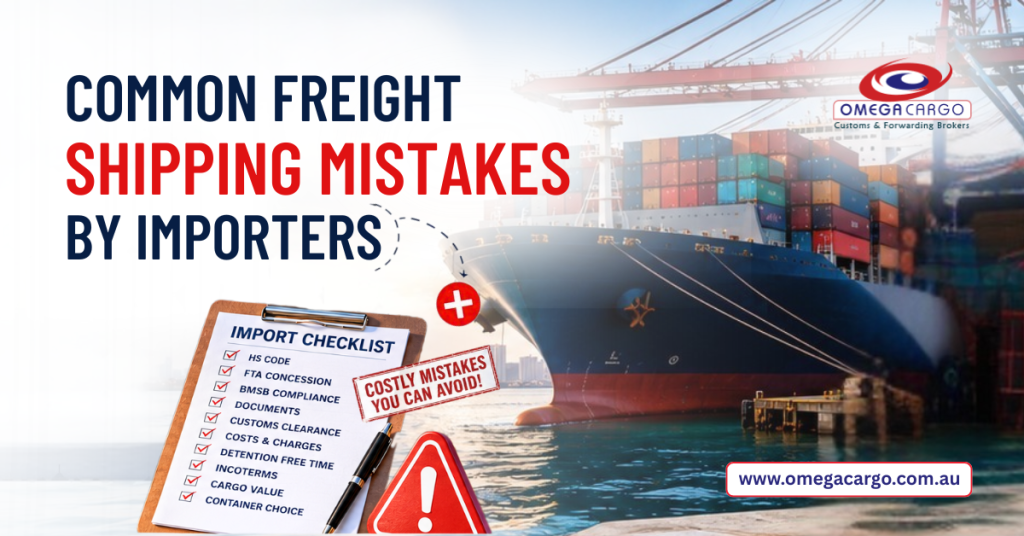
Australian importers lose an estimated AUD $200–$500 million every year to avoidable freight errors — wrong HS codes, missed FTA concessions, ignored detention charges, BMSB compliance failures and documentation errors that trigger fines, delays and rejected shipments. Almost every single one of these costly mistakes is preventable.
The costly and most common freight shipping mistakes made by Australian importers include: using wrong HS tariff codes; failing to claim FTA duty concessions (ChAFTA/AUSFTA); missing BMSB treatment during season; choosing the wrong container type (LCL vs FCL); not pre-clearing customs before vessel arrival; sending documents too late; comparing quotes that exclude Australian destination charges; ignoring container detention free time; under-declaring cargo value; and using the wrong incoterms. Every one of these mistakes is avoidable with proper planning and the right freight forwarding partner. Collectively, they cost Australian importers hundreds of millions of dollars every year in unnecessary charges, fines and delays.
Did you know that a staggering 57% of international shipment delays are caused by simple, preventable document errors? Imagine your container finally arriving at the port after weeks at sea, only to be held up by customs because of a single typo on your commercial invoice. While you wait for the paperwork to be corrected, your cargo sits idle, racking up hundreds of dollars a day in storage fees.
This guide is designed to change that. Each of the following ten mistakes comes with a clear explanation of what it costs, why it happens, and — most importantly — exactly what you can do to stop it from costing you money on your next shipment.
If you are bringing goods into the country, navigating the complex world of global trade can feel like walking through a minefield. From confusing customs regulations to unpredictable shipping rates, the margin for error is razor-thin. The truth is, Common Freight Shipping Mistakes Made by Importers that could cost your business thousands (And How To Avoid Them) is a topic every modern business owner needs to master before booking their next container.
Top 10 Importer Freight Mistakes — Relative Cost Impact & Category
| # | Mistake | Relative Cost Impact | Frequency |
| 1 | Wrong HS tariff code | High — back-taxes plus penalties | Very common |
| 2 | Missing FTA duty concession | High, recurring on every shipment | Extremely common |
| 3 | Failing BMSB treatment requirements | High — re-export and delay costs | Common in season |
| 4 | Wrong container choice (LCL vs FCL) | Moderate, per shipment overpayment | Very common |
| 5 | Not pre-clearing customs before vessel arrives | Moderate — demurrage plus storage | Very common |
| 6 | Late documentation to customs broker | Moderate — port storage | Very common |
| 7 | Comparing quotes that exclude destination charges | Moderate — unexpected charges | Extremely common |
| 8 | Ignoring container detention charges | Escalates rapidly the longer it continues | Very common |
| 9 | Under-declaring cargo value | Severe — fines plus seizure risk | Occasional |
| 10 | Using the wrong incoterms | High — unexpected costs | Common with new importers |
Costs vary significantly based on shipment value, volume, cargo type, current rates and specific circumstances — always confirm current figures with your freight forwarder. All mistakes are avoidable with proper planning and expert freight forwarding support.
Most freight shipping mistakes don't happen because importers are careless. They happen because international trade is genuinely complex — and the compliance requirements, documentation chains and cost structures involved aren't always obvious until something goes wrong and the invoice lands. You might be importing regularly and paying more than you need to on every single shipment without ever realising it. Or you might be one missed BMSB treatment certificate away from having an entire container turned back at the Australian border. Or paying thousands in detention charges simply because no one told you about the free time window before you signed your first import contract.
Wrong HS Tariff Code
Wrong duty rate + ABF audit risk stretching back several years
Potential cost: high — back-taxes plus penalties
Every product imported into Australia must be classified with a 10-digit Harmonized System (HS) tariff code. This code determines your duty rate, your FTA eligibility, any permit requirements, and your biosecurity obligations. Getting it wrong is one of the most expensive mistakes an importer can make — and it's far more common than most businesses realise.
A wrong HS code can go undetected for years. But when the Australian Border Force (ABF) audits your import declarations — which they can do retrospectively over a multi-year window — the consequences are severe. If your wrong code resulted in underpaid duty, you owe back-taxes on every shipment during that period, plus penalties that can be very substantial under the Customs Act 1901. And if you've been overpaying duty (also extremely common), you've simply been handing money to the government unnecessarily on every shipment.
Real Cost Example
A business importing a significant volume of goods per year that used the wrong HS code — attracting a duty rate instead of a lower or zero rate it should have qualified for — overpaid a meaningful amount in duty annually. Across the ABF's multi-year audit window, that adds up to a substantial sum in unnecessary duty payments — all of which is recoverable by amending declarations, but only if you catch the error. Contact your customs broker for guidance on what this could mean for your specific import volume.
How to Fix It
Missing FTA Duty Concession (ChAFTA / AUSFTA)
Paying import duty you don't legally have to pay — every single shipment
Potential cost: high, and it recurs on every shipment
This is the single most common way Australian importers waste money on international freight — and it happens silently, shipment after shipment, often for years before someone notices. Under Australia's Free Trade Agreements, most goods originating from China (ChAFTA), the USA (AUSFTA), Japan (JAEPA), South Korea (KAFTA) and CPTPP countries can attract a significantly reduced or zero import duty rate in Australia. But this concession is not applied automatically. Your customs broker must specifically claim it on your Import Declaration — and to do so, you need a valid Certificate of Origin from your supplier.
If your broker doesn't claim the FTA concession, or if your supplier hasn't provided a Certificate of Origin, you pay the standard MFN (Most Favoured Nation) duty rate on every shipment — an unnecessary cost on every container that arrives in Australia.
Real Cost Example
A business importing a substantial value of goods per shipment from China, shipping regularly throughout the year, that forgets to claim ChAFTA ends up paying an avoidable duty amount on every shipment, which compounds into a significant annual sum in duty that was legally not owed. Contact your customs broker to estimate what this could mean for your specific import volume and product category.
How to Fix It
Missing BMSB Treatment — During the Designated Season
Goods turned back at the Australian border — entire container re-exported at your cost
Potential cost: high — re-export plus delay costs
The Brown Marmorated Stink Bug (BMSB) is an agricultural pest that Australia's biosecurity system works extremely hard to exclude. During the DAFF-designated BMSB risk season each year, all sea freight from target risk countries (USA, most of Europe, Turkey, and others) that includes target high-risk goods must be treated with certified fumigation or heat treatment before departure from the origin country. Failing to do this is not a paperwork issue — it is a border exclusion event.
If your container arrives at Port Botany, Melbourne or Fremantle during BMSB season without a valid treatment certificate, the Australian Border Force will direct it for immediate re-export at your expense. You pay return freight, demurrage while the container waits at the port, storage fees and then all costs associated with re-treatment and re-shipping. Pre-departure treatment in the origin country is a modest, planned cost — a BMSB compliance failure discovered at the Australian border is a much larger, unplanned one, on top of losing weeks of stock availability.
How to Fix It
Wrong Container Choice — LCL When FCL Cheaper (or Vice Versa)
Paying significantly more than necessary on every shipment over a certain volume
Potential cost: moderate, per shipment overpayment
One of the most straightforward but widely made freight mistakes is defaulting to LCL (Less than Container Load) for shipments that have grown large enough that FCL (Full Container Load) would be cheaper — or conversely, booking a full container for a load that's only partially full when LCL would have cost a fraction of the price. There's a volume break-even point on the China–Australia lane where FCL typically starts winning on total cost, transit time and cargo safety, and it tends to sit lower than the global norm due to Australia's higher CFS deconsolidation charges. For smaller shipment volumes, LCL is almost always more cost-effective.
Many businesses that started importing at low volumes establish LCL as their default — and never revisit that decision as their order volumes grow. A business that has scaled up its monthly volume while staying on LCL when FCL would now be cheaper is overpaying on every shipment, every month.
How to Fix It
Failing to Pre-Clear Customs Before Vessel Arrival
Container sits at port accumulating demurrage and storage charges while clearance processes
Potential cost: moderate — demurrage plus storage
Pre-clearance — lodging your Import Declaration with the ABF before the vessel arrives at the Australian port — is one of the most valuable habits any importer can develop. When you pre-clear, your customs broker has already processed your declaration and the ABF has already assessed it before your container comes off the ship. The moment the vessel docks and your container is unloaded, it's cleared and available for collection. Without pre-clearance, your container sits in the terminal while the declaration is lodged and processed — incurring daily storage charges and eating into your free time window.
At busy ports like Port Botany and Port of Melbourne, containers that arrive without pre-clearance during peak periods can sit for a noticeable stretch before customs clearance completes. With terminal storage charges accruing daily during that wait, that adds up to a meaningful, completely preventable cost — plus you're losing days from your free time window and creeping toward detention charges on top.
How to Fix It
Late Documentation — After the Ship Has Already Arrived
Storage charges mount while your broker waits for the documents they need to clear your goods
Potential cost: moderate — port storage charges
Even if your customs broker is ready to lodge immediately, they can't process your Import Declaration without the documents — and your supplier in China, the USA or Europe may not send them promptly. The commercial invoice might be wrong, the packing list might be missing weights, the Certificate of Origin might not arrive until after the vessel docks. Every day of document delay while the container sits at the terminal is a day of storage charges accumulating.
This problem is compounded when importers send documents directly from their supplier's email without reviewing them. A commercial invoice with the wrong declared value, wrong country of origin, or missing HS codes can cause your broker to submit an incorrect declaration — which leads to its own set of delays and potential compliance issues.
How to Fix It
Avoid These Mistakes With an Experienced Freight Forwarder
Omega Cargo's team proactively manages every step — from BMSB compliance to pre-clearance, FTA duty savings to container choice — so you never pay for preventable mistakes.
Get Your Free Quote or Choose Your Freight Forwarder
Comparing Ocean Rates Instead of All-In Landed Costs
Choosing the "cheapest" quote and then receiving a much higher final invoice
Potential cost: moderate — surprise destination charges
This is the most common disappointment in freight quoting. You compare three freight quotes, choose the cheapest, and then the final invoice arrives noticeably higher than expected. Why? Because the cheap quote only included ocean freight, while the others included Australian destination charges (Terminal Handling Charge, Port Service Charge, customs broker fee, delivery) that add a meaningful amount per container.
Comparing an ocean-rate-only quote against an all-in quote is a meaningless comparison. The all-in quote almost always works out cheaper in the end than the cheaper-looking ocean-only quote, once you add the hidden destination charges.
How to Fix It
Not Knowing Your Container Detention Free Time
Daily charges that start small and escalate rapidly the longer they continue
Potential cost: escalates sharply the longer detention continues
Container detention is one of the most silent and avoidable costs in Australian importing — and it catches new and experienced importers alike. When your import container is released from the port terminal, your shipping line starts a countdown of "free time" in which you can use the container for unloading. After free time expires, daily detention charges begin — typically starting modest and escalating considerably the longer the container is held.
An importer who takes far longer than their free time allowance to unload and return a container has incurred a meaningful number of days of detention — potentially a very significant, completely preventable cost. The container sat waiting, the charges accumulated, and nobody told the importer it was happening until the invoice arrived.
Real Cost Example
A first-time importer received their 20ft container and took considerably longer than their allotted free time to unload, because they weren't ready at destination. The resulting detention period, charged daily once free time expired, added up to a substantial, entirely avoidable cost. Contact your freight forwarder for the current free time allowance and detention rate schedule on your specific route before this happens to you.
How to Fix It
Under-Declaring the Value of Your Imported Goods
ABF fines that can be very substantial per incident + potential seizure of goods
Potential cost: severe — fines plus seizure risk
Under-declaring the value of imported goods is both illegal and increasingly detectable, as the ABF uses AI-powered risk targeting to identify declarations where the declared value is inconsistent with known market prices, supplier histories or comparable imports. The motivation is usually to reduce the GST and duty liability — but the consequences of being caught far outweigh any short-term saving.
The penalties under the Customs Act 1901 for under-valuation are serious: fines that can run very high per incident, seizure of goods, and potential criminal prosecution for deliberate fraud. The ABF also has the right to audit a multi-year window of past import declarations — meaning a single detected under-valuation triggers a forensic review of your entire import history. Even if the under-declaration was your supplier's error rather than yours, you as the importer are the responsible party in Australian customs law.
How to Fix It
Wrong Incoterms — Losing Cost Control or Cargo at Risk
Unexpected freight costs, insurance gaps or supplier choosing your carrier
Potential cost: high — surprise costs or claim gaps
Incoterms (International Commercial Terms) define who pays for freight, who arranges insurance, who handles export customs, and at which point the risk of cargo loss passes from seller to buyer. Using the wrong incoterm in your purchase contract gives your supplier control over decisions that should be yours — including which carrier they use, how freight is insured, and how the costs are structured.
The most common incoterm mistake Australian importers make is accepting CIF (Cost, Insurance, Freight) — where the supplier arranges both freight and insurance. This means your supplier chooses the cheapest shipping line available, which may not be the most reliable. They buy insurance that covers their interest, not necessarily yours. And you lose the ability to negotiate freight rates through your own freight forwarder.
FOB (Free on Board) — where the supplier is responsible only to the point of loading at the origin port, and you arrange freight and insurance from there — is generally the preferred incoterm for Australian importers using a freight forwarder. It gives you control over your freight cost, your carrier choice and your insurance coverage.
Key Incoterms for Australian Importers — Quick Reference
| Incoterm | Who Pays Freight | Who Arranges Insurance | Best For Importer? |
| EXW (Ex Works) | Buyer (you) | Buyer (you) | Only if you have strong China logistics |
| FOB (Free on Board) | Buyer from origin port | Buyer from origin port | Best for most importers |
| CFR (Cost & Freight) | Seller to destination port | Buyer | Seller chooses carrier — not ideal |
| CIF (Cost, Insurance, Freight) | Seller to destination port | Seller arranges (for their interest) | Avoid — lose control of freight and insurance |
| DDP (Delivered Duty Paid) | Seller — everything | Seller — everything | Only for very small orders — seller controls all |
How to Fix It
Every one of the ten mistakes on this list is entirely preventable. They're not caused by bad luck or unforeseeable events — they're caused by knowledge gaps, process gaps, or simply not having a freight forwarding partner who's proactive enough to catch them before they happen. Here's your quick action plan.
10 Freight Mistakes + 10 Fixes — Complete Action Plan for Australian Importers
| # | Mistake | Key Fix | Who Implements It |
| 1 | Wrong HS code | Get broker to validate every HS code before first shipment | Customs broker |
| 2 | Missing FTA concession | Get Certificate of Origin from supplier every shipment | You + supplier |
| 3 | Missing BMSB treatment | Know BMSB season dates; arrange treatment in origin country | Freight forwarder + supplier |
| 4 | Wrong container type | Calculate CBM before every shipment; compare LCL vs FCL | You + freight forwarder |
| 5 | No pre-clearance | Send documents well ahead of vessel arrival | You + customs broker |
| 6 | Late documents | Brief supplier to send docs on load day; review before forwarding | You + supplier |
| 7 | Incomparable quotes | Always request all-in door-to-door quotes in AUD | You |
| 8 | Container detention | Know free time period; have facility ready before arrival | You + freight forwarder |
| 9 | Under-declaring value | Always declare true transaction value; claim GST back through BAS | You + customs broker |
| 10 | Wrong incoterms | Use FOB for sea freight; control your own freight and insurance | You + supplier |
An experienced freight forwarder with in-house customs brokerage should be proactively managing items 1, 3, 4, 5, 6, 7, and 8 on your behalf — not waiting for you to ask. If they're not doing this, it's worth reviewing your freight forwarding relationship.
Avoiding these top 10 mistakes is the secret to building a highly profitable import business. When your competitors are stuck paying demurrage fees and arguing with customs over wrong HS codes, your cargo will flow seamlessly from the factory floor to your warehouse shelves.
At our logistics hub, we believe that technology and expertise are the ultimate cures for freight headaches. Whether you need an urgent air shipment, cost-effective ocean freight, or expert customs brokerage, we have the tools to give you real-time visibility and peace of mind.
Ready to upgrade your logistics? Get a Tailored, Transparent Freight Quote Today
The most common and costly freight shipping mistakes made by Australian importers are: (1) Using the wrong HS tariff code, exposing them to back-taxes and ABF penalties; (2) Failing to claim FTA concessions like ChAFTA or AUSFTA, paying unnecessary import duty every shipment; (3) Missing BMSB treatment requirements during the designated season, resulting in goods being turned back at the Australian border; (4) Choosing LCL when FCL would be cheaper, or vice versa; (5) Not pre-clearing customs before the vessel arrives, triggering demurrage and storage charges; (6) Sending shipping documentation late to their customs broker; (7) Comparing freight quotes that exclude Australian destination charges; (8) Ignoring container detention free time and incurring escalating penalties; (9) Under-declaring cargo value; and (10) Using the wrong incoterms and losing control of freight and insurance decisions.
Importers can reduce freight costs by forecasting inventory accurately to avoid expensive last-minute air freight, consolidating smaller shipments into Full Container Loads (FCL), carefully negotiating FOB Incoterms with suppliers, and comparing rates across multiple reliable freight forwarders.
The responsibility for paying import duties and taxes depends entirely on the Incoterms agreed upon between the buyer and the seller. In most common agreements like FOB or EXW, the buyer (importer) is responsible for all destination country duties and taxes. If the terms are DDP (Delivered Duty Paid), the seller is responsible.
If customs discovers an error, they will place a hold on your shipment. You will be required to submit amended documents, which can take time to process. During this period, your cargo cannot leave the port, and you may be subjected to daily storage fees, compliance fines, or even a deep physical inspection of your cargo.
Demurrage is a fee charged by the port or shipping line when your full container sits at the terminal beyond the allotted free time. Detention is a fee charged when you take the container out of the port to unload it at your warehouse, but you fail to return the empty container to the port within the allowed timeframe.
Using the wrong HS code can cost an Australian importer a significant amount in penalties and back-taxes. If the Australian Border Force (ABF) catches the error, you will have to pay the difference in any unpaid duties. On top of that, the ABF often issues Infringement Notices, which range from minor administrative fines to heavy financial penalties for repeated or deliberate misclassifications.
Australia has incredibly strict Brown Marmorated Stink Bug (BMSB) regulations to protect its local agriculture. If your cargo requires BMSB treatment and you miss it before the ship departs, your container will be held at the Australian port upon arrival. You will be forced to pay for expensive, time-consuming onshore fumigation. If onshore treatment isn't possible, your cargo could be completely rejected and exported back to the origin port or destroyed at your expense.
To stop overpaying on import duties from China, make sure you are taking full advantage of Free Trade Agreements (such as ChAFTA if you are importing into Australia). You must obtain a valid Certificate of Origin (COO) from your Chinese supplier before the goods ship. Additionally, work with a licensed customs broker to ensure you are using the correct HS codes and applying for any legal tariff concessions that could significantly reduce your duty rate.
Importing goods doesn't have to be a stressful gamble. By understanding the Top 10 Common Freight Shipping Mistakes Made by Importers that could cost your business significantly (And How To Avoid Them), you are already ahead of the curve.
Remember: secure the right Incoterms, buy cargo insurance, classify your goods correctly, and always double-check your paperwork. Logistics is all about preparation. The work you do before your cargo gets on the ship determines how smoothly it arrives at your door.
Stop leaving your profit margins to chance. If you are ready to experience shipping without the stress, delays, and hidden fees, we are here to help.
Click here to speak with one of our freight experts and get a tailored, customized shipping strategy for your next import today.
The good news about every mistake on this list is that they're all preventable. None of them require special knowledge that's hard to access — they require a systematic approach to your freight process, a well-briefed supplier, a proactive customs broker, and a freight forwarder who treats your account as a partnership rather than a transaction.
The most powerful single step you can take to avoid the majority of these mistakes is working with a freight forwarder who has in-house licensed customs brokers — one point of contact for transport, customs compliance, FTA optimisation, biosecurity management and documentation. When your freight forwarder manages the entire chain proactively, the gaps that allow these mistakes to happen simply close.
Your Importer's Mistake-Prevention Checklist
Stop Paying for Preventable Freight Mistakes
Omega Cargo's team proactively manages every step of your import — from BMSB compliance to FTA duty savings, pre-clearance to container selection — so you never pay for avoidable mistakes again.
Get Your Consultation or View All Services
Disclaimer: The cost impacts, thresholds and timeframes referenced in this guide reflect general industry patterns and are provided for planning purposes only. Actual costs, fines, fees and applicable rates depend on your specific shipment, compliance history, and independent assessments by the Australian Border Force (ABF) and DAFF, and are not promised or guaranteed by this article. Always confirm current rates, thresholds and penalties directly with the ABF, DAFF, or a licensed customs broker for your specific situation.


