
A staggering 99% of Australia’s international trade by volume moves through its maritime ports? It is a surprising but entirely true statistic. As an island nation spanning millions of square kilometers, Australia is completely dependent on the sea. Every year, more than 29,000 international trading ships visit Australian shores. They move over 1.6 billion tonnes of cargo, facilitating a sea freight economy valued at well over $467 billion annually. From the furniture in your living room and the car in your driveway to the massive volumes of iron ore and agricultural products shipped overseas, the ocean is the undisputed highway of Australian commerce.
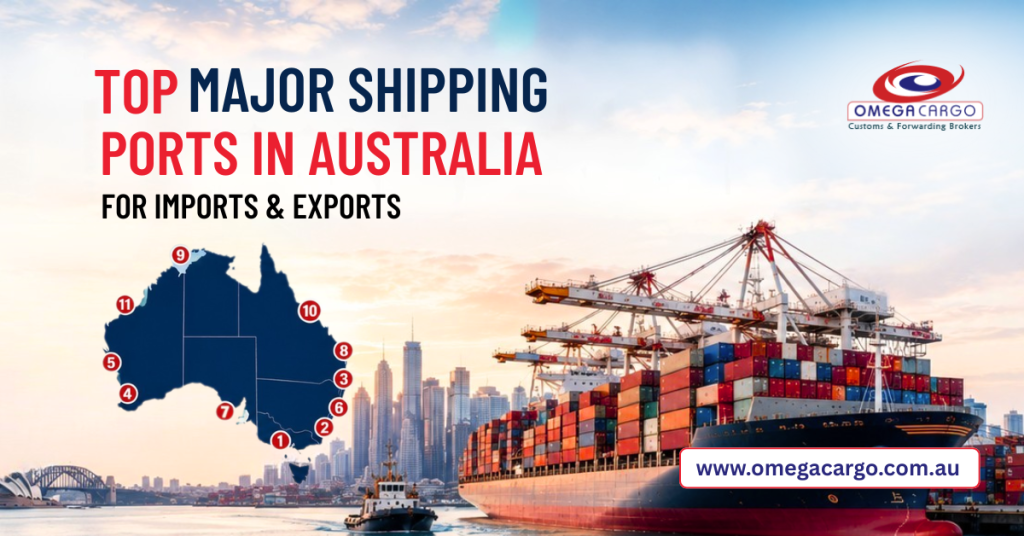
The Top 11 Major Shipping Ports in Australia for Imports & Exports in 2026 are: (1) Port of Melbourne — Australia's busiest container port, 3.26M TEU/year; (2) Port Botany (Sydney) — 2.8–3.5M TEU, second largest container hub; (3) Port of Brisbane — 1.6M TEU, fastest growing; (4) Fremantle (Perth) — sole WA container gateway, 810K TEU; (5) Port Hedland — world's largest iron ore export port, 520M tonnes; (6) Port of Newcastle — world's largest coal export port, 160M tonnes; (7) Port of Adelaide — South Australia's primary gateway; (8) Port of Gladstone — major LNG and coal hub; (9) Port of Darwin — Asia's northern gateway; (10) Port of Townsville — northern Australia's largest general port.
When you import goods into Australia or export products overseas, there's a very good chance your shipment passes through one specific port — and which port that is has a direct impact on your freight cost, transit time, and the biosecurity and customs compliance process your goods go through. Understanding which ports handle what cargo, and what each port's strengths and limitations are, is genuinely useful knowledge for anyone involved in Australian trade.
Australia's ports aren't all the same. Some are container terminals serving capital cities and their surrounding retail and commercial supply chains. Others are specialist bulk commodity export facilities that dwarf anything you'd see at a capital city port — moving hundreds of millions of tonnes of iron ore, coal and LNG to Asia and beyond. And some serve specialist roles — northern gateways to Southeast Asia, agricultural export hubs, or multi-commodity facilities that connect regional industries to global markets.
If you are a business owner, a freight forwarder, or an e-commerce brand looking to move goods in or out of the country, understanding this massive maritime network is crucial. Navigating ocean freight can be overwhelming, but knowing which port best suits your specific cargo can save you time, slash your shipping costs, and streamline your entire supply chain.
In this comprehensive guide, we are going to explore the Top Major Shipping Ports in Australia for Imports & Exports. We will break down exactly what makes each port unique, what kind of cargo they handle, location, annual throughput, key cargo types, trade lanes, and how you can leverage them to grow your business.
Australia's Top Shipping Ports — 2026 Quick Reference
| # | Port | State | Type | Annual Volume | Key Cargo |
| 1 | Port of Melbourne | VIC | Container | 3.26M TEU / 112M tonnes | Consumer goods, vehicles, food, machinery |
| 2 | Port Botany (Sydney) | NSW | Container | 2.8–3.5M TEU | Consumer goods, automotive, electronics |
| 3 | Port of Brisbane | QLD | Container + Bulk | 1.6M TEU / 34.1M tonnes | Agriculture, coal, refrigerated goods |
| 4 | Fremantle (Perth) | WA | Container | ~810K TEU | Mining equipment, grain, consumer goods |
| 5 | Port Hedland | WA | Bulk Export | ~520M tonnes | Iron ore (Pilbara), battery metals |
| 6 | Port of Newcastle | NSW | Bulk Export | 160M tonnes | Coal (world's largest coal export port) |
| 7 | Port Adelaide | SA | Multi-commodity | ~6M tonnes containers | Grain, wine, defence, consumer goods |
| 8 | Port of Gladstone | QLD | Bulk + LNG | 118.33M tonnes | LNG, coal, alumina, cement |
| 9 | Port of Darwin | NT | Multi-commodity | 2M+ tonnes | Petroleum, LNG, livestock, containers |
| 10 | Port of Townsville | QLD | Multi-commodity | 10M+ tonnes | Zinc, copper, sugar, machinery |
| 11 | Port of Dampier | North-west coast | Multi-commodity | 147M tonnes | Iron ore, Liquefied Natural Gas (LNG), and salt |
Sources: BITRE Yearbook 2025, Port Authority annual reports, Infrastructure Australia 2026 Priority List, Lloyd's List. Volume data reflects the most recent reported year (2023–25). TEU = Twenty-foot Equivalent Unit (standard container measurement). |
|||||
Before we dive into the specific ports, you need to understand why choosing the right port matters so much for your business.
Australia is the fifth-largest user of shipping services in the world. Because the country operates primarily on a "hub and spoke" shipping model—often routing through massive global hubs like Singapore before reaching local shores—the efficiency of the receiving Australian port dictates the speed of your delivery.
When you import or export goods, you aren't just paying for the sea voyage. You have to consider landside logistics, port congestion, biosecurity processing, and inland transportation (trucking and rail). Shipping your goods to a port that is closer to your final warehouse—or one that specializes in your specific type of cargo—can completely change your profit margins.
Whether you are moving standard twenty-foot equivalent units (TEUs) full of consumer goods, massive roll-on/roll-off (RoRo) vessels carrying vehicles, or dry bulk carriers filled with grain, there is a specific gateway perfectly suited for your needs.
Let's take a journey around the vast Australian coastline and explore the heavyweights of the maritime industry. These are the top 10 major shipping ports in Australia for imports and exports that keep the nation's economy thriving.
Victoria — Australia's Busiest Container Port | Southern Hemisphere's Largest
Location: South-east coast, at the head of Port Phillip Bay.
Best For: Containerized consumer goods, agricultural exports, and vehicles.
The Port of Melbourne is the undisputed king of Australian container ports. Processing over 3.26 million TEUs per year and handling approximately 112 million revenue tonnes of cargo annually, it ranks 76th globally among the world's busiest container ports — and it's the single most important gateway for goods flowing into and out of Australia's largest consumer market. If you're importing or exporting commercial goods from Victoria, Port of Melbourne is almost certainly your port.
Founded in 1835, the port operates two major container terminals: DP World Melbourne at Swanson Dock and VICT (Victoria International Container Terminal) at Webb Dock. VICT is one of the most automated container terminals in the Southern Hemisphere. The port is also home to Australia's largest motor vehicle trading terminal — processing hundreds of thousands of vehicles annually. In 2026, an on-dock rail expansion is underway at Port Botany-scale, with rail freight mode share rising from 13% in 2022-23 to 20% in early 2026.
3.26 million TEU
112 million revenue tonnes
DP World, VICT (Webb Dock)
#76 globally (Lloyd's List)
Consumer goods, Motor vehicles, ElectronicsFood & beverage, Machinery, Pharmaceuticals, Refrigerated goods
2026 Watch: New western corridor toll charges have added AUD $60–70 per container movement for road freight. Melbourne's port is actively encouraging rail mode shift to mitigate this. If you're importing into Melbourne, coordinate with your freight forwarder on whether rail or road delivery is more cost-effective for your warehouse location.
If you are importing retail products, electronics, or furniture, chances are high that your goods will sail through the Port of Melbourne. As Australia’s busiest container and general cargo port, Melbourne handles around 3.39 million TEUs annually. In the 2024-2025 financial year alone, it facilitated a record-breaking $154 billion worth of trade.
Why it matters to you: The Port of Melbourne handles more than one-third of the nation’s entire container trade. It is the lifeblood of south-eastern Australia's supply chain.
The port is currently undergoing nearly $1 billion in infrastructure upgrades, extending its docks to accommodate even larger, next-generation ships. If you want a reliable, high-volume gateway for standard container freight, Melbourne is your top choice.
New South Wales — Australia's Second-Largest Container Port
Location: Eastern coast, Botany Bay (just 10km south of the Sydney CBD).
Best For: Manufactured goods, consumer imports, bulk liquids, and heavy machinery.
Port Botany, is Australia's second-largest container port and the primary trade gateway for New South Wales. Originally developed in 1971 as cargo operations outgrew Sydney Harbour, Port Botany now handles approximately 2.8–3.5 million TEUs annually — equivalent to roughly AUD $30 billion in trade value per year. It is home to some of Australia's most advanced automated container terminals, operated by Patrick Terminals and DP World.
Port Botany is particularly strong for automotive imports (one of Australia's major automotive import gateways), high-value consumer goods, petroleum and chemicals imports (liquid bulk terminals at the port handle significant petroleum imports for NSW's energy needs), and Asia-Pacific trade connections. The port's on-dock rail system is undergoing a major capacity expansion from 1 million to 3 million TEU annually to shift more freight from road to rail — with mode share already rising to 20% in early 2026.
2.8–3.5 million TEU
Patrick Terminals, DP World
20% (2026) — growing
Automotive imports, Consumer electronics, Petroleum & chemicals, Retail goodsHigh-value imports, Food & beverages
2026 Watch: Port Botany experiences regular peak period surcharges due to high demand — particularly October–January pre-Christmas peak. Book 6–8 weeks ahead during this window. Peak period congestion at Port Botany can add 2–5 days to container release times without pre-clearance.
Port Botany is Australia’s second-largest container port and the premier maritime gateway for New South Wales. Established in the 1970s to relieve the historic Sydney Harbour, Port Botany is a sprawling, high-tech facility that operates 24/7. It handles over 2.5 million TEUs every year.
Why it matters to you: Sydney is Australia’s most populous city, meaning the consumer demand here is massive.
If your primary customer base is located in NSW, routing your imports through Port Botany is a no-brainer. Be mindful, however, that the eastern seaboard can sometimes face extreme weather—like the severe winds seen in mid-2025—which can occasionally pause operations. Partnering with a skilled freight forwarder can help you navigate these sudden delays.
Queensland — Fastest-Growing Port in Australia | One of the World's Safest
Location: Eastern coast, at the mouth of the Brisbane River.
Best For: Agricultural exports, construction materials, motor vehicles, and meat.
The Port of Brisbane is Australia's third-largest container port and its fastest growing — both in container throughput and technology adoption. Located on purpose-built Fisherman Islands at the mouth of the Brisbane River, it moves approximately 1.6 million TEUs and 34.1 million tonnes of cargo annually. Brisbane was the first Australian port to introduce semi-automated stevedoring and has invested heavily in electric cranes that reduced port emissions by 20% in 2025.
The Port of Brisbane's greatest strength for Australian importers and exporters is its refrigerated container (reefer) infrastructure — the best in Australia for temperature-controlled cargo. Queensland's beef, dairy, fruit and agricultural exports rely heavily on Brisbane's reefer capabilities. For importers, Brisbane serves as the gateway for Queensland and also for Northern Australia (goods trucked north from Brisbane into the NT and FNQ). Its inland rail connection to the port is a 2026 Infrastructure Priority List priority for improvement.
1.6 million TEU
34.1 million tonnes
Best reefer infrastructure in AU
Fisherman Islands, Brisbane River
Agricultural exports, Refrigerated goods, Coal, Project cargo, Machinery, Consumer goods
2026 Watch: Queensland inland rail freight improvements to the Port of Brisbane are listed as a priority investment — improving connections between Brisbane and inland Queensland production regions. Freight rail improvements will reduce congestion on port access roads and boost productivity for large-volume exporters.
The Port of Brisbane is Queensland’s largest seaport and Australia’s third busiest port overall. It is widely recognized as one of the fastest-growing and most technologically advanced ports in the country.
Why it matters to you:
If you are importing construction materials for Queensland's booming infrastructure projects or exporting high-quality Australian produce to Japan or South Korea, the Port of Brisbane is your ideal strategic partner.
Western Australia — Sole WA Container Gateway | Westport Future Development
Location: Western coast, at the mouth of the Swan River (near Perth).
Best For: Asian trade, general cargo, agricultural exports, and imported vehicles.
If you're importing anything into Western Australia, it almost certainly comes through Fremantle Port — the sole container gateway for the state, located approximately 19km south of Perth's CBD. The Inner Harbour handles virtually all of Western Australia's container trade, processing approximately 810,000 TEUs annually along with livestock exports, motor vehicle imports and dry bulk commodities. Fremantle's dominant cargo mix reflects WA's economy: mining equipment and parts imports, grain and mineral exports, and consumer goods for Perth's growing population.
Fremantle is also a major hub for personal effects imports — reflecting WA's high population of UK, European and Asian expatriates who regularly ship household goods to Perth. The port currently operates under significant infrastructure constraints, with capacity expected to be reached by 2038. The long-term solution — Westport — is a new container port being developed at Kwinana, supported by AUD roadworks improvements to Anketell Road, which are listed as an immediate infrastructure priority for 2026.
~810,000 TEU
19km south of Perth CBD
Yes — sole gateway for all WA imports
Westport at Kwinana (capacity by 2038)
Mining equipment, Grain exports, Livestock exports, Motor vehicles, Consumer goods, Personal effects
2026 Watch: The Fremantle Traffic Bridge replacement works started February 2026. Road congestion around North Quay terminals is significant. Work with your freight forwarder to explore port-to-rail delivery options where available to avoid road congestion delays and cost premiums. Also note WA's dual biosecurity compliance requirements (federal DAFF + state DPIRD) for goods entering WA.
Serving as the maritime gateway for Perth and the broader Western Australian region, the Port of Fremantle is the largest and busiest general cargo port on the country's west coast.
Why it matters to you:
If your business operates in Western Australia, shipping directly into Fremantle rather than relying on costly cross-country rail freight from the eastern states will save you a fortune.
Western Australia — World's Largest Bulk Export Port | Iron Ore Capital
Location: North-west coast, Pilbara region.
Best For: Iron ore, bulk minerals, and heavy mining equipment.
Port Hedland is a port unlike anything else in Australia — and arguably unlike anything else in the world. Located on the remote Pilbara coast of Western Australia, it holds the distinction of being the largest bulk export port in both Australia and Oceania, and is the single largest iron ore export port globally. Processing approximately 520 million tonnes of cargo annually, Port Hedland handles more cargo by weight than the entire combined container volume of Melbourne, Sydney and Brisbane.
The port's entire purpose, infrastructure and operation centres on one thing: getting iron ore from the Pilbara's mines onto ships bound for China, Japan and South Korea as efficiently as possible. BHP and Roy Hill are the dominant operators. In 2026, a major AUD $565 million government-backed expansion at Lumsden Point is developing a multi-use facility and logistics hub to support battery metals exports and imports of renewable energy infrastructure — beginning Port Hedland's strategic diversification beyond iron ore.
~520 million tonnes
Iron ore (Pilbara region)
World's largest bulk export port
$565M Lumsden Point expansion
Iron ore (dominant), Battery metals (growing), Renewable energy equipment, General freight (limited)
Now we move away from consumer container ports and into the world of sheer, unadulterated bulk. Port Hedland is not just the largest port in Australia by tonnage; it is the largest bulk export port in the entire world. In recent years, it has handled an unbelievable 576 million tonnes of cargo annually.
Why it matters to you:
For the average e-commerce retailer, Port Hedland won't be on your radar. But if you are in the industrial, mining, or commodities sector, this port is the undisputed center of your universe.
New South Wales — World's Largest Coal Export Port | Clean Energy Pivot
Location: Eastern coast, Hunter Region (north of Sydney).
Best For: Coal, agricultural products, and breakbulk machinery.
The Port of Newcastle holds a remarkable title: it is the world's largest coal export port, handling approximately 160 million tonnes of cargo annually. Located on the Hunter Valley coast of NSW, the port's entire operational history has been shaped by the Hunter Valley's vast coal reserves — connecting mines in the Hunter to Asian markets (primarily China, Japan, India and South Korea) that rely on Australian coal for steelmaking and electricity generation.
In 2026, Newcastle is making a deliberate strategic shift. The port is developing a Clean Energy Precinct at Kooragang Island, aiming to generate more than 50% of its revenue from non-coal sources by 2030. This includes hydrogen export infrastructure and facilities for oversized renewable energy components — reflecting the global energy transition's direct impact on Australia's export ports. The port's deep-water facilities and large-vessel handling capacity (it regularly handles Capesize vessels) give it a strong foundation for this
~160 million tonnes
World's largest coal export port
50%+ revenue from non-coal sources
Clean Energy Precinct — Kooragang Island
Thermal coal, Metallurgical coal, Grain, Alumina, Hydrogen (emerging)
It is a massive driver of the New South Wales economy.
Why it matters to you:
For bulk commodities on the east coast, Newcastle is entirely unmatched in its scale and efficiency.
Shipping Goods Through Any Australian Port?
Omega Cargo provides freight forwarding and customs clearance services across all major Australian ports — with 24+ years of experience and dedicated account managers for every shipment.
Get Your Free Quote → Sea Freight Services
South Australia — Wine, Grain, Defence & Retail Gateway
Location: Southern coast, Gulf St Vincent.
Best For: Grains, wine, automobiles, and general containerized cargo.
South Australia's primary maritime gateway, Port Adelaide handles a diverse mix of container cargo, bulk commodities, and project freight. SA's signature exports — wine (Barossa, McLaren Vale, Coonawarra and Clare Valley), grain (wheat, barley, canola) and refined minerals — all leave through Port Adelaide. On the import side, the port serves as the gateway for consumer goods, vehicles and industrial machinery supporting South Australia's economy, including its growing defence industry (AUKUS submarine program).
Port Adelaide serves as a backup gateway when Melbourne faces industrial action or capacity constraints — making it an increasingly strategic port in Australia's eastern seaboard supply chain. In 2026, Port Adelaide is included in an Infrastructure Priority List proposal for enabling infrastructure for Renewable Energy Zones, supporting large-scale renewable energy components moving from the port to South Australia's REZs.
~6M tonnes containers
Wine, grain, refined minerals
AUKUS defence industry gateway
DP World
Wine exports, Grain exports, Consumer goods imports, Defence freight, Motor vehicles, Renewable energy infrastructure
The Port of Adelaide (also known as Flinders Ports) is South Australia’s primary maritime hub. It is a highly versatile, multi-cargo port that beautifully reflects the diverse economy of the state it serves.
Why it matters to you:
If you are in the agribusiness sector—whether importing fertilizers or exporting premium Shiraz—the Port of Adelaide offers a less congested, highly efficient alternative to the larger eastern ports.
Queensland — Australia's Largest Multi-Commodity Port | LNG Capital
Location: Central Queensland coast.
Best For: Coal, LNG, alumina, and aluminum.
The Port of Gladstone is Queensland's largest multi-commodity port and one of Australia's most powerful industrial export hubs, handling approximately 118.33 million tonnes of cargo annually. Gladstone's natural deep-water harbour — one of the few in Australia capable of handling "Capesize" vessels on the East Coast — makes it the preferred port for ultra-large vessels carrying bulk commodities. The port handles coal, alumina, cement, and is the departure point for massive LNG exports from Curtis Island — Queensland's Curtis Island LNG facility is one of the world's largest LNG export operations.
For freight forwarders and commercial importers, Gladstone is the key entry point for heavy industrial machinery destined for Central Queensland's mines and industrial facilities. The port's 2026 master plan identifies opportunities to support emerging hydrogen export infrastructure — one of the most significant energy transition diversification opportunities in Australia's port network.
118.33 million tonnes
Capesize vessels (deep-water)
Curtis Island — one of world's largest
Hydrogen export master plan
LNG exports, Coal exports, Alumina, Cement, Industrial machinery imports, Hydrogen (emerging)
Why it matters to you:
If your supply chain involves bulk industrial raw materials, Gladstone provides the deep-water access and heavy-duty infrastructure required to move mountains of cargo safely.
Northern Territory — Australia's Northern Gateway to Asia | Strategic Trade Hub
Location: Northern coast, Timor Sea.
Best For: Live cattle, minerals, LNG, and defense logistics.
The Port of Darwin holds a unique strategic position in Australia's maritime trade network — it is Australia's closest port to Asia and serves as the "northern gateway" connecting Australia's resource-rich north to Southeast Asian markets. Located on the Timor Sea, Darwin handles more than 2 million tonnes of cargo annually, with a strong focus on petroleum and LNG exports, live cattle exports (a major Northern Territory industry), zinc and lead concentrates from mines at Mount Isa (trucked via road), and containerised goods for the Top End's remote population.
Darwin's deep-water facilities allow it to accommodate large heavy vessels — critical for the NT's resources sector. In 2026, the port is evolving strategically, with enhanced security infrastructure for northern trade given Darwin's proximity to Southeast Asia and its role in Australia's defence posture. The port's operator, Darwin Port Corporation, has been working to diversify trade flows beyond resources into agri-food exports and FMCG imports for regional NT communities.
2M+ tonnes
Yes — Timor Sea access
Live cattle, LNG, zinc/lead
Defence + northern trade gateway
As Australia’s northern most major port, the Port of Darwin is strategically vital. It physically represents Australia’s closest maritime connection to the massive, booming economies of Asia.
Why it matters to you:
If you are trading heavily with Indonesia, Singapore, or the Philippines, keeping a close eye on the Port of Darwin’s growing container capabilities could unlock new, faster supply chain routes for your business.
Queensland — Northern Australia's Largest General Port | $1.6B Expansion
Location: North-eastern coast, Queensland.
Best For: Sugar, refined metals, live cattle, and fertilizers.
The Port of Townsville is the lifeline for Northern Australia — servicing not only Townsville and North Queensland, but the mining regions of Mount Isa and the agricultural belts of the tropical north. It is northern Australia's largest general cargo port, handling over 10 million tonnes of cargo annually including zinc, copper, lead, sugar, fertiliser, molasses, and containerised goods for Queensland's northern communities and industries.
In 2026, Townsville is undergoing a transformative AUD $1.6 billion port expansion — the Port Expansion Project — which is widening shipping channels to allow larger vessels (up to 8,500 TEU capacity) to dock at Townsville for the first time. This is critical for reducing freight costs for Northern Australian importers who previously faced significant premiums because goods had to truck north from Brisbane. Once complete, this expansion will bring direct international container services to Townsville and dramatically improve supply chain economics for Northern Queensland businesses.
10M+ tonnes
Zinc, copper, lead, sugar
$1.6B Port Expansion (2026 underway)
Up to 8,500 TEU vessels (post-expansion)
Zinc, copper, leadSugar, Fertiliser, Molasses, General containers, Defence freight
2026 Watch: The Townsville expansion is a game-changer for North Queensland importers. Once complete, container rates and transit times to northern Queensland will improve significantly as direct vessel services become viable.
Serving as the largest general cargo port in Northern Australia, the Port of Townsville is an essential gateway for the region's massive agricultural and mining output.
Why it matters to you:
If your business is rooted in North Queensland's booming resources, farming, or agriculture sectors, Townsville provides a highly efficient, specialized, and cost-effective alternative to the larger capital city ports.
Location: North-west coast, Pilbara region.
Best For: Iron ore, Liquefied Natural Gas (LNG), and salt.
Located just down the coast from Port Hedland, the Port of Dampier is the second-largest port in Australia by cargo tonnage. Managed alongside Port Hedland by the Pilbara Ports Authority, Dampier is another titan of the global resources trade.
Why it matters to you:
If your logistics company specializes in oversized, heavy-lift, or dangerous goods, understanding the strict safety and operational protocols at the Port of Dampier is essential.
For most Australian importers, your destination port is determined by your business location — goods for Melbourne go through the Port of Melbourne, goods for Perth go through Fremantle. But for exporters, and for larger commercial importers with multiple distribution points, port selection can be a strategic decision that affects freight cost, transit time and supply chain resilience. Here's a quick guide.
Which Australian Port Should You Use? Quick Selection Guide
| Your State / Region | Primary Port | Alternative Port | Key Consideration |
| Victoria | Port of Melbourne | Port Adelaide (contingency) | 2026 toll increases — compare road vs rail delivery costs |
| New South Wales | Port Botany (Sydney) | Port of Brisbane (alt.) | On-dock rail capacity expanding — good for inland distribution |
| Queensland (SE) | Port of Brisbane | Port Botany (alt.) | Best reefer infrastructure for food/agricultural imports |
| Queensland (North) | Port of Townsville | Port of Brisbane | $1.6B expansion improving vessel access from 2026 |
| Western Australia | Fremantle Port | No alternative — sole WA port | 2026 Traffic Bridge works causing congestion — use rail where possible |
| South Australia | Port Adelaide | Port of Melbourne (alt.) | Good alternative when Melbourne faces industrial action |
| Northern Territory | Port of Darwin | Port of Townsville | Best Asian lane connections; strategic northern location |
So, with all these options, how do you actually choose the right gateway for your cargo? Here is a simple, actionable checklist to guide your decision:
Regardless of which Australian port your goods arrive at, biosecurity compliance is a national obligation enforced by DAFF (Department of Agriculture, Fisheries and Forestry) at every port. But there are port-specific differences that affect your risk profile.
From 1 September to 30 April each year, goods from BMSB target countries (USA, most of Europe, parts of Asia) that include target high-risk goods must be treated and certified before departure. This applies equally to Port Botany, Melbourne, Fremantle, Brisbane and every other Australian container port. No port is exempt. Goods arriving without a valid treatment certificate are directed for re-export at the importer's cost. Always confirm BMSB status with your freight forwarder before shipping.
Fremantle and all entry points into Western Australia have additional biosecurity requirements enforced by DPIRD (WA's Department of Primary Industries and Regional Development) on top of federal DAFF rules. WA's agricultural industries — grain, horticulture, viticulture, livestock — are protected by the strictest state-level biosecurity regime in Australia. Goods entering WA, including by interstate road freight after port arrival in another state, face these additional checks. Your freight forwarder must be familiar with WA-specific biosecurity requirements.
Choosing the right port is only half the battle. Because Australia is an isolated island with a unique ecosystem, it has some of the strictest customs and biosecurity laws in the entire world. The Australian Border Force (ABF) and the Department of Agriculture, Fisheries and Forestry (DAFF) monitor everything that crosses the docks.
What you need to know:
Partnering with a licensed customs broker who has physical representation at these major ports will save you from devastating delays. They understand the local port authorities and can clear your goods through the red tape smoothly.
Navigating the major shipping ports in Australia doesn't have to be a headache. Whether you are importing your first container of retail goods into Melbourne or exporting heavy machinery out of Fremantle, having the right logistics partner changes everything.
You need a team that understands the local landscape, knows how to bypass port congestion, and can handle the complex Australian customs processes on your behalf.
Don't leave your profit margins stranded at the dock. Contact our expert freight forwarding team today for a free, no-obligation quote. We will analyze your specific cargo, recommend the perfect Australian port of entry, and build a tailored strategy that saves you time and money.
Get Your Free Freight Quote Today!
It depends on how you measure "largest." By container volume, the Port of Melbourne is Australia's largest general cargo and container port in Australia, handling roughly 3.39 million TEUs (twenty-foot equivalent units) annually. By total cargo volume (all types including bulk), Port Hedland in Western Australia is the largest, handling approximately 520 million tonnes of cargo per year — primarily iron ore from the Pilbara region — making it the largest bulk export port in both Australia and Oceania. The Port of Newcastle holds another record: it is the world's largest coal export port by volume. However, if measuring by sheer weight and bulk tonnage, Port Hedland in Western Australia is the largest, driven almost entirely by massive iron ore exports.
The "best" port depends entirely on your final destination, but the Port of Melbourne, Port Botany (Sydney), and the Port of Brisbane handle the vast majority of imports from China. If your goal is the fastest ocean transit time to the east coast, Brisbane is slightly closer, while the Port of Fremantle offers the fastest transit times for goods heading to Western Australia.
The Port of Fremantle is the primary maritime gateway servicing Perth and the broader Western Australian region for containerized goods, imported vehicles, and general cargo. However, for bulk minerals, heavy machinery, and industrial commodities, Port Hedland and the Port of Dampier are the crucial heavyweights servicing the state's booming resource sector.
TEU stands for "Twenty-foot Equivalent Unit." It is the standard global unit of measurement used in the shipping industry to determine cargo capacity for container ships and ports. One TEU represents the cargo capacity of a standard 20-foot-long shipping container. Therefore, a standard 40-foot container is measured as two TEUs (2 TEU).
The vast majority of imported consumer goods (such as furniture, electronics, and clothing) enter through the Port of Melbourne, Port Botany (Sydney), and the Port of Brisbane. These three eastern seaboard ports feature the most advanced container handling facilities and are located closest to Australia's largest population centers.
Australia actually has over 70 commercial ports operating across its massive coastline. However, the vast majority of the nation's international freight and economic value is concentrated through the top 10 to 15 major strategic ports discussed in this guide, which act as the primary lifelines for the country's imports and exports.
Once cargo is unloaded at major ports, it is moved via specialized landside logistics. Containers are either placed directly onto freight trains at on-dock rail facilities (common in Sydney and Brisbane) to be taken to inland intermodal terminals, or they are loaded onto heavy transport trucks for direct delivery to distribution warehouses.
Because Australia is a massive island nation far removed from global manufacturing hubs, it relies on sea transport for over 99% of its international trade by volume. Sea freight is the only cost-effective way to import the vast quantities of consumer goods the country needs, and to export the massive volumes of agricultural and mineral resources the country produces.
Australian ports face several challenges, including occasional severe weather events (like high winds that force crane shutdowns), rigid industrial relations that can cause labor delays, and the constant need to upgrade infrastructure to accommodate the new generation of massive "mega-ships." Additionally, strict biosecurity regulations require complex processing to ensure no foreign pests enter the country.
Australia's shipping ports are not just physical infrastructure — they're the economic arteries of the country. With 98% of Australia's trade moving by sea, the ports you choose, the transit routes your goods take, and the customs and biosecurity compliance you manage at each port directly shape your supply chain costs, lead times and reliability.
For most importers, your destination port is your nearest capital city port — Melbourne, Sydney, Brisbane, Fremantle or Adelaide. The key to optimising your cost and transit time is working with an experienced freight forwarder who knows the specific characteristics, peak periods, surcharges and compliance requirements of your port — and who can pre-clear your customs before the vessel arrives to avoid costly port storage and demurrage charges.
Whether your goods arrive through Port Botany's automated terminals, clear biosecurity at Fremantle with its dual DAFF and DPIRD requirements, or move through the expanding infrastructure at Townsville, having the right logistics partner makes every port a smooth gateway rather than a compliance obstacle.
Key Facts: Australia's Major Shipping Ports 2026
Importing or Exporting Through Any Australian Port?
Omega Cargo — 24+ years of freight forwarding and customs clearance across all major Australian ports. Get a full all-in quote from our experienced team today.


