
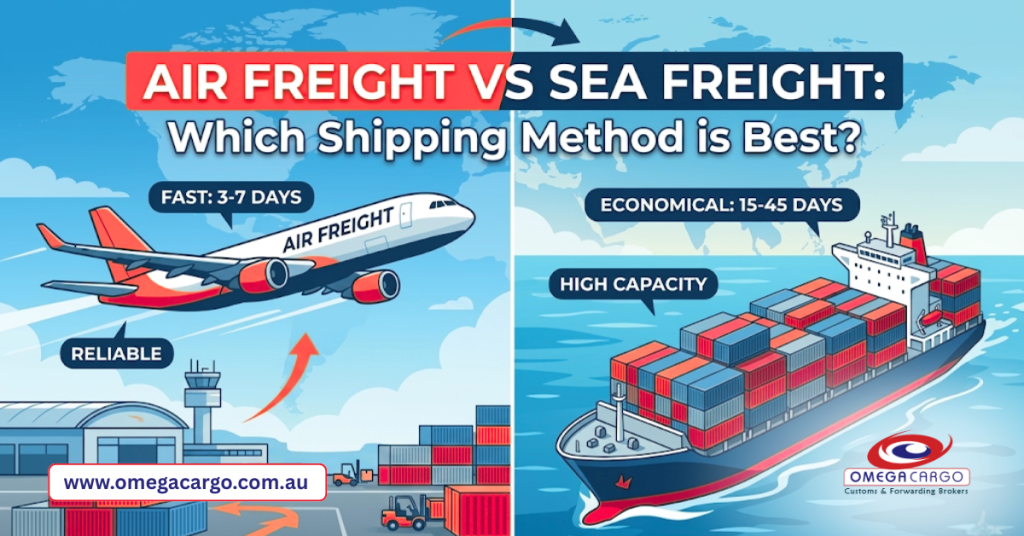
Here's a fact that stops most shippers in their tracks: air freight generates dramatically more CO₂ per tonne-kilometre than sea freight — yet businesses still choose air freight every single day, and often for very good financial reasons. The truth is that air freight vs sea freight is never a simple question of which is better. It's always a question of which is better for your specific shipment, right now. This complete comparison guide gives you everything you need to make that call confidently every time.
Air Freight vs Sea Freight: Which Shipping Method is Best? There's no single winner in the air freight vs sea freight comparison — it depends on your shipment. Air freight wins for speed, reliability, high-value-to-weight cargo, and urgent stock replenishment. Sea freight wins for cost (considerably cheaper per kilogram), large and heavy shipments, environmental impact (a small fraction of the CO₂ per tonne-kilometre), and non-time-sensitive goods. There's a shipment-weight point above which sea freight almost always becomes more cost-effective — contact our team to work out where that point sits for your cargo. Most experienced businesses use both — sea freight for standard replenishment, air freight as their emergency or premium line.
Did you know that although airplanes carry a very small share of the world's global trade volume, they transport a disproportionately large share of its total value? It's an incredible statistic. Every year, a vast amount of high-value goods fly right above our heads. When you are standing in a warehouse looking at a massive order of products ready to be shipped across the globe, the choice of how to move them can feel overwhelming.
If you've ever agonised over whether to send your next shipment by air or sea, you're in good company. It's one of the most common and most consequential decisions in international trade — and it's rarely as simple as "pick the cheaper one" or "pick the faster one." The real cost of your shipping decision includes much more than the freight rate: it includes your inventory holding time, your stockout risk, your customer satisfaction, and increasingly, your company's carbon footprint and ESG reporting obligations.
In this guide to air freight vs sea freight, you'll get a complete, honest comparison of both shipping methods — rates, transit times, cargo suitability, carbon emissions, hidden costs, and the practical decision frameworks that experienced logistics professionals actually use. By the end, you'll have a clear picture of exactly when to use each option — and you'll stop overpaying for air freight when sea would do, and stop losing sales by defaulting to sea when your business urgency demands air.
Before we dive into the deep comparisons, let's make sure we have a solid understanding of the two main contenders in global shipping.
Air freight simply means transporting your goods by aircraft. It is the express lane of international trade. Cargo planes (and the cargo holds of regular passenger planes) are loaded with carefully measured pallets and containers. Because space inside an airplane is highly restricted, airlines strictly calculate the weight and dimensions of every single box.
Air freight is widely used for:
The Pros of Air Freight:
The Cons of Air Freight:
Sea freight, also known as ocean freight, is the absolute backbone of global commerce. The large majority of the world's physical trade travels on ships. Goods are packed into massive steel containers (usually 20-foot or 40-foot lengths) and loaded onto colossal cargo ships that cross the oceans.
When you use sea freight, you generally have two choices:
Sea freight is typically used for:
The Pros of Sea Freight:
The Cons of Sea Freight:
Let's start with the fundamentals. Here's how the two freight modes compare across the factors that matter most to your business.
Now we reach the million-dollar question: Air Freight vs Sea Freight: Which Shipping Method is Best? The honest answer? It depends entirely on your specific business needs at this exact moment.
To figure out which method is your true champion, we need to compare them across four major battlegrounds: Cost, Speed, Reliability, and Environmental Impact. Let's break them down.
When it comes to shipping, cost is usually the loudest voice in the room. The logistics market moves in cycles, but the fundamental price differences between the two modes remain fairly consistent.
How Air Freight is Priced: Air freight is expensive because you are paying for speed and jet fuel. Airlines charge based on "chargeable weight." This is a tricky concept for many beginners. Chargeable weight is calculated by looking at both the actual physical weight of your box and the dimensional (volumetric) weight (how much space it takes up). The airline will charge you for whichever number is higher.
How Sea Freight is Priced: Sea freight is all about volume. If you have enough goods, you can rent an entire container. This is called FCL (Full Container Load). You pay a flat rate for the box, regardless of how much weight is inside (up to the legal limit). If you don't have enough to fill a whole container, you use LCL (Less than Container Load). Here, you share a container with other businesses and pay only for the cubic metres (CBM) your goods take up.
The Verdict on Cost: As a general rule of thumb, for very light shipments, the cost difference between air and sea might be small enough that the speed of air freight wins. But once your shipment volume or weight climbs, sea freight becomes drastically cheaper. Check out our Ocean Freight Services to get a live quote.
In the modern business world, time is money.
Air Freight Speed: Air freight is the undisputed king of speed. A cargo plane can leave Shanghai and land in Melbourne or Los Angeles within a matter of hours. Factoring in loading, unloading, and customs clearance, door-to-door transit times are typically measured in days rather than weeks. If you have a customer waiting, a factory line paused, or an emergency restock, air freight is your only real option.
Sea Freight Speed: Sea freight requires patience. A ship leaves the port, navigates oceans, waits in line at the destination port, and is slowly unloaded by cranes. Door-to-door transit times can vary considerably depending on the route — contact our team for a current transit estimate.
The Verdict on Speed: If your product loses its value quickly (like fresh food, fast fashion, or trending tech), the speed of air freight justifies the high cost. If your product has a long shelf life (like furniture or canned goods), you should save your money and plan ahead with sea freight.
You need to know where your goods are and that they will arrive safely.
Air Freight Reliability: Airlines run on incredibly tight, down-to-the-minute schedules. While bad weather can delay a flight, that delay is usually measured in hours, not weeks. Furthermore, airports have some of the tightest security on the planet, meaning your goods are handled less frequently and are closely guarded.
Sea Freight Reliability: Ocean shipping has improved massively with digital tracking, but it is still vulnerable to global events. Port strikes, labor shortages, unexpected storms, or global geopolitical issues can cause ships to wait outside ports for extended periods.
The Verdict on Reliability: If missing a delivery window means losing a major client, use air freight. If you have a buffer built into your inventory timeline, sea freight is perfectly fine.
Sustainability is no longer just a buzzword; it is a business requirement. Consumers care about your carbon footprint, and government regulations increasingly target heavy emitters.
That means air freight is roughly 40 to 50 times more carbon-intensive than sea freight.
The Verdict on Environment: If your brand prides itself on sustainability, or if you are trying to meet corporate ESG (Environmental, Social, and Governance) goals, you must prioritize sea freight.
(Need an urgent delivery? Explore our Air Freight Services for rapid, global door-to-door delivery options.)
To really answer "Air Freight vs Sea Freight: Which Shipping Method is Best?", let's look at how successful businesses make the choice in the real world.
Imagine you run a fast-growing IT firm. You'll be familiar with the ongoing trend in Cloud Infrastructure: businesses demanding massive scalability, physical resilience, and rapid digital growth. To support this, you need to import highly sensitive, extremely expensive physical server components and AI processors.
You run a retail clothing brand. You have a massive winter collection launching in a couple of months.
Sometimes, the best choice isn't one or the other — it's both.
Say you are launching a new consumer gadget. You need some inventory in stores immediately for the launch date, but the rest of the inventory can arrive later to serve ongoing sales. Smart businesses will ship a smaller portion of the goods via Air Freight to guarantee the launch is successful, and send the bulk of the order via Sea Freight to protect their profit margins.
Cost is usually the first factor businesses look at — and the gap between air freight and sea freight is significant. But the headline rate is only part of the story. Here's how the costs generally compare across major trade lanes.
Air Freight vs Sea Freight — Indicative Rate Comparison by Route
| Route | Air Freight (per kg) | Sea LCL (per CBM) | Sea FCL 20ft | Cost Winner |
| China → Australia | Higher | Lower | Lower | Sea ✓ |
| USA → Australia | Higher | Moderate | Moderate | Sea ✓ |
| UK/Europe → Australia | Highest | Higher | Moderate–Higher | Sea ✓ |
| Asia → USA | Higher | Lower–Moderate | Lower–Moderate | Sea ✓ |
| China → UK/Europe | Higher | Moderate | Moderate | Sea ✓ |
Sea freight rates are port-to-port. Air freight rates are door-to-door estimates. Both exclude Australian destination charges, customs duty, GST and inland delivery. Rates fluctuate with market conditions, season and carrier capacity. Always get all-in quotes for proper comparison.
To make the cost comparison real, here's how a moderate-sized shipment from Shenzhen to Melbourne generally compares in practice, using typical line items rather than fixed figures.
Air Freight — typical line items
Sea Freight LCL — typical line items
In this kind of comparison, sea freight typically costs considerably less than air freight for the same shipment. The trade-off is transit time — sea freight takes noticeably longer than air. Whether that time difference is worth the cost gap depends entirely on your inventory position and urgency. Contact our team for a genuine side-by-side, all-in quote for your specific shipment.
The Weight-Based Rule of Thumb
As a general guide, air freight and sea freight LCL start to converge in total all-in cost once a shipment reaches a certain weight. Below that point, air freight is often competitive or even cheaper than LCL once you factor in LCL's origin CFS fees, destination deconsolidation charges, and longer transit costs. Above that point, sea freight starts delivering clear cost advantages that grow larger with every additional kilogram. This isn't a hard rule — always compare actual all-in quotes — but it's a reliable starting point for your decision. Contact our team to find where that point sits for your cargo.
This is usually the biggest deciding factor for business owners. Freight costs directly impact your profit margins. As a general rule, air freight is considerably more expensive than sea freight on a per-kilogram basis.
However, it's not always that simple. You need to understand how both methods charge you.
Airlines don't just put your box on a scale; they also measure how much space it takes up. They charge you based on the Chargeable Weight, which is whichever is greater: the actual weight or the volumetric weight.
How to calculate volumetric weight: Multiply Length x Width x Height (in centimetres) and divide by 6,000.
Example: Let's say you are shipping a box of large, fluffy teddy bears.
Even though the box only weighs 10 kg, the airline will charge you for 40 kg because it takes up so much space in the plane. For bulky, lightweight items like this, costs can climb quickly — contact our team for a current per-kilogram rate.
Sea freight is much more straightforward.
So, when is air freight actually cheaper?
There is a golden rule in logistics: if your shipment is small, air freight might actually be cheaper. Why? Because sea freight comes with fixed port handling charges, document fees, and customs clearance base costs. If you are only shipping two small boxes, the base fees of sea freight will outweigh the actual cost of transport.
Speed is where air freight wins clearly and unconditionally. Here's how the two modes generally compare on the world's most active trade lanes.
Transit Time Comparison — Air vs Sea Freight (Door-to-Door, Relative)
| Route | Air Freight | Sea Freight | Sea LCL (adds CFS time) | Time Winner |
| China → Sydney | Fastest | Slower | Slowest | Air ✓ |
| China → Melbourne | Fastest | Slower | Slowest | Air ✓ |
| China → Perth (Fremantle) | Fast | Slower | Slowest | Air ✓ |
| USA → Australia | Fast | Slower | Slowest | Air ✓ |
| UK/Europe → Australia | Moderate | Slowest | Slowest | Air ✓ |
| India → Australia | Fastest | Slower | Slowest | Air ✓ |
Transit times include customs clearance at destination. Sea freight door-to-door adds extra time on top of port-to-port for customs clearance, CFS deconsolidation (LCL) and last-mile delivery. Air freight customs typically clear quickly. Seasonal port congestion and carrier delays can extend sea freight estimates further. Contact our team for a current transit estimate for your specific route.
The transit time advantage for air freight is significant. But speed only has value if you actually need it. If your inventory planning has a comfortable buffer, the extra transit time of sea freight costs you nothing in lost sales — and saves you considerably in freight costs.
Getting your goods from Point A to Point B isn't just about speed and cost; it's also about peace of mind. You need to know your cargo is safe.
Air freight operates on incredibly strict, precise schedules. Flights depart frequently, and if your cargo misses one flight, it can usually just catch the next one a short while later. Delays in air freight are typically measured in hours.
Sea freight, however, is highly vulnerable to delays. Bad weather, port strikes, and massive port congestion can leave ships waiting offshore for extended periods. If you are operating a "Just-In-Time" inventory system, sea freight can sometimes introduce unwanted risk.
Every time your goods are moved, there is a risk of damage.
If you are shipping highly fragile items (like precision medical equipment) or highly valuable items (like luxury watches), the extra cost of air freight essentially acts as an insurance policy against damage.
The carbon footprint of your shipping decisions is no longer just an ethical consideration — it's a financial one. Regulatory frameworks such as the EU's Emissions Trading System (EU ETS) are progressively extending to cover shipping emissions, and more supply chains globally are facing mandatory ESG disclosure requirements. Understanding the environmental cost of air vs sea freight is now part of good financial planning.
The numbers are stark. Air freight produces approximately 500g of CO₂ per metric ton of cargo per kilometre. Sea freight produces 10–40g of CO₂ per metric ton per kilometre. That means air freight emits roughly 47 times more greenhouse gas emissions per ton-mile than sea freight.
Carbon Emissions — Air Freight vs Sea Freight Comparison
| Mode | CO₂ per tonne/km | Example: 1 tonne, a long-haul route |
| Air Freight | ~500g (0.5kg) | Considerably higher total emissions |
| Sea Freight (container) | 10–40g | A small fraction of air freight's emissions |
| Sea Freight (bulk) | ~7g | The lowest emissions per tonne of the modes compared here |
| Rail Freight | 20–50g | Higher than sea, lower than air |
CO₂ figures are approximate averages. Actual emissions depend on vessel type, vessel age, fuel type, cargo fill rate and routing. International shipping regulations are progressively tightening emissions requirements for the industry — check the latest requirements with your compliance team. Sources: FreightAmigo, ICCT, IMO Strategy documentation.
For businesses with ESG commitments or customers in markets with strict environmental procurement rules, the carbon cost of air freight is increasingly relevant. Shifting even a portion of your air freight volume to sea freight can dramatically reduce your Scope 3 emissions — a key consideration for multinational supply chains reporting under CSRD or GHG Protocol standards.
The Hybrid Strategy: Sea + Emergency Air
Many experienced businesses reduce their carbon footprint and freight costs simultaneously by defaulting to sea freight for regular inventory replenishment and reserving air freight only for genuine emergencies or premium product lines. If you can shift a meaningful share of your air freight volume onto sea freight, you reduce your freight carbon emissions significantly — and your freight budget even more so. This hybrid strategy is worth modelling with your freight forwarder.
To make this practical, let's look at exactly when you should choose each method.
Not all cargo can travel by both modes — and not all cargo should travel by both modes, even when it legally can. Here's your practical guide to what works best by which mode.
Air freight is the right choice when speed, security or cargo characteristics make it necessary or clearly cost-effective:
High-value, lightweight, time-sensitive (new product launches, replacement parts). The value-to-weight ratio makes air freight cost-efficient, and fast delivery protects market position.
Temperature-sensitive, short shelf life, often life-critical. Air freight's speed reduces the risk of temperature excursion and ensures timely delivery of essential medications.
Trend-driven, time-sensitive, must arrive in-season. Missing the fashion window means deeply discounted clearance sales — the air freight premium pays for itself.
Manufacturing or equipment downtime costs far exceed air freight cost. A modest air freight bill is trivial compared to the substantial daily cost of factory downtime waiting for a critical part.
Short shelf life makes sea freight impossible for most fresh goods. Air freight is the only practical mode for fresh cut flowers, live seafood, fresh produce and short-dated food.
Very high value relative to weight and volume — air freight cost is proportionally small. Superior security and shorter exposure to theft risk makes air the preferred mode.
Heavy, bulky, not time-sensitive. Most machinery cannot travel by air even if you wanted to. Sea freight in FCL containers is the only practical option.
Bulky, low value-to-weight ratio, not time-sensitive. Sea freight in a 20ft or 40ft container is the standard method for household moves and furniture imports.
Large volumes, regular replenishment cycles, predictable demand. Sea freight's lower cost per unit is critical to maintaining competitive retail pricing for high-volume consumer goods.
Heavy, dense, low value-to-weight. Air freight is prohibitively expensive for these materials. Bulk carriers and container shipping are the only economically viable options.
Vehicles ship exclusively by sea (RoRo or container). Large automotive parts and assemblies are also prohibitively expensive by air and ship routinely by sea.
Many chemicals and flammable liquids are prohibited on passenger or cargo aircraft. Dangerous goods by sea (under IMDG Code) is often the only compliant option.
Not Sure Whether Air or Sea Freight is Right for Your Shipment?
Omega Cargo's freight specialists compare all-in costs and transit times for both options — and recommend the best fit for your cargo, urgency and budget.
The headline freight rate is never the full story. Both air freight and sea freight carry additional charges that can significantly change your cost comparison. Here are the ones most importers are surprised by.
Air Freight — Common Additional Charges Beyond the Base Rate
| Charge | Notes |
| Fuel Surcharge (BAF) | Fluctuates with jet fuel price — always confirm the current rate |
| Security Surcharge | Applied to all international air freight |
| Airport terminal handling | Applies at both origin and destination airports |
| Dangerous goods surcharge | Applies to lithium batteries, flammables, etc. |
| Volumetric weight uplift | Charged on the greater of actual kg or volumetric weight (L×W×H÷6,000) |
| Australian customs broker fee | An import declaration is required above the applicable low-value threshold — confirm the current threshold with your broker |
| GST (Australia) | The standard Australian import GST applies to the taxable value — claimable by GST-registered businesses |
Sea Freight LCL — Common Additional Charges Beyond the Base Rate
| Charge | Notes |
| Origin CFS consolidation | Charged at origin CFS warehouse |
| Fuel surcharge (BAF) | Marine fuel cost passthrough |
| Destination deconsolidation | Australian CFS separation charge |
| Australian port THC | Terminal handling at AU port |
| Port Service Charge (PSC) | Port authority facility charge |
| Container detention | Applies if the empty container is not returned within free time |
| Customs broker + DAFF fee | Import declaration + biosecurity assessment |
| GST (Australia) | The standard Australian import GST applies to the taxable value — claimable by GST-registered businesses |
The Golden Rule: Always Compare All-In Door-to-Door Costs
An air freight quote can look expensive compared to a bare sea LCL base rate — until you add the LCL's origin CFS charges, destination deconsolidation, documentation, and port handling. For small shipments, the all-in LCL cost can be surprisingly close to or even higher than air. Always request full door-to-door all-in quotes from your freight forwarder for a genuine comparison — never compare base rates alone.
Here's the practical framework that experienced logistics managers use to make the air vs sea decision consistently and confidently.
Air Freight vs Sea Freight — Decision Framework
| Factor | Choose Air Freight If... | Choose Sea Freight If... |
| Shipment weight | Relatively light | Relatively heavy |
| Shipment volume | Small volume | Larger volume (LCL), or approaching full container (FCL) |
| Urgency | Delivery needed soon | A longer lead time is acceptable |
| Goods value | High value relative to weight | Low-to-moderate value relative to weight |
| Shelf life | Short shelf life or perishable | Long shelf life, stable goods |
| Stock position | Facing stockout or urgent replenishment | Regular inventory replenishment, buffer stock |
| Carbon obligation | Only when absolutely necessary | Default choice for ESG compliance |
| Goods nature | Documents, samples, tech, medical | Machinery, furniture, bulk materials, vehicles |
| Cost premium acceptable | Air premium < cost of delay or stockout | Sea savings exceed the cost of extra lead time |
Apply this framework to each individual shipment. The right choice can change between consecutive orders of the same goods depending on your current inventory levels, demand forecast and cash flow position.
What if you don't want to choose just one? In recent years, a hybrid approach has become incredibly popular for savvy businesses looking to balance speed and cost.
How Sea-Air Freight Works: Imagine you are shipping from China to Europe or the US. Instead of sending it all by sea (slow) or all by air (very expensive), your freight forwarder uses a multi-modal strategy.
The Result? You get your goods considerably faster than standard ocean freight, at a noticeably lower cost than a pure air freight shipment. It is a fantastic middle-ground for seasonal retail goods where time is somewhat sensitive, but budgets are tight.
Additionally, you can split your shipments. If you order a large batch of a product, you can fly a smaller portion by air to immediately stock your shelves, while the remaining bulk of the order travels cheaply by sea to arrive later as backup inventory.
Make sea freight your standard operating mode. Reserve air freight for genuine emergencies, high-value perishables and new product launches. This one policy change can meaningfully reduce your freight spend without changing what you import.
Most emergency air freight happens because someone didn't plan far enough ahead. Building a healthy inventory buffer eliminates the panic that forces you to pay air rates for sea-freight goods. The cost of holding extra inventory is almost always less than the air premium.
For shipments in the weight range where air and sea genuinely compete, the total all-in cost of air vs LCL sea can be surprisingly similar once you add LCL's CFS fees and destination deconsolidation. Always get full door-to-door quotes for both options in this range before deciding.
If you regularly ship small air freight consignments, ask your forwarder about weekly consolidation — combining multiple small loads into one shipment. This typically reduces your per-kg rate compared to shipping each order individually.
Deferred air freight is noticeably cheaper than priority air freight. It uses lower-priority cargo space on flights, adding a little extra transit time but reducing cost meaningfully. For non-urgent shipments that still can't wait for sea, deferred air is a valuable middle option.
Calculate what percentage of your annual freight spend goes to air vs sea. Most businesses that haven't actively managed this rely on air more than they need to. Setting a target ratio and reviewing it regularly creates accountability for freight cost reduction.
For new product launches, ship the first batch by air to hit your launch date. Order the replenishment by sea at the same time. You get your launch stock on time without paying air rates for your entire inventory. This is the standard strategy for e-commerce and retail importers.
One factor that sometimes makes the air vs sea decision for you is cargo restrictions. Air freight has significantly tighter restrictions on dangerous goods than sea freight. Here are the most common goods that cannot travel by air (or face strict limitations).
If your goods fall into any restricted category, your freight forwarder will advise you on whether sea freight is the only compliant option, or whether special handling arrangements can be made for air transport. Always disclose the nature of your goods upfront — failing to declare dangerous goods on an air waybill carries serious legal and financial consequences.
Air freight moves goods internationally by aircraft, offering the fastest transit of the two modes. Sea freight moves goods in shipping containers aboard cargo vessels, which is considerably slower but far cheaper for large or heavy shipments. Air freight costs considerably more per kilogram than sea freight, but provides superior speed, reliability and security. Sea freight handles the large majority of world trade by volume — it's the backbone of global supply chains for bulk goods, machinery, consumer products and raw materials. Air freight dominates for time-sensitive, high-value, perishable or lightweight goods where the speed premium is justified by the business case.
To calculate whether air or sea freight is cheaper, you must determine your shipment's chargeable weight. Air freight charges by weight or dimensional volume (whichever is higher), while sea freight (LCL) charges by cubic metre (CBM). As a general rule, lighter shipments are often cheaper by air due to lower base handling fees, while heavier or higher-volume shipments are drastically cheaper by sea. Contact our team for a current comparison based on your exact shipment.
Yes, air freight is generally considered safer than sea freight. Cargo transported by air experiences less physical handling, spends significantly less time in transit, and undergoes strict airport security screenings. This drastically lowers the risk of physical damage, moisture exposure, and cargo theft compared to the long journey of an ocean container.
Shipping hazardous materials by air freight is highly restricted and often prohibited. Airlines have strict safety regulations regarding flammable liquids, gases, lithium batteries, and magnetic substances. While some dangerous goods can fly with special packaging and declarations, sea freight is vastly more accommodating and is the standard method for shipping chemicals and hazardous materials.
Air freight is substantially worse for the environment, emitting roughly 40 to 50 times more carbon dioxide per tonne-kilometre than sea freight. Ocean shipping averages 10 to 40 grams of CO2 per tonne-kilometre, while air cargo generates roughly 500 grams or more, making sea freight the clear choice for environmentally conscious businesses.
The verdict on air freight vs sea freight is this: there is no universal winner — only the right choice for your specific shipment, at this moment in your supply chain. Sea freight wins on cost, volume capacity, environmental impact and suitability for non-urgent goods. Air freight wins on speed, reliability, security and suitability for high-value, time-sensitive or perishable cargo.
The smartest businesses don't choose one mode and stick to it forever. They use a dynamic freight strategy — sea freight as the default for planned replenishment, air freight reserved for genuine urgency, emergency stock or premium product lines. If you can shift even a modest share of your current air freight volume to sea without impacting your business, you can meaningfully reduce your freight spend and carbon footprint simultaneously.
The key to making this work is working with a freight forwarder who understands both modes, provides all-in cost comparisons for both options, and helps you design your supply chain to maximise sea freight while maintaining air freight as a fast, reliable emergency lever. That's exactly what Omega Cargo's team does — for every client, on every shipment.
If you are dealing with high-value electronics, critical spare parts, or a sudden inventory shortage, the premium price of air freight is an investment in customer satisfaction and business continuity.
However, if you are moving heavy machinery, bulk commodities, or standard retail stock with a well-planned calendar, sea freight remains the undisputed king of cost-effective global trade.
Remember, the most successful businesses don't lock themselves into just one method. They analyze every single shipment, adapt to the current market rates, and often blend both methods to create a resilient, scalable, and highly efficient supply chain.
Your Air vs Sea Freight Decision Checklist
Need Air Freight or Sea Freight for Your Next Shipment?
Omega Cargo provides both air freight and sea freight services — with transparent all-in quotes, in-house customs clearance and decades of Australian freight expertise.
Disclaimer: The cost comparisons, weight thresholds and timeframes referenced in this guide reflect general industry patterns and are provided for planning purposes only. Actual costs, rates, thresholds and transit times depend on your specific shipment, carrier, route and current market conditions, and are not promised or guaranteed by this article. Always request a current, tailored quote from Omega Cargo before making shipping decisions.


