
Your shipment has landed in Australia. The vessel has berthed, the container is off the ship, so why can't you simply collect it and start selling? Because getting goods across a border legally takes more than getting them there physically.
So, what does a customs broker do? A customs broker manages the legal and administrative side of bringing your goods into Australia. They review your shipping documents, classify your goods under the correct tariff code, lodge the import declaration with the Australian Border Force (ABF), work out the duty and GST likely to apply, check for permits and biosecurity conditions, and deal with the ABF or the Department of Agriculture, Fisheries and Forestry (DAFF) if a query or hold comes up. The physical transport is a separate job, handled by your freight forwarder.
If you have never imported before, the middle of the journey can feel like a black box. This guide opens it: what a customs broker does step by step, the documents they need, how classification, duty, GST and biosecurity work, what causes customs clearance delays, how brokers work with freight forwarders, what drives brokerage costs and how to choose the right broker.
Whether you are an e-commerce seller bringing in your first trial order, a wholesaler restocking from overseas or a manufacturer importing components and raw materials, the same principles apply.
A customs broker is a licensed professional or company authorised by the Australian Border Force to prepare and lodge customs declarations on behalf of importers and exporters. They act as your registered representative with Australian customs and biosecurity authorities, applying specialist knowledge of tariff classification, customs valuation and compliance rules so your goods can be lawfully cleared for release.
According to the ABF, the Customs Act 1901 provides that only the owner of the goods or a licensed customs broker can submit an import declaration to enter goods for home consumption. Brokers are licensed under Division 3 of Part XI of the Customs Act, and a licence can be held by a natural person, a company or a partnership.
Think of a customs broker as your translator, compliance adviser and border paperwork specialist rolled into one. Instead of you learning the Customs Tariff, valuation rules and biosecurity conditions from scratch, the broker applies them to your shipment and presents it to the authorities correctly.
You may also hear the term customs clearance agent or customs agent. In everyday Australian usage these terms describe the same licensed role. What matters is that whoever handles your clearance holds a current customs broker licence.
Customs brokers work with importers of every size: e-commerce sellers bringing in overseas stock, manufacturers importing machinery or components, wholesalers restocking from China, the United States or Europe, and first-time importers who have never dealt with the Integrated Cargo System. Large, high-volume importers use brokers just as often as small businesses, because the paperwork burden doesn't shrink with shipment size.
In fact, a delay often hurts a small business more. A held container can represent a big share of its inventory and cash flow, and storage charges are harder to absorb.
Customs brokerage is a licensed profession because classification, valuation and compliance are genuinely technical. A single wrong digit in a tariff code, or a missed biosecurity requirement, can have real consequences. In the trade chain, the broker sits after the supplier and freight forwarder and before the goods reach your door, handling the legal declaration of what is crossing the border and what is owed on it.
A customs broker wears many hats. Here is a clear breakdown of their main responsibilities and why each one matters for your shipment. Several of these topics are explained in more depth further down the page.
Before anything is lodged, the broker checks your commercial invoice, packing list, bill of lading or air waybill and supporting documents for consistency and completeness. Does the invoice value match the packing list? Does the consignee name match your business details? Is the country of origin declared correctly?
Most clearance delays trace back to a documentation mismatch rather than a customs decision. Catching a typo or missing detail before lodgement, rather than after an ABF query, is often the difference between a smooth release and an extended hold.
The broker analyses your product's material, function and construction and determines the correct tariff classification under the Customs Tariff Act 1995. That code drives your duty rate, free trade agreement eligibility and whether a permit is needed. Classification is not always obvious: a pair of shoes can fall under different codes depending on whether the upper or sole is leather, rubber, plastic or textile.
The customs value isn't always just the invoice price. The broker makes sure your declared value is calculated on the correct basis and supported by documents, including any assists, royalties or commissions that should be added. Understating value, even accidentally, is a common trigger for a query that holds an entire shipment.
The broker checks whether your goods are prohibited, restricted or need a permit, and what DAFF's biosecurity conditions require, such as packing declarations, treatment certificates or inspection. Finding this out before you place the order leaves you far more options than finding out while the container is on the water.
Based on the classification, customs value and origin, the broker works out the duty, GST and other charges your shipment is likely to attract. You need a realistic landed cost before you price your product for sale, not after the bill arrives. Many brokers also arrange payment of these amounts as part of clearance and invoice you afterwards.
The broker prepares your import declaration and lodges it electronically through the Integrated Cargo System, stating what the goods are, their tariff classification, customs value, origin and importer details.
Under current ABF rules, a full Import Declaration (often called an N10) is required when a consignment has a combined value of over AUD 1,000 and is being cleared for home consumption. Lower-value air and sea cargo is generally cleared on a Self-Assessed Clearance (SAC) declaration instead. Always confirm the current threshold and rules on the ABF import declarations page.
A declaration is a legal statement to the Australian Government. Because Australia uses self-assessment, errors can surface as a duty demand or penalty long after the goods have been sold.
The broker is your point of contact with the ABF and, for biosecurity matters, DAFF. If either agency asks for a supplementary document, a value clarification or a product specification, the broker gathers what is needed and responds on your behalf. A clear, complete answer can close a query quickly, while an incomplete one, or the wrong document, extends the hold. Where other agencies are involved, such as the Therapeutic Goods Administration, your broker helps you work out what each one expects.
When something goes wrong, such as a disputed value, a challenged classification, a rejected document or an unexpected hold, the broker manages the resolution. They know who to contact, what evidence is needed and how to present it, which reduces the chance of a minor problem becoming a major delay with storage charges attached.
If your cargo is selected for a documentary, X-ray, physical or biosecurity inspection, the broker coordinates access, documents and follow-up with the examining authority, the depot and the transport company. Goods held with no one actively managing them can sit far longer than the inspection itself requires. What a broker cannot do is control whether an inspection happens or override its outcome.
Once clearance is granted and any duty and GST is paid, the broker makes sure the terminal, airline, depot or bonded facility receives the release so your transport provider can collect the goods. A cleared shipment that isn't actioned for release can keep accruing storage charges, so prompt follow-through matters.
Brokers keep records of your declarations, supporting documents and correspondence. According to the ABF, after an import declaration is made you must keep all relevant documents for five years; check the current requirement with the ABF. This paper trail is what you produce if the ABF carries out a post-clearance compliance check.
Beyond a single shipment, a good broker helps you understand your obligations as a regular importer, including record keeping, consistent valuation and tariff or regulatory changes that affect your product range. Ideally, they review a new product line before you place the order.
Across all of these tasks the common thread is prevention. Correct documents, classification and valuation, plus early identification of permit or biosecurity requirements, are what keep a shipment moving. Most delays importers experience are avoidable.
A customs broker manages the legal and administrative work needed to get your goods lawfully released from the Australian border. They don't move your cargo (that is the freight forwarder's job) and they don't make the final government decision (that is the role of the ABF and DAFF). The broker is your licensed representative working between the two on your behalf.
Customs brokerage isn't a single event at the border. It is a chain of steps that starts well before your goods leave the supplier and ends once they reach you. For a closer look at clearance itself, see our customs clearance step-by-step guide.
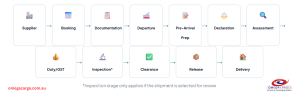
Your overseas supplier manufactures and packs your goods and should provide accurate commercial documentation from the start. This is where many documentation problems begin, so a clear brief to your supplier about what Australian customs needs to see pays off later.
Your freight forwarder (or the same company acting as both forwarder and broker) books space with a shipping line or airline and confirms the routing. This stage is largely outside the customs broker's direct control, but it sets up everything that follows.
The supplier issues the commercial invoice and packing list, and the carrier or forwarder issues the transport document. Your broker reviews these as early as possible, ideally before the vessel or aircraft departs, checking for consistency and confirming the tariff classification.
Once the goods leave origin, the broker uses the documents already in hand to classify the goods, check for permits and biosecurity conditions and draft the declaration ahead of arrival. This is the single most valuable stage for avoiding delay, because the declaration can be lodged as soon as the shipment details allow.
The broker formally lodges the import declaration through the ABF's Integrated Cargo System, including the tariff classification, declared value and origin of the goods.
The ABF assesses the declaration using its own risk-based systems, and goods are referred to DAFF where biosecurity assessment is needed. Straightforward, well-documented declarations are often processed without further review. Others may be flagged for a documentary check or physical examination.
Any duty, GST and charges owing are calculated and must be paid before the goods can be released, unless GST is deferred under the ATO's deferred GST scheme for eligible registered businesses. Your broker tells you what is payable and usually coordinates the payment.
If the ABF or DAFF selects your shipment for document review, X-ray or physical inspection, this happens before clearance is finalised. The inspection is government-directed and not something a broker controls, but your broker manages communication throughout.
Once the ABF (and DAFF, if biosecurity assessment applied) is satisfied, clearance is granted and your goods are approved for release.
The broker coordinates the physical release from the port terminal, airport or depot, and your transport provider, often the same freight forwarder that booked the shipment, collects and delivers the goods to your door.
Need help with your next import? Omega Cargo's customs and quarantine clearance team can manage documentation, classification and communication with the ABF and DAFF for you.
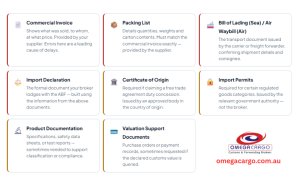
To clear your goods, a customs broker needs a specific set of documents. Each one plays a particular role, and a missing or inconsistent document is the most common cause of a preventable delay. Providing them early is the easiest way to support a smooth clearance.
| Document | What it is | Why it matters | Who typically provides it |
|---|---|---|---|
| Commercial invoice | The supplier's bill of sale showing buyer, seller, goods, quantities, unit prices, total value and currency | Forms the basis of customs valuation and duty and GST calculation; errors here are a leading cause of delays | Your supplier |
| Packing list | A breakdown of how the goods are packed: cartons, pallets, weights, dimensions and contents | Must match the invoice exactly; used to verify the shipment and support any inspection | Your supplier |
| Bill of lading (sea) or air waybill (air) | The transport contract and receipt for the goods issued by the carrier or forwarder | Confirms carriage, consignee and cargo details; needed to take control of the cargo | Shipping line, airline or freight forwarder |
| Certificate of origin | A formal document confirming where the goods were made | Needed to claim preferential duty treatment under a free trade agreement such as ChAFTA | Your supplier or an approved issuing body in the origin country |
| Import permit | Government permission for restricted or regulated goods, such as certain foods or chemicals | Legally required before certain goods can be released, regardless of duty status | The relevant government agency (varies by product) |
| Manufacturer's and packing declarations | Statements about material make-up, packaging and treatments | Often required for biosecurity assessment | Your supplier or manufacturer |
| Product documentation | Specification sheets, safety data sheets, material composition, test reports or technical catalogues | Supports correct classification and any compliance or biosecurity assessment | Your supplier or manufacturer |
| Valuation support documents | Purchase orders, payment terms, proof of payment, details of any assists, royalties or commissions | Confirms the declared customs value is complete if it is queried | You and your supplier |
| Import declaration | The formal statement lodged with the ABF describing the goods, value, origin and classification | The legal document that triggers assessment and clearance | Prepared and lodged by your customs broker |
An incomplete or inconsistent document set is the main reason a broker can't lodge on time. It is rarely that the broker is slow; it is that the file isn't ready. Our guide to document errors that cause customs delays covers the most common problems in more detail.
Your commercial invoice, packing list and transport document all need to describe the same goods, in the same quantities, at consistent values. Even small mismatches, such as a slightly different product description or a rounding difference in value, can flag a shipment for documentary review. This is one of the most preventable causes of clearance delay, and it is exactly why the broker's document review step exists.
Tariff classification is one of the most technical and important parts of what a customs broker does.
An HS (Harmonized System) code is an internationally standardised system of numbers used to classify traded goods for customs purposes. It is maintained by the World Customs Organization and used by customs authorities around the world. The international HS code is six digits, and those first six digits are the same worldwide. Australia extends this to an eight-digit tariff classification under the Customs Tariff Act 1995, with a further two-digit statistical code making up the ten digits shown on an Australian import declaration.
Tariff classification means matching your product to the correct code within that system. It is governed by a strict set of General Rules of Interpretation applied in order, not by guesswork or by copying the code a competitor used.
Because Australia runs a self-assessment system, goods can clear under an incorrect code and the error may only surface in a later compliance review, sometimes long after the shipment has been sold. At that point it can mean a retrospective duty demand plus penalties, with no margin left to absorb the cost. Deliberately choosing a code to get a lower duty rate is a serious offence, not a saving.
A broker classifies goods based on what they actually are, their material, function and construction, not their brand name, how they are marketed or what the invoice happens to call them. This is why product descriptions matter more than most importers expect. "Plastic parts" gives a broker nothing to classify against; a description that covers material, function and use lets the rules be applied correctly.
Classify the actual goods each time, not the code used for a similar product last time; a small difference in material or use can change the heading entirely.
For a deeper walkthrough, read our HS code and customs tariff classification guide and our resource on product classification in Australia.
Once your goods are classified, your customs broker helps you understand the charges likely to apply. The actual amount always depends on the specifics of your goods and shipment, not a fixed formula that applies to everyone.
| Charge | What it depends on | Who determines the final amount |
|---|---|---|
| Customs duty | Tariff classification, customs value, country of origin and whether a free trade agreement or concession applies; some goods are duty-free | ABF assessment under the Customs Tariff |
| Import GST | The value of the taxable importation (broadly, the customs value plus duty, international transport and insurance, and certain other amounts) | ABF collects it; the ATO administers broader GST treatment |
| Import processing charge | How the declaration is lodged and the value and type of shipment | Set by the Australian Government |
| Other charges (where applicable) | Specific goods categories, for example anti-dumping duty, wine equalisation tax or luxury car tax | The relevant government body |
According to the ABF, GST on taxable importations is charged at 10% of the value of the taxable importation, and for most goods valued at AUD 1,000 or less no duty, taxes or charges are payable, with exceptions such as tobacco and alcohol. Confirm the current rules on the ABF GST and other taxes page before you rely on them.
If your business is registered for the ATO's deferred GST scheme, your broker can code the declaration so that import GST is deferred to your Business Activity Statement rather than paid at the border, which can help cash flow. Check your eligibility with the ATO or your accountant.
The importer is responsible for paying customs duty and GST, not the customs broker. Your broker helps identify what is likely to be owed and typically coordinates payment as part of clearance, but the legal obligation sits with you. GST-registered businesses should confirm their GST treatment, including input tax credits, with their accountant or the ATO.
Two shipments of what looks like "the same product" can carry different duty outcomes if the classification, origin or valuation basis differs. Duty rates, GST rules, thresholds and charges are set and updated by the Australian Government. A broker's job is to interpret how the current rules apply to your goods, not to publish a fixed price list. For a line-by-line walkthrough, see our duty and GST calculation guide.
Customs valuation is the process of determining the value your goods are declared at for customs purposes, the figure duty and GST are calculated from. Get the valuation wrong and every downstream calculation is wrong with it.
In most straightforward commercial transactions, customs value is based on the transaction value: broadly, the price actually paid or payable for the goods when sold for export to Australia, adjusted to include certain costs where required. You might assume the value is simply what you paid the supplier, but additions can apply, such as:
Where a straightforward transaction value can't be used or verified, related-party transactions being a common example, other valuation methods apply. A broker checks whether the invoice reflects the full price paid, whether any assists should be added and whether the relationship between buyer and seller might have affected the price.
An inaccurate value can mean paying more duty than necessary, or underpaying and facing a query or reassessment later. A broker helps make sure the declared value is supported by appropriate documents, such as the commercial invoice and purchase order. There is no universal formula; it depends on the transaction, so refer to ABF guidance on customs valuation for the complete rules. Your Incoterms also affect which costs sit with you and which sit with your supplier.
Some goods can be imported freely once duty and GST are settled. Others need a permit or condition met before release, regardless of value or duty status. A customs broker helps identify, ahead of arrival, which category your goods fall into:
Examples of agencies and requirements that can apply include:
The permits themselves are issued by the relevant government authority, not the broker. Without this check, goods can be held, seized or refused entry.
Timing is everything with permits and restrictions. Many permit requirements must be satisfied before your goods are shipped, not after they arrive. Checking with your customs broker before you place an order gives you time to obtain what is needed, instead of your shipment sitting in limbo at the Australian border.
Australia's freedom from many pests and diseases that affect agriculture elsewhere is a genuine national asset, and the government protects it accordingly. The Department of Agriculture, Fisheries and Forestry (DAFF) is responsible for biosecurity at the border, working alongside the ABF on cargo clearance.
DAFF maintains the Biosecurity Import Conditions system (BICON), the official online database importers and brokers use to check the conditions that apply to a product, by product type and origin. Your broker checks BICON before you import, tells you whether goods such as timber furniture need treatment, advises whether food products need a manufacturer's declaration and arranges DAFF inspections if your goods are directed for a biosecurity hold.
Depending on what you import, DAFF may require:
Seasonal risk is part of the picture too. Certain pests are treated as a heightened risk from specific countries during particular parts of the year, which can add treatment requirements that don't apply at other times.
Biosecurity conditions are product- and origin-specific, and DAFF updates them regularly, so this guide deliberately doesn't list them. Your customs broker can prepare biosecurity documentation and liaise with DAFF, but always verify the current conditions for your goods through BICON or DAFF's official resources, ideally before you place the order.
It is important to be precise about this boundary. The Australian Border Force is the government agency responsible for border protection, including customs control, clearance decisions and enforcement. A customs broker is not the ABF and does not work for the ABF.
The broker works for you: they prepare the data, advise on compliance and lodge the paperwork. The ABF works for the government: it reviews the data, collects duties and taxes, conducts inspections and enforces the law.
| Function | Customs broker | Australian Border Force |
|---|---|---|
| Who they work for | You, the importer or exporter | The Australian Government |
| Import declaration | Prepares and lodges it | Receives and assesses it |
| Tariff classification | Proposes the classification based on expertise | Can review, query or reassess it |
| Inspections | Cannot control whether they happen; coordinates the process | Makes risk-based decisions on what to inspect |
| Clearance and release | Coordinates release once clearance is granted | Makes the clearance decision (with DAFF for biosecurity) |
| Duty rates and GST rules | Applies the existing rules to your goods | Enforces rules set by the government |
| Communication | Your primary point of contact | May contact the importer or broker directly if needed |
| Guaranteed outcome? | No; prepares the strongest possible case for a smooth clearance | Final decisions are theirs alone |
A broker's job is to give the ABF everything it needs to make a straightforward decision. The broker cannot instruct the ABF, negotiate a guaranteed clearance time or override an inspection decision. Any broker who implies otherwise is overstating what the role can do. A good broker greatly improves your chances of a smooth clearance, but cannot guarantee outcomes that are ultimately the government's decision.
Even with excellent paperwork, the ABF or DAFF may select your cargo for inspection. Cargo can be examined for several reasons: random selection as part of risk management, an inconsistency in the documents, intelligence-led targeting of a shipment, supplier or commodity, or because the product category carries an inherent inspection rate, as some biosecurity-risk goods do.
Common types of examination include:
What a broker can do: track the status, coordinate access for examining officers, liaise with the inspection facility, provide requested documents promptly and keep you informed about progress and any inspection-related costs, so nothing on your side holds the process up.
What a broker cannot control: whether an inspection happens, how long the examining agency takes or the outcome. No broker can honestly guarantee that your shipment won't be inspected. Inspection-related costs are generally payable by the importer, even when selection is random. Our guide to the customs inspection process in Australia explains each stage in more detail.
Many importers start asking what a customs broker does after a frustrating delay. The good news is that most delays are avoidable. Here are the causes brokers see most often and what prevents each one.
| Cause | Impact | Prevention |
|---|---|---|
| Incorrect documents, such as an invoice missing key details | Declaration rejected or queried, restarting the process | Have your broker review documents before the vessel or aircraft departs |
| Missing documents, such as a certificate of origin not yet received | Declaration can't be lodged, or a concession can't be claimed | Confirm the full document set with your supplier before shipping |
| Incorrect HS code | Wrong duty applied, a permit requirement missed or a later reassessment | Provide full, specific product details so classification is right the first time |
| Vague product description, such as "car parts" instead of "steel brake rotors for light commercial vehicles" | Classification can't be confirmed | Describe the material, function and use, not just a product name |
| Import permit not obtained | Goods can't be released until the permit is in place | Check permit requirements before the order is placed |
| Restricted or prohibited goods | Goods held, refused or seized | Screen the product category early with your broker |
| Biosecurity issues, such as soil on a container or untreated timber packaging | DAFF hold pending inspection, treatment or extra documents | Check BICON conditions before departure and brief your supplier on packaging |
| Customs inspection | Documentary or physical hold while goods are examined | Not fully preventable; clean documentation reduces the risk, and prompt responses limit the impact |
| Valuation questions, such as a declared price that looks low | Clearance paused while value is clarified | Make sure the invoice reflects full value, including assists or commissions |
| Duty or GST payment problems | Goods can't be released until payment is resolved | Confirm what is payable and have funds ready before arrival |
| Supplier documentation errors, including the wrong goods being loaded | Mismatched paperwork flagged during review | Brief your supplier clearly and confirm documents before shipping |
| Incorrect importer or consignee details, such as an ABN that doesn't match | Declaration doesn't match your registered business details | Double-check company name, ABN and address details |
| Transport document problems | Bill of lading, air waybill or manifest errors block release | Confirm transport documents match the invoice and packing list |
| Product compliance issues | Goods don't meet a mandatory safety or labelling standard | Check compliance requirements before ordering |
| Unexpected regulatory changes | A new rule or alert since your last shipment of the same product | Ask your broker to check for changes on repeat product lines |
| Port congestion or government processing volumes | Physical or processing delays independent of your documents | Outside a broker's control; lodge early and build buffer time into your supply chain during peak periods |
For more detail, see our guides to why customs clearance gets delayed in Australia and how to speed up customs clearance.
Yes and no. A good customs broker can meaningfully reduce avoidable delays through thorough document checks, careful classification, pre-arrival preparation so the declaration is ready as soon as it can be lodged, proactive compliance checks, accurate declarations that don't invite a query, and fast, complete responses if a query does arrive. This is one of the strongest reasons to work with an experienced broker rather than going it alone.
No customs broker can honestly promise to eliminate delays or guarantee a clearance time. What a good one can promise is to minimise the delays that are actually preventable.
A licensed customs broker offers advantages that go well beyond filling in forms:
Handling clearance without a broker is possible, but it carries risk. A single mistake can lead to penalties, storage and demurrage charges or a held shipment, and the brokerage fee often costs far less than fixing an avoidable error.
First-time importers often confuse these roles, and for good reason: they often sit inside the same company and touch the same shipment. But they are legally and functionally distinct.
A simple way to picture it: if your cargo were a traveller, the freight forwarder would be its travel agent and driver, booking space on the ship or aircraft, arranging pick-up and tracking its movement. They move the box. The customs broker is closer to the passport and visa specialist, handling the legal permission for that box to enter the country through paperwork, duties, taxes and compliance.
| Function | Customs broker | Freight forwarder |
|---|---|---|
| Customs declarations | Core function; licensed to prepare and lodge them | Can't lodge declarations unless they employ or partner with licensed brokers |
| Freight booking | Not typically their role | Core function; secures space with shipping lines and airlines |
| Cargo transport | Not involved in physical movement | Arranges and coordinates the physical movement |
| Tariff classification | Core responsibility | Not their licensed role |
| Customs clearance | Their specialised, licensed service | Coordinates with a broker or in-house brokerage team |
| Documentation | Reviews documents for customs purposes and lodges customs documents | Prepares transport documents such as bills of lading, air waybills and booking confirmations |
| Warehousing | Not a typical core service | Often available or arranged as an add-on |
| Shipment tracking | Limited to the clearance stage | Core service, often door to door |
| Import compliance | Primary area of expertise, including ABF and DAFF requirements | Supports but generally relies on a broker |
| Final delivery | Not typically involved | Often arranges wharf cartage and final delivery |
| Government licence | Customs broker licence issued by the ABF | No equivalent customs licence required to arrange freight |
In most cases you need both: a forwarder to physically move the goods and a broker to clear them legally. Some companies, including Omega Cargo, offer freight forwarding and customs brokerage under one roof, which gives you one point of contact for booking, transport and clearance. Not every freight forwarder is a licensed customs broker, though, so if a provider is vague about which licence they hold, ask directly. For a fuller comparison, see our guide to freight forwarder vs customs broker.
On many shipments, a freight forwarder and a customs broker work the same file from two angles. When they coordinate well, the handover between them is invisible to you.
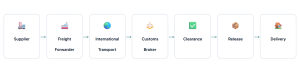
A typical combined workflow looks like this:
Some businesses use separate providers for forwarding and brokerage, which works well with good communication but adds a coordination point. Others use one provider for both, so the handover at step 4 happens internally. Either way, what matters is clear communication and defined responsibility at every stage.
Are you legally required to use a customs broker? Not in every case. Under the Customs Act, the owner of the goods can lodge their own import declaration, and importers can apply for access to the Integrated Cargo System, although there are costs involved. However, the ABF itself encourages first-time or infrequent importers to use a licensed customs broker.
The key point is that the compliance responsibility for an incorrect declaration sits with the importer regardless of who prepared it. That is why most commercial importers, especially first-timers, choose professional help rather than carry that risk alone.
| Importer type | Is professional brokerage typically valuable? | Why |
|---|---|---|
| First-time importer | Very likely | Unfamiliar process and a higher risk of avoidable mistakes |
| Small e-commerce business | Likely | Limited internal resources, and a held shipment can tie up a large share of stock and cash |
| Regular commercial importer | Yes, standard practice | Volume makes accuracy and efficiency valuable, and compliance obligations don't shrink with experience |
| Business importing complex products | Yes | Classification and compliance are more complex |
| Business importing restricted or regulated goods | Strongly recommended | Permit, biosecurity and compliance risk is significant |
| High-volume importer | Yes, usually integral to operations | Consistency across many declarations; one repeated classification error compounds quickly |
| Very simple, low-value, one-off import | Case by case | Some importers manage simple cases themselves |
Professional customs support is likely to be worthwhile if you answer yes to any of these questions:
If you sell online and import stock regularly, our e-commerce logistics service can combine freight, clearance and fulfilment support.
Even experienced business owners make mistakes when they start importing. Here are the most common pitfalls a licensed customs broker helps you avoid:
For more pitfalls beyond customs, see the freight forwarding mistakes importers make in Australia.
There is no single fixed price for customs brokerage in Australia, and any article that quotes one flat number is oversimplifying. Customs broker fees typically depend on:
The cheapest brokerage quote is not automatically the cheapest total import cost. A broker who under-quotes but gets a classification wrong, misses a permit or lodges an incomplete declaration can cost you far more in penalties, storage and delay than a properly resourced broker charging a fair price. Price the service, not just the fee.
Your broker's fee is only one part of your landed cost. A complete picture usually includes several separate components:
| Cost component | What it covers |
|---|---|
| Customs broker fee | The broker's service for classification, declaration and clearance coordination |
| Freight | Sea or air transport from origin to Australia |
| Customs duty | Government charge based on tariff classification, value and origin |
| GST | Calculated on the value of the taxable importation |
| Government charges | Import processing and any product-specific government fees |
| Biosecurity and inspection costs | Costs linked to a DAFF assessment, physical examination or treatment, if required |
| Storage | Terminal or depot storage, particularly if clearance runs beyond the free period |
| Demurrage and detention | Shipping line charges for keeping a container beyond the allowed free time |
| Port and terminal charges | Terminal handling and other destination charges at the port or airport of arrival |
| Delivery | Transport from the port or airport to your final destination |
Seeing these laid out separately makes the point: the broker's fee is often a modest line next to freight, duty and GST, but it is the line that most directly determines whether the rest of the process runs smoothly or expensively.
Brokerage, duty and destination charges vary with your goods, route and service requirements, so treat any figure you see online as a guide only. Request a tailored quote for an estimate based on your actual shipment.
Not all brokers are the same. Evaluate a prospective broker against criteria that actually predict good service, not just a low quote:
Our guide to choosing a customs broker in Australia covers selection in more depth.
These hypothetical examples show how a broker's work plays out in practice. They are illustrations only; every shipment's requirements and outcomes differ.
Without a broker: Alex runs an online fitness brand and imports a large consignment of rubber yoga mats. To save on fees, he lodges the declaration himself and guesses the tariff code, choosing a heading for plastic sporting goods rather than the correct one for the vulcanised rubber product. The code doesn't match his invoice description, the ABF queries the entry and the container is held for examination. Storage charges build, his stock arrives late and he may face a reassessment and penalty.
With a broker: Alex engages a licensed broker before the goods leave the factory. The broker classifies the mats correctly, confirms the duty and GST position and prepares the declaration ahead of arrival. When the ship arrives, the ABF already has accurate data, duty and GST are paid promptly and, unless an inspection is ordered, the container is released without avoidable hold-ups.
Situation: a small business owner orders a shipment of ceramic mugs from overseas and doesn't know what an import declaration is or that GST applies at the border. Broker's role: the broker explains the process, classifies the mugs, prepares the declaration and arranges payment of duty and GST. Lesson: brokers turn a daunting legal process into a manageable one for beginners.
Situation: an online seller imports several pallets of fitness equipment and wants to claim preferential duty under ChAFTA. Broker's role: the broker reviews the certificate of origin, spots an error that would invalidate the claim and asks the seller to obtain a corrected copy from the supplier before the ship arrives. Lesson: proactive document checking protects duty concessions you are entitled to.
Situation: a restaurant wants to import specialty cheeses from Italy, and dairy products are tightly regulated for biosecurity. Broker's role: before the order is placed, the broker checks BICON, advises on the permit and documents required and prepares the paperwork for DAFF so the goods are ready for assessment on arrival. Lesson: checking regulated goods before ordering helps prevent holds, refusals or seizure.
Situation: a manufacturer imports the same machinery parts on a regular schedule and finds the paperwork and upfront GST tie up time and cash. Broker's role: the broker sets up consistent product profiles and classifications for repeat lines and suggests the business check its eligibility for the ATO's deferred GST scheme. Lesson: brokers help regular importers improve consistency, efficiency and cash flow.
A customs broker gets your imported goods legally cleared through the Australian border. They check your documents, classify your goods, work out duty and GST, lodge the import declaration with the ABF, handle any queries from the ABF or DAFF and coordinate the release of your cargo.
Customs broker fees depend on the shipment type, value, complexity, number of tariff lines, permit or biosecurity requirements, whether an inspection occurs and the scope of service. Duty, GST, government charges and destination fees are separate from the broker's own fee. Ask for a quote that shows what is included so you can compare your total landed cost.
A broker can't make a ship sail faster, but by reviewing documents early and preparing the declaration before arrival, they help make sure your goods aren't held up by avoidable paperwork problems once they land. They can't control inspections, port congestion or government processing volumes.
Clearance times depend on the completeness of your documents, the type of goods, whether permits or biosecurity assessment are needed, whether the shipment is selected for inspection and processing volumes at the time. Lodging early with accurate documents gives you the best chance of a smooth clearance. Contact our team for a shipment-specific estimate.
Yes. Under the Customs Act, the owner of the goods can lodge their own import declaration, and importers can apply for access to the Integrated Cargo System, although there are costs involved. However, the ABF encourages first-time or infrequent importers to use a licensed customs broker, and you remain responsible for any errors either way.
Often not. Express courier companies usually arrange customs clearance for the low-value parcels they carry as part of their service. You are more likely to need your own broker for commercial quantities, regulated goods or consignments above the ABF's AUD 1,000 threshold that require a full Import Declaration.
In Australia, "customs broker" is the term for the licensed profession, while "customs agent" and "customs clearance agent" are commonly used to mean the same thing. Whatever term a provider uses, check that a licensed customs broker is handling your declarations.
Under Australia's self-assessment system, the importer is legally responsible for the accuracy of the declaration, including classification and value, even when a broker prepares it. That is why choosing an accurate, experienced broker and giving them complete information matters so much.
Goods may be seized if they are prohibited, counterfeit or seriously misdeclared, or if required permits are missing. If this happens, you or your broker will receive formal notice. Your broker can help you understand why the seizure happened and what options may be available, although a particular outcome can't be guaranteed. Our guide on what happens when customs seizes a shipment explains the process.
At its heart, a customs broker turns a complex legal and regulatory process into something you can manage confidently without becoming a customs expert yourself. From reviewing documents and classifying goods to lodging your declaration and managing communication with the ABF and DAFF, a broker handles the compliance-heavy work between your goods arriving in Australia and actually being in your hands.
What a broker can't do is override government decisions, guarantee inspection-free clearance or promise specific timeframes, and no honest broker will claim otherwise. What a good one can do is greatly reduce avoidable risks and delays, communicate clearly when something needs attention and become a long-term partner in how your business handles international trade.
Getting a shipment through Australian customs cleanly comes down to the same things every time: accurate documentation, correct classification, early preparation and someone who knows what the ABF and DAFF expect to see.
Whether you are bringing in your first shipment, scaling up a regular import program or handling goods with biosecurity or permit conditions, Omega Cargo's team of licensed customs brokers can review your documents, handle classification and lodgement, and coordinate with our sea freight and air freight services so nothing falls into a gap between providers. We recommend speaking with us before you place your order, so duty, documents, permits and treatments can be checked in advance.
Request a quote for your next shipment, or contact our team to talk through your import requirements.


