
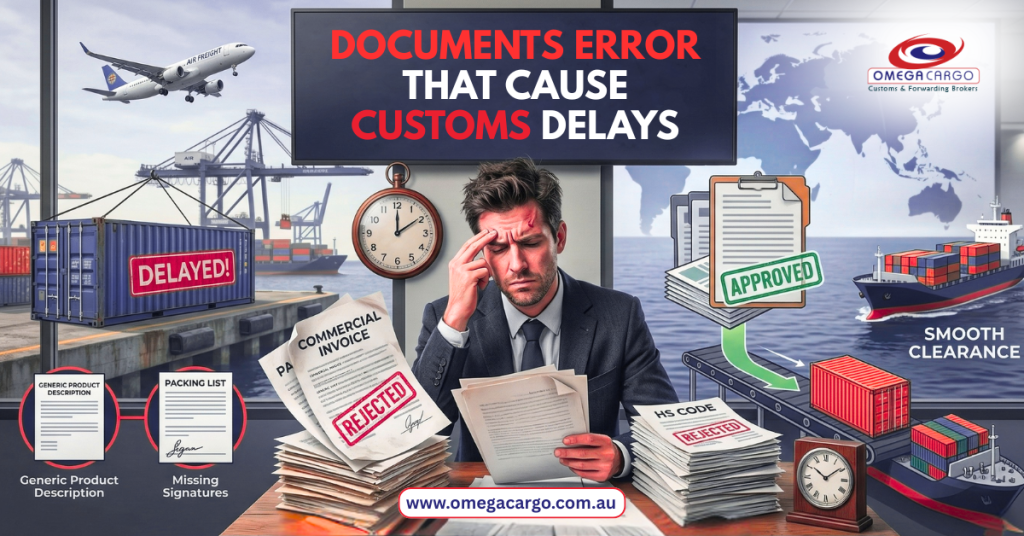
Your container has landed, the freight is paid, and your customers are waiting. So why does the tracking still say “held”?
Most of the time, the answer is paperwork. The documents that cause customs delays are rarely exotic. They are the everyday ones: a commercial invoice missing a field, a packing list that doesn’t match it, a tariff code copied from a supplier’s system, or a certificate that was never requested. Each one gives the Australian Border Force (ABF) or the Department of Agriculture, Fisheries and Forestry (DAFF) a reason to stop and ask a question, and your goods wait while someone finds the answer.
Here’s the part many importers miss: almost every one of those questions could have been answered before the goods left the supplier’s warehouse.
This guide walks you through the 15 documentation errors that hold up Australian imports most often, how customs actually reviews your paperwork, who has to fix each problem, and a stage-by-stage checklist you can use on your next shipment. By the end, you’ll know exactly what to check, when to check it, and when it makes sense to hand the job to a licensed customs broker.
The documents error that cause customs delays in Australia are usually the commercial invoice, packing list, bill of lading or air waybill, import declaration, certificate of origin, import permits and biosecurity documents. Delays happen when one is missing, incomplete, inconsistent with the others, or doesn’t match the goods. Checking every document against the others before dispatch prevents most holds.
Customs clearance is, at its core, a verification exercise. Your paperwork tells the ABF what the goods are, where they came from, who sold them, who bought them, what they’re worth and how they travelled. If those facts are clear and consistent, the declaration can move through quickly. If they aren’t, someone has to stop and check. That’s why the documents that cause customs delays are almost always the ones carrying those core facts.
For Australian importers, the documents serve four jobs at once:
A single weak document can undermine all four. A vague description like “parts”, for example, makes classification guesswork, hides whether a permit is needed, and is a classic risk flag.
There’s no reliable official statistic that measures what share of Australian shipments are delayed by paperwork, so be wary of any article that quotes a precise percentage. What is clear from day-to-day clearance work is that documentation problems are among the most frequent, and most preventable, causes of holds. Inspections and random checks can happen to anyone. Paperwork errors are largely within your control. For the wider picture beyond paperwork, including inspections, unpaid duty and port congestion, see our guide to why customs clearance is delayed in Australia.
The cost of a paperwork hold isn’t a fixed number. It depends on:
That’s why a shipment-specific landed-cost view is more useful than any average. It shows you which of these risks actually applies to your goods.
Knowing what happens after lodgement helps you see why small errors matter.
Imports valued over AUD 1,000 are cleared on a Full Import Declaration, commonly called the N10 Import Declaration. Lower-value air and sea cargo generally uses a Self-Assessed Clearance (SAC) declaration, although there are exceptions, such as tobacco and alcohol, and goods that need a permit. Declarations are lodged electronically through the ABF’s Integrated Cargo System (ICS), usually by a licensed customs broker. The ABF import declaration page sets out which declaration applies.
The declaration data is screened against risk profiles. If the description, value, origin, tariff code and parties make sense together, the goods can be cleared without further intervention.
If something doesn’t line up, or a consignment is selected for a compliance check, an officer may ask for supporting documents, typically the commercial invoice, transport document, packing list, permits or proof of payment. This is where a hold begins. The clock on your goods effectively pauses until the officer receives a satisfactory answer.
In practice, these are the patterns that most often invite questions:
DAFF assesses biosecurity risk alongside, but separately from, the ABF’s customs assessment. Paid duty and GST don’t release goods that DAFF still needs to inspect. Timber packaging, container cleanliness, plant and animal products, and goods subject to seasonal pest measures all depend on the right biosecurity statements or certificates being available.
When a document is rejected or a query is raised, your broker receives the request and has to obtain the correct information, usually from your supplier, the carrier or you. The goods aren’t released until the issue is resolved and, where needed, the declaration is amended. For a deeper look at what happens if goods are selected for examination, see our guide to the customs inspection process in Australia.
Below are the 15 errors that hold up Australian imports most often. For each one, you’ll see what goes wrong, why it delays clearance, and how to prevent it.
What goes wrong: No invoice is supplied, or it’s missing key details such as the seller and buyer, item-level descriptions, unit prices, currency or Incoterms. A proforma invoice is sent instead of the final commercial invoice.
Why it delays clearance: The invoice is the primary evidence of what was bought and for how much. Without it, the broker can’t accurately complete the declaration’s value and description fields.
How to prevent it: Give your supplier a written invoice checklist (see the section below) and make a compliant invoice a condition of shipment.
What goes wrong: Carton counts, gross and net weights or quantities don’t match the invoice. Contents per package aren’t shown. Packaging materials aren’t described.
Why it delays clearance: Officers use the packing list to find and check goods during an examination. DAFF also relies on packaging information, and its required packaging statements are often printed on the packing list.
How to prevent it: Cross-check the packing list line by line against the invoice before the goods are dispatched.
What goes wrong: The supplier’s export code is reused, several different products are grouped under one code, or a “parts” code is used for a complete item.
Why it delays clearance: Classification decides the duty rate and whether restrictions apply. A code that doesn’t fit the description invites reclassification and possible duty adjustments.
How to prevent it: Have the goods classified against the Australian tariff, not the supplier’s, before you order. For new or tricky products, consider ABF Tariff Advice (more on that below).
What goes wrong: The consignee or notify party is wrong, the cargo description is incomplete, container or seal numbers don’t match, or the house and master bills don’t line up.
Why it delays clearance: The transport document links the physical cargo to the declaration. If the details don’t match, the cargo report and declaration can’t be reconciled cleanly.
How to prevent it: Ask for the draft bill before it’s issued and check every field against the invoice and packing list.
What goes wrong: A preferential duty rate is claimed but the certificate of origin or origin declaration is missing, in the wrong form for that agreement, unsigned, or doesn’t cover the goods.
Why it delays clearance: Without valid proof of origin, the preference can’t be supported. You may have to pay the general rate and claim a refund later, or amend the declaration.
How to prevent it: Confirm which form of proof the relevant FTA accepts and ask your supplier for it when you place the order, not after dispatch.
What goes wrong: The goods need a DAFF biosecurity import permit or another agency’s permission, and it hasn’t been obtained, has expired, doesn’t cover the product, or its conditions haven’t been met.
Why it delays clearance: Permits usually can’t be fixed quickly. DAFF states that goods arriving without a required permit won’t be cleared and must be re-exported or destroyed.
How to prevent it: Check BICON and the relevant agency’s rules before you commit to the purchase.
What goes wrong: Values, quantities, origin or codes on the declaration don’t match the commercial documents, or mandatory fields are left blank.
Why it delays clearance: The declaration is your legal statement to the ABF. Inconsistencies invite queries, and false or misleading statements can attract penalties under the Customs Act.
How to prevent it: Give your broker complete, final documents and review the declaration before lodgement when you can.
What goes wrong: Lines read “accessories”, “samples”, “parts” or “general merchandise”, with no material, model, function or end use.
Why it delays clearance: Officers can’t classify or risk-assess what they can’t identify. Vague descriptions are one of the most common reasons a broker or officer has to go back to the supplier.
How to prevent it: Describe every line by what it is, what it’s made of, and what it does.
What goes wrong: The declared value is lower than the price actually paid, currency isn’t stated, discounts aren’t explained, or extra payments to the seller aren’t declared.
Why it delays clearance: The ABF values most imports on the price actually paid or payable, with adjustments. A value that doesn’t reconcile with payment records invites an investigation.
How to prevent it: Declare the real transaction price and keep proof of payment on file.
What goes wrong: Timber packaging lacks a valid ISPM 15 mark or treatment certificate, packaging statements are missing, a treatment certificate doesn’t match the consignment, or a phytosanitary or veterinary certificate is absent.
Why it delays clearance: DAFF may direct inspection, treatment, re-export or destruction until the risk is addressed.
How to prevent it: Confirm biosecurity requirements in BICON and get the right statements and certificates from your supplier before loading.
What goes wrong: The invoice says one quantity, the packing list another, and the bill of lading a third. Names, addresses or descriptions vary slightly between documents.
Why it delays clearance: Every mismatch is a question that needs answering, and officers can’t assume which version is right.
How to prevent it: Generate all documents from one source of data and compare them side by side before dispatch.
What goes wrong: Therapeutic goods aren’t on the Australian Register of Therapeutic Goods (ARTG), electrical and radio equipment lacks compliance evidence, or chemical products aren’t covered by the importer’s registration.
Why it delays clearance: Regulated goods may be held or refused until the relevant agency’s requirements are met, and some can’t be supplied in Australia at all without approval.
How to prevent it: Research product-specific rules before ordering (see the product table below).
What goes wrong: Handwritten invoices, poor scans, cut-off pages, faded copies or documents with corrections written over the top.
Why it delays clearance: If an officer or broker can’t read a value or description with confidence, it can’t be relied on.
How to prevent it: Ask for typed, complete PDFs from the supplier’s system, with all pages included.
What goes wrong: Documents that need signing aren’t signed, origin declarations lack the required certification, or your broker doesn’t hold your authority to act.
Why it delays clearance: Unsigned or unauthorised documents may not meet the requirements they’re meant to satisfy.
How to prevent it: Know which documents need a signature for your goods and agreement, and set up your broker authority before the first shipment.
What goes wrong: The importer’s name or ABN is wrong, the supplier’s name differs from the payee, or contact details are missing.
Why it delays clearance: Customs needs to know exactly who owns the goods and who sold them. Mismatched parties also complicate GST credits and later audits.
How to prevent it: Give your supplier your exact legal entity name, ABN and delivery address, and check them on every draft.
Not all documents that cause customs delays are equal. The table below ranks them by how hard they usually are to fix after the goods arrive, and who typically has to fix them. That second column is often what decides how long your goods sit.
| Error | Who usually has to fix it | How hard to fix after arrival | What drives the delay | Impact |
| Missing import permit or approval | Importer and government agency | Very hard — may not be fixable | Whether a permit can be issued at all, or re-export is required | High |
| Missing or invalid biosecurity documents | Supplier and DAFF | Hard | Inspection, treatment availability, re-export | High |
| Missing product safety or regulatory evidence | Importer and regulator | Hard | Whether the product can be approved or must be refused | High |
| Wrong tariff classification | Broker and importer | Moderate | Reclassification, duty adjustment, possible review of past entries | Medium–High |
| Undervalued or incorrectly valued goods | Importer and supplier | Moderate | Evidence of payment, valuation review | Medium–High |
| Missing or invalid proof of origin | Supplier | Moderate | Supplier response time, agreement rules | Medium |
| Inconsistent information across documents | Supplier and forwarder | Moderate | Which document is correct, reconciliation | Medium |
| Incomplete commercial invoice | Supplier | Easy to moderate | Supplier response time and time zone | Medium |
| Bill of lading or air waybill errors | Carrier or forwarder | Moderate | Carrier amendment process | Medium |
| Incorrect import declaration | Broker | Easy to moderate | Quality of the underlying documents | Medium |
| Vague product descriptions | Supplier | Easy | How quickly detail can be provided | Low–Medium |
| Incorrect or missing packing list | Supplier | Easy | Supplier response time | Low–Medium |
| Incorrect importer or supplier details | Importer and supplier | Easy | Whether entity details need verifying | Low–Medium |
| Missing signatures or authorisations | Supplier or importer | Easy | Who needs to sign and where they are | Low |
| Handwritten or illegible documents | Supplier | Easy | Resending a clear copy | Low |
The pattern is clear: anything that depends on a government approval is the slowest to fix, and anything that depends on a supplier overseas is only as fast as their reply.
The commercial invoice drives description, value and origin, so it’s worth getting right every time. The ABF uses the price actually paid or payable as the starting point for value, which means your invoice needs to show that price clearly.
Ask your supplier to include:
If you’re unsure what the Incoterm on your invoice means for value and responsibility, our Incoterms guide explains each one.
| Poor description | Better description |
| Electronic parts | Replacement LCD display screens for mobile phones, glass and plastic assembly, model XYZ-62, 100 pieces |
| Clothing | Men’s knitted T-shirts, 100% cotton, short sleeve, sizes S–XL, 240 pieces |
| Samples | Unassembled stainless-steel kitchen tap samples for product evaluation, 6 pieces, not for resale |
| Parts | Brake pads for passenger cars, ceramic compound, model BP-210, 50 sets |
A good description answers four questions: what is it, what is it made of, what does it do, and how many are there?
The packing list is the map officers use to find goods in a container. It should show:
For containerised sea cargo, DAFF requires certain non-commodity statements about packaging and the container. Under DAFF’s non-commodity documentary policy, these cover:
These statements are commonly provided on a packing declaration, but DAFF accepts them on the packing list or invoice too. What matters is that they’re present, accurate, and issued by the party that packed the goods. A missing or contradictory statement is one of the most common reasons a container is referred for inspection.
Australian tariff classifications and duty rates are set out in Schedule 3 of the Customs Tariff, which is based on the World Customs Organization’s Harmonized System. On an import declaration, goods are classified with an 8-digit tariff classification plus a 2-digit statistical code.
Have a licensed customs broker classify new products before you buy, and keep a classification record for each product you import regularly. For goods where the answer isn’t obvious, you can apply for ABF Tariff Advice. A Tariff Advice applies to a specific good from a specific manufacturer, and once issued it must be followed when those goods are imported. It isn’t designed for goods already waiting for clearance, so apply well before shipping.
Our HS code and tariff classification guide and the customs tariff resource page go deeper on how classification works.
Valuation errors often come from misunderstanding what the customs value includes.
So an invoice that bundles freight into the product price, or leaves out a separate payment to the seller, can push the declared value in the wrong direction. The ABF can’t accept a transaction value where a relationship between buyer and seller has influenced the price, which is something related-party importers need to manage carefully.
If you’re GST-registered, it’s worth asking your broker or accountant whether the ATO’s deferred GST scheme suits your business. Our duty calculation guide walks through how duty is worked out.
Australia’s free trade agreements can reduce or remove duty, but only when you can support the claim. The key point is that proof of origin differs between agreements:
Whatever the agreement, you need the origin documentation at the time the goods are entered, and the goods must meet the agreement’s rules of origin and transhipment requirements.
For a full rundown of which agreements may apply to your goods, see our guide to free trade agreements for Australian importers.
Missing permits and approvals cause the longest and least predictable delays, because the fix often sits with a government agency rather than your supplier. Under the ABF’s prohibited goods rules, many restricted goods can only be imported with written permission.
| Product type | Who regulates it | What you typically need |
| Food, plants, animal products, seeds, soil-risk goods | DAFF | Check conditions in BICON; some goods need a biosecurity import permit and certificates |
| Medicines, supplements, medical devices | Therapeutic Goods Administration (TGA) | Generally, goods must be on the ARTG before commercial import, unless exempt (TGA guidance) |
| Electrical, radio and telecommunications equipment | Australian Communications and Media Authority (ACMA) | Compliance records and labelling, typically the Regulatory Compliance Mark (RCM) (ACMA labelling rules) |
| Industrial chemicals, including those in products such as cosmetics | Australian Industrial Chemicals Introduction Scheme (AICIS) | Your business may need to register (AICIS registration) |
| Firearms, parts and ammunition | ABF, state and territory police, Department of Home Affairs | Permission under the Customs (Prohibited Imports) Regulations 1956, for example police certification on form B709A for some categories (ABF firearms page) |
| Wildlife products and CITES-listed species (including some timbers, shells and coral) | Department of Climate Change, Energy, the Environment and Water (DCCEEW) | CITES export permit from the origin country and an Australian wildlife trade import permit, depending on the listing (DCCEEW CITES guidance) |
A note on electrical goods: an overseas mark such as CE or FCC doesn’t, on its own, allow the product to be supplied in Australia. If you’re importing in these categories, our guides to importing electronics and importing cosmetics cover the details.
Australia’s biosecurity rules are strict, and biosecurity paperwork is among the documents that cause customs delays most often, even though the hold itself comes from DAFF rather than the ABF. The common document checks are:
DAFF also publishes minimum documentary requirements for documents presented for biosecurity assessment, which is a useful reference to share with suppliers.
The core documents are similar across modes, but each has its own pressure points.
| Shipment type | Main transport document | Common document problems |
| Sea freight FCL | Ocean bill of lading (house and master) | Container and seal numbers, packaging and cleanliness statements, BMSB seasonal measures |
| Sea freight LCL | House bill of lading | Consolidator details, package marks, packaging statements for shared containers |
| Air freight | House and master air waybill | Descriptions on the air waybill, dangerous goods declarations, lithium battery paperwork |
| Express courier | Courier waybill | Vague declared descriptions and values, missing invoices on low-value goods |
| Personal effects | Bill of lading or air waybill | Inventories, ownership and use declarations, biosecurity items such as outdoor gear |
For lower-value imports, remember the declaration type changes at the AUD 1,000 threshold. Goods that need a permit still have to be declared appropriately, whatever their value.
Most documents now move electronically, which speeds things up only if the files are usable:
After an import declaration is made, the ABF requires you to keep all relevant documents for five years, so a tidy digital file per shipment also protects you in any later audit.
If your goods are held because of paperwork, move quickly and work through these steps:
Sometimes you discover an error after goods have been cleared. The ABF’s voluntary disclosure process lets you correct it by amending the declaration in ICS or by writing to the ABF. A full, voluntary disclosure can protect you from the false or misleading statement offences, but that protection is lost if you wait until after the ABF has issued a verification notice or started action. If an error has resulted in an underpayment, speak to your broker promptly.
If goods have been seized rather than held, our guide on what happens when customs seizes a shipment explains the next steps.
Most problems with the documents that cause customs delays are quicker and cheaper to fix the earlier you find them. Use this checklist at each stage of the shipment.
| Stage | What to check | Who to involve |
| Before you order | Tariff classification, permits and approvals, BICON conditions, FTA eligibility, product compliance (TGA, ACMA, AICIS) | Broker, regulator websites |
| When you place the order | Invoice requirements, description standard, Incoterms, packaging and timber rules, proof-of-origin form | Supplier |
| Before dispatch | Draft invoice, packing list and bill of lading cross-checked; packaging statements and certificates ready; BMSB measures checked if applicable | Supplier, forwarder |
| While in transit | All documents sent to the broker; declaration prepared and checked; permits attached | Broker |
| On arrival | Queries answered quickly; storage and container deadlines tracked | Broker, forwarder |
| After clearance | Records filed for five years; errors corrected through voluntary disclosure if found | Importer, broker |
Before you approve dispatch, place the invoice, packing list and draft bill of lading side by side and confirm these match exactly:
If any line differs, fix it before the goods leave. It takes minutes at origin and can take far longer at an Australian port. Our guide on how to speed up customs clearance in Australia covers more ways to keep clearance moving.
These are hypothetical scenarios that show how common errors develop. They aren’t real customer cases.
Example 1 — the mismatched carton count. An importer brings in a 20ft container of homewares from China. The invoice shows 640 cartons, the packing list 652 and the bill of lading 640. The broker spots the gap before lodgement and asks the supplier, who confirms 12 cartons of free display stands were added. A corrected invoice and packing list are issued while the vessel is still at sea, and the declaration is lodged with matching documents. Lesson: a pre-arrival check turns a potential hold into a routine fix.
Example 2 — the supplier’s tariff code. An importer of LED lighting components uses the HS code printed on the supplier’s invoice. After lodgement, the ABF queries whether the goods are complete luminaires rather than parts. The classification is reviewed, duty is adjusted, and the importer reviews earlier shipments of the same product. Lesson: classify against the Australian tariff, and consider Tariff Advice for products you import repeatedly.
Example 3 — the unmarked pallets. A machinery shipment arrives on timber pallets without a visible ISPM 15 mark, and no treatment certificate was supplied. DAFF directs the packaging for inspection and treatment before the goods can be released. Lesson: confirm timber packaging compliance with your supplier before loading, especially for heavy goods that are often palletised or crated.
In Australia, only the owner of the goods or a customs broker licensed by the ABF can submit an import declaration, and the ABF encourages first-time or infrequent importers to use a licensed broker. A broker’s value is less about filling in forms and more about catching problems in the documents that cause customs delays before they reach the border: classification, valuation, origin claims, permits and biosecurity statements. If you want to know more about the role, read what a customs broker does.
Regular importers with a strong compliance record may also want to look at the ABF’s Australian Trusted Trader program, which offers trade facilitation benefits to accredited businesses.
At Omega Cargo, our licensed customs brokers handle customs and quarantine clearance for air, sea and courier imports, with teams across Perth, Fremantle, Sydney, Melbourne, Brisbane and Adelaide. We can also give pre-purchase advice on duty, documents, prohibited goods, overseas treatments and import permits, which is exactly where most document delays can be prevented.
Most commercial imports need a commercial invoice, packing list, and a bill of lading or air waybill, which a customs broker uses to lodge the import declaration. Depending on the goods, you may also need proof of origin for an FTA claim, import permits, biosecurity certificates or packaging statements, and product approvals from agencies such as the TGA or ACMA.
Customs documents cause delays when officers can’t verify what the goods are, what they’re worth, where they came from or whether they’re safe. Missing documents, vague descriptions, inconsistent figures between documents and missing permits all force an officer to stop and request more information before the goods can be released.
If an import declaration is wrong, the ABF may query it, hold the goods or require an amendment, and duty or GST may be adjusted. False or misleading statements can attract penalties under the Customs Act. If you find an error yourself, correcting it through the ABF’s voluntary disclosure process is treated more favourably than waiting for the ABF to raise it.
Of all the documents that cause customs delays, missing import permits, biosecurity documents and product approvals usually hold goods the longest, because the fix depends on a government agency and sometimes can’t be made at all. Supplier documents such as invoices and packing lists are usually quicker to correct, but they still hold goods until a compliant version arrives.
There’s no standard duration. It depends on what’s missing, who has to supply it, how quickly they respond, and whether the problem triggers an inspection, treatment or reclassification. A missing signature can be resolved much faster than a missing permit. Lodging complete documents before arrival is the most reliable way to avoid a delay in the first place.
Yes, most document errors can be corrected after arrival by supplying the right document and, where needed, amending the declaration. The catch is that your goods usually wait while it happens, and storage or container charges may build up. Some problems, such as a missing biosecurity import permit, can’t be fixed after arrival and may lead to re-export or destruction.
A handwritten invoice isn’t automatically invalid, but it’s a common cause of queries because it’s harder to read, easier to alter and often missing required details. A typed commercial invoice generated from the supplier’s system, with complete item-level detail and a clear value, is far less likely to be questioned.
It means an officer is checking your supporting documents against the declaration, either because the system flagged a risk or the consignment was selected for a compliance check. Your broker may be asked to provide the invoice, packing list, transport document, permits or proof of payment. Responding quickly with clear, consistent documents is the best way to shorten the review.
No. Proof of origin is needed when you claim a preferential duty rate under a free trade agreement. The form of proof depends on the agreement: some require a certificate of origin from an authorised body, while others accept a declaration of origin. Without valid proof, you can’t support the preferential rate.
The ABF requires importers to keep all relevant documents for five years after an import declaration is made. That includes invoices, transport documents, proof of payment, permits and origin documentation, whether you lodged the declaration yourself or a customs broker lodged it for you.
No. The ABF handles customs requirements such as duty, GST and prohibited goods, while DAFF handles biosecurity. Your goods need clearance from both before they can be released. Paying duty and GST doesn’t release goods that DAFF still needs to inspect, treat or assess.
A customs broker can spot errors, explain what’s needed and correct the declaration, but can’t create or alter your supplier’s commercial documents. A corrected invoice, certificate of origin or treatment certificate has to come from the party that issued it, which is why checking documents before dispatch matters so much.
Before your next shipment leaves origin, make sure you can tick every item:
The documents that cause customs delays are predictable, which is good news. Once you know where errors come from, you can catch them at origin, where they’re quickest and cheapest to fix.
Not sure whether your paperwork is ready? Send us your supplier’s draft invoice, packing list and product details, and our licensed customs brokers can review them before your goods leave origin, flag what’s missing, and advise on permits, classification and biosecurity requirements. Have your supplier’s country, the product description and the shipping mode ready.
Request a customs clearance quote or contact our customs team to get started.
This guide is general information only. Customs, biosecurity and regulatory requirements can change, so confirm current requirements with your customs broker, the ABF or the relevant agency before you ship.


