
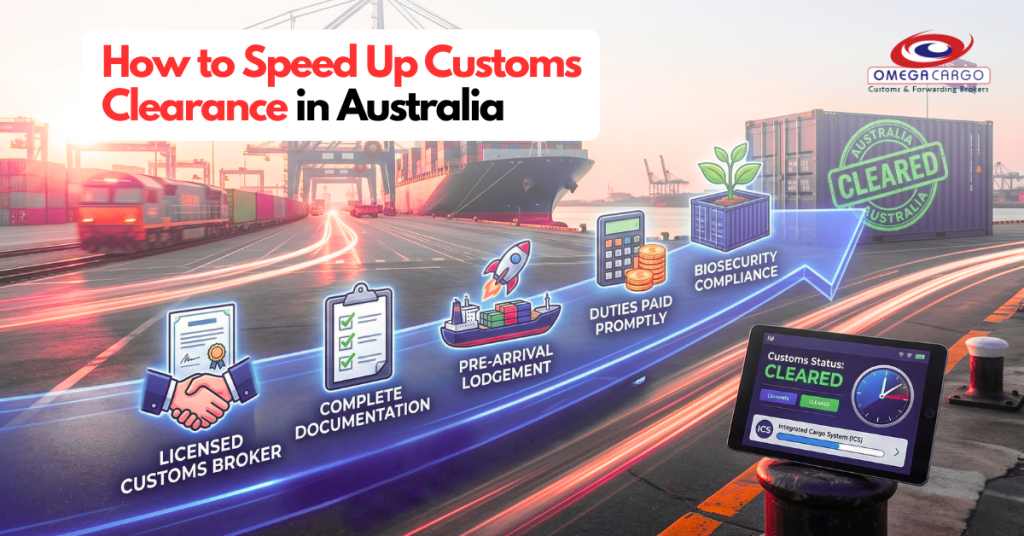
Few things are more frustrating than knowing your cargo has landed but cannot leave the port. Stock sits idle, customers wait, and storage charges can start to build up. The good news is that most border holds are avoidable. If you want to know how to speed up customs clearance in Australia, the answer comes down to preparation: accurate paperwork, correct classification, early lodgement and a clean compliance record.
Whether you import commercial stock, sell online or are waiting on a personal shipment, this guide shows you what slows the customs clearance process and what you can do about it.
You will find 15 practical tips used by experienced importers and customs brokers, a documents checklist, biosecurity advice, guidance for specific industries and ports, and clear steps to follow if your shipment is already stuck. No tip can promise a particular clearance time, because the Australian Border Force (ABF) and the Department of Agriculture, Fisheries and Forestry (DAFF) decide when goods are released. What you can control is how ready your shipment is when it reaches them.
Before you can speed up customs clearance, it helps to understand what the process involves and who is responsible for each step. For a full walk-through, see our customs clearance step-by-step guide.
Customs clearance is the mandatory process of getting imported goods approved to enter Australia (or exported goods approved to leave). For imports, it means lodging the right declaration, paying any duty and taxes that apply, and showing that your goods meet Australia's safety, security and biosecurity rules.
Australian customs clearance runs through the Integrated Cargo System (ICS). Carriers report the cargo, and your customs broker lodges the import declaration electronically. The system then assesses risk, calculates duty and GST, and flags whether the goods need a document check, an inspection or a biosecurity referral. Once everything is in order and payments are made, the goods receive a clear status and can be released.
The ABF manages the customs side of the border. Its job is to support legitimate trade while stopping illegal, dangerous or non-compliant goods. DAFF manages biosecurity, checking goods, packaging and containers for pests, diseases, soil and other contamination. Many shipments need clearance from both. Working with their requirements, rather than against them, is the real secret to fast customs clearance.
There is no single clearance time that applies to every shipment. A simple, well-documented consignment can move through quickly, while a shipment with missing paperwork, an inspection or a biosecurity issue can be held for much longer. Timing depends on these factors:
| Factor | How it affects clearance timing |
|---|---|
| Transport mode | Express courier, air freight and sea freight each follow different reporting, handling and release steps. Sea freight usually involves more physical handling at the port and depot. |
| Documentation quality | Complete, consistent documents let the declaration move through without queries. Errors and gaps trigger manual review. |
| Type of goods | Food, plant and animal products, chemicals, pharmaceuticals, vehicles and other regulated goods attract more checks. |
| Biosecurity status | Goods that need DAFF assessment, treatment or inspection have an extra clearance step. |
| Permits | Goods that need an import permit cannot be released until a valid permit is in place. |
| Inspection selection | Shipments selected for X-ray or physical examination must wait for the inspection, plus any unpacking and repacking. |
| Payment of duty and GST | Goods are not released until the assessed duty and taxes are paid or properly deferred. |
| Arrival timing and volume | Weekends, public holidays and peak trade periods can slow manual processing, terminal work and depot handling. |
| Importer history | New importers and those with past compliance issues may face more scrutiny than regular, compliant importers. |
Because every shipment is different, any clearance estimate should be treated as a guide only. For a shipment-specific estimate, contact our team with your cargo details. If your goods are already held, our guide to how long customs can hold a package explains what affects the length of a hold.
Understanding the reasons behind the wait makes it easier to see where you can save time:
If your cargo is stuck in customs, one of these causes is usually to blame. Our guide to common customs clearance delays in Australia covers each one in more depth.
| Cause | What goes wrong | How to prevent it |
|---|---|---|
| Incomplete or incorrect documents | Missing invoices, unclear packing lists, or names, quantities and values that do not match | Check every document against the others before the goods are shipped |
| Missing import permits | Restricted goods arrive without the required approval | Check permit requirements and apply well before shipping |
| Biosecurity concerns | Dirty containers, soil, pests or timber packaging without ISPM 15 treatment marks | Brief your supplier on Australian biosecurity rules and packaging standards |
| Incorrect classification | The wrong tariff code leads to the wrong duty and possible penalties | Have goods classified by a licensed customs broker before they ship |
| Unpaid duty or GST | Goods are not released until the assessed amounts are paid | Budget for duty and GST and pay as soon as you receive the advice |
| Security or compliance flags | The origin, supplier or shipping pattern triggers further checks | Use reputable suppliers and keep your declarations consistent |
| Physical inspection | The shipment is selected at random or because something looks unusual | Pack and label goods so they are easy to inspect |
| Weekend or holiday arrival | Manual processing, inspections and depot work may not happen until the next business day | Plan arrivals and paperwork around business days where you can |
| High-volume periods | Peak seasons cause congestion at ports, terminals and depots | Ship earlier and lodge your paperwork early in peak periods |
| First-time importer status | The ABF has no history for you, so your shipment may face more scrutiny | Make your first shipments especially accurate and well documented |
Many delays start with simple paperwork mistakes. See our article on the document errors that cause customs delays for real-world examples.
These 15 strategies are the habits that help importers avoid holds. None of them can force a release, but together they remove the most common reasons a shipment gets stopped.
If one step makes the biggest difference, it is using a licensed customs broker. Brokers know what the ABF and DAFF expect to see, lodge declarations electronically through the ICS and catch vague descriptions, inconsistent values and classification problems before customs does. Fees vary with the shipment and the services you need, but avoiding a single hold and its storage charges usually makes professional help good value. The broker section below explains more.
Learn more about what a customs broker does, or see our customs and quarantine clearance services.
Customs clearance documents are the foundation of every import. Before your goods leave the origin port, confirm that your commercial invoice, packing list and bill of lading or air waybill are complete and consistent, and that any certificate of origin, import permit, treatment certificate or test report your goods need is ready. Use the full checklist in the documents section below every time you ship.
Your tariff classification decides the duty rate, whether concessions apply and whether permits are needed. The international Harmonized System uses six-digit codes, and Australia's tariff extends these to eight digits, plus a two-digit statistical code.
If you pick a code with a lower duty rate and customs decides another code applies, you can face delays, extra duty and penalties. Our customs tariff and product classification guide explains the process in detail.
Some goods, such as certain chemicals, vehicles, foods, plant and animal products, firearms and other regulated goods, need a permit or approval before import. Processing times vary by agency and product, so apply well before your goods are shipped, never after they arrive, and give your broker the permit numbers for your declaration. The permits section below explains where to apply.
Ask your supplier to make sure containers and goods are free of soil, seeds, insects and plant material, that any required fumigation or heat treatment is done before shipment, and that a packing declaration and treatment certificates are supplied where needed. Even a small amount of soil can lead to a cleaning direction, extra costs and a longer hold. Check the import conditions for your goods in DAFF's BICON database, and see the biosecurity section below for more detail.
You do not have to wait for the vessel or aircraft to arrive before starting the paperwork.
If you want quick customs clearance in Australia, your paperwork needs to be complete and consistent. Use this checklist.
Tip: Make sure all documents are in English, legible and consistent. If your invoice says 100 cartons and your packing list says 101, expect questions before your goods are released.
You might ask whether you really need a broker for fast customs clearance. For most commercial imports, the answer is yes. A licensed customs broker acts as your representative with the Australian Government. They prepare and lodge your declaration through the ICS, classify your goods, calculate duty and taxes, and deal with customs and biosecurity queries on your behalf. If you are comparing providers, see our guide to choosing a customs broker in Australia.
Experienced brokers review your documents before the government sees them, classify goods correctly the first time and know which free trade agreements and concessions may apply, which can reduce the duty you pay. A self-lodged clearance often takes longer because of unfamiliar systems, questions and corrections. For food, plant products and other biosecurity-sensitive goods, a broker who understands DAFF requirements is especially valuable.
Broker fees depend on the type of goods, the number of tariff lines, documentation and permit requirements, biosecurity involvement and any extra services. Compared with the storage and demurrage charges that can build up while cargo is held, a broker is usually well worth it, especially for commercial imports, high-value shipments, regulated or biosecurity-sensitive goods, and first-time imports.
Australia's geographic isolation means a single exotic pest can do serious damage to agriculture and the environment. Biosecurity is often where avoidable delays happen.
DAFF, whose border biosecurity role was once carried out by the former AQIS, works alongside the ABF and focuses on pests, diseases and contamination. Check the import conditions for your goods in BICON before you buy.
Ask your overseas supplier to sweep and inspect the container before loading. Soil or contamination on or in a container can lead to a mandatory cleaning direction.
Where required or practical, have goods inspected and certified in the country of origin before they are shipped.
DAFF applies seasonal measures for brown marmorated stink bug (BMSB). Under the current DAFF rules, these apply to targeted goods manufactured in or shipped from target risk countries and shipped between 1 September and 30 April (inclusive). Affected goods may need approved treatment by an approved offshore provider. Check the DAFF BMSB seasonal measures page for the current dates, target countries and goods before you ship.
Keep soil, plant material and insects out of your shipments, including on used machinery and vehicles.
Timber pallets, crates and dunnage usually need to be treated and marked to the ISPM 15 international standard. Untreated or unmarked timber may need to be treated, exported or destroyed at your expense.
Do not let a missing permit hold up your clearance.
Common examples include vehicles, many foods, plant and animal products, some chemicals and certain regulated goods. Goods with an asbestos risk, such as some brake pads and gaskets, also need extra care, because Australia prohibits the import of goods containing asbestos.
Apply through the relevant government agency, for example DAFF (via BICON) for biosecurity permits or the Department of Infrastructure for road vehicle approvals. The ABF's prohibited and restricted goods information is a good starting point.
Permit processing times vary by agency, product and how complete your application is. Apply well before your cargo is shipped, never once it is already on the water.
Some agencies may offer priority or fast-track processing for an extra fee. Check directly with the relevant agency.
Gather technical specifications, safety data sheets (SDS) and lab reports before you apply to avoid back-and-forth requests.
If your status shows a customs hold, do not panic. Follow these steps. Our guide to a consignment held by customs has more detail.
Use your tracking number and find out who has the goods. Is the hold with the ABF, DAFF or the terminal? Knowing that is step one.
This is where a broker earns their fee. Your broker can check the entry in the ICS and tell you exactly what is holding it up.
If you lodged the entry yourself, contact the ABF or DAFF directly, and be prepared for a wait.
If customs asks for more information, reply as quickly as possible. If they need a corrected invoice, ask your supplier for it straight away.
Give a complete answer the first time. If customs asks what a product is made of, send the safety data sheet, product brochure and photos.
If the hold is caused by a valuation or classification dispute, ask your broker about paying the assessed amount under protest so the goods can be released while the dispute is resolved, then seeking a refund if you are successful.
You can ask for a review of many customs decisions. Where possible, secure the release of your goods first so storage charges do not keep building while the review runs.
How you ship affects how your goods are reported, handled and cleared. Here is how the main shipment types compare.
Air cargo volumes are smaller than sea cargo volumes, and air waybill data reaches the ICS quickly. With pre-arrival lodgement and complete documents, air freight is generally the quicker way through the border, although biosecurity checks and inspections still apply. Learn more about our air freight services.
Container cargo involves more physical handling. The container is discharged, moved through the terminal and, for LCL shipments, unpacked at a depot. That handling, plus the higher biosecurity exposure of containers and timber packaging, means sea freight clearance usually involves more steps. Pre-lodging the entry still makes a real difference. See our sea freight services.
Express couriers run their own streamlined clearance processes for the parcels they carry, and many lower-value consignments clear through simplified reporting. Higher-value or regulated goods still need a full import declaration and any permits, so a courier label does not guarantee a quick release.
Personal effects, such as household goods when you move to Australia, have their own rules and concessions, but they are still checked closely for biosecurity risks. Commercial goods are assessed more closely for correct valuation, classification and payment of duty and GST.
Under current ABF rules, an Import Declaration is required when a consignment has a combined value of over AUD 1,000 and is being cleared into home consumption. For most goods valued at AUD 1,000 or less, there are no duties, taxes or charges to pay at the border, although some goods, such as tobacco and alcohol, are taxed regardless of value. Under ATO rules, GST on many low-value goods sold to Australian consumers is collected by the overseas seller at the point of sale.
These thresholds and exceptions can change, so confirm the current rules on the ABF import declarations page before you ship.
Delays cost money, so it helps to know which charges can apply and what makes them bigger or smaller. Every shipment is different, so treat this as a list of cost categories rather than a price guide.
Broker fees depend on the complexity of your goods, the number of tariff lines, whether permits or biosecurity processing are involved and what extra services you need. Ask for a quote based on your actual shipment.
Customs duty depends on the tariff classification of your goods, their customs value and their country of origin. Free trade agreements can reduce or remove duty on eligible goods if you hold valid origin documentation, and some goods are duty-free under the tariff or a concession.
The ABF explains that, under the GST Act, GST on taxable importations is 10% of the value of the taxable importation. That value is made up of the customs value of the goods, any duty payable, and the cost of transporting and insuring the goods to Australia. Check the ABF's GST and other taxes page for the current rules before you budget.
If DAFF needs to assess, inspect or treat your goods, fees and charges may apply. The amount depends on the type of service, how long it takes and where it happens.
This is where delays really hurt. Terminals and depots usually allow a limited free storage period, after which storage charges apply. Shipping lines may also charge demurrage on containers held at the terminal and detention on containers kept too long before they are returned. The free period and the charges depend on the terminal, depot, shipping line and your contract, which is why fast clearance matters financially.
Forwarders, shipping lines and terminals may charge for document handling, delivery orders and other local services. Ask your forwarder for a full breakdown of the local charges that may apply to your shipment.
Want a clearer picture of your landed cost? Request a tailored quote with your cargo details and our team will explain the charges that apply.
Good information keeps your clearance moving. These tools help you spot problems early:
The ABF uses profiling to decide which shipments need a closer look. Avoid these red flags where you can.
Descriptions such as "items", "goods" or "gifts" make it hard to assess a shipment and greatly increase the chance of questions or an inspection.
A declared value far below what the goods are obviously worth, such as a new commercial appliance listed at a token price, is likely to prompt a valuation query or an investigation.
Shipments from origins or along routes associated with illicit drugs, counterfeit goods or biosecurity risks can face closer scrutiny.
Never try to slip tobacco, weapons, unapproved medicines or other restricted goods into a shipment. Check the ABF's prohibited goods information before you order.
Handwritten invoices, missing contact details or documents that appear to have been altered will stop your clearance while customs verifies the information.
If you have never imported before, the ABF has no history for you. Make your paperwork complete and accurate, and expect that your early shipments may be checked more closely.
Keep clear records of how you paid your supplier. Unusual payment arrangements or missing payment evidence can make it harder to support your declared value if customs asks.
Different goods face different requirements. Here is what to watch for in common industries.
Online sellers who import regular stock benefit from consistent product descriptions, confirmed tariff classifications for each product line and a logistics partner that can manage clearance, storage and fulfilment together. See our e-commerce logistics services.
If you import parts or equipment, check whether a Tariff Concession Order (TCO) applies. According to the ABF, TCOs are a revenue concession that exists where there are no known Australian manufacturers of substitutable goods. If you need a new TCO, start the process well before you ship. Learn more on the ABF's Tariff Concession System page.
Food imports must meet DAFF biosecurity import conditions and Australian food standards, including labelling and ingredient requirements. Check BICON and confirm the requirements before you place your order.
Medicines and medical devices are regulated by the TGA. Make sure the right approvals are in place before import.
Electrical and electronic goods may need to meet Australian electrical safety and RCM requirements. Confirm compliance before the goods leave the factory.
Used machinery must be thoroughly cleaned of soil, plant material and other contamination before shipment, or it may need cleaning or treatment on arrival.
State the exact fibre composition, including the proportion of each material in a blend, so your goods can be classified correctly the first time.
Where your goods arrive can affect how handling and clearance play out. Conditions at every port change with volume, labour availability, weather and inspection workloads, so check with your forwarder before you book.
One of Australia's busiest container ports. High volumes mean congestion and industrial action can affect handling at peak times, so pre-lodging your entry is especially valuable. See our customs clearance services in Sydney.
A major container gateway with well-developed infrastructure. Biosecurity inspection and depot workloads can build up during busy periods. See our customs clearance services in Melbourne.
The main port for Queensland imports. As at every port, conditions vary with volume and season, so complete documents and early lodgement still matter. See our customs clearance services in Brisbane.
Western Australia's main container port and a common gateway for cargo from Asia. If your goods need specialised biosecurity inspection, check availability early. See our customs clearance services in Fremantle.
South Australia's main container port. Planning ahead with complete documents is just as important here. See our customs clearance services in Adelaide.
Air cargo terminals at major airports often operate outside standard business hours, and air cargo usually needs less physical handling than containers. That is one reason air freight tends to reach you sooner than sea freight, although inspections and biosecurity checks apply to both.
What if you need goods released urgently? These options may help, but none of them can guarantee a release time.
For small, urgent consignments, an express courier or priority air freight service may be the quickest option. Your forwarder can advise which service suits your cargo's size, weight and contents.
A broker can ask the authorities to prioritise an urgent shipment where there is a genuine need, but the outcome is at the authorities' discretion.
For critical items, such as medical supplies or urgent aircraft parts, after-hours clearance may be possible if it is arranged in advance with the relevant authorities.
If you move time-critical cargo, agree in advance how you will reach your broker and forwarder outside business hours.
Expect extra charges for after-hours, weekend or priority services. The amount depends on the service, the authority involved and how long the work takes.
The best way to speed up customs clearance for good is to build a repeatable system:
There is no fixed clearance time. It depends on the transport mode, your documents, the type of goods, biosecurity requirements, any inspection and how quickly duty and GST are paid. Simple shipments with complete documents lodged before arrival generally clear sooner. Contact our team for a shipment-specific estimate.
Use a licensed customs broker, keep your invoice and packing list complete and consistent, confirm the tariff classification before you ship, lodge before arrival, meet biosecurity requirements and pay duty and GST as soon as you are advised.
Common reasons are missing or inconsistent documents, unpaid duty or GST, valuation or classification questions, a missing permit, or selection for a physical or biosecurity inspection. Your broker can check the entry and tell you what is holding it up.
In most cases, yes. Brokers lodge electronically, catch paperwork errors early, classify goods correctly and know how to answer ABF and DAFF queries. They cannot control inspection selection or government processing, but they remove many common causes of delay.
A detailed commercial invoice, an accurate packing list and the bill of lading or air waybill. Depending on your goods, you may also need a certificate of origin, permits, biosecurity certificates, a packing declaration or safety compliance evidence.
Use your forwarder's tracking or your courier's notifications, or ask your customs broker to check the live status of your entry in the ICS.
Biosecurity problems often cause the longest holds, because soil, insects or untreated timber may mean cleaning, treatment, re-export or destruction. Missing permits and detailed inspections can also add significant time.
Generally, yes, because volumes are smaller and there is less physical handling. But an air shipment with missing documents or a biosecurity issue can still be held.
Yes. Your broker can lodge the declaration while the goods are in transit. If the entry is low risk and duty and GST are paid, the goods may be cleared by the time they are available for collection, subject to any biosecurity or inspection requirements.
Declare items accurately, avoid restricted goods such as food, plant material and untreated wood, keep receipts and an itemised list, and check whether personal effects concessions or the ABF's low-value rules apply.
Electronic systems keep running, but manual assessments, inspections and depot services may wait until the next business day. Plan arrivals and paperwork around business days where you can.
Reply quickly with complete, accurate information, such as technical specifications, invoices or permits, and get any corrected documents from your supplier straight away.
Speeding up customs clearance does not depend on insider secrets. It depends on preparation, accuracy and the right support:
The more accurate and consistent your imports are, the less likely they are to be stopped.
If you want fewer holds and a smoother path through the border, you do not have to manage it alone. Omega Cargo's customs and quarantine clearance team can review your documents, classify your goods, lodge your entries and keep you updated until your cargo is released.
Contact Omega Cargo to discuss your shipment requirements, or request a tailored quote for your next import.


