
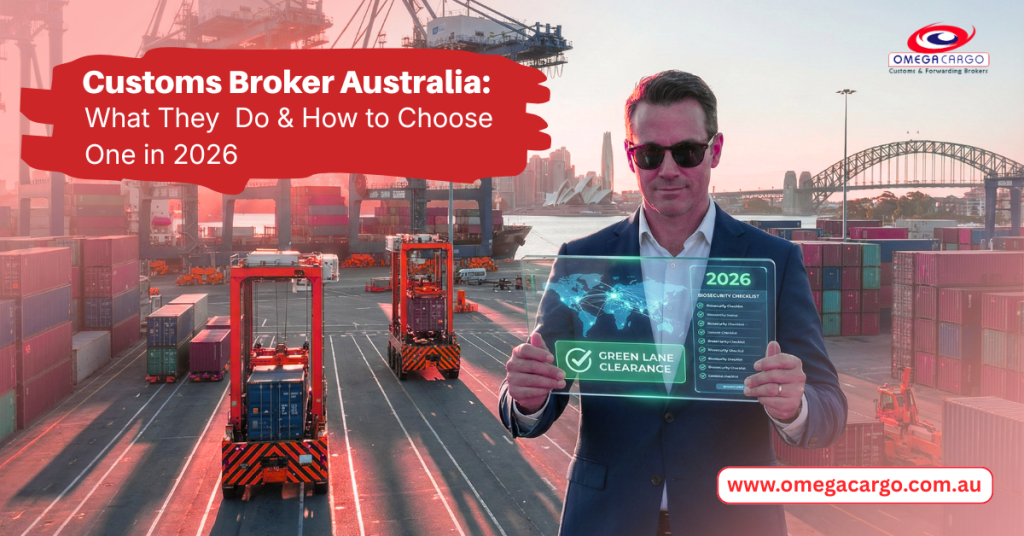
A single error on an import declaration can leave your goods held at the border while storage charges build up at the wharf or depot.
For many importers, the difference between a smooth shipment and a costly hold-up comes down to one partner: your customs broker. This customs broker Australia guide explains what a licensed customs broker actually does, how they differ from a freight forwarder, how their fees are made up, and what to check before you hand over your next shipment. Whether you are bringing in solar components for an infrastructure project or importing boutique textiles for the first time, the same principles apply.
Australian border rules are increasingly digital and data-driven, and the Australian Border Force (ABF) and the Department of Agriculture, Fisheries and Forestry (DAFF) expect accurate, consistent information. We cover strict liability, sanctions screening, biosecurity and how Free Trade Agreements can reduce the duty you pay.
A customs broker is a trained, licensed professional who acts between you (the importer or exporter) and the government agencies that control the border, mainly the ABF and DAFF.
Think of them as the compliance representative for your cargo. A freight forwarder might book the ship or aircraft that carries your goods, but the customs broker prepares and lodges the declarations that allow those goods to be released into Australia. For a deeper look at the day-to-day tasks, read our guide on what a customs broker does.
Customs clearance in Australia is no longer just about filling out a form. It involves accurate data, biosecurity compliance and making correct use of Free Trade Agreements (FTAs) to reduce the duty you pay. The ABF uses data matching to flag inconsistencies, so a "she'll be right" approach to paperwork can lead to holds, audits and penalties.
Under the Customs Act 1901, only the owner of the goods or a customs broker licensed by the ABF can lodge an import declaration to enter goods for home consumption. That gives your broker a position of trust. They must balance your commercial interests (paying no more duty and tax than the law requires) with their legal duty to provide correct information to the government.
If you give your broker false information, you can be liable for penalties. If the broker is negligent, their licence can be put at risk. This shared responsibility makes a good broker a key partner in your business compliance: they help stop prohibited goods entering the supply chain and help compliant businesses avoid accidental breaches.
The core job of a customs brokerage firm is to make sure your goods enter the country legally and that you pay the correct amount of duty and tax: no more, no less. Here is what that involves.
Every item that enters Australia, from a plastic toy to an industrial robot, must be classified under the tariff using the Harmonized System (HS). The first six digits are set internationally, and Australia's tariff adds further digits for its own tariff classification and statistical code. The classification decides which duty rate and import conditions apply. Our customs tariff and product classification guide explains how this works.
Import and export regulations in Australia require goods to be valued precisely. It is not always as simple as reading the total on your invoice. Your broker works out:
To see how these elements combine on your bill, read understanding duty calculation.
Australia has some of the strictest biosecurity import and export laws in the world to protect its agriculture and environment. Brokers who lodge biosecurity information for you should understand DAFF requirements and, ideally, hold the relevant DAFF approved arrangements.
Australia has FTAs with many trading partners, including China (ChAFTA), the United States (AUSFTA), the United Kingdom (A-UKFTA), New Zealand and the Regional Comprehensive Economic Partnership (RCEP) members. A skilled import and export broker knows which origin documentation you need to claim a preferential duty rate.
You might be asking, "Can I just do this myself?" Technically, yes: the law allows owners to lodge their own declarations. For most commercial importers, though, the risk of errors outweighs the brokerage fee, and the rules keep changing.
Many Customs Act offences for false or misleading statements are strict liability offences. That means if you make a false statement on an import declaration, even through a genuine mistake or a typo, you can still be penalised.
Australian sanctions laws, administered by the Department of Foreign Affairs and Trade (DFAT), restrict dealings with certain countries, entities and goods. Importers must make sure they are not paying sanctioned parties or importing goods covered by sanctions. A customs broker can help you screen suppliers and countries of origin against UN and Australian autonomous sanctions, adding a layer of protection to your trade.
Freight forwarding in Australia works on tight schedules. Container terminals and empty container parks only allow a limited free storage period, which depends on the terminal, shipping line and contract.
Many people confuse freight forwarding with customs brokerage. Many companies offer both customs clearance services and logistics, but the roles are distinct and need different skills. We compare them in more depth in freight forwarder vs customs broker.
| Feature | Freight Forwarder | Customs Broker |
|---|---|---|
| Primary focus | Logistics, transport and warehousing | Compliance, customs law and taxation |
| Main job | Moving goods from origin to destination, booking space on ships, aircraft and trucks | Clearing goods through the border legally and lodging declarations with the government |
| Licensing | No customs broker licence is needed to arrange transport | Must hold a customs broker licence issued by the ABF; DAFF approved arrangements are separate |
| Key activity | Booking transport and tracking movement | Classifying goods, calculating duty and taxes, managing biosecurity requirements and lodging declarations |
| Best for | Route planning and competitive freight options | Avoiding errors, penalties, audits and legal issues |
Tip: For a simpler experience, look for a provider that offers both freight forwarding and customs brokerage. Ask whether the brokerage team is in-house or outsourced, because in-house teams usually communicate faster and take clearer responsibility.
Finding the right partner matters. Use this checklist when choosing a customs broker that fits your business.
This is non-negotiable. In Australia, all customs brokers are licensed by the ABF under the Customs Act. A licensed customs broker has met education, experience and fit-and-proper requirements. Ask for their licence details and confirm them with the ABF if you are unsure.
Ask whether the broker operates under DAFF approved arrangements, such as the non-commodity for containerised cargo clearance (NCCC) arrangement and Automatic Entry Processing (AEP) for eligible commodities.
Not all cargo is the same. The rules for importing steel are very different from the rules for importing cheese.
Ask them directly: "Have you cleared this type of product before? What are the common pitfalls?"
Emailing PDFs back and forth is slow and easy to get wrong. Good customs brokerage companies give you clear visibility of your entries. Ask whether you can:
Customs broker fees can be hard to compare. Some brokers quote a low entry fee but add separate disbursement or agency charges. Ask for a full schedule of charges that shows:
Knowing what makes up your clearance bill helps you budget and compare quotes. The table below explains each charge without fixed amounts, because the real figures depend on your goods, their value, the transport mode and the services you need.
| Charge type | Who sets it | What affects the amount |
|---|---|---|
| Import Processing Charge (IPC) | Government (ABF) | Set by the government and varies with the transport mode (sea, air or post), the value of the goods and how the declaration is lodged |
| Biosecurity fees | Government (DAFF) | Depend on whether documents need assessment, whether an inspection or treatment is required and how long it takes |
| Brokerage service fee | Your customs brokerage firm | Depends on the number of tariff lines, invoice complexity, permits, FTA claims and any extra services |
| Import duty | Customs Tariff (collected by the ABF) | Calculated on the customs value at the rate for your tariff classification; may be reduced or removed under an FTA or TCO |
| GST | GST Act (collected by the ABF) | 10% of the Value of Taxable Importation (customs value + duty + transport and insurance to Australia), unless an exemption applies |
Note: Customs broker fees are a service charge. Duty, GST and the IPC are government charges that your broker collects on behalf of the government and pays to it. Figures and rules can change, so please treat this table as general guidance rather than final information, and confirm the charges for your shipment with our team.
Want a clearer picture of your own landed cost? Request a tailored quote and our team will explain the charges that apply to your goods.
Not always. According to the ABF's import declaration guidance, most goods valued at AUD 1,000 or less have no duties, taxes or charges to pay at the border and are usually cleared through a Self-Assessed Clearance, often handled by the courier or Australia Post. However, duties and taxes apply to some goods, such as tobacco and alcohol, regardless of value, and permits or biosecurity conditions can still apply. Goods valued above that threshold need a full import declaration, and using a broker helps you avoid errors. Always check the current threshold with the ABF.
Only if they employ or work with a licensed customs broker. Only the owner of the goods or a licensed customs broker can lodge an import declaration. A forwarder without a licensed broker would have to outsource the clearance. Check whether your provider handles brokerage in-house, as this usually gives better accountability and faster communication.
Clearance times vary. They depend on how early and accurately the declaration is lodged, whether the ABF or DAFF selects the shipment for document checks or inspection, the type of goods, and terminal or depot availability. When paperwork is complete and lodged early, many shipments clear without intervention. An experienced customs broker in Australia reduces delays by getting the data right first time. Our step-by-step customs clearance guide walks through each stage.
To clear your goods efficiently, you will usually need to provide:
They are protecting you. Because of strict liability under the Customs Act, you are responsible for errors. Your broker asks detailed questions about the product's composition (for example, the cotton and polyester content of a shirt), its end use (is this pipe for oil, gas or water?) and how it was made. These details decide the tariff classification. If the ABF reviews your declarations later, the answers you gave your broker can be important evidence that you took reasonable care.
Yes. A broker can respond to ABF or DAFF requests for information, arrange inspections or treatment, and explain what is needed to release your goods. Read more about the customs inspection process in Australia.
Customs and biosecurity rules are national, so a licensed broker can lodge declarations for any port. Local knowledge of terminals, depots and inspection facilities still helps. Omega Cargo provides customs and quarantine clearance in Sydney, Melbourne, Brisbane, Fremantle and Adelaide.
Managing international trade regulations takes more than good logistics. It takes a compliance partner who understands strict liability, biosecurity and trade agreements.
A skilled Australian customs broker does more than fill out forms. They protect your margins, help your goods clear without avoidable delays and keep your business compliant with Australian law. They are your first line of defence against audits and one of your best tools for managing landed costs.
Whether you need a customs broker in Melbourne, Sydney, Perth or elsewhere, the checklist stays the same: confirm the licence, ask about DAFF approved arrangements, check industry experience and value expertise over the cheapest service fee. To avoid other common pitfalls, read our guide to the top freight forwarding mistakes importers make in Australia.
Don't let your goods sit at the border building up storage charges. Omega Cargo's customs and quarantine clearance service works alongside our air freight, sea freight and freight forwarding services, so your freight and clearance can be coordinated by one team.
Contact Omega Cargo to discuss your shipment requirements, or request a tailored quotation for your next import.


