
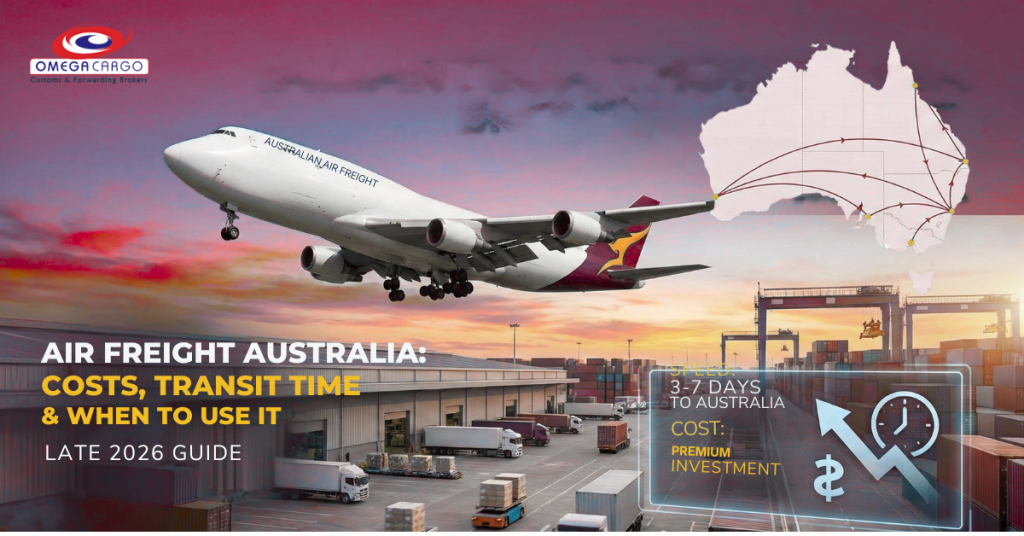
Can your business afford to wait weeks for stock while your competitors are already selling?
The business world in Australia moves fast, distance is usually the greatest issue, and 30 days wait time for a sea container is like waiting forever! Air freight is what keeps Australian supply chains going! Whether you are a retailer restocking a best seller, or manufacturing needing a high priority part sent yesterday, air freight is your fastest option.
But speed can be costly. How do you find a healthy balance between urgency and operating on a limited budget?
This complete guide will breakdown air freight in Australia late 2026. The guide includes what the current cost structures are, estimated time of transit, and most importantly, recent and future regulatory changes that will affect the industry going forward.
Air freight is simply a way of shipping items anywhere in the world via plane. In fact, you can have your items delivered to your home from any country within just a few days. In contrast, if you ship via sea, it may take several weeks for the items to reach their destination.
However, it’s not just about putting a box on a plane. Air freight involves a complex ecosystem of logistics providers, customs brokers, ground handlers, and strict security protocols. For Australian businesses, it is often the premium choice for high-value or time-sensitive goods.
Deciding between air and sea freight isn't just a coin toss. It’s a strategic calculation. You should choose air freight services Australia when:
If you have a strict deadline—such as a product launch, a trade show, or a production line stoppage—air freight is your only viable option. While sea freight from China takes 15–25 days (and often longer with port congestion), air freight can deliver in 3–5 days.
Air freight is priced by weight (chargeable weight), whereas sea freight is priced by volume (container size). For small, heavy, or expensive items like electronics, jewellery, or pharmaceuticals, air freight is often cost-competitive because the insurance costs are lower (due to less transit time) and you aren't paying for empty container space.
Holding months of inventory in a warehouse ties up your cash flow. Air freight allows for a "Just-in-Time" (JIT) inventory strategy. You can order smaller batches more frequently, reducing your warehousing costs and keeping your cash liquid.
Airports have significantly tighter security controls than seaports. If you are shipping sensitive data, prototypes, or fragile luxury goods, the risk of theft or damage is drastically lower with air cargo.
"How long will it take?" is the most common question in logistics. For Australia air freight transit time, the answer depends on the service level you choose and the origin.
Here are the current average transit times for late 2025:
| Origin | Service Level | Transit Time (Airport-to-Airport) | Transit Time (Door-to-Door) |
| China (CN) | Standard | 3 - 5 Days | 5 - 7 Days |
| China (CN) | Express | 1 - 2 Days | 3 - 4 Days |
| USA (US) | Standard | 4 - 7 Days | 7 - 10 Days |
| USA (US) | Express | 2 - 3 Days | 4 - 5 Days |
| UK / Europe | Standard | 5 - 8 Days | 8 - 12 Days |
| New Zealand | Standard | 1 - 2 Days | 2 - 4 Days |
Note: "Door-to-Door" includes the time taken for pickup, export customs, the flight, import customs in Australia, and final delivery. Always build a 1-2 day buffer for Australian biosecurity clearance, which is among the strictest in the world.
Air freight costs in Australia can vary wildly. It’s not as simple as a flat rate per kilo. To budget effectively, you need to understand how the price is built.
This is where most businesses get caught out. Airlines charge based on whichever is greater: the actual weight of the cargo or its volumetric weight.
Rates fluctuate weekly based on fuel prices and capacity.
When you see a quote, look for these line items. They are mandatory extras:
Still on the fence? Here is a quick cheat sheet to help you decide.
| Feature | Air Freight | Sea Freight (LCL/FCL) |
| Speed | 3 - 7 Days | 20 - 45 Days |
| Cost | High ($3 - $10/kg) | Low ($0.50 - $2/kg equivalent) |
| Reliability | Very High (Consistent schedules) | Moderate (Subject to port delays) |
| Tracking | Real-time, detailed | Milestone-based |
| Carbon Footprint | High | Low |
| Best For | Electronics, Fashion, Pharma, Urgent parts | Furniture, Bulk commodities, Textiles, heavy machinery |
Navigating the logistics maze can be daunting. Here is the typical workflow for international air freight Australia.
You or your supplier contacts a freight forwarder. You will need to provide the Commercial Invoice and Packing List. The forwarder will calculate the chargeable weight and book space on a flight (e.g., Qantas, Cathay Pacific, Singapore Airlines).
Goods are collected from the factory and taken to the origin airport warehouse.
The goods are cleared for export from the country of origin.
Your goods are loaded onto a plane. This could be a dedicated freighter (Cargo plane) or the "belly" of a passenger plane.
Upon landing, goods are moved to a Cargo Terminal Operator (CTO) like Qantas Freight or Dnata. They are checked against the manifest.
This is the most critical step. Your customs broker lodges an import declaration.
Once cleared, a truck collects your goods from the airport terminal and delivers them to your warehouse.
The landscape of air cargo Australia is shifting. Here are two massive changes you must be aware of right now:
For years, imported goods under $1,000 AUD were often exempt from duty and GST at the border (or GST was collected by the vendor).
If you are an Australian business exporting to the USA, be aware that in August 2025, the US government suspended their $800 USD de minimis exemption. This means Australian exports to the US that used to enter duty-free now face full customs entry and tariffs. Plan your pricing accordingly!
Not all air freight companies in Australia are created equal. When selecting a partner, ask these three questions:
Air freight is the premium fuel that powers agile businesses. It is not for every shipment, but when time is your most valuable currency, it is the only choice.
By understanding the costs (especially chargeable weight), preparing for Australian customs quirks, and keeping an eye on the 2025 regulatory changes, you can turn your supply chain from a cost centre into a competitive advantage.
Ready to get your goods moving? Don't guess the cost. Reach out to a reputable freight forwarder today and ask for a quote broken down by "All-In" costs so there are no surprises when the invoice lands.
Q: How much is air freight from China to Australia per kg?
As of late 2025, expect between $3.00 USD and $8.00 USD per kg, depending on the weight of your shipment (heavier = cheaper per kg).
Q: Does air freight include customs clearance?
Typically, no. The freight rate covers transport. Customs clearance, duties, and taxes are separate charges handled by a customs broker.
Q: What is the fastest shipping to Australia?
"Next Flight Out" (NFO) services or Courier Express (AXON/DHL/FedEx) are the fastest, often


