
Have you ever wondered how products travel across the world and arrive at your warehouse or doorstep without you having to manage dozens of different shipping companies?
how a sofa made in a factory in Guangdong, China ends up in a living room in Perth, Western Australia passing through ports on three different continents, clearing customs in two countries, surviving ocean swells and port terminals without you ever needing to speak to a shipping line, a customs officer, or a truck driver? The answer, almost always, is a freight forwarder. They're one of the most essential and most misunderstood businesses in global trade. This guide explains everything.
A freight forwarder is a company that arranges the international transportation of goods on behalf of importers and exporters without owning the ships, planes, or trucks. Think of them as the orchestrator of your entire shipping journey: they book carrier space, manage documentation (Bills of Lading, Packing Declarations, certificates of origin), coordinate pickup and delivery, track your shipment, arrange cargo insurance, and often provide customs clearance. Approximately 80% of global trade moves through freight forwarders. The global market was valued at around USD $285 billion in 2024. For Australian importers and exporters, the best freight forwarders also have in-house ABF-licensed customs brokers giving you one team from overseas factories to Australian warehouse doors.
If you are importing electronics from China, exporting agricultural goods from Australia, or managing an international e-commerce brand, navigating the complex web of global trade can feel overwhelming. That is where a logistics expert steps in.
Here's a fact that surprises most people new to international trade: freight forwarders don't own ships. They don't own planes. They often don't even own the trucks that pick up your goods. What they own and what makes them indispensable is something far more valuable: deep relationships with the companies that do own those assets, and the expertise to navigate the bureaucratic, legal and logistical complexity that would otherwise make international shipping nearly impossible for most businesses.
Without freight forwarders, the global trade system would effectively freeze. The paperwork alone, Bills of Lading, Certificates of Origin, Packing Declarations, Import Declarations, DAFF biosecurity forms, BMSB treatment certificates, FTA certificates would overwhelm any business trying to manage it alone. Add to that the need to negotiate carrier rates, track shipments across multiple handoffs, coordinate pickup in Shenzhen and delivery in Sydney, and navigate customs clearance in two or more countries, and you have a job description that requires dedicated specialist knowledge to execute well.
Imagine you have a pallet of handmade furniture in a warehouse in Vietnam, and a customer waiting for it in a storefront in Chicago. Between point A and point B lies a vast, complex maze: trucks, ports, cranes, a massive ocean, customs inspectors, taxes, more trucks, and a mountain of paperwork.
How do you get your goods across the world without losing your mind—or your money?
This guide gives you everything you need to understand freight forwarding whether you're a first-time importer trying to figure out how this all works, a seasoned supply chain manager or a growing business evaluating whether to change freight forwarders. This guide will provide you with the actionable insights you need to master global shipping. Let’s dive in.
Global trade is moving faster than ever. In 2026, the world will be more connected, but international logistics has also become more complicated. New regulations, environmental rules, and shifting trade routes mean that moving goods is no longer just about putting a box on a boat.
If you are involved in import and export, you know that one missing document or one missed connection can result in your cargo sitting at a port for weeks, racking up storage fees.
This is why freight forwarding companies are essential. They are the architects of the shipping world. They don't usually own the ships or the planes, but they know exactly how to use them to get your cargo transportation done right. They are the glue that holds the global supply chain together.
In this guide, you will learn everything you need to navigate the waters of global shipping and transportation. We will keep it simple, friendly, and packed with actionable advice.
A freight forwarder is an international logistics expert that acts as an intermediary between a business that wants to ship goods and the various transportation carriers that move those goods. Freight forwarders do not actually move the cargo themselves; instead, they arrange the entire global shipping process from storage and packing to customs clearance and final delivery.
Think of a freight forwarder as a travel agent for your cargo. Just as a travel agent books your flights, hotels, and airport transfers to ensure a seamless holiday, a freight forwarder books space on cargo ships, airplanes, trains, and trucks to ensure your products reach their destination efficiently.
They are the architects of your supply chain management, utilizing their relationships with major carriers (like Maersk, MSC, DHL, or FedEx) to negotiate competitive freight rates and ensure your cargo logistics run smoothly.
A freight forwarder also known as a forwarding agent, international freight agent, or freight broker (in some markets) is a third-party logistics specialist who manages the movement of goods on behalf of the cargo owner, coordinating every step of the international shipping process from origin to destination.
The formal definition from the International Federation of Freight Forwarders Associations (FIATA): a freight forwarder is a professional who handles the international transportation of goods — including the arrangement of transport, customs clearance, documentation, and related logistics services — on behalf of shippers and consignees.
In plain English: a freight forwarder is your logistics manager for everything that happens between "goods ready at supplier" and "goods delivered to your door." They don't own the vehicles — but they orchestrate all the people and companies that do.
Just as a travel agent books your flight, hotel and transfers without owning a single plane or hotel room, a freight forwarder books your cargo's journey from factory to warehouse without owning a ship or truck. The difference: cargo logistics is dramatically more complex than a holiday package. A single sea freight shipment from China to Australia can involve an export customs broker, a shipping agent, the vessel operator, a stevedore, a port terminal operator, the ABF, DAFF, a road carrier, a customs broker, and a delivery driver — all in sequence. Your freight forwarder manages the relationships with all of them so you don't have to.
Think of a freight forwarder as a travel agent for your cargo.
When you want to go on a complex vacation to three different countries, you could book every flight, bus, hotel, and tour guide yourself. But it would be stressful, and if one flight is delayed, your whole trip will be ruined. Instead, you hire a travel agent who books everything, finds you the best routes, gets you deals, and fixes problems if they happen.
Freight forwarding services work the same way:
A freight forwarder definition often includes the fact that they are experts in import export regulations. They know the rules so you don’t have to.
Usually, no. Most freight forwarders do not own the massive container ships or the Boeing 747 cargo planes. Instead, they use their massive buying power to negotiate low rates with the carriers who do own the assets. Then, they pass those savings and services on to you.
The scope of what a freight forwarder does depends on the engagement — some handle only the ocean freight booking, while full-service forwarders like Omega Cargo manage the complete door-to-door journey including customs clearance. Here's what a comprehensive freight forwarding service covers.
A world-class freight forwarding company handles a vast array of international logistics services. Here is a detailed breakdown of the exact services they provide:
Prepares, reviews and manages all documents required for international shipment: Commercial Invoice verification, Packing List, Bill of Lading, Airway Bill, Packing Declaration, and Certificate of Origin. Correct documentation is the single most important factor in avoiding customs delays.
International commerce requires a mountain of paperwork. Your forwarder will prepare, process, and review all critical shipping documents, including the Bill of Lading, Air Waybill, and Commercial Invoice, ensuring they comply with international trade laws.
Before your cargo ever leaves the warehouse, a freight forwarder analyzes your specific needs. They determine the most efficient and cost-effective route, choosing between air freight, sea freight, rail freight, or road freight based on your budget and transit time requirements.
Books space on shipping vessels, aircraft, or trains with carriers — leveraging volume relationships to secure rates you couldn't obtain individually. Freight forwarders book LCL (Less than Container Load) and FCL (Full Container Load) sea freight, and consolidate multiple small shipments into shared containers for cost efficiency.
Because freight forwarders manage massive volumes of cargo, they have established relationships with global carriers. They use this leverage to negotiate the best shipping costs and book the necessary cargo space on your behalf, even during peak shipping seasons.
Groups your small shipment with other importers' cargo in a shared container — so you only pay for the space your goods actually use. Essential for shipments that don't fill a full 20-foot or 40-foot container. Freight forwarders run their own consolidation programs on regular trade lanes.
Navigating the rules of the World Customs Organization (WCO) and local authorities (like the Australian Border Force or US Customs) is notoriously difficult. Many freight forwarders act as (or partner with) licensed customs brokers to ensure your import and export declarations are filed correctly, HS codes are accurate, and duties are paid, preventing costly delays.
International shipping comes with risks, from rough seas to port accidents. A freight forwarder will offer cargo insurance policies to protect your financial investment in case your goods are damaged, lost, or stolen during transit.
Arranges marine cargo insurance for your goods in transit. Carrier liability is strictly limited under international conventions (typically USD $2.50 per kilogram for air freight, a nominal amount for sea freight). Proper cargo insurance covers the actual commercial value of your goods.
Often, your goods may need to be stored before they are loaded onto a vessel or after they arrive at the destination port. Forwarders provide warehousing solutions, consolidation services (combining your small shipments with others), and final distribution to the end user.
Modern freight forwarding solutions include advanced digital tracking. Your forwarder provides real time updates on your shipment's location, offering end-to-end shipment visibility so you always know where your inventory is.
Provides real-time shipment tracking from departure through transit to arrival monitoring vessel positions, port arrival times, customs status and terminal availability. Your freight forwarder is your point of contact when something goes wrong in transit.
Coordinates DAFF biosecurity compliance for Australian imports — preparing Packing Declarations, coordinating BMSB treatment certificates for seasonal requirements, and managing DAFF holds. In-house AEP-accredited brokers can self-assess certain biosecurity documents for faster clearance.
Advises on the most appropriate Incoterms (EXW, FOB, CIF, DDP etc.) for your transaction — clarifying exactly where your responsibility for cost and risk begins and ends, and structuring the shipment terms to minimise your exposure and maximise cost efficiency.
Arranges container pickup from the port terminal after customs release and delivery to your warehouse. This is the final logistics step — and having your freight forwarder manage it means one coordinated handoff rather than separately booking a transport company after clearance.
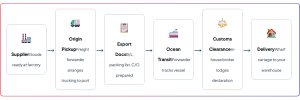
Here's how a complete freight forwarding journey works for a typical Australian importer shipping goods from China via sea freight
You need to know the anatomy of a shipment. Here is the step by step freight forwarding process from the supplier to the final destination:
Freight Forwarding Process, Detailed Step by Step
| Stage | What Your Freight Forwarder Does | What You Need to Provide |
| Booking & Planning | Confirms sailing schedule, books vessel space (LCL or FCL), advises on documentation requirements, checks BMSB compliance for season | Supplier name, location, cargo dimensions/weight, required delivery date |
| Origin Coordination | Coordinates pickup from supplier factory, arranges export documentation with origin agent, ensures goods are packed and labelled correctly for international transit | Commercial Invoice, Packing List from supplier; Certificate of Origin if FTA applies |
| Export & Loading | Manages export customs at origin country; supervises loading; issues House Bill of Lading (HB/L); sends tracking notification with vessel and ETA details | Confirm shipment details match documentation exactly |
| Ocean / Air Transit | Tracks vessel position; monitors for delays, diversions or transshipment issues; notifies you of any schedule changes; provides pre-arrival documentation to destination agent | Be available for any queries during transit (usually minimal) |
| Pre-Arrival Preparation | Prepares Import Declaration for pre-clearance lodgement 5–7 days before arrival; confirms BMSB/biosecurity compliance; advises on duty and GST estimates | Confirm any additional product information needed for HS classification or permits |
| Customs Clearance | Lodges Import Declaration via ABF ICS; pays customs duty and GST (rebilled to you); coordinates DAFF biosecurity; obtains Green Lane clearance before vessel arrives where possible | Pay duty and GST invoice promptly; provide any additional documents if ABF queries |
| Port Release & Delivery | Obtains Delivery Order from shipping line after clearance; books wharf cartage; arranges container pickup from terminal; delivers to your warehouse | Confirm delivery address and any special requirements (tailgate, forklift, etc.) |
| With a full service freight forwarder (like Omega Cargo), all stages above are managed by one team under one contract; you receive updates at key milestones and have a single contact for any query throughout the journey. | ||
This is the transfer of goods from the supplier's factory or warehouse to the freight forwarder's origin warehouse. The forwarder arranges a local truck to pick up the goods.
Once the cargo arrives at the forwarder’s origin facility, it is inspected. The forwarder confirms the piece count, checks the packing list, and prepares the cargo for shipping (such as palletizing or consolidating into a shipping container).
Before the cargo can leave the country of origin, it must be cleared by local customs. The forwarder submits the required export declaration and documents to the government authorities.
This is the primary leg of the journey. The freight forwarder manages the loading of the cargo onto the ship or aircraft and monitors its transit across the globe.
As the cargo arrives at the destination country, it must clear customs again. The customs broker (managed by the forwarder) submits the import declaration, pays the necessary taxes and duties, and ensures the cargo complies with local regulations.
The cargo is unloaded from the vessel or aircraft and moved to the forwarder's destination warehouse. Here, it is unpacked, sorted, and prepared for the final leg of the journey.
Also known as last-mile delivery, the forwarder arranges for trucks or local carriers to transport the cargo from the destination warehouse directly to your business, warehouse, or customer.
To understand freight forwarding services, you need to know the different ways cargo moves. A good global shipping guide covers the "Big Four" modes of transport plus the essential support services.
Not all cargo requires the same mode of transport. A reliable international logistics consultant will help you choose between the following core services:
Freight Forwarding Service Types Overview
| Service Type | What It Is | Best For | Typical Cost (AU import) |
| LCL Sea Freight | Your cargo shares a container with other importers' goods; you pay per CBM | Shipments under ~14–16 CBM; regular small-to-medium orders | USD $80–$150/CBM + destination charges |
| FCL Sea Freight (20ft) | You take an entire 20-foot container; typically 25–28 CBM capacity | Shipments over 14–16 CBM; single-commodity full loads | USD $800–$2,500+ per container (route-dependent) |
| FCL Sea Freight (40ft) | Full 40-foot container; approximately 55–68 CBM capacity | Large volume orders; furniture, machinery, consumer goods | USD $1,200–$3,500+ per container (route-dependent) |
| Air Freight | Goods transported by aircraft — fastest option, highest cost per kg | High-value, time-sensitive, perishable or lightweight goods | AUD $5–$15/kg depending on route and commodity |
| Express Air Freight | Priority air routing with fastest available capacity; door-to-door | Emergency replenishment, samples, time-critical parts | Premium — 20–40% above standard air rates |
| Road / Rail Freight | International road or rail freight (primarily Asia-Europe corridors) | China-Europe transit as alternative to sea or air | Between sea and air costs; 15–25 day transit |
| Multimodal / Combined | Combines sea, air, road and/or rail for optimal cost-speed balance | Complex routes; different speeds for different legs | Custom-quoted based on specific route combination |
| Rates quoted are indicative only and subject to change based on market conditions, carrier capacity, fuel surcharges and seasonal demand. Always request current rates from your freight forwarder. Destination charges (port fees, terminal handling, cartage) are additional and often significant. | |||
Pro Tip: Air freight rates are becoming more dynamic with AI pricing. Ask your forwarder about "spot rates" vs. "contract rates."
Sea freight is the workhorse of the global economy. 90% of world trade moves by sea.
Trucks move goods from the factory to the port, and from the port to your door.
A great middle-ground. Faster than sea, cheaper than air. The "New Silk Road" rail route between China and Europe is a popular example.
This is perhaps the most critical service. Customs clearance involves declaring your goods to the government to pay duties and taxes (tariffs).
Sometimes you aren't ready to receive the goods yet. Forwarders offer:
Carriers have limited liability. If a ship sinks, the shipping line might only owe you $500 for a container worth $50,000. Freight forwarders offer cargo insurance to protect the full value of your goods against loss, theft, or damage.
Most international freight forwarding involves multimodal transport—using a combination of trucks, ships, and trains under a single contract (and a single Bill of Lading) to move your cargo from origin to destination.
Freight Mode Comparison Table
| Feature | Air Freight | Sea Freight | Rail Freight | Road Freight |
| Speed | Very Fast (1-5 days) | Slow (15-45 days) | Moderate (10-20 days) | Fast (Domestic) |
| Cost | High | Low | Medium | Medium |
| Ideal Cargo | Electronics, Pharmaceuticals | Machinery, Textiles | Heavy goods, Minerals | Local distribution |
| Environmental Impact | High | Low | Very Low | Medium |
It is easy to get confused by the different entities in global trade. Let's clarify the differences.
While both deal with international shipping, their roles are distinct. A freight forwarder is responsible for the physical movement and logistics of the cargo. A customs broker is a licensed professional responsible solely for clearing goods through customs, ensuring compliance with border regulations, and paying tariffs. Note: Most enterprise-level freight forwarders have in-house customs brokers.
A shipping company (like Maersk or CMA CGM) actually owns the physical assets: the cargo ships, airplanes, or trucking fleets. The freight forwarder does not own the ships; they buy space on those ships on behalf of their clients, acting as the middleman.
An NVOCC (Non-Vessel Operating Common Carrier) is very similar to a freight forwarder. However, an NVOCC acts more like a carrier and can issue their own Bill of Lading (called a House Bill of Lading). Freight forwarders act as agents on your behalf. In today's market, many large logistics companies operate as both.
| Entity | Owns Transport Vehicles? | Handles Customs? | Arranges End-to-End Logistics? | Issues Bill of Lading? |
| Freight Forwarder | No | Yes (Usually) | Yes | Yes (Forwarder's Receipt) |
| Customs Broker | No | Yes | No | No |
| Shipping Carrier | Yes | No | No | Yes (Master Bill of Lading) |
| NVOCC | No | No (Usually) | Yes | Yes (House Bill of Lading) |
In the world of international freight forwarding, terms often get confused. You might hear "broker" or "3PL" and wonder if they are the same thing. They are not. Here is the breakdown so you can choose the right partner.
In 2026, the lines are blurring. Many freight forwarding companies now offer 3PL services like warehousing, and many 3PLs offer freight forwarding services. However, if your main need is moving bulk goods internationally, a forwarder is your best bet.
One of the most common points of confusion in international trade is understanding the difference between the various intermediaries involved in a shipment. Here's a clear breakdown.
The Most Efficient Setup for Australian Importers
For the vast majority of Australian importers, the most efficient and cost-effective setup is a freight forwarder with
in-house ABF-licensed customs brokers
This gives you one company managing the entire journey from the supplier's factory through ocean or air transit, through Australian customs, and into your warehouse. No handover between a separate freight forwarder and customs broker. No divided accountability. One invoice, one contact, full visibility.
Omega Cargo has operated this combined model since 2000, see customs clearance services and freight forwarding services.
You might be thinking, "Can't I just call the airline or the shipping line myself?" Technically, yes. But here is why freight forwarder benefits usually outweigh the DIY approach. Why shouldn't you just book space with a shipping airline or ocean carrier directly?
Here is why businesses rely on freight forwarding companies:
Freight forwarders ship huge volumes of cargo. Because they ship so much, they get "bulk discounts" from carriers. They can offer you a shipping rate that is much lower than what you would get if you called the shipping line directly. Forwarders consolidate shipments and negotiate bulk freight rates, passing the savings on to you.
You can focus on growing your business while the forwarder handles the tedious cargo logistics, saving you hundreds of hours in supply chain management.
They prevent your cargo from being held up at the border, ensuring you don't face hefty fines for incorrect import declarations.
International logistics is a headache. You have to deal with Incoterms, HS codes, port authorities, and foreign languages. A forwarder speaks this language fluently. They manage the complexity so you can focus on making and selling your product.
What happens if your goods get stuck in the Suez Canal? Or if a strike shuts down a port in Germany? A freight forwarder has a global network of agents. They can re-route your cargo, find alternative transport, and solve problems you didn't even know existed.
If a port goes on strike or a flight is canceled, a forwarder has the network to reroute your cargo immediately.
Getting your goods detained at the border is a nightmare. Customs documentation is strict. If you miss a comma or use the wrong code, you face fines or delays. Forwarders ensure your paperwork is perfect before the goods ever leave the factory.
Do you need freight handling services for hazardous materials? Or perhaps you need a refrigerated container (reefer) for food? Forwarders have access to specialized equipment and services for any type of cargo.
Instead of dealing with trucking companies, ocean carriers, and customs agencies separately, you have one dedicated account manager.
Even with a top-tier freight forwarder, global trade presents challenges. Being aware of these can help you mitigate risks:
Expert Tip: Always build a buffer into your supply chain timeline. If you need products for a November launch, aim to have them arrive by late September to account for unforeseen delays.
To help you understand how this works in practice, let's look at a hypothetical scenario using freight forwarding services in 2026.
The Situation: You own a tech company in California. You need to import 5,000 wireless headphones from a factory in Hanoi, Vietnam.
Without a forwarder, you would have had to coordinate a Vietnamese trucker, a shipping line, a warehouse in Dubai, an airline, a US customs broker, and a US trucking company. The forwarder did it all with one email.
In import export logistics, paperwork is king. If you don't have the right paper, you don't have your cargo. Here are the documents your forwarder will help you manage:
This is the bill of sale from the seller to the buyer. It lists what the goods are, how much they cost, and the Incoterms (who pays for shipping). Customs uses this to calculate taxes.
This tells you exactly what is in each box. It includes weight, dimensions, and item counts. It does not include prices.
This is the most important document. It is three things in one:
A document declaring the country where the goods were manufactured. which can impact duty rates and trade agreements. This is crucial for trade agreements. For example, if you are importing from a country with a Free Trade Agreement, this document can make your import tax-free.
Similar to a Bill of Lading, but for Air Freight. Unlike a BOL, an AWB is not a document of title—it’s just a receipt and contract.
If you are shipping batteries, chemicals, or liquids, you need this to prove the cargo is safe to handle.
A globally recognized 6-digit number used by customs to classify traded products. Using the wrong HS Code is a massive red flag for border force agencies.
To understand our "What Is a Freight Forwarder? Complete Global Shipping Guide", you must understand Incoterms (International Commercial Terms). Created by the International Chamber of Commerce (ICC), these terms define who is responsible for the costs and risks during shipping.
Incoterms Comparison Matrix
| Incoterm | Buyer Pays Freight? | Buyer Pays Insurance? | Buyer Pays Customs? | Who Takes Primary Risk? |
| EXW | Yes | Yes | Yes | Buyer |
| FOB | Yes (Ocean/Air) | Yes | Yes (Import) | Split at Origin Port |
| CIF | No | No | Yes (Import) | Split at Origin Port |
| DDP | No | No | No | Seller |
The world of Global shipping and transportation is changing. As we look at the freight forwarding industry trends for 2026, here is what you need to watch out for.
The days of fax machines are gone. In 2026, the best freight forwarding companies use Artificial Intelligence.
Environmental regulations are getting stricter.
After the supply chain crisis of the early 2020s, companies are prioritizing safety over just low cost.
Forwarders are becoming more like tech companies. They are integrating their software directly with platforms like Shopify and Amazon. This means when you sell a product, the shipping order is created automatically.
Avoid these costly errors when managing your international commerce:
You might be wondering: can't I just contact the shipping line directly? Can't I just sort out customs myself? In theory, yes — importers can deal directly with shipping lines and lodge their own customs declarations. In practice, almost no business does this, and there are good reasons why.
Do You Need a Freight Forwarder? Scenario Guide
| Your Situation | Do You Need a Freight Forwarder? | Why |
| First-time importer from overseas | Yes — strongly recommended | Documentation, customs and compliance complexity is significant without experience |
| Regular importer of 1–5 containers/month | Yes | Volume relationships give better rates; pre-clearance saves time and costs |
| High-volume importer (10+ containers/month) | Yes — dedicated account team | Scale requires volume rate negotiation and dedicated customs expertise |
| E-commerce business sourcing from China | Yes | LCL consolidation, small shipment expertise, FTA duty concessions |
| Exporter sending goods overseas | Yes | Export documentation, foreign customs compliance, carrier booking |
| Importing restricted goods (food, chemicals) | Yes — with specialist expertise | Import permits, regulatory compliance — errors risk seizure |
| Shipping once a year for personal goods | Possibly a removals company instead | Personal effects have different requirements; specialist removalists serve this market |
| If your business imports or exports goods internationally on any regular basis, a licensed freight forwarder with in-house customs brokerage is essentially non-negotiable. The question isn't whether you need one — it's how to choose the right one. | ||
With thousands of companies out there, freight forwarding company selection can be tough. Here is a checklist to help you pick the right partner in 2026.
Does the forwarder know your industry? If you ship frozen food, don't use a forwarder who specializes in dry clothes. Ask for case studies of clients in your specific sector.
Do they have their own offices in the country you are importing from, or do they use third-party agents? A forwarder with their own office in the origin country usually has better control and communication.
Ask for a demo of their customer portal.
Shipping costs money. If your forwarder goes bankrupt while your goods are on the water, your cargo could be held hostage by the carrier. Check their reputation and financial health.
When things go wrong (and they will), you need a human to talk to. Call their support line. Do you get a robot or a person? Do they seem friendly and helpful?
Be careful of "hidden fees." A bad forwarder will give you a cheap quote but hit you with extra charges like "documentation fees," "handling fees," or "chassis fees" later. Ask for an "All In" quote.
The most important qualifying question. In-house means faster pre-clearance, no handover risk, clearer accountability and typically lower combined cost than using a separate customs broker.
Membership in Australia's customs and freight forwarding industry professional bodies confirms adherence to industry codes of conduct and professional standards. Ask for their member number.
A forwarder shipping 50 containers per month from China to Fremantle has carrier relationships, port knowledge, and problem-solving capacity that a generalist handling your route occasionally simply doesn't.
AEP accreditation allows self-assessment of certain biosecurity documents, saving 2–4 business days per DAFF-assessed shipment. Critical during BMSB season September–April.
Insist on a quote covering all charges from the origin factory to your Australian warehouse door, not just ocean freight. This is the only way to accurately compare forwarders and your true landed cost.
You should have a specific, named person as your point of contact — not a ticket queue. When your container is held at Port Botany on a Friday afternoon, you need someone who picks up the phone.
The right answer: "We automatically check every shipment and advise on treatment requirements before loading." If they look blank, that's a red flag for Australian biosecurity compliance.
Reputable freight forwarders are happy to provide client references. Speak with clients on similar trade lanes to yours — ask about response times, problem resolution and customs clearance accuracy.
Not all logistics companies are created equal. Use this buyer checklist when vetting a potential shipping agent:
Don't let complex cargo logistics slow your business down. Our team of expert freight forwarders provides reliable, transparent, and cost-effective International Freight Forwarding solutions tailored to your unique needs.
Whether you need rapid Air Freight, economical Ocean Freight, or seamless Customs Clearance, we offer true end-to-end shipment visibility and dedicated logistics support.
Contact Us Today for a Free, No-Obligation Freight Quote and experience the difference of a world-class logistics partner.
Navigating the world of import and export doesn't have to be scary. While the international shipping process is filled with steps, rules, and potential pitfalls, you don't have to walk it alone.
A good freight forwarder is more than just a vendor; they are a strategic partner in your business. They turn the chaos of global supply chain logistics into a smooth, predictable process. They save you time, reduce your costs, and ensure your goods arrive safely.
As we move through 2026, leverage the new freight forwarding services available to you. Use the digital tools, explore green shipping options, and build a relationship with a forwarder who understands your vision.
Whether you are shipping via Air Freight or Sea Freight, the world is open for business. Now that you have this global shipping guide, you are ready to ship with confidence.
Ready to move your cargo? Start by vetting your potential partners using the checklist above, and take control of your logistics today.
A freight forwarder is much more than a logistics booking agent. They are your representative in a global system that would otherwise require you to maintain direct relationships with shipping lines, port terminals, customs authorities, road carriers, biosecurity agencies, and international trading partners across multiple time zones. They carry specialist knowledge that would take years to develop in-house — and apply it to every shipment you move.
The difference between a good freight forwarder and a great one shows up most clearly when something goes wrong. When the ABF places a Red Line hold on your goods, when DAFF flags a biosecurity issue three weeks before your peak selling season, when a vessel diverts due to port congestion — that's when a freight forwarder's relationships, experience, and in-house capabilities determine whether you're on the phone in crisis mode or receiving a calm update with a resolution plan already in motion.
For Australian importers and exporters, the most important characteristic to look for is a freight forwarder who also has in-house ABF-licensed customs brokers — with AEP accreditation for DAFF biosecurity. This single feature eliminates the handover risk, reduces customs clearance time, and gives you a genuinely accountable single point of contact for every stage of your shipment.
A freight forwarder is a company that arranges international shipping on your behalf — without owning ships, planes or trucks. Think of them as the travel agent for your cargo. They book space on carriers, prepare and manage all the necessary documents (like the Bill of Lading and customs declaration), coordinate pickup and delivery at both ends of the journey, track your shipment through transit, and often handle customs clearance through in-house licensed customs brokers. About 80% of all global trade moves through freight forwarders, because managing international logistics independently requires specialist expertise, carrier relationships, and knowledge of customs requirements across multiple countries.
In the United States, international freight forwarding involves compliance with U.S. Customs and Border Protection (CBP) regulations. A freight forwarder helps you file import and export declarations, manage customs clearance, calculate duties, and ensure compliance with U.S. trade laws for air freight and sea freight shipments.
Freight forwarding in Europe requires compliance with EU customs rules, VAT regulations, and cross‑border trade policies. A freight forwarder helps you manage customs documentation, Intrastat reporting, and smooth cargo transportation between EU member states and non‑EU countries.
In Asia and the Middle East, freight forwarding often involves complex port operations, free trade zones, and region‑specific import export regulations. A local‑experienced freight forwarder ensures smooth customs clearance, port handling, and inland transportation across countries such as China, India, UAE, and Saudi Arabia.
Yes. In developing markets, freight forwarding may involve additional documentation checks, port congestion, and regulatory delays. An experienced international freight forwarding partner helps you reduce risk, manage customs inspections, and maintain predictable delivery timelines.
The best method depends on your priorities. Air freight forwarding is best for urgent or high‑value goods, while sea freight forwarding is ideal for bulk cargo and cost‑efficient global shipping. A freight forwarder helps you choose the right option based on destination, budget, and delivery time.
Freight forwarders connect manufacturers, suppliers, ports, carriers, and customs authorities. By coordinating transportation, documentation, and compliance, they strengthen the global supply chain and reduce disruptions in international logistics.
Common customs documentation includes commercial invoices, packing lists, certificates of origin, bills of lading, and import or export licenses. Your freight forwarder prepares and verifies these documents to ensure smooth customs clearance in any country.
You should choose a freight forwarder based on global coverage, experience in your target regions, knowledge of local regulations, transparent pricing, and reliable customer support. Strong freight forwarding company selection improves long‑term shipping performance.
Freight forwarding services are global but often supported by local offices or partners. This local expertise helps manage country‑specific regulations, port procedures, and customs clearance requirements.
global shipping faces stricter regulations, digital customs systems, and sustainability requirements. Freight forwarders help you adapt to these changes while keeping your cargo compliant, cost‑efficient, and competitive worldwide.
Ready to Work With Australia's Most Complete Freight Forwarder?
Omega Cargo — 24+ years, CBFCA member, in-house ABF-licensed customs brokers, AEP-accredited, covering all Australian ports. Sea freight, air freight, customs clearance and door-to-door delivery.
Get Your Free Quote or Freight Services
Disclaimer: This guide is for informational purposes. Import and export regulations change frequently. Always consult with a licensed customs broker or legal professional for specific advice regarding your shipments.


