You've just paid two separate invoices for what you thought was one simple shipment. One says "freight forwarding services." The other says "customs brokerage fee." Are you being quietly double-billed for the same job or is something else going on that nobody's ever properly explained to you? The honest answer reveals one of the most misunderstood distinctions in international trade, and understanding it properly could save you thousands of dollars and weeks of delay on your very next shipment.
Think a freight forwarder and customs broker do the same job? They often work together to move your cargo across borders, but their responsibilities can be very different—and choosing the wrong service can lead to border delays, unexpected storage costs, or serious compliance problems.
If you are importing or exporting goods, you need to know exactly who is responsible for your transportation, and who is legally authorized to clear your goods through customs.
So, freight forwarder vs customs broker: what’s the difference?
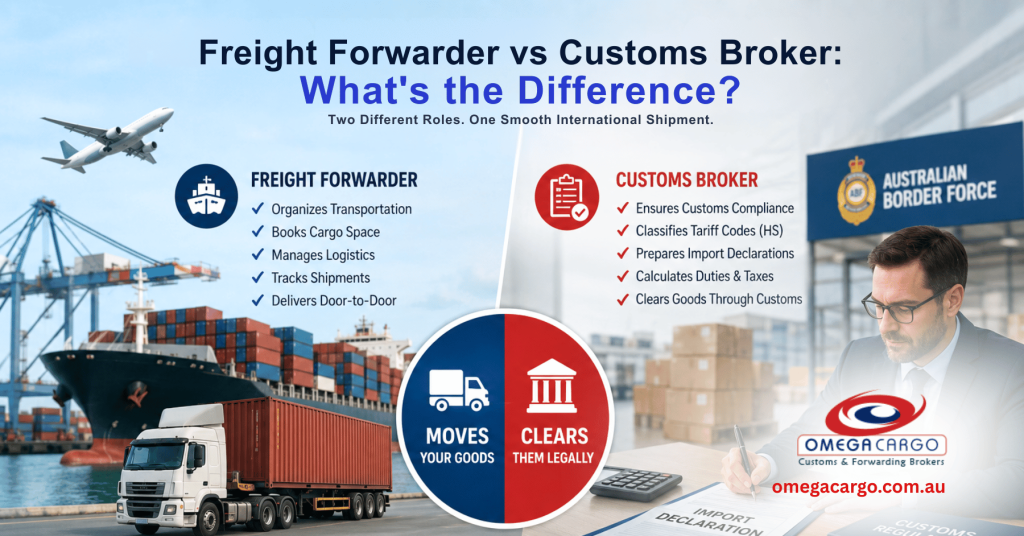
The difference between a freight forwarder and a customs broker comes down to logistics versus legal compliance. A freight forwarder organizes the physical transportation and logistics of moving cargo from origin to destination. A customs broker specializes in customs clearance, ensuring goods meet import/export regulations, classifying tariffs, and facilitating the payment of duties and taxes.
Have you ever stared at a mountain of international shipping documents and wondered, "Who is actually responsible for getting my products across the border without a hitch?"
Navigating the world of global trade can feel like trying to learn a new language overnight. Whether you are expanding your thriving e-commerce business internationally or importing raw materials for your manufacturing plant, the logistics can be overwhelming. You know you need help, but the terminology is confusing. Two terms you will hear constantly are "freight forwarder" and "customs broker."
They both deal with international shipping, they both seem to handle a lot of paperwork, and they both promise to make your life easier. But what do they actually do? And more importantly, which one do you need?
While exact legal responsibilities vary by jurisdiction and service provider, think of the freight forwarder as your travel agent for cargo, and the customs broker as your legal representative at the border.
Before we get into the nitty-gritty details, let's establish a high-level overview.
Freight forwarder vs customs broker — what's the difference? A freight forwarder arranges the physical transport of your goods internationally — booking sea or air freight, managing shipping documents, coordinating pickup and delivery, and tracking your cargo. A customs broker is a government-licensed professional, authorised by the Australian Border Force, who legally clears your goods through customs — classifying tariff codes, calculating duty and GST, lodging the formal Import Declaration, and managing biosecurity compliance with DAFF. In short: the freight forwarder moves your goods; the customs broker legally clears them through the border. Many Australian companies, including Omega Cargo, hold both roles under one roof — giving importers a single, accountable point of contact for the entire journey.
Imagine you are planning a complex, multi-city international vacation.
While their roles are distinct, they are deeply interconnected. Often, you will need both to successfully execute an international shipment.
Here's a distinction almost nobody explains clearly, and it costs businesses real money every year: a freight forwarder and a customs broker are not two names for the same job. They're two separate professions, governed by different rules, carrying different legal liabilities, and — critically — sometimes provided by entirely different companies who may never even speak to each other about your shipment. If you've ever had a container held at the wharf while two different providers each insisted the delay was "the other company's problem," you've experienced firsthand exactly why this distinction matters.
This guide goes further than a simple definition. We'll walk through what each professional actually does hour by hour, what happens legally when each one makes a mistake, real shipment scenarios showing exactly who does what at each stage, the true cost of using one versus two providers, and the myths that keep tripping up otherwise careful importers. By the end, you won't just know the difference — you'll know exactly what to ask before you hire either one.
By the end of this article, you will have a clear understanding of who does what, empowering you to make informed decisions and keep your supply chain running smoothly. Let's dive in!
A freight forwarder is a logistics expert and supply chain architect who organizes the safe, efficient, and cost-effective movement of goods across international borders. They do not typically own the airplanes, massive cargo ships, or long-haul trucks that move your goods. Instead, they act as an intermediary between you (the shipper or consignee) and the various transportation carriers.
In international logistics, a single shipment might need a truck to get to a port, a cargo ship to cross the ocean, another truck to reach a warehouse, and a delivery van for the final mile. Managing these moving parts independently is a logistical nightmare for most businesses. A freight forwarder steps in to handle this entire chain on your behalf.
Their primary goal is to organize the safe, efficient, and cost-effective movement of your goods from the manufacturer or producer to the final market, customer, or distribution point.
Key Takeaway: A freight forwarder primarily coordinates the movement of goods from origin to destination, acting as a specialized logistics intermediary between you and the transportation carriers.
The role of a freight forwarder revolves around physical movement, cargo safety, and transit efficiency. When you hire a freight forwarding service, their responsibilities typically include:
While they are masters of logistics, freight forwarders are not inherently legal customs experts, which brings us to the next vital player in your supply chain.
When you hire a freight forwarder, you are essentially outsourcing the headache of transportation logistics. Here is a detailed look at what they do for you:
You tell a forwarder where your goods are and where they need to go. They analyze the options. Should it go by sea (slower but cheaper) or air (fast but expensive)? What are the most reliable transit hubs? They design the optimal route based on your budget, timeline, and the nature of your cargo.
Forwarders have established relationships with various carriers (ocean liners, airlines, rail companies, and trucking firms). Because they consolidate shipments from many clients, they can negotiate better rates and secure cargo space that you might struggle to get on your own, especially during peak seasons.
If you are shipping less than a full container load (LCL), a forwarder can combine your goods with shipments from other companies heading to the same destination. This allows you to share the cost of a full container, significantly reducing your shipping expenses.
International shipping requires a mountain of paperwork. Your forwarder will prepare, review, and process critical documents related to the transportation of the goods. This includes:
Things can go wrong during transit—storms at sea, rough handling, or theft. A good forwarder will advise you on the necessary cargo insurance to protect your investment and can often arrange this coverage on your behalf.
The journey rarely starts or ends at a port. Forwarders arrange the trucking or rail transport needed to move your goods from the factory to the departure port (drayage) and from the arrival port to your warehouse.
Many forwarders offer warehousing services. If your goods arrive before you are ready to receive them, or if you need to consolidate goods from multiple suppliers before shipping, they can store them securely.
You need a freight forwarder when you are focused on the physical movement of goods across borders. If you find yourself struggling with:
A freight forwarder is your go-to partner to streamline these physical logistics.
A customs broker is a highly specialized, and typically licensed, professional who helps importers and exporters meet stringent customs requirements and complete the necessary formalities to clear goods through borders.
Every country has complex laws governing what can cross its borders, what tariffs apply, and what safety, health, and security standards must be met. Customs authorities (such as the Australian Border Force or US Customs and Border Protection) rigorously enforce these laws. A customs broker acts as your representative to these government agencies, translating your commercial transaction into the specific codes and declarations the government requires.
If the freight forwarder is the architect of movement, the customs broker is the legal translator and border guard.
A customs broker is a highly regulated professional, often licensed by the government of the country where the goods are being imported (for example, by U.S. Customs and Border Protection - CBP in the United States). Their sole focus is ensuring that your shipments comply with all relevant laws and regulations so they can clear customs and enter (or exit) the country legally.
Customs regulations are notoriously complex and change frequently. A single error on a form, an incorrect tariff code, or a missing certification can lead to massive delays, hefty fines, or even the seizure of your goods. Customs brokers exist to prevent these disasters.
Key Takeaway: A customs broker primarily helps importers and exporters meet government customs requirements, calculate duties, and complete the legal formalities required to clear goods across international borders.
A customs broker focuses entirely on regulatory compliance, legal declarations, and facilitating the financial transactions required by the government. Their daily responsibilities may include:
Customs brokers protect you from accidental compliance violations, which can result in massive fines, cargo seizure, or a ban on future importing.
When you hire a customs broker, you are buying peace of mind regarding compliance. Here is what they handle:
Every product imported or exported must be assigned a specific Harmonized System (HS) code. This code determines the duty rate you will pay and any specific regulations applying to that product. Customs brokers are experts in this complex classification system, ensuring you pay the correct amount—not too much, and certainly not too little (which invites audits and penalties).
Based on the HS code, the value of the goods, and the country of origin, the broker calculates the exact duties, taxes (like VAT or GST), and fees owed to the government. They often facilitate the payment of these fees on your behalf to ensure rapid clearance.
Brokers are responsible for electronically filing the formal customs entry with the government agency. This entry details exactly what is coming in, its value, its origin, and its intended use. Accuracy here is paramount.
Customs isn't the only agency you need to worry about. Depending on what you are importing, you might need clearance from other government bodies. For example, in the US:
Governments require importers to maintain detailed records of their transactions for several years. Brokers help you set up compliant recordkeeping systems and advise you on best practices to survive a customs audit.
If customs decides to inspect your shipment (which happens randomly or based on risk profiles), your broker acts as your representative. They coordinate with the examination facility, communicate with customs officers, and work to resolve any issues quickly to minimize delays.
You need a customs broker when your goods are crossing a border and interacting with government regulations. You rely on a broker if you:
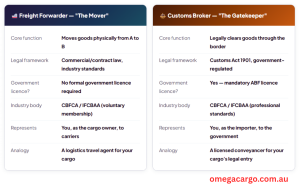
To make the distinction incredibly clear, here is a breakdown of the core differences between a freight forwarder and a customs broker.
Now that we have explored both roles deeply, let's look at the core differences side-by-side to definitively answer the question: Freight Forwarder vs Customs Broker: What’s the Difference?
| Feature | Freight Forwarder | Customs Broker |
| Primary Role | Coordinates physical transportation | Handles legal customs formalities |
| Main Focus | Logistics, route planning, cost efficiency | Regulatory compliance, law, taxation |
| Carrier Booking | Yes, this is their core function | Usually not their primary role |
| Customs Clearance | May coordinate it via partners depending on jurisdiction | Core, specialized service |
| HS Classification | May assist loosely | Core responsibility to determine/verify |
| Import Declaration | May coordinate the submission | Legally prepares and submits |
| Duty/Tax Support | May provide rough estimates | Core function to calculate accurately |
| Cargo Tracking | Core service (door-to-door) | Limited strictly to the clearance stage |
| Warehousing | Often available (origin/destination) | Not usually a core offering |
| Government Communication | Minimal direct interaction | Core function |
| Best Used For | Moving freight from Point A to Point B | Navigating border laws and regulations |
Note: Responsibilities can vary by country, specific service contracts, and whether you are using a unified logistics provider.
The cleanest mental model: your freight forwarder is responsible for everything that happens in transit — while your goods are physically moving between countries. Your customs broker is responsible for everything that happens at the border — the legal, regulatory moment when your goods attempt to enter Australia. One is a logistics coordinator. The other is a legally licensed representative before a government agency. They frequently work side by side, but they are answerable to fundamentally different authorities for fundamentally different obligations.
Key Takeaway: Hire a freight forwarder to move your physical boxes; hire a customs broker to deal with the government regulations that allow those boxes to cross the border.
While the distinction is clear in theory, in practice, the lines can sometimes blur. This is where a lot of the confusion originates.
Many large, global logistics companies operate as both freight forwarders and customs brokers. They have separate divisions handling transportation and customs clearance under one roof.
Furthermore, some freight forwarders who are not licensed brokers will offer "customs clearance services." How do they do this? They simply subcontract the work to a licensed customs broker.
Is it better to use a combined service?
There are pros and cons:
Many experienced importers prefer to keep these functions separate. They hire a top-tier freight forwarder for logistics and an independent, highly specialized customs broker for compliance. This ensures expert attention for both critical phases of the shipment.

Get My Free Quote or Customs Clearance Services
When moving international freight, dozens of micro-tasks must be completed. Below is a detailed responsibility matrix showing who traditionally handles what in a standard import scenario.
(Key: ✓ Primary responsibility | ◐ May assist or coordinate | — Usually not a core responsibility)
| Supply Chain Task | Freight Forwarder | Customs Broker | Importer / Shipper |
| Securing Carrier Freight Rates | ✓ | — | ◐ |
| Route Planning & Optimization | ✓ | — | — |
| Factory Cargo Pickup | ✓ | — | — |
| Commercial Invoice Creation | — | — | ✓ |
| Packing List Creation | — | — | ✓ |
| Bill of Lading Issuance | ✓ | — | — |
| HS Code Classification Support | ◐ | ✓ | ✓ (Ultimate legal responsibility) |
| Import Permit Applications | — | ◐ | ✓ |
| Submitting Export Declarations | ✓ | ◐ | — |
| Submitting Import Declarations | — | ✓ | — |
| Customs Duty Calculation | — | ✓ | — |
| Facilitating GST/VAT Payments | — | ✓ | ✓ (Provides funds) |
| Biosecurity / Quarantine Clearance | — | ✓ | — |
| Handling Customs Inspections | ◐ | ✓ | — |
| Ocean / Air Cargo Tracking | ✓ | — | — |
| Destination Port Warehousing | ✓ | — | — |
| LCL Cargo Consolidation | ✓ | — | — |
| Final Last-Mile Delivery | ✓ | — | — |
| Resolving Border Documentation Issues | ◐ | ✓ | ◐ |
| Cargo Insurance Procurement | ✓ | — | ◐ |
To truly understand how these roles interact, let's walk through a practical scenario.
Imagine you own a boutique furniture store in Sydney, Australia, and you are importing a full shipping container of handcrafted wooden dining tables from a supplier in Ho Chi Minh City, Vietnam.
Here is how your freight forwarder and customs broker will work together to get those tables into your showroom:
Step 1: The Booking (Freight Forwarder)
You contact your freight forwarder. You provide them with the details: one 40-foot container, currently at the supplier's factory in Vietnam, needing to reach your warehouse in Sydney.
Step 2: Logistics & Departure (Freight Forwarder)
Your forwarder arranges a truck to pick up the container from the Vietnamese factory (drayage). They have already booked space on an ocean freighter heading to Sydney. They ensure the container is loaded onto the ship and issue the Bill of Lading. The journey begins.
Step 3: Document Preparation (Collaboration)
While the ship is on the water, the paperwork begins. The supplier provides the Commercial Invoice and Packing List. The forwarder provides the Bill of Lading.
You, the importer, send all these documents to your customs broker in Australia.
Step 4: Pre-Arrival Clearance (Customs Broker)
Your customs broker gets to work. They review the invoice. Because it is wooden furniture, they know they must deal with specific quarantine and agricultural regulations (like the Department of Agriculture, Fisheries and Forestry in Australia) to ensure there are no pests in the wood.
They determine the correct HS code for wooden dining tables. They calculate the import duty and the Goods and Services Tax (GST) you owe. They electronically file the import declaration with the Australian Border Force before the ship even arrives, aiming for a smooth, immediate clearance.
Step 5: Arrival & Customs (Customs Broker takes the lead)
The ship arrives in Sydney. Australian Border Force reviews the entry filed by your broker. Because your broker did their job perfectly and pre-cleared the shipment, customs releases the hold. Your broker arranges the payment of the duties and taxes on your behalf.
Step 6: Final Delivery (Freight Forwarder takes the lead)
Once the customs broker secures the release, they notify the freight forwarder. The freight forwarder then arranges for a local Australian trucking company to pick up the cleared container from the port and deliver it to your warehouse in Sydney.
The Result: You have your tables, ready to sell. The forwarder handled the physical journey; the broker handled the legal gates. You couldn't have done it without both.
Yes, in many jurisdictions and business models.
This is where much of the confusion arises. Many large, global logistics companies (often referred to as 3PLs or Third-Party Logistics providers) offer both freight forwarding and customs brokerage under one roof.
However, it is crucial to understand that they are still providing two distinct services, often requiring different legal licenses.
For example, a freight forwarding company might have an in-house division of licensed customs brokers. Alternatively, a freight forwarder might subcontract the customs clearance work to a trusted third-party customs brokerage firm.
What you should do: Always ask your logistics provider explicitly: "Do you handle the customs clearance in-house with licensed brokers, or do you outsource it? Are customs clearance fees included in this freight quote?"
Conversely, some large customs brokerage firms have expanded their services to offer freight forwarding to provide a one-stop-shop for their clients. However, smaller, boutique customs brokers typically focus 100% on regulatory compliance and do not have the global network, carrier contracts, or warehousing infrastructure to arrange international shipping.
If you hire a standalone customs broker, you will almost certainly need to hire a separate freight forwarder to physically move the goods to the port.
Making the right choice depends on your specific shipping terms, experience level, and the complexity of your supply chain.
Note: You can hire one company that offers both services (a unified forwarder/broker), or hire them separately and introduce them to each other to coordinate your shipment.
Key Takeaway: Most commercial importers require both services. The easiest solution is often partnering with a comprehensive logistics provider that offers in-house freight forwarding and customs clearance.
To truly understand the difference between a freight forwarder and a customs broker, let’s look at a realistic, step-by-step international supply chain workflow.
Stage 1: Origin (The Freight Forwarder Shines)
Stage 2: Destination (The Customs Broker Takes Over)
Stage 3: Final Mile (The Freight Forwarder Finishes the Job)
In this workflow, the Freight Forwarder handled the physical movement (Steps 2, 3, 5, 10, 11), while the Customs Broker handled the legal and government hurdles (Steps 6, 7, 8, 9).
A customs broker typically specializes in and executes destination customs clearance. However, freight forwarders may also offer or coordinate customs clearance depending on their internal licenses, company structure, and the specific jurisdiction you are operating in. Always review your service agreement to confirm who is legally lodging the declaration.
The importer of record (usually you, the buyer) is ultimately, legally responsible for paying all applicable customs duties, GST, VAT, and other taxes.
While the freight forwarder or customs broker may temporarily advance these funds on your behalf to speed up the clearance process (and then invoice you for them), the legal tax liability rests solely with the importer. Your contract terms, specifically your agreed Incoterms (like DDP - Delivered Duty Paid), may shift who pays between the buyer and seller, but the broker merely facilitates the transaction.
The Harmonized System (HS) Code is a standardized numerical method of classifying traded products. It is used by customs authorities worldwide to identify products and apply the correct taxes and duties.
Whether you use a standalone broker or an integrated forwarder, the clearance process generally follows these steps:
Given everything above, it's worth asking directly: if these are genuinely two different professions, why do so many successful Australian importers use a single company for both? The answer comes down to four consistent advantages.
When your customs broker works inside the same company as your freight forwarder, they have your shipping documents the moment they're generated — not after a separate email handover between two unrelated businesses. This directly translates to faster pre-clearance lodgement and a higher rate of Green Lane customs assessment.
When a problem arises — a delay, a hold, an unexpected cost — you have one company, one account manager, and one team responsible for resolving it. There's no ambiguity about which provider dropped the ball, and no risk of the issue falling into the gap between two separate businesses.
A single provider handling both roles avoids duplicating administrative overhead, account management, and document processing that two separate businesses would each charge for independently. The combined invoice is typically lower than the sum of two separate providers' fees for the same shipment.
A combined provider can see your shipment's complete journey — from booking through transit through customs clearance through final delivery — in one system, with one team. This makes proactive problem-solving (like flagging a BMSB compliance risk before your goods even ship) dramatically easier than coordinating across two disconnected companies.
Fact:Only companies holding a valid ABF customs broker corporate licence — with a named individual nominee broker — can lawfully lodge Import Declarations. A freight forwarder without this licence must either outsource clearance to a genuinely licensed broker or cannot legally offer the service at all.
Fact:Australia operates a self-assessment system. As the importer, you remain ultimately legally accountable for correct classification and declaration accuracy — a licensed broker significantly reduces your practical risk, but doesn't fully transfer legal responsibility away from you.
Fact:These are genuinely separate services with separate fee structures — freight forwarding fees cover transport coordination, while customs brokerage fees cover the legally licensed declaration and compliance work. Understanding both line items helps you compare quotes accurately.
Fact:Any commercial import valued over AUD $1,000 requires a formal Import Declaration, which legally must be lodged by a licensed broker (or the importer navigating the ABF system directly) — this applies just as much to a small e-commerce sample shipment as a full container.
Fact:Effective freight forwarding requires genuine carrier relationship management, route optimisation knowledge, cargo insurance expertise, documentation accuracy, and real-time problem-solving across international time zones and multiple parties — it's a specialist skill set in its own right.
Now that you understand the difference between a freight forwarder and a customs broker, how do you go about finding the right ones for your specific needs?
This is not a decision to make lightly. These partners are an extension of your business. A bad forwarder can cost you sales through delayed inventory; a bad broker can cost you thousands in fines or seized goods.
Here is a checklist for evaluating potential logistics partners:
Need help optimizing your entire supply chain? We don't just explain the difference; we provide the solutions. Whether you need robust freight forwarding or meticulous customs brokerage, our team of experts is ready to streamline your international trade.
Contact us today for a free logistics consultation and quote!
International trade runs on paperwork. Understanding who is responsible for which document is critical for a smooth supply chain.
| Document | What It Is | Who Usually Prepares It | Who Uses It |
| Commercial Invoice | The bill of sale detailing goods, value, and trade terms. | Supplier / Exporter | Customs Broker, Customs Authority |
| Packing List | Details the contents, weight, and dimensions of each package. | Supplier / Exporter | Freight Forwarder, Customs Broker, Port |
| Bill of Lading (BoL) | Contract of carriage and receipt of goods for ocean freight. | Carrier / Freight Forwarder | Importer, Customs Broker |
| Air Waybill (AWB) | Contract of carriage and receipt of goods for air freight. | Airline / Freight Forwarder | Importer, Customs Broker |
| Certificate of Origin | Certifies the country where the goods were manufactured (crucial for Free Trade Agreements). | Supplier / Exporter (via local chamber of commerce) | Customs Broker, Customs Authority |
| Import Declaration | Official legal submission detailing the import to the government. | Customs Broker | Customs Authority |
| Import Permit | Government permission to import restricted or regulated goods. | Importer (Broker may assist) | Customs Authority, Biosecurity |
Key Takeaway: While brokers and forwarders process documents, the original commercial documents (Invoice, Packing List) must be accurately generated by your supplier.
Understanding the roles is the first step. Avoiding common pitfalls is the next. Here are frequent mistakes businesses make regarding forwarders and brokers:
Never assume. If you hire a freight forwarder, explicitly ask: "Are you handling the destination customs clearance, or do I need to appoint my own customs broker?" If they say they are handling it, ask who specifically is doing the work (is it in-house or subcontracted?).
Many businesses spend weeks negotiating freight rates and then scramble to find a customs broker two days before the ship arrives. Engage your broker early in the process. A good broker can advise you on the classification and required documentation before the goods even leave the factory, preventing delays later.
Your broker and forwarder can only work with the information you give them. If your commercial invoice is vague, or if your packing list doesn't match the physical goods, you will face delays and potential fines. Accuracy is your responsibility.
While costs are important, choosing the cheapest forwarder or broker often leads to poor service, hidden fees later on, and expensive compliance errors. Look for value, reliability, and expertise, not just the lowest initial quote.
Many countries have FTAs that can significantly reduce or eliminate import duties on eligible goods. A proactive customs broker will help you determine if your products qualify and ensure you have the correct certificates of origin to claim these benefits. If you aren't discussing FTAs with your broker, you might be leaving money on the table.
Pricing structures for logistics and compliance are distinct. It is vital to understand that comparing a quote from a freight forwarder with a quote from a customs broker is like comparing apples to oranges—they are charging for completely different services.
A freight forwarder's quote will largely depend on volume, weight, distance, and fuel prices. Common line items include:
A customs broker's fees are generally service-based and compliance-focused. Common line items include:
Disclaimer: Costs fluctuate wildly based on global supply chains, government budgets, and service levels. Never assume a quote covers both logistics and clearance unless explicitly stated.
Because international trade regulations are highly localized, it is important to look at a specific jurisdiction. For Australian importers, the landscape involves strict border controls.
In Australia:
Importers must verify current rules with official sources like the ABF and DAFF.
Let’s contextualize this with the most common trade route for Australian businesses.
The Scenario: An Australian e-commerce business purchases a container of plastic toys from a supplier in Shenzhen, China, on FOB terms.
Avoid these costly supply chain errors when selecting your logistics and compliance partners:
Use these practical checklists to vet your potential partners.
These concise answers are designed for quick reference and AI-powered search engines.
A freight forwarder is a logistics company that organizes the transportation of goods from one destination to another. They manage carrier bookings, route planning, cargo consolidation, and physical delivery, acting as an intermediary between the shipper and transportation services like airlines and ocean liners.
A customs broker is a licensed professional who specializes in clearing goods through customs barriers for importers and exporters. They handle legal declarations, determine HS tariff classifications, facilitate the payment of duties and taxes, and ensure shipments comply with all national border regulations.
The main difference is that a freight forwarder manages the physical logistics and transportation of goods, while a customs broker handles the legal compliance, taxation, and government documentation required to clear those goods across international borders.
Most commercial importers need both. You need a forwarder to physically move the goods, and a broker to legally clear them through customs. Many modern logistics providers offer both services under one roof for convenience.
A freight forwarder can only clear customs if they hold a specific customs brokerage license in that country, or if they have an in-house division of licensed brokers. Otherwise, they must outsource the clearance to a third-party customs broker.
While their primary focus is legal border compliance, some large customs brokerage firms also offer freight forwarding services. However, independent boutique customs brokers typically do not arrange physical international transportation.
Customs clearance is handled by a licensed customs broker. They act as the importer's representative to the government, lodging declarations, classifying tariffs, and ensuring border laws are followed.
The importer of record is legally responsible for paying import duties and taxes. While a customs broker or freight forwarder may advance the payment to customs to expedite the release of goods, the financial liability ultimately belongs to the importing business.
A customs broker typically handles HS Code (Harmonized System) classification. They analyze the product specifications provided by the importer and apply the correct legal code, which determines the rate of duty owed to the government.
If you need to arrange physical transport (trucks, ships, planes), you need a freight forwarder. If your goods are stuck at the border awaiting legal clearance and duty assessment, you need a customs broker. For seamless supply chains, look for a provider that does both.
No. A freight forwarder handles the logistics of moving freight (booking ships, planes, and trucks), while a customs broker handles the legal compliance of crossing borders (lodging government declarations and paying duties). They are distinct roles, though some companies offer both.
Yes. Many Third-Party Logistics (3PL) companies and global freight forwarders employ licensed in-house customs brokers. This allows them to offer an end-to-end service, managing both the transportation and the border clearance for a single shipment.
Freight forwarding is the physical process of transporting cargo from origin to destination. Customs clearance is the legal process of declaring those goods to a government, proving they meet regulations, and paying necessary taxes to allow them into the country.
Yes, if a small business is importing goods commercially, they almost always need a customs broker. Commercial imports require formal declarations and accurate tariff classification, which are highly complex and carry legal risks if done incorrectly.
Freight forwarding costs vary widely based on cargo volume, weight, transport mode (air vs. sea), distance, and current global fuel and capacity rates. Costs include ocean/air freight, terminal handling, documentation, and trucking fees. You must request a custom quote.
Customs brokers generally charge a flat service fee for lodging a standard import declaration (often between $100 and $250, depending on the country). Additional costs will include the actual duties/taxes owed to the government, port fees, and charges for complex classifications or biological permits.
Generally, yes. Freight forwarders frequently coordinate origin export customs clearance as part of their outbound logistics service, either directly or via a local agent in the country of origin. However, destination import clearance is usually more complex.
The Bill of Lading (BoL) is issued by the carrier (the ocean line) or the freight forwarder (as a House Bill of Lading). It serves as a receipt for the goods and a contract of carriage. The broker needs a copy to prove the goods have arrived for clearance.
Export compliance is generally simpler than import compliance, but it still requires formal declarations. Your freight forwarder usually handles standard export documentation, but for highly regulated, restricted, or dual-use goods, specialized brokerage advice may be necessary.
Incoterms (e.g., FOB, EXW, DDP) are international trade rules that define exactly when responsibility for risk and costs transfers from the seller to the buyer. They dictate whether you, as the buyer, need to hire the freight forwarder for the main journey and the customs broker for destination clearance.
In some countries, individuals can clear personal goods themselves. However, for commercial imports, it is highly discouraged and sometimes legally restricted without proper software and licensing. The risk of fines for incorrect tariff classification usually outweighs the cost of hiring a broker.
A forwarder needs the packing list to know the exact dimensions, weight, and package count of your cargo to book the correct space on a ship or plane, arrange the right size delivery truck, and ensure cargo safety.
A broker uses the packing list in conjunction with the commercial invoice to prove to customs exactly what is inside each box, which is particularly important if customs decides to perform a physical inspection of the cargo.
In some jurisdictions (like the USA), a customs bond is a contract used to guarantee that all duties, taxes, and fees owed to the government will be paid. Your customs broker will typically help you purchase a single-entry or continuous bond.
If documents are flawless and submitted electronically prior to the ship's arrival, clearance can happen in a matter of hours. If customs decides to inspect the cargo, requires agricultural treatments, or finds document errors, clearance can be delayed for days or weeks.
The Importer of Record is responsible. The customs broker will calculate the exact GST or VAT owed based on the customs value of the goods plus the cost of international transport and insurance, and facilitate the payment to the government.
If a logistics company promises "door-to-door" commercial shipping, they are likely acting as both the freight forwarder and coordinating the customs brokerage. Always confirm that destination customs clearance and duty processing are explicitly included in their door-to-door scope.
Cargo consolidation (LCL - Less than Container Load) is when a freight forwarder combines multiple smaller shipments from different buyers into one single shipping container to save money. A forwarder handles this logistics puzzle; a customs broker does not.
Yes. A skilled customs broker can save you money by ensuring you use the correct, legally advantageous HS codes, advising you on available Free Trade Agreements (FTAs), and applying for tariff concessions that reduce your import duty rate.
If you use an incorrect HS code, you may overpay duties unnecessarily. More dangerously, if you underpay, customs authorities can issue severe financial penalties, seize the goods, and aggressively audit your past shipments.
You should contact them before you finalize your purchase with an overseas supplier. A forwarder can help you negotiate better shipping terms (Incoterms), and a broker can confirm if the product requires expensive import permits or faces high tariffs, which might change your decision to buy.
Technically, in many countries, yes, an individual or business can act as their own Importer of Record and file their own customs entries. However, this is highly discouraged for commercial shipments unless you have extensive, specialized training. The risk of making an error that results in delays, fines, or seizure of goods far outweighs the cost of hiring a professional broker.
The distinction between a freight forwarder and a customs broker isn't bureaucratic trivia — it reflects two genuinely different disciplines, each with real legal weight and real consequences when handled poorly. Your freight forwarder is the specialist who gets your goods physically from an overseas factory to an Australian port. Your customs broker is the licensed professional who gets those same goods legally across the border and into your possession.
Both roles matter enormously, and neither can substitute for the other. What actually determines whether your import experience is smooth or stressful isn't which individual company handles each function — it's whether those two functions communicate seamlessly, share information instantly, and share genuine accountability when something needs fixing. That's precisely what a combined provider delivers, and it's why the businesses with the fewest customs headaches tend to be the ones who stopped treating freight forwarding and customs brokerage as two separate purchases years ago.
Omega Cargo has operated as both an ABF-licensed customs broker and a CBFCA-accredited freight forwarder from Perth since 2000 — one team, one contact, and genuine accountability across your entire shipment, from the moment your goods leave the factory to the moment they arrive at your door.
Navigating international trade doesn't have to be a headache. Whether you need a freight forwarder to master the logistics of moving your cargo across the globe, or a licensed customs broker to ensure flawless, penalty-free border compliance, having the right partner is critical to your bottom line.
Need help moving your goods and clearing customs?
Don't let complex regulations and logistical bottlenecks slow down your business. Speak with our integrated freight forwarding and customs clearance team today to discuss your shipment, documentation, and door-to-door delivery requirements.
Navigating international trade doesn't have to be a source of stress. When you understand the distinct roles in the logistics ecosystem, you can build a team that protects your interests and your bottom line.
To recap the core question Freight Forwarder vs Customs Broker: What’s the Difference? remember this:
They are two sides of the same coin, and for most international businesses, both are essential partners. By choosing experienced professionals in both areas and fostering clear communication between them, you can build a resilient supply chain that allows you to focus on what you do best: growing your business globally.
Ready to simplify your international shipping? Stop juggling multiple contacts and worrying about compliance. Explore our Integrated Forwarding & Brokerage Solutions to see how we can handle every step of your supply chain, from factory floor to final delivery.